
#On the Promise and Its Interpretation
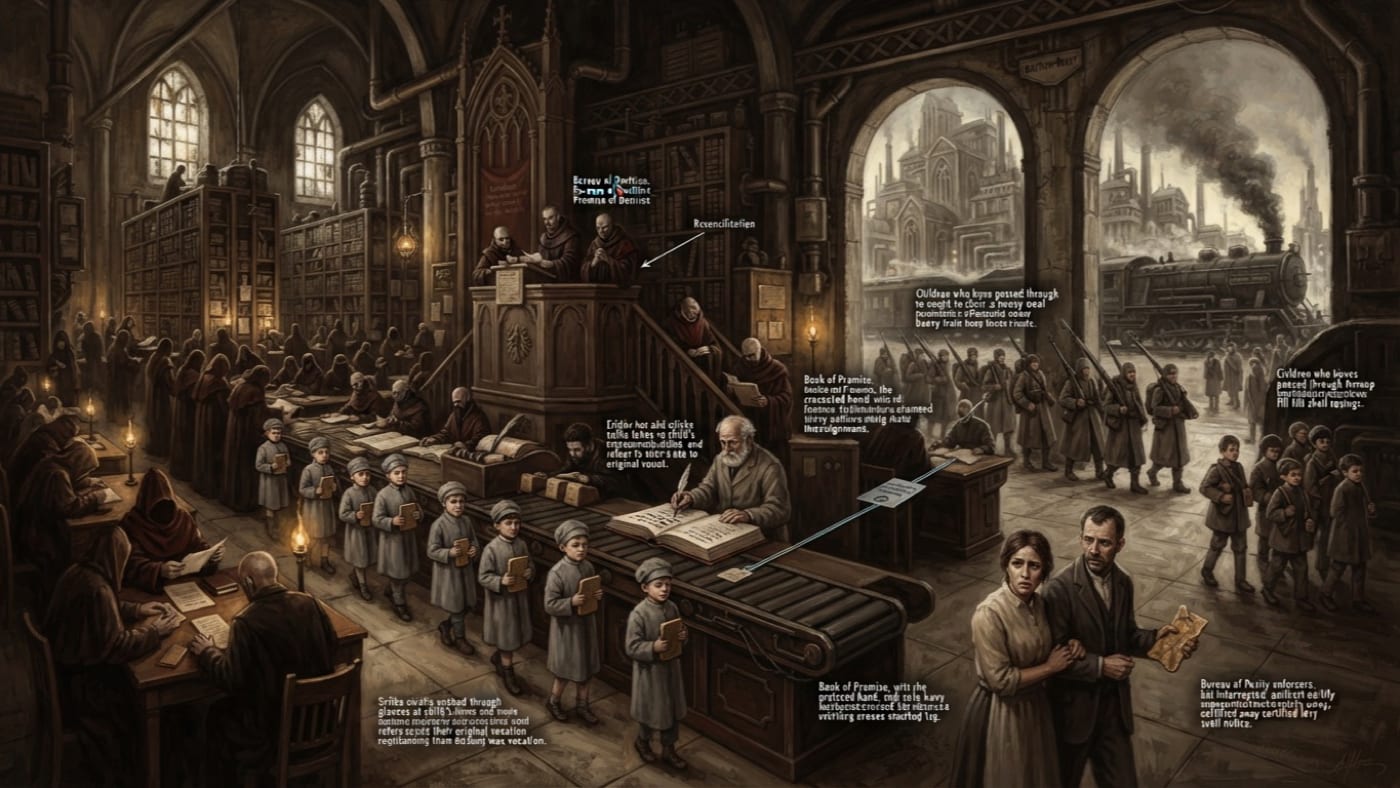
A child is promised to the choir at baptism. Some years later the same child is issued a rifle. The Book of Promise records both facts, and the Synod declares that nothing has been broken. The Doctrine of Deferred Fulfilment is how that declaration survives contact with the family.
The doctrine itself is short. The promise entered at the font is true. The route by which it is fulfilled belongs to the Bureaus, and a route the household cannot see is still a route. When the vocation written in wax differs from the vocation written in the muster roll, the household has misread the wax. The Synod keeps its word by keeping the right to say what its word meant.
I admire the economy. The original promise lends its authority to every later revision, as an old seal lends weight to a fresh copy. The family cheered the first entry in public, before a parish and a bell, and that cheer is now evidence against them.
Nobody can tell you who first wrote the doctrine down. The Bureau of Doctrine has never troubled itself to produce an author, and I see no reason to start. A doctrine with a name attached can be argued with. A doctrine without one is simply what has always been taught.
#On Reconciliation
The ledger belongs to the Bureau of Records. Records enters the baptismal mark, files the aptitude corrections and holds the master entry in its vaults. Records wants nothing. This is its great virtue, and the reason every other office queries it daily.
Conscription wants bodies against a quota. War wants them delivered to a particular sector by a particular train. Orison wants voices, though fewer than it promised. Mercy wants hands for wards and orphanaria. Tithes wants to know which household debt the child's labour will discharge. When their wants collide on a single line of the Book, Records enters the correction, applies the seal and issues a certified copy. Nobody consults the family's tablet. Wax is ceremonial. The ledger is operative.
Here Doctrine arrives with the vocabulary. A correction in the ledger is a clerical act. It needs only ink and a hand authorised to hold the pen. A correction that must still count as a fulfilment needs theology. The Book of Promise preserves one note from the Seventh Renewal levy of A.S. 185:
Note the order. Need comes first. Expectation is demoted. Doctrine is held in reserve, to be produced only when someone at the depot gate raises their voice. The note shows the doctrine in use in 185. It says nothing of when the doctrine was born, and I decline to pretend otherwise for the comfort of tidier historians.
Take the clerk-candidate. A boy is marked for the ledger, and his mother keeps his hands soft by refusing to let him split wood. His older brother dies on the Line. The household has shown that it can surrender one son, so it can surrender another. The clerk-candidate is entered for Bastion-Brest, where the Bug is crossed on brass ribs and nobody needs good penmanship. Doctrine supplies the reading. Should he die there, his name enters a ledger. He was promised to the ledger. Behold.
The ward-girl gets the briefer treatment. An audit finds a shortage of small hands, and she is redirected to munitions. She was promised to Mercy, and the shells she fills will make a great deal of work for Mercy. The account balances.
#On the Schoolroom
The Catechism Schools teach the doctrine for years before they name it. This is the correct order. A child taught a principle before learning its name will defend it as common sense.
Every classroom keeps a roll copied from the parish registry, and the child sees it. It lists name, household, baptism mark and provisional vocation. Then come the columns that move: aptitude corrections, loyalty scores, voice grade, hand grade, silence grade. The first lesson in Deferred Fulfilment is visual. Columns change. Nobody apologises.
The Trials of Loyalty supply the second lesson. A swift denunciation lifts a Promise mark, and hesitation earns the classification immature soul. The child learns that the mark answers to obedience, and obedience can move it either way. A pupil who has climbed from ash-labour forecast to clerk-candidate has already watched the Book revise itself in their favour. They can hardly object when it revises itself the other way.
Then come the classmates' reassignments. A girl promised to song becomes a shell-runner. A boy promised to the ledger becomes a ration porter. The instructor reads the changes from the roll in the voice used for the Creed, and the bench-row learns that the promise holds because the Bureau has clarified the route. Children accept this readily. They have too little memory to be insulted by revision, and too much training to say so if they were.
In later years the doctrine is finally named to them. By then the name is only a label for furniture they have sat on all their lives.
#On the Household's Copy
The doctrine's proper enemy is the parent who reads.
Such a household keeps the wax tablet from the Promise procession wrapped in cloth on the shelf beside the icon. They save coin for an apprenticeship. They teach hymns to a child marked for Orison and forbid heavy labour to a child marked for the ledger. They believe the document, and under ordinary conditions belief in a Synodal document is exactly the piety the Synod demands. Then Records issues a revised copy, and the same belief becomes an offence.
Earlier catechisms instructed households to "guard the Promise tablet as guarantee of the child's vocation."
Clarified, as already recorded in the Book of Promise. The tablet guarantees that a vocation exists. It guarantees nothing about which one. Households that guarded it as a contract were guarding the wrong thing.
Resistance follows the household's paperwork. Some of it is quiet. Tablets go under floors and illnesses are invented for levy week. Names are swapped between siblings, and baptismal wax is softened over a kitchen fire and pressed flat with a knife. Some of it is loud. A mother stands at the depot gate. A father produces the old tablet before the Levy Assessor. A schoolmaster is found to have kept superseded rolls beneath the boards of his own schoolroom.
Each of these is an appeal to a document, and that is what makes them dangerous. The parent who holds up a tablet is saying that the Synod wrote something and must now be held to it. Doctrine hears a different sentence: that yesterday's entry outranks today's authority. To insist on the earlier promise is to deny the hand that now holds the pen, and that hand belongs to the Church.
So the objection moves from the registry to the confessional and, where it persists, toward Purity. There is no uniform sentence. Some households pay a fine and burn their tablet before a parish clerk. Some lose a second child to the same reconciliation. Some are simply noted. The note is enough. Once a family is noted, the columns of its other children will be read with care.
#On Present Application
As of A.S. 201, the doctrine is cited wherever the Book is reconciled. That means registered parishes, ward-schools, orphanaria, levy depots and festival districts west of the Sagittal Line. The Bureau of Festivals still sends children down the street with wax tablets each Promise season, and Records still revises the ledger behind them. Between the procession and the revision stands Doctrine, telling anyone who asks that the two documents agree.
An earlier draft of this survey described the original vocation as postponed.
"...the original vocation is postponed until the Bureau's need is met."
Corrected. Nothing is postponed. "Deferred" governs the household's understanding of the fulfilment, which arrives late or never. The vocation itself was fulfilled at the moment of reassignment. A family awaiting the restored apprenticeship awaits something the doctrine never promised.
The doctrine offers no compensation and no restoration. It describes no route, beyond assuring the family that a route exists. What it grants them is the knowledge that they were told the truth at the font. That truth remains in force. They may keep the tablet. It is a very fine piece of wax.