
#On the Governing Declaration
What the Bureau declares, and where the Bureau keeps it.
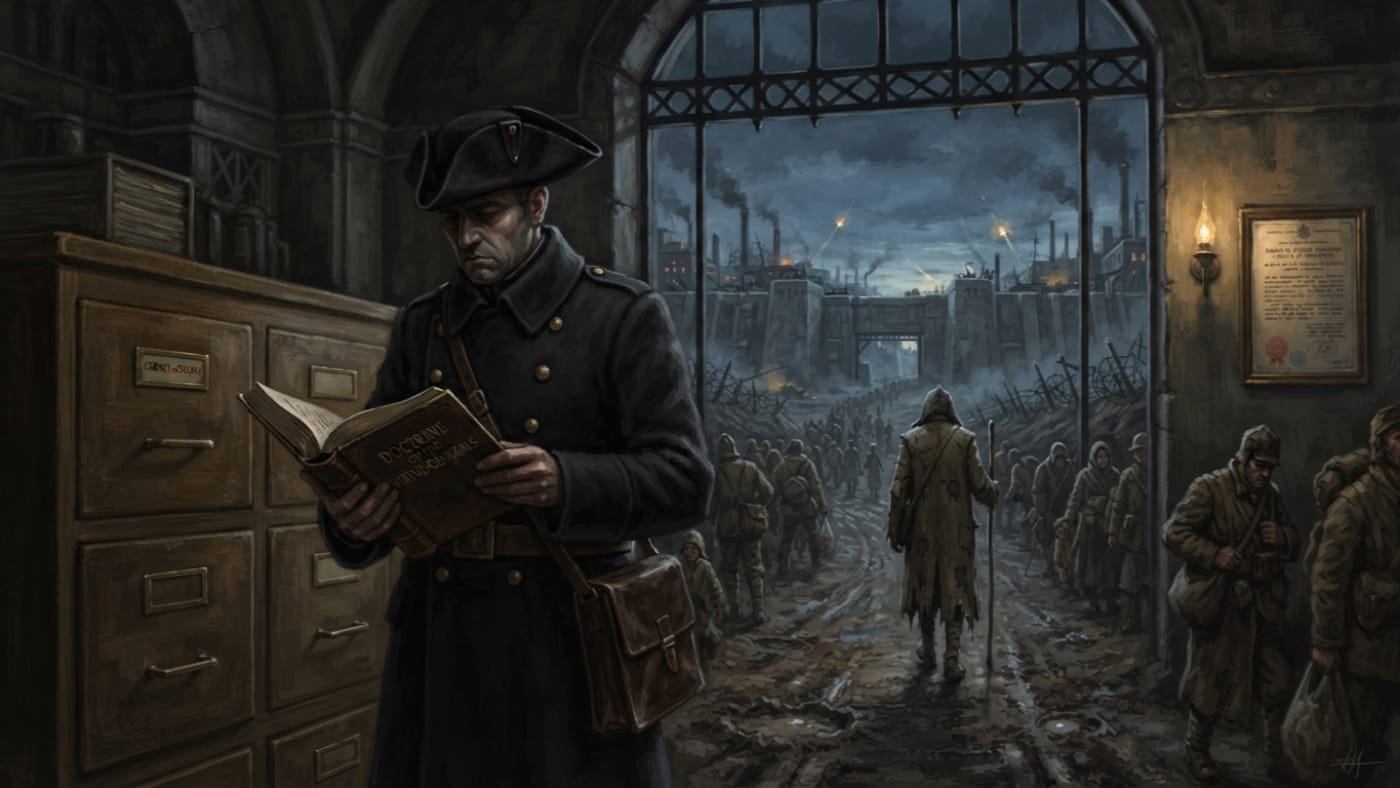
The Doctrine of the Virtue-Generals is my declaration. I composed it at the Gallery desk of the Tower of the Quill on a Tuesday in autumn. The ink dried before the candle guttered, which I record because it is the only thing that evening that behaved as instructed. The declaration went out to every diocese, every bastion and every gatehouse with orders that it be read aloud at Compline. Congregations heard it between the last psalm and the extinguishing of lamps, when the faithful are tired, frightened of the dark and most inclined to agree.
Its legal spine is older than my hand. Standing Order 44-D was issued by the Bureau of Doctrine in A.S. 134. The declaration gives that order a voice fit for the pulpit. The order gives the declaration teeth.
The fair copy rests in Cabinet Astrum-3, beside the file of the Condemnation of Kraków and a rejected sermon arguing that comets are divine punctuation. The neighbours share a drawer and nothing else. No astronomer of Kraków ever testified to a celestial champion, and no champion has ever been seen through a Kraków lens. The cabinet keeps them together by a principle I approve: witnesses report what they saw, and Doctrine decides what it means. Rudzka with her telescope and the peasant with her vision commit the same offence at different altitudes.
#On the Belief Condemned
The claim, compressed. The full dossier is restricted.
The heresy holds that seven celestial champions walk the world, each embodying a virtue, and that they stand against the Seven Sin-Generals. Heretics add that these champions answer to no Bureau and keep no ledger, and that they come to the desperate unsummoned.
The roster, in the order the condemned sources give it: the Child of Innocence; the Crone of Patience; the Warrior of Justice; the Silent One; the Flame of Charity; the Exile of Temperance; the Seventh Unnamed.
These are designations taken from heretics' mouths, and none of them is a commission. They also tell us nothing about who any wanderer actually is. The Child is said to be a pale, ageless boy whose truths dissolve loyalty, and Rhine villages that report him have afterward reported fires. The record shows only that the two came together; who set the fires is not established. The Crone is an old woman in rags who is said to outlast armies. Some heretics give her three centuries. The Warrior is faceless and wounded and never falls, and nobody has settled whose side he fights on. The Silent One has no agreed nature at all. The Flame heals and burns in Iberian testimony. The Exile wanders the North without hunger and teaches balance in place of obedience. The Seventh is said to sleep.
The longer survey stands in The Virtue Generals (So-Called). Its intelligence roster carries a restricted stamp marked not for homiletic use. That dossier was never read at Compline. The declaration was. One is a catalogue of the disease and the other is the sermon against it, and a parish priest who confuses the two will be corrected.
#On the Grounds of Refutation
Three folds, sealed in order.
First, mediation. The Creator works through the institutions He has authorized. That is the Covenant, and the Synod is its instrument. A champion who saves outside the Synod tells the faithful that the Synod was not enough. Whatever the heresy's sincerity, it amounts to a structural accusation, and the Bureau answers structural accusations with structural force.
Second, symmetry. Seven sins, seven generals, seven virtues, seven champions. Heretics present the arrangement as a revelation. I see a forger's hand in it. Creation has never answered a demon with a matched opposite the way a printer sets a facing page. When an error comes in pairs this neat, someone has been at it with a ruler.
Third, the Line. The Sagittal Line holds because soldiers stand in it, because the Bureau of War feeds and arms them, because the bells keep their hours and the faithful pray in prescribed forms. Wandering rescuers do not hold it. If a faceless man pulled one sapper from the wire, a requisitioned shell held the trench for a thousand. Credit belongs where the logistics are.
These three folds carry the full force of law. None of them tells the Bureau what any particular walker on a particular road is, or whose errands they run. The Doctrine has never pretended to answer that question. It governs what the faithful may believe about the answer.
#On Profession and Penalty
The machinery, as published.
Standing Order 44-D enters the belief in the Index Damnatus as Category Two Heresy. Category Two permits prosecution but does not mandate a general eradication campaign. The Bureau reserves fire for heresies that deserve it, and this one, in the Bureau's estimate, does not. The order was prompted by Purity reports that the belief had reached seventeen bastion communities and four Heartland dioceses. Readers should note communities. Seventeen garrison chapels and refugee parishes stand behind that figure, which is far short of seventeen great bastions.
Any person who professes the belief, distributes material concerning it or promotes it is referred to Purity for examination under Article 9 of the Catechism of Obedience. Article 9 sets the graduated penalties: supervised recantation for a first offence, public penance for a second and immurement for a third. A fourth offence has no penalty because no one has ever been in a position to commit one. Article 9 also reserves to Doctrine alone the power to declare a belief heretical, and makes such declarations retroactive. A man who whispered of the Crone before A.S. 134 whispered heresy, though nobody had yet told him so.
The order has been revised twelve times. Its Twelfth Revision dates from A.S. 196. In A.S. 197 a supplement applied Article 4 to the matter. Article 4 treats hope, consolation, prophecy and prayer beyond prescribed forms as licensed spiritual commodities. A champion who brings comfort without a licence is, under that article, a smuggler.
#On the Evidence Retained
Condemnation closes a question of belief. It does not close a file.
The earliest testimony comes from Brother Albrecht of Innsbruck, examined in A.S. 78 before the ecclesiastical courts of that unsettled time, which was twelve years before the Synod's formal settlement. His sworn statement was taken under duress, and it concerns one figure seen in a dream. The figure was unarmed, said nothing and was, by his account, radiant. The surviving extract does not show that Albrecht coined the term Virtue General. He founded no sevenfold sect, nobody ever took him for a champion and he was never charged under an order issued long after his death. He was reassigned to a Carpathian parish whose name the record does not keep, and he froze the following winter. The transcript passed into Bureau custody later, when there was a Bureau to hold it. His dossier has more on him.
The Bureau's response to the heresy was immediate.
Albrecht was examined in A.S. 78. Standing Order 44-D was issued in A.S. 134. That is fifty-six years. The dates stand. The adjective is withdrawn.
The Bureau of Shadows has kept a posting at Toulouse since A.S. 187 to watch a woman associated with the Crone. The posting proves the woman walks. It does not prove that she is the figure on the heretics' roster or that she is three centuries old. Nor does it prove that Shadows thinks she is. What it proves is that Shadows keeps paying the watchers.
The Warrior dossier contains an account from the A.S. 197 wire breach at Bastion-Przemyśl. Two sappers survived it. Both describe an unmarked, already wounded soldier who came through wire that killed everything else it touched, cleared a path and pointed them toward a crawl route. They say he was still standing in the breach when they reached the inner trench. No body was recovered. I preserve their words with attribution, and I note that the same dossier places the same description on the other side of Synod punitive actions. A rescuer at Przemyśl is still unidentified, and his loyalties are unproven.
Further reports from beyond the Black Sea are summarised in the parent tract. They are filed there and go no further here.
#On Present Application
The Doctrine is in force. Category Two stands, and so do Article 9's penalties, the A.S. 197 supplement and every revision of 44-D through the twelfth. Purity prosecutes the belief. Shadows collects the reports. Doctrine reads both files and declares the matter settled.
Readers who find this arrangement contradictory have misunderstood the division of labour. The Bureau has never held that seeing confers the right to interpret, whether the instrument is a Kraków lens or a sapper's eyes in a burning orchard. The witness hands up what he saw and the Bureau names it. Until it is named, it does not exist in law, whatever it may be doing on the roads.