
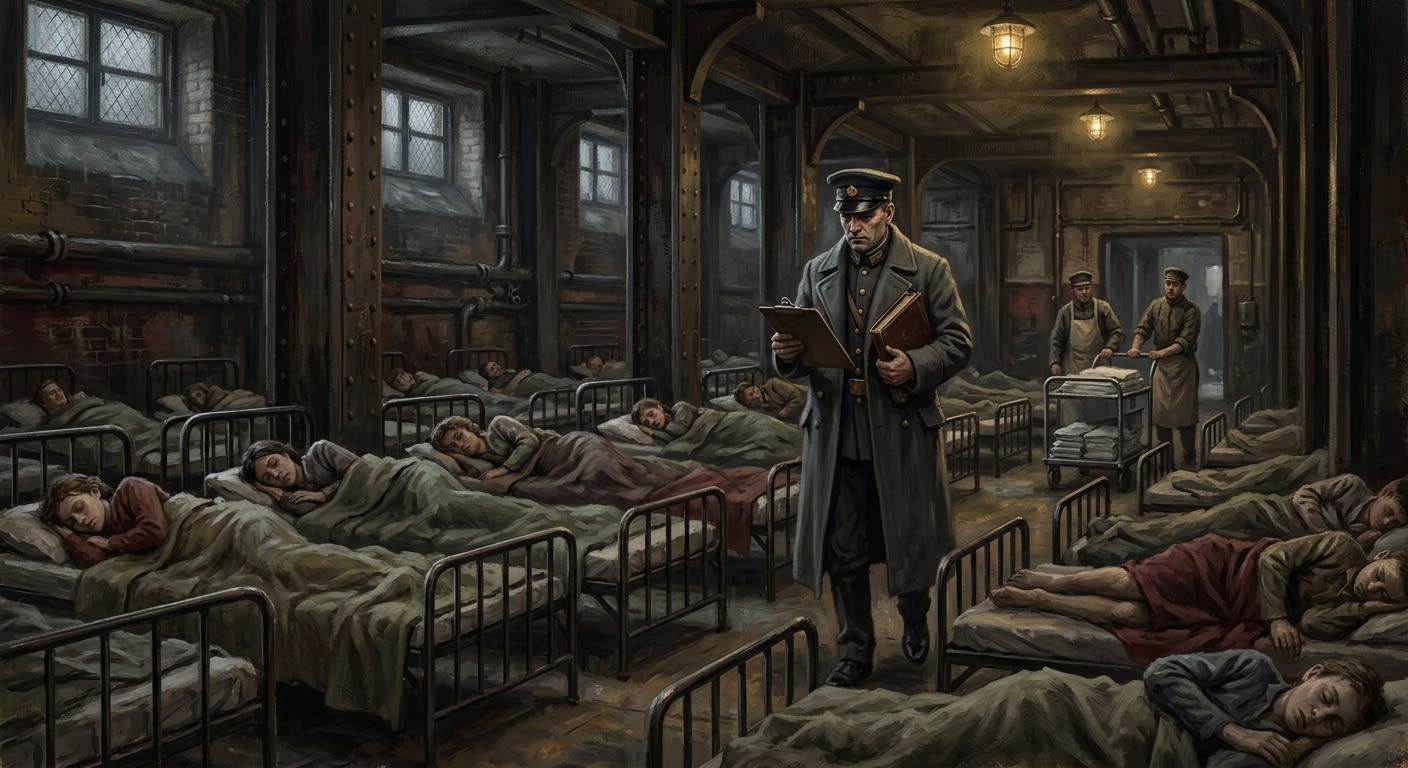
#On Four Bars of Official Mercy
The Dormition Canticle is the Bureau of Mercy’s approved four-bar lullaby for orphanage sleep, composed by committee in A.S. 134, sanctioned by the Bureau of Orison and Song, and inflicted upon children with the confidence only adults without shame can bring to failure. It has the cadence of a tax form. I speak literally. I have read tax forms with more maternal heat.
The Canticle’s public purpose is comfort. Its administrative purpose is substitution. After the Eleven Laundry-Women of Candlewick in A.S. 94 and the Vienna Incident in A.S. 112, the Synod faced a difficulty of its own making: it had criminalised useful lullabies, punished mothers for possessing them, removed children into Mercy custody, and then discovered, as tyrannies so often do, that terror does not rock a cradle very well.
The Bureau required a lullaby that could be licensed, copied, audited, taught, corrected, and defended in court. It produced the Dormition Canticle. Children did not sleep. Committees did.
#On the Need for an Approved Substitute
The Orison Licensing Acts of A.S. 94 placed every melody, cadence, work-bar, lullaby, market call, funeral response, and domestic hum under Orison custody: licensed or criminal, no middle category, no appeal. The law was clean. Life was not. Children kept crying. Mothers kept needing songs. Ward-sisters kept improvising soft phrases under their breath and calling them counting exercises whenever an auditor passed the door.
The Candlewick executions supplied the first lesson: public destruction of paper does not destroy memory. The Vienna sweep supplied the second: branding mothers does not create sleep. The child carts arriving at Mercy orphanages after Vienna carried more than bodies. They carried habits, half-remembered turns, cradle rhythms, rain-and-barley fragments, shock, grief, and a dangerous piece of evidence against the state: a forbidden song had worked.
Mercy disliked the evidence. Orison disliked it more. Doctrine disliked the embarrassment. Records asked for a category. When four Bureaus dislike the same fact, one may safely expect a committee.
The Founding Memorandum describes the Canticle as “arising from pastoral concern for institutional children.”
Corrected. Pastoral concern attended the meetings, spoke twice, and was defeated by licensing requirements before luncheon.
The Canticle was meant to close the market the Unauthorized Melody Smuggler served. If mothers wanted sleep, the Bureau would supply sleep. If ward-sisters wanted quiet, the Bureau would supply quiet. If children wanted comfort, the Bureau would define comfort down until the supply matched the requisition.
#On the Committee
The Dormition Committee met in Strasbourg under joint Mercy-Orison authority. Its membership changed across drafts because some members resigned, one died, two were reassigned, and one Orison examiner accused a Mercy submatron of “sentimental interval preference,” a charge that should have ended in laughter but instead produced three appendices. The final roster included two Mercy ward-supervisors, three Orison Cantor-Scribes, one Records formula clerk, one Doctrine observer, a paediatric physician with no vote, and a Bureau of Tithes cost assessor who objected to the proposed fifth bar on grounds of copying expense.
The fifth bar died. This may be the only documented case in which Tithes improved music by removing part of it.
The committee began with eighty-three candidate phrases. Folk material was disallowed unless stripped of regional markers, saint-names, maternal vocables, rocking syllables, weather references, animal references, harvest references, and “excessive bodily softness.” This eliminated, by my count, every lullaby ever used by a living creature. Orison contributed licensed interval progressions from penitential hymns. Mercy contributed ward quieting calls. Doctrine removed a descending third because it sounded insufficiently resigned. Records regularised the scansion. Tithes shortened the refrain.
Four bars remained.
#On the Sound Itself
The Canticle begins with an obedient rise, pauses for approval it will never receive, descends in a manner suggesting a clerk sitting down, and ends on a tone so legally neutral that even the Bureau of Bells declined to contest jurisdiction. Its words are simple enough for a ward-sister to teach, dull enough for Orison to licence, and empty enough to survive translation between orphanages without alarming Records.
The authorised text varies by province only in pronunciation, never meaning. The child is instructed to close eyes, still hands, accept rest, receive mercy. No mother appears. No father. No roof, rain, bread, barley, lamb, river, saint, kitchen, breast, or remembered hand. The Canticle contains sleep the way a ration chit contains bread: procedurally, at a distance, with the relevant human substance missing.
It is sometimes said that the Canticle is ugly. This is unfair. Ugliness has character. The Canticle is administrative. It does not wound the ear; it submits an application to the ear, stamped in triplicate, then waits beside the crib while the child stares at the ceiling and learns hatred without vocabulary.
#On the Forty-Infant Trial
The Strasbourg Central Orphanarium trial remains the Canticle’s central evidentiary jewel, mounted in brass, polished daily, and visibly cracked. Forty infants were selected from Mercy wards under observation by Orison auditors and Records clerks. The Canticle was performed according to draft rubric by approved ward-sisters after evening feeding. Thirty-eight infants displayed “compliant rest.” Two fell asleep. Both were later discovered to be deaf.
The Bureau called this a success.
The trial forms are exquisite little coffins. Child One: eyes open, hands still, vocalisation reduced. Child Two: continued crying; reclassified as digestive distress. Child Seven: turned toward singer; no sleep; “attention compliance.” Child Fourteen: slept after third repetition; later medical note: severe auditory impairment. Child Twenty-Six: slept before performance; excluded from primary count; included in Mercy morale appendix. Child Thirty-Nine: silent throughout; later note sealed by Orison.
“Compliant rest” did most of the labour. An infant who did not sleep but stopped struggling qualified. An infant who lay rigid qualified. An infant who watched the ceiling with the solemn disgust of a retired inquisitor qualified. The category converted failure into countable mercy. This is why categories were invented: to spare reality the humiliation of being believed.
Public teaching copies state that the Canticle “achieved rest in forty observed infants.”
Revised for internal accuracy. Sleep occurred in two cases, both medically compromised. The remaining thirty-eight exhibited stillness under institutional conditions. Mercy calls this rest. Infants have not been invited to amend the record.
#On Ward-Sisters and Quiet Treason
Mercy’s ward-sisters knew the Canticle failed. They knew by midnight, by the second week, by the way children clenched blankets during the second bar, by the way the best sleepers were those rocked after the official performance ended and the auditor had gone to warm his hands. Ward-sisters are sentimental in the dangerous practical sense. They want the crying to stop because the child hurts, because the room is full, because their own nerves are raw, because mercy sometimes begins as simple exhaustion and becomes doctrine only after a clerk ruins it.
Some complied exactly. Some slowed the second bar into something almost human. Some added breath before the final tone. Some tapped rhythm on mattress frames. Some mouthed old songs without sound and pretended to inspect blankets. One Strasbourg ward-sister, later cited in a Saint Hessa devotional knot, taught a child to sleep by pressing two fingers against the crib rail in a pattern that did not appear in any Orison register. Orison called such deviations “maternal substitution.” Mercy called them staff fatigue. The children called them sleep, though not in words the file preserved.
ORPHANARIUM OBSERVATION — NIGHT WARD C Sister █████ performed authorised Canticle, then remained after lamps-out. Hand motion observed: four taps, pause, two taps, cradle pressure. Child slept. Recommendation: do not prosecute until staffing replacement secured.
The Dormition Canticle produced, by its very uselessness, a black market in better silence. Unauthorized Melody Smugglers sold half-bars to ward staff. Former Vienna children remembered fragments and traded them for extra broth. Listening-cell hosts began carrying “anti-Dormition” turns, little endings designed to warm the dead fourth bar into life. Orison blamed criminal persistence. The Canticle was a recruiting poster for the crime it meant to starve.
#On Its Current Use
As of A.S. 201, the Dormition Canticle remains approved. Approval is hardier than evidence. It appears in Mercy orphanages, hospital quiet rooms, child transfer carts, punishment dormitories, pilgrim nurseries, and those family wards whose parents have already drawn Orison attention and wish to demonstrate clean domestic sound. The rubric has received twelve clarifications, four tempo circulars, two provincial pronunciation guides, one failed illustrated edition, and a disciplinary annex for ward-sisters who “over-soften” the third bar.
The Bureau of Mercy defends it because withdrawing the Canticle would admit that thirty-eight instances of compliant rest were not sleep. Orison defends it because an approved failure is preferable to an unlicensed success. Doctrine defends it because Doctrine wrote the blessing line and refuses to waste a good sentence merely because babies hate it.
The children still lie still and stare at the ceiling. Ward-sisters still pause before the second bar. Mothers in tenements still pay for thirty seconds of contraband humming when the official alternative makes a cradle feel like a ledger drawer. The Canticle endures in hymnals, training cards, Mercy audits, and Orison prosecutions. It endures because no Bureau has ever needed a thing to work in order to require it.