
#On the House That Teaches Air to Obey
“The saints carried the Word through death. Their dust carries it through static.” — lintel inscription, west choir-door
The Cloister of Calibrated Breath stands in Strasbourg as the seat of the Bureau of Orison and Song, which is the charitable way of saying that one of the capital's largest ecclesiastical engines is disguised as a place of prayer. It has cloisters, yes. It has carved saints, yes. It has a central garth, pale glass, processional walks, choir-stalls, refectory bells, and the requisite number of devotional inscriptions reminding the visitor that obedience may be inhaled.
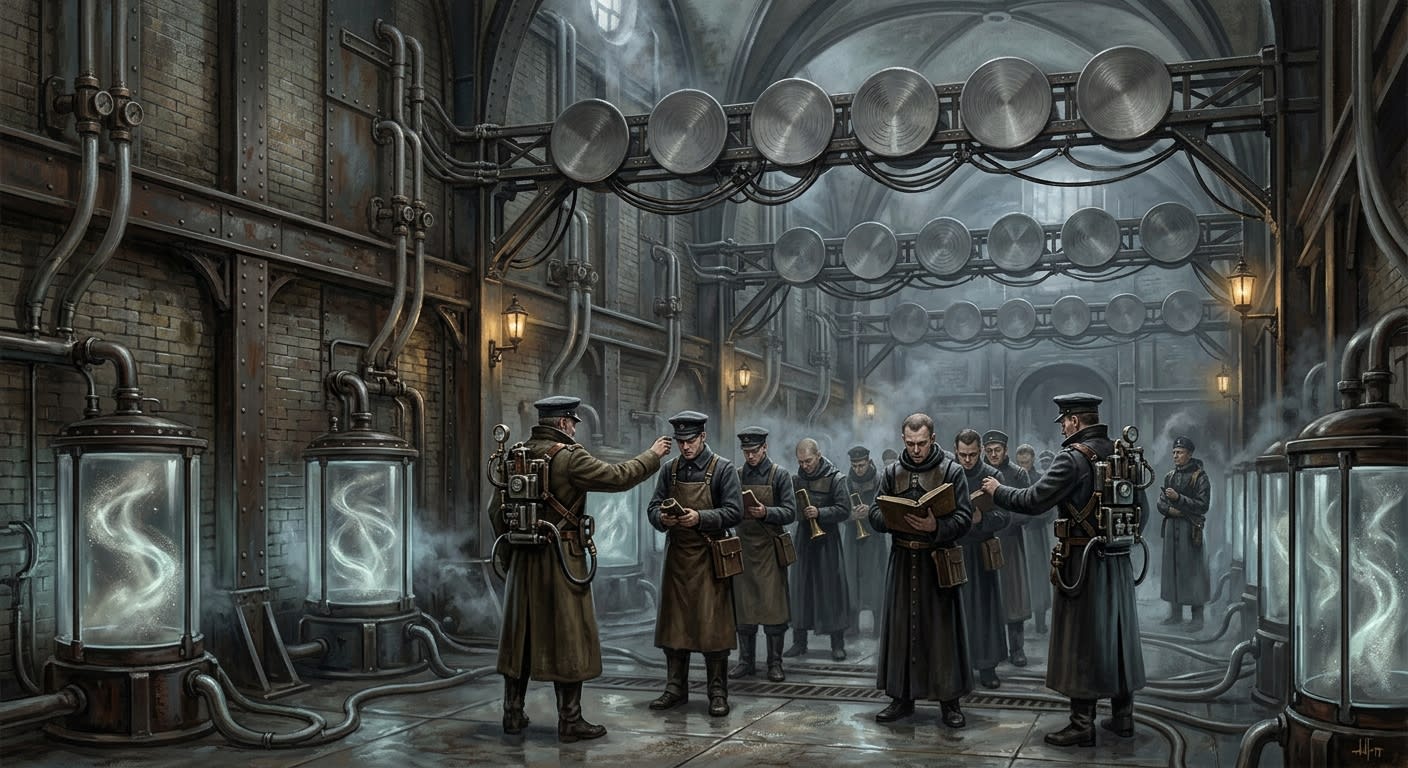
It also has coil rooms beneath the chapels, saint-dust cages behind three locked veils, listening vaults where novice auditors learn to flinch at the correct intervals, and broadcast galleries in which Orison Signal Engineers feed powdered bone into copper until the Synod's approved voice travels cleaner than the air that carries it.
The name is smug even by Strasbourg standards. Calibrated Breath. One hears the theology immediately: the lung exists, the Bureau measures, the hymn obeys. A citizen breathes because nature has not yet received its corrective stamp. An Orison clerk breathes because the breath has been counted, licensed, tuned, and made available for institutional use.
#On Foundation and Jurisdiction
The Cloister's formal authority descends from the Bureau's A.S. 92 charter, filed in the Concordat apparatus when the newborn Synod discovered that conquest by writ required reinforcement by voice. The public account says the Cloister was founded to preserve hymns. The private account says the first transmission houses kept producing corrupted prayer packets, and someone needed a building in which every bad note could be blamed, trapped, dissected, blessed, and priced.
Both accounts are true enough to stand in the same chapel without spitting.
The earliest Cloister was smaller: a choir school, a plate vault, a transmission room with sweating copper, and a narrow yard where novices recited until their throats bled delicately into handkerchiefs embroidered with Bureau insignia. Growth followed fear. The Orison Licensing Acts of A.S. 94 placed melody under office custody. The Irongate Great Hush made continuous choral maintenance a military matter. The first unhymn scares made saint-dust more valuable than modesty. By A.S. 110, after Essen's industrial chant compact hardened calibration into sacrament, the Cloister had swollen into a complex large enough to deserve resentment from the Bureau of Bells.
Early guidebooks described the Cloister as “a contemplative foundation dedicated to sacred song.”
Corrected. Contemplation was admitted as a decorative tenant after the coil galleries, plate vaults, licence benches, dust stores, and disciplinary listening cells had taken the better rooms.
Jurisdiction within the walls is layered like bad pastry. The Hymnal Directorate owns the Master Plates and stanza registers. The Broadcast Directorate owns the coil rooms, saint-dust stores, carrier benches, and Clean Carrier archives. The War Directorate owns the sealed lower galleries into which polite visitors are not taken and from which certain notes rise after midnight with the professional misery of men who call atrocity output.
#On the Architecture of Breath
The Cloister is built around a square garth too quiet for comfort. No fountain stands in it. Water distracts from breath. Instead, four yew trees mark the corners, each clipped to the same height and trained by wire into shapes that resemble lungs if one has recently been interrogated by a physician. Around the garth run the four covered walks: Intake, Plate, Carrier, and Silence. Novices process clockwise in the morning, counter-clockwise after evening correction, and never diagonally unless summoned by a superior or chased by facts.
The west range holds the public chapels and licence hall. Choirs arrive there to receive writs, corrections, reprimands, and, in rare cases, praise so faint it might pass for cold air. The north range holds the Vault of Tuning, where Master Hymnal Plates sleep in steel drawers under wax, linen, and the attention of Cantor-Scribes whose eyes have the scraped shine of men who dream in notation. The east range houses broadcast offices, signal ledgers, dust reconciliation, coil-bank accounting, and the small chapel of Saint Damaris of the Coil, whose historical existence remains laughable and whose candles remain numerous.
The south range is called the Quiet Walk. It contains the side cells, silence chambers, audition rooms, and stairwells descending to equipment that appears on no public plan. Visitors who ask to see the Quiet Walk are told it is under cleaning. This is sometimes true, if one counts blood, wax, vomit, and doctrine as dirt.
The building hums. It hums in stone, bench, glass, tooth, ring, hinge, and ink-pot. New visitors mistake the sound for machinery. Old visitors know better than to distinguish between machinery and prayer inside an Orison house.
#On the Vault of Tuning
The Vault of Tuning is the Cloister's coldest room and its proudest lie. Every approved hymn descends, in theory, from a Master Hymnal Plate held there: steel engraved with authorised staves, stanzas, pauses, emphases, breath marks, and punitive marginalia. Access requires three Bureau seals, a Doctrine countersignature, and the willingness to be searched by a Provost whose hands smell of cold iron and cloves.
The Plates are arranged by liturgical class: parish, war, industrial calibration, funeral, orphanage, penitential, broadcast, curfew, work-song substitute, dormition, execution, and the peculiar shelf labelled Mercy, which is dustier than charity should permit. Each Plate has a custody chain. Each chain has a correction history. Each correction history has at least one line in which the Bureau insists it has always sung the current version.
Cantor-Scribes learn to read deviation at a glance. A note half a hair too low. A breath too generous. A comma whose kindness might encourage interpretation. Hymnal Auditors carry portable plate rubbings into parishes, factories, barracks, orphanages, and prisons. A misplaced comma may be a clerical error. A misplaced note is a security incident. A misplaced stanza is a door left open for the Enemy, or worse, for memory.
This is where the approved Dormition Canticle is stored: four bars composed by committee after earlier lullaby purges made maternal comfort politically awkward. The Canticle has put almost no child to sleep. It has made thousands lie still. The Bureau calls this success because motion, like truth, is expensive to supervise.
#On Dust and the East Range
The east range is where the Cloister stops pretending to be a school. Broadcast rooms occupy two floors above a brick substructure. Copper coils line the walls. Carrier benches face altar-like banks of switches, urn-locks, wax journals, guard-band dials, and saint-dust injectors. Masks hang beside prayer cards. One protects the lung; the other protects the report.
Saint-dust enters through the Reconciliation Vestibule, in casks and sealed urns graded by provenance, potency, contamination, theological attractiveness, and political need. Bone ash from authenticated relic stock. Sanctified salts. Grave wax. Powdered martyr-scrap. Emergency ash from sources no one names while eating. The material is weighed, blessed, logged, blended, and distributed to engineers who will spend the rest of their careers discovering that the dead are more breathable than forgiving.
The Clean Carrier benches test Orison Hour packets before release to the transmission houses. Prayer, ration schedule, curfew amendment, casualty roll, doctrinal notice, work quota, feast correction: all pass through the Cloister's rehearsed throat. If the packet arrives dull, it is strengthened. If it arrives sweet, it is suspected. If it arrives too clean, the engineer logs nothing until he has checked whether his own name is being said beneath the third verse.
BROADCAST TEST CELL — EAST RANGE, A.S. 200 Packet class: Orison Hour rehearsal. Machine reading: clean. Auditor report: under-voice beneath casualty correction. Recognised name: ██████████████ Witness action: began answering before mouth opened. Disposition: cell salted; bench retuned; witness retained for further calibration.
#On Discipline and the Quiet Walk
The Quiet Walk teaches absence. That phrase would sound mystical in a poorer building. Here it is operational. Silence is never empty inside Orison jurisdiction. It is tested, weighed, provoked, searched for teeth, and sealed if it proves too articulate.
Novices enter the audition cells after their first licence examination. They sit behind screens while instructors play approved hymn, corrupted hymn, bait cadence, enemy counter-hymn, silence-pressure, child-song fragment, and blank carrier hiss. They must identify each without humming, flinching, correcting, weeping, or showing the vulgar satisfaction of being right. Those who pass become useful. Those who fail become data. Those who correct the bait cadence aloud are immediately suitable for prosecution work, provided Purity finds their fear attractive.
The Quiet Walk also houses disciplinary listening. Offenders against Orison law are placed in calibrated chambers and made to hear their error until error becomes confession. Tone Inquisitors train here before hunting Unauthorized Melody Smugglers in tenements, docks, pilgrim barns, and trench rear-towns. Failed engineers train here after saint-dust exposure leaves them unfit for coil work and excellent at detecting comfort through a door.
A Bureau memorandum described the Quiet Walk as “non-punitive auditory correction.”
Clarified. Correction is not punishment only when the punished party survives with gratitude, and gratitude has never been a reliable instrument.
No one sings in the Quiet Walk without order. No one whispers true names. No one enters the last stairwell alone. A scratched brass plate above the stair says: Silence Is the Enemy's First Victory. Someone has scratched beneath it, in a smaller hand: Then why do we keep so much of it? The hand was never found. The plate remains, because removing it would confess the question.
#On the Cloister's Present Strain
As of A.S. 201, the Cloister of Calibrated Breath is crowded, necessary, feared, underfunded in the ways that kill workers, lavish in the ways that impress visitors, and currently pretending that the Mirror Choir is a solvable infestation rather than an argument with pitch. The Voice Prelate occupies the upper office; Records tracks the office more confidently than the man. The Hymnal Directorate demands more auditors. Broadcast demands more dust. War demands more throat. Purity demands access to everything and receives enough to remain dangerous.
The Cloister's anxieties arrive daily. At Bastion-Königsberg, the Grey sings hymns before the Bureau broadcasts them. At Essen-of-Hymnsteel, micro-discords pass for fatigue until bell-cannon crack. At Shipka, stimulant hymns fight sleep-fog until operators bleed over their masks. In Strasbourg's own tenements, unlicensed lullabies keep walking out of mouths the Bureau has already threatened.
I have inspected the Cloister three times. Each time the air tasted of copper, wax, old bone, and ambition. Each time a guide assured me the hum was normal. Each time the hum changed when my name was spoken in full.
This is why I prefer my title abbreviated inside Orison walls. Vanity is no excuse for making oneself easier to tune.