
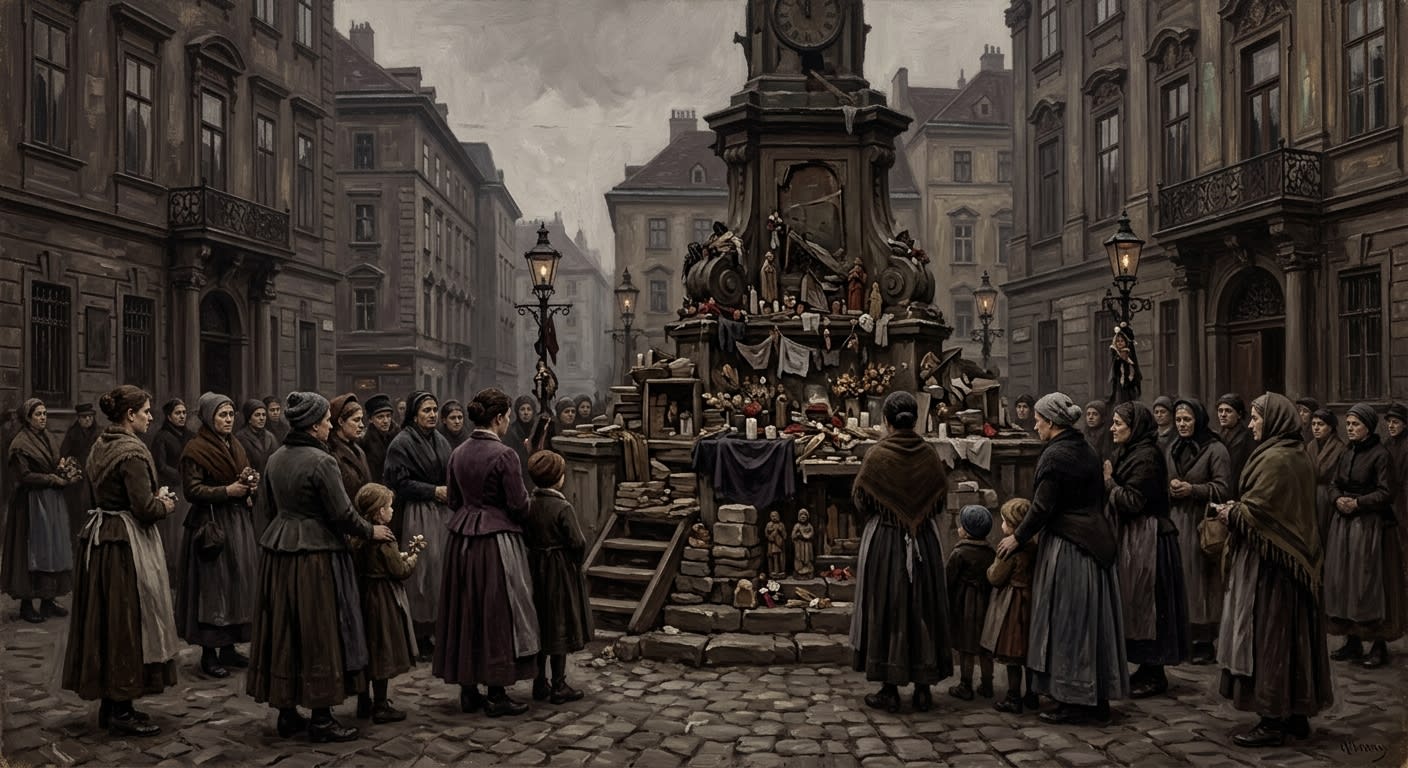
#On the Unauthorized Candles of Judenplatz
The Mothers' Shrine in the Judenplatz is an illegal devotional accumulation, a municipal embarrassment, a theological inconvenience, and one of the few honest places in Vienna. It commemorates the five thousand mothers branded during the Vienna Incident of A.S. 112, when the Bureau of Orison and Song discovered a folk lullaby about rain and barley, classified sleep as contagion, and proved with irons what it could not prove with evidence.
The shrine began as candle stubs around a brick marked with five strokes. This is how revolutions start when decent people are too tired for banners.
The Judenplatz itself sits within the pilgrim quarter's older civic bones, a square whose stones have heard Rationalist decrees, Synodal confiscations, hungry bargaining, Mercy carts, Orison horns, and the particular silence that follows a child asking why his mother cannot sing. The shrine occupies no grand altar. It keeps to a wall, which is tactically wise. The Bureau is excellent at regulating altars. Walls are harder. Walls pretend to be architecture until devotion stains them past denial.
#On the Mothers Remembered There
The official cause was an unlicensed lullaby. The real cause was Bureau humiliation.
The approved sleep phrases had failed in the low quarters near the Donaukanal. Infants fevered from travel, exhausted by bells and curfew horns, refused the sanctioned lines printed on Mercy placards. Someone sang an old tune about rain on barley, barley in hand, hand on cradle, cradle under roof. Children slept. Mothers learned. Neighbours listened through plaster. The cadence moved through laundry steam, boarding rooms, stairwells, cradle cloth, and the small domestic mercy by which the poor survive governments.
Orison heard competition.
The sweep followed: Tone Inquisitors with calibrated forks, Sky-Sermon Attendance Auditors marking weak response zones, Purity cordons at the alleys, Mercy carts waiting for children under the phrase protective transfer. Five thousand mothers were branded. Their tongues were charred black with hymn-fire, leaving them able to speak and unable to hide the category of their punishment. The Bureau likes a wound that introduces its owner.
Several local retellings date the purge to A.S. 94, the year of the Orison Licensing Acts.
Corrected. A.S. 94 made the lullaby criminal. A.S. 112 supplied the irons, carts, prosecution slates, branded tongues, reassigned children, and the Judenplatz shrine. Law is the threat. Enforcement is the sacrament.
#On the Shrine's First Removal
The first removal was clerical. A Purity sergeant lifted the marked brick, bagged the candle ends, scraped the soot, and filed a tidy note: devotional nuisance abated. The next morning the brick had returned. Not the same brick, Records insists, because Records weighed the first one and the second was three ounces heavier. The five strokes were the same. The candles were lit.
The second removal was Orison's. Censors scraped the wall, washed the stones with hymn-water, and posted a notice declaring unauthorized commemoration acoustically suspect. Names appeared in the mortar within the week: Marta, Elska, Johanna, Sabine, Tereza, Gritta, names cut so shallow that rain should have erased them and so stubborn that chisels merely made them darker.
The third removal involved Engineering, which arrived with measuring rods, demolition chalk, and the expression of men who have been asked to solve theology with tools. They declared the wall load-bearing. This was almost certainly true and wholly convenient. Engineering has many sins; occasional mercy by technical memorandum is not the least attractive of them.
The fourth removal was performed at night. No office claimed authorship, which means either Silence assisted or three departments became cowardly at the same time. By dawn the candles had returned, already lit, though no watchman reported seeing anyone enter the square. The names were carved deeper. Barley grains lay in the cracks between stones, dry in rain.
#On Candles, Barley, and Closed Mouths
The shrine's offerings are small because its dead are living women, which is worse. Martyrs receive reliquaries, feast days, oil lamps, tax schedules, processions, school rhymes, and official poetry of unreliable quality. The mothers receive candle ends, barley grains, strips of cradle cloth, cracked teething rings, ward-number tags stolen from Mercy orphanages, and little knots tied in cord for Saint Hessa of the Closed Mouth. No canon recognises Hessa. No condemnation names her. Her absence gives the shrine a patron without giving Orison a target.
Visitors do not sing. That is the shrine's hardest rule and its sharpest accusation. Women stand with closed mouths. Children press fingers to their throats and feel the pulse answer. Old ward-sisters from Mercy orphanages leave grey thread. Unauthorized Melody Smugglers leave nothing visible, which is either discipline or professional vanity. Both are common among criminals and prelates.
The candles are ordinary tallow. Orison tested them for acoustic residue after the second removal and found none. Purity tested the barley for infernal contamination and found grain. Records counted the names and stopped at four hundred because the wall kept acquiring more between inspections. Doctrine recommended no public sermon against the shrine. This was wise. The Bureau can survive hatred. It is less comfortable with pity.
#On Current Custody and Official Cowardice
As of A.S. 201 the Mothers' Shrine remains unapproved, unremoved, monitored, photographed, denounced in drafts, avoided in proclamations, and visited after dusk by persons whose names appear in respectable ledgers elsewhere. Orison wants a fifth removal. Purity wants arrests with evidence clean enough to survive tribunal review. Mercy wants everyone to stop saying children were taken, preferring reassigned, which is a smaller word only to people who did not lose the child. Engineering wants no part of the wall. Doctrine wants the square quiet.
ORISON INTERNAL PROPOSAL — FIFTH REMOVAL Recommended action: controlled demolition under night cordon. Anticipated risk: crowd formation; maternal chant recurrence; ward-child convergence; █████████████████ from orphanage registers; possible Hessa cult amplification. Doctrine annotation: “Do not create what you cannot prosecute.”
Pilgrims detour through the Judenplatz despite the absence of an approved route marker. Guides pretend to lose their way. Mothers from the pilgrim barns arrive with children who do not sleep to the Dormition Canticle. Some touch the wall and leave before curfew. Some remain until the bells force them out. No one sings.
A draft Orison bulletin described the shrine as “morbid nostalgia for corrected misconduct.”
Suppressed before posting. Even Orison, in one of those rare convulsions that resembles thought, perceived that five thousand branded women make poor subjects for scolding prose.
The shrine is illegal. The candles burn. The names deepen. The barley stays dry. Bureau notices peel from the wall by morning, and some clerk, somewhere, sharpens another knife of language for a square that has already learned how to answer without sound.