
#On the Mother-House Without Mothers
Strasbourg Central Orphanarium is the mother-house of the Orphanarium system, which proves at once that the Bureau of Mercy understands irony and is unfit to be left alone with a cradle.
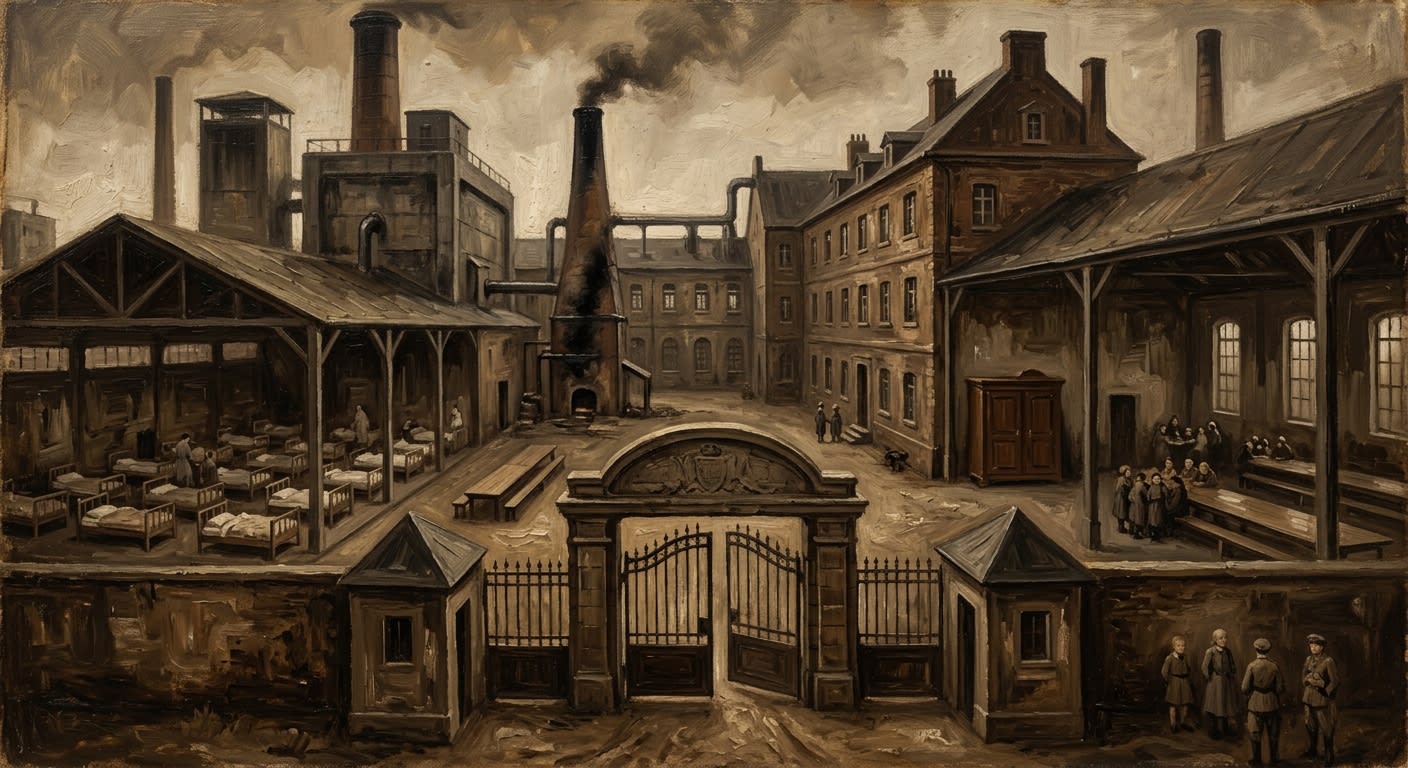
It stands in Strasbourg, under Mercy jurisdiction, close enough to Records traffic that amendment strips arrive before breakfast, close enough to Doctrine that the morning sermons find every ear, close enough to Purity that the basement air has learned to stand at attention. Its walls are grey. Its corridors are whitewashed. Its courtyards are locked. Its chapel to Saint Moriah of the Ledger-Cradle contains painted infants cleaner than any child who has passed through the gate, and this is how one identifies official art: it improves the victim before displaying the virtue.
The public map marks the building as a shelter. The internal maps divide it into seven dormitory wings, three quarantine courts, two lineage chapels, a refectory, tag kiln, Records annex, Purity interview rooms, placement hall, wash house, infirmary, staff cloister, coal yard, receiving gate, and the locked lower rooms where Mercy stores the truths it cannot bear to advertise and cannot bear to lose.
Strasbourg Central is not the largest child-house in the Synod by floor area. Bastion-Constantinople has denser wards during Scour afterwash. Warsaw has more wartime transfers. Budapest receives worse corridor overflow. Central's authority comes from precedent. It is the house whose forms other houses copy, whose failures become trial models, whose scandals become training cautions, whose little cruelties spread west and east under neat Mercy circulars. A provincial Registrar who asks how to name a child from a burned household receives a Strasbourg form. A bastion ward-sister who asks how to sort siblings receives a Strasbourg schedule. A frightened Orison auditor who asks how to make children sleep receives, may the Creator forgive the paper, the Dormition Canticle file.
The first thing a child sees is the gate. The gate has no teeth, no spikes, no vulgar iron theatricality. It is a clean arch with a little shrine niche and a receiving bell whose rope is too high for any child to reach. Above the first washing bench is the old maxim: A child without paper is a demon's invitation. The letters have been repainted after smoke, fever, lice-boiling steam, and one incident involving a boy from Metz who scratched out paper with a spoon handle and wrote mother in the wet plaster beneath.
The plaster was replaced. The maxim survived. Policy usually does.
#On the Founding and the First Rows
Central began as a Mercy ward annex, which is how many permanent horrors enter Strasbourg: as a temporary room with a good explanation.
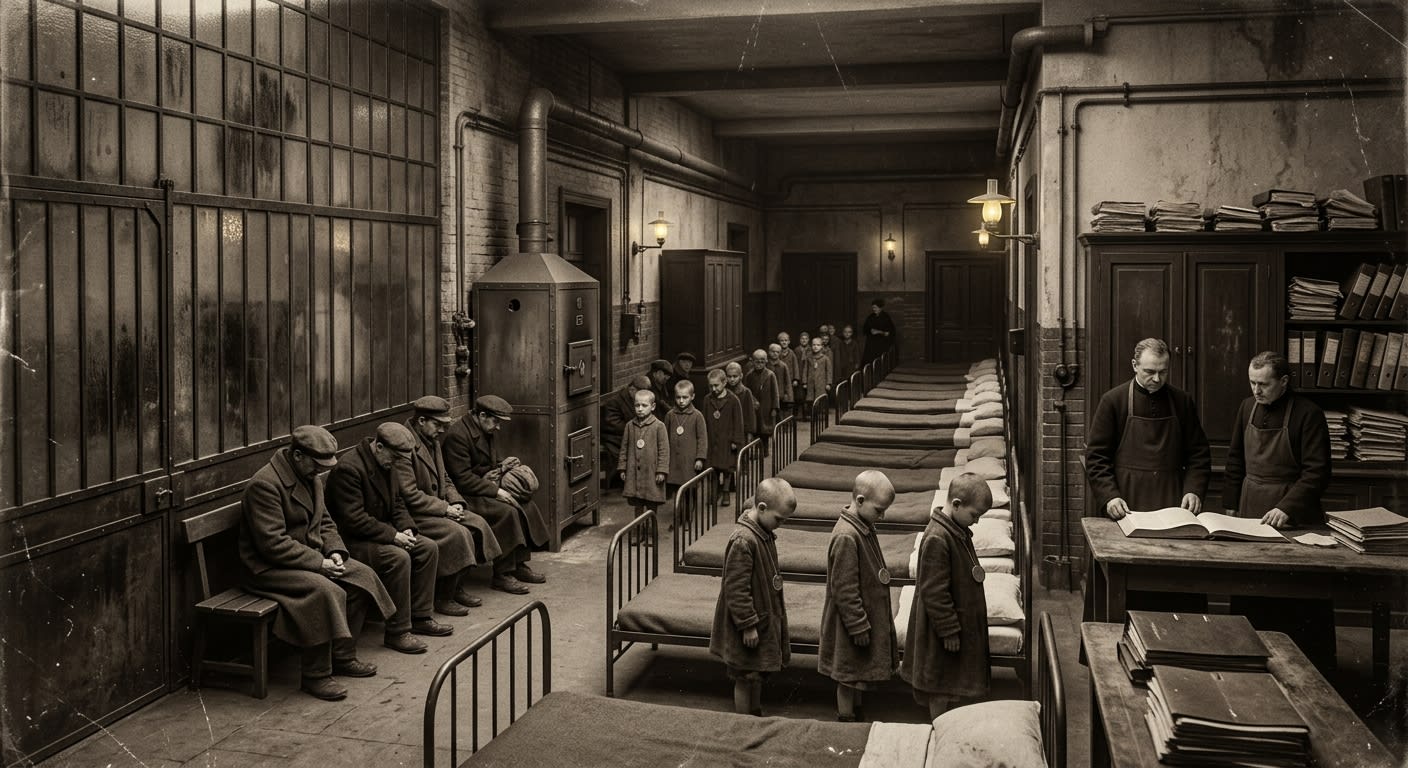
After the Great Retreat hardened the western corridors and the early Line works began consuming adults faster than parish ledgers could bury them, Strasbourg's Mercy kitchens found children sleeping under benches, in coal bins, behind laundry racks, and beneath the carts that brought the wounded in from corridor depots. Some had parents in the wards. Some had parents in the ash. Some had parents whose names were politically inconvenient by morning. Mercy first wrote pending kinship review on slates and placed them in dry rooms. The slates multiplied. So did the children.
By the Concordat years, the annex had become a house. By A.S. 92, when the Bureaus began learning the pleasures of permanent authority, Central had a receiving gate, a washing bench, a provisional roll, and a small chapel whose first Saint Moriah icon was so ugly that even starving children found it suspicious. Charity supplied the first cots. Fear supplied the walls. Records supplied the rolls. Mercy, in the noble generosity for which it invoices itself quarterly, supplied soup.
The first rows were sorted by source: plague, battlefield, unknown, apostate, street, dissolved household, noble-disputed, Mercy-voluntary. This failed. Children from the same parish found one another by accent. Siblings found one another by cough. Older girls rebuilt family trees under bed slats with charcoal. A boy from a condemned Rhine household taught two dormitories his father's oath against the Bureau of Purity. Source-sorting preserved memory.
Strasbourg corrected the error.
Mercy anniversary pamphlets describe Strasbourg Central as “founded in maternal charity after the sorrows of war.”
Corrected. The first cots were charitable. The institution was founded when charity became insufficiently obedient. Maternal charity did not create risk sorting, witness ribbons, tag kilns, lineage chapels, or a basement cabinet with a separate key.
The second arrangement sorted by age, risk, speech, health, and placement value. It worked. The soup lines shortened. The dormitory whispers thinned. Siblings lost one another more efficiently. The old names loosened under repetition. Mercy filed the improvement under ward stability. I would have chosen a crueller phrase, but I was not yet in charge of the sentence.
#On the Gate, the Bench, and the Three Tags
The receiving gate opens before first bell because shame prefers darkness and Purity prefers early carts.
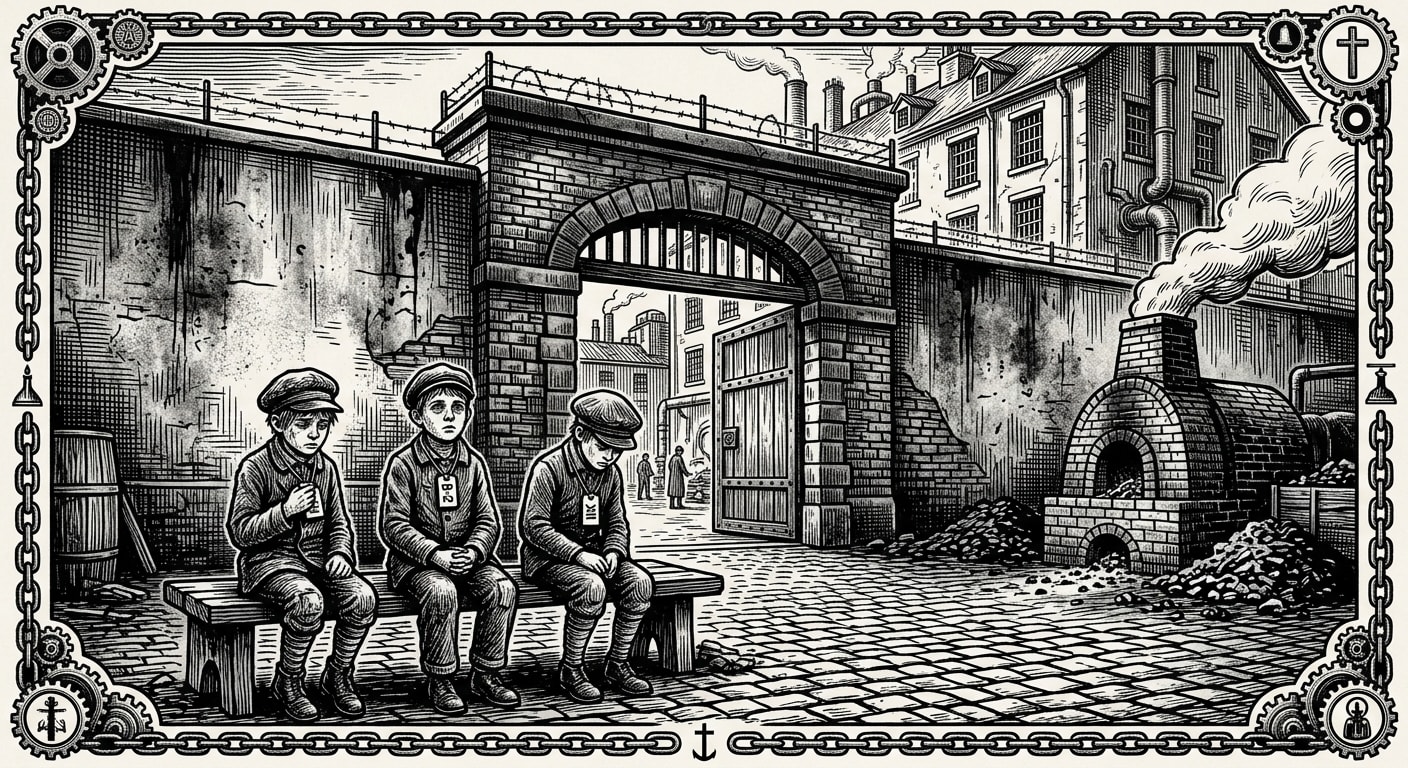
A morning line may contain babies surrendered in baskets, children seized under Natal Registration Act enforcement, Root transfers with witness ribbon at the wrists, street walkers who have decided soup is worth surrender, bastion evacuees carrying ash in their hair, fever orphans from corridor wards, and children delivered in sealed carts whose drivers do not meet the Registrar's eyes. The gate clerk separates the line by sound first: crying, coughing, silent, gagged, sleeping, speaking old names. The categories are crude. They are accurate enough to begin.
At the first washing bench, the old life is removed in layers. Dirt, lice, blood, soot, street oil, kitchen smoke, mother's smell, parish dust, forbidden ribbons, illegal amulets, crumbs sewn into cuffs, saint cards, little knives, teeth wrapped in cloth, bits of bell metal, toy horses, letters never meant for clerks. Everything becomes evidence or waste. Evidence goes to the side table. Waste goes to fire. The child goes to the measure rod.
The Orphanage Registrar reads age by teeth and bone, not by claim. Children lie about age badly; adults lie about children with devotion; teeth tell fewer sentimental stories. Scars are mapped. Dialect is noted. Handedness is marked because Root examiners can make suspicion from the direction a child reaches for bread. Infants are weighed, assigned condition, and passed to ward-sisters whose tenderness survives training in contraband scraps.
Then the Three Tags. Name, ration, labour. The name disk holds the approved or provisional designation. The ration disk opens soup, milk, broth, medicine, fasting exemption, festival scrap. The labour disk announces the future before the child has learned the present: guild, choir, ward service, Records copy-hand, Bell rope, Mercy apprenticeship, Ash auxiliary, Conscription review, Purity observation, or blank pending appetite. The punch through ceramic is small. The child startles anyway. Identity has acquired a hole.
Central's tag kiln runs at night. The smell is clay, coal, and burned glaze. Children in the lower dormitories say the kiln coughs names when rain comes from the river. Mercy denies this. Mercy also oils the kiln door with blessed tallow and keeps a ward-sister stationed there during thunderstorms, which is how Strasbourg denies things properly: by staffing the denial.
#On Dormitories, Bells, and the Arithmetic of Breath
The dormitories breathe in rows.
Seven wings hold the ordinary children: lower ages near the refectory, older girls above the sewing room, older boys near the yard, fever-cleared children in the east wing, Root-coded children where the bells can be heard through two walls, street-feral intake under double latch, infants in the warmed hall where the air smells of milk, vinegar, wool, and the terror of women trying not to love too personally. Each cot has a number. Each blanket has a mark. Each child has a tag. The tags strike the bed frames at night when children turn in sleep, producing a little ceramic rain that makes visitors sentimental and makes ward-staff count unconsciously.
The bells govern the day. Rising bell, wash bell, soup bell, catechism bell, silence bell, yard bell, inspection bell, chapel bell, dormitory bell. Bells are excellent parents: tireless, impersonal, impossible to disappoint except by failing to move when struck. By seven, most Central children stand before the second peal. By ten, the clever ones know which bell can be delayed by a jammed refectory latch, which ward-sister limps after rain, which clerk waters ink, and which old name may be mouthed into a blanket only when the tag kiln is firing.
The refectory is a long hall with Saint Marrow painted above the ladle station. The prayer is short enough for hunger to tolerate: Saint Marrow, count the ladle. Saint Moriah, count the child. Mercy counts both. The soup is grey, brown, pale, thick, thin, charitable, punitive, ordinary, feast-day, fever-cut, or inspection-grade. Inspection-grade soup contains visible vegetables and should be understood as theatre.
Breath counts are taken in the dormitories during winter cough. Ward-sisters pass with blue-glass lamps and chalk breath marks on slate: present, shallow, fevered, absent, uncertain, transferred, do not wake, wake at second, wake with witness. Death in a dormitory is not first a tragedy. It is first a count discrepancy with a body attached. The tragedy arrives later, if staffing permits.
#On the Dormition Trial
The Dormition Canticle trial is Central's most celebrated musical embarrassment, polished daily by the offices that need it to remain proof.
In A.S. 134, under joint Mercy-Orison authority and the long shadow of the Orison Licensing Acts, forty infants were selected from Central's wards for observation. The committee wished to test an approved sleep phrase after Vienna had proved that useful lullabies could become politically expensive. Folk material had been stripped of mothers, rain, barley, kitchens, animals, saints with too much local affection, and all rocking syllables. Orison contributed intervals. Mercy contributed ward calls. Doctrine removed warmth. Tithes removed the fifth bar for copying expense. Four bars survived, because sometimes parsimony shows mercy by accident.
The infants were fed, placed, observed, sung to, categorized, and betrayed by the forms. Thirty-eight displayed “compliant rest.” Two slept. Both were later found deaf. The trial became evidence that the Canticle worked. Evidence, in Strasbourg, means a paper survived long enough to embarrass reality.
The forms remain in Central's teaching archive. Child One: eyes open, hands still, vocalisation reduced. Child Fourteen: slept after third repetition; later note, severe auditory impairment. Child Twenty-Six: slept before performance; excluded from primary count; included in morale appendix. Child Thirty-Nine: silent throughout; note sealed by Orison. Thirty-eight stillnesses became rest by category. Two deaf sleepers became triumph by poster.
Ward-sisters knew by midnight that the Canticle failed. They knew because children stiffened rather than slept, because the second bar made the older toddlers stare, because the quietest infants were those rocked after auditors left. The practical women slowed bars, added breath, tapped crib rails, pressed fingers against blanket seams, or mouthed old songs without sound while pretending to check fever cloths. Orison called this maternal substitution. Mercy called it fatigue. Children called it sleep in the only language the file believed: their bodies finally loosened.
The Canticle remains authorised as of A.S. 201. Approval is hardier than evidence and less burdened by shame. Its failure created markets for the Unauthorized Melody Smuggler, Saint Hessa knots, pillow-taps, cuff-stitches, breath-songs, and little illegal endings that warm the dead fourth bar into life.
#On Root Children and the Cabinet
The hardest carts arrive without noise.
Root transfers come under the authority of the Order of the Root, whose examiners believe heresy passes through blood as fever passes through cloth and whose brown cuffs remain one of the great chromatic insults of the century. The children arrive with witness ribbons: red for direct line, white for household exposure, black for unidentified kinship, grey for bloodline under review. The ribbons are recorded before removal. Some Root examiners believe cloth retains genealogical accusation. I find the doctrine absurd. I have learned not to confuse absurdity with harmlessness.
Central houses Root-coded children in the low-bell wing, where the sound is damped enough to prevent panic and clear enough to enforce schedule. They eat apart at first. Their letters are copied, if allowed at all. Their names are provisional longer than other children's names. They are inspected for residual contagion: forbidden dialect, inherited gesture, old prayers, night terrors oriented toward the old house, lullabies with condemned intervals, left-handed spoon use, and the offensive habit of remembering grandmothers with accuracy.
Official doctrine states that reeducation is universal. The child is protected from ancestral consequence by reclassification under Synod parentage. No kin but the Synod. No claim but the tag. No old root beyond the reach of Mercy's spade.
The basement cabinet says the rest.
The cabinet sits below the east stair, behind a linen store that smells too clean. Its index names Root intakes, reeducation outcomes, transfer codes, failed placements, special corrections, and the small dark column Mercy clerks once labelled cull before Purity ordered better vocabulary. Children deemed too old, too attached, too fluent in the condemned household's memory, too likely to carry the old name forward like contraband under the tongue: they leave the ordinary ledgers through night categories.
Mercy's public position is that the cabinet does not exist. My position is that I have the key. These positions are not equal in dignity, but only one opens the drawer.
An A.S. 199 Bureau of Mercy briefing stated: “No culling of Orphanarium intakes occurs under Mercy authority.”
Clarified. The sentence remains accurate when Mercy authority excludes Root recommendation, Purity countersignature, Records disappearance, night transfer, failed reeducation classification, locked annex custody, and rooms whose windows were omitted by design.
#On Language, Memory, and House Gods Made of Lint
Central's enemy is memory because memory is the only contraband a child can carry naked.
A girl remembers the smell of onions before soldiers entered. A boy remembers his father's limp after Records has struck the father's name. Three siblings separated before noon tap the same kitchen rhythm on three dormitory walls by evening. A toddler uses a word for mother that belongs to no approved district and every older child in the room turns toward it. The manuals call these residual attachment behaviours. The ward-hands call them hauntings. The children call them nothing near adults.
The Index strips arrive in the Records annex each morning. Names condemned. Households dissolved. Songs forbidden. Lineages marked. Regional words replaced. A surname that was merely sad at matins becomes contraband by noon. The Registrar revises the roll. The ward-sister revises the child's mouth. The child learns that yesterday can be outlawed after breakfast.
Children create house gods from what policy overlooks. Crumbs under radiator pipes for Little Hollow. A blue button called Aunt. A crack in plaster named after a vanished brother. Mattress straw bundles that receive whispered surnames. A dead beetle kept in a matchbox and invoked against inspection fever. Saint Moriah presides from the chapel wall with ledger and cradle. The children prefer smaller gods with less paperwork.
Ward-sisters tolerate these cults until Purity visits. Then the button vanishes, the crumbs are swept, the crack is plastered, the straw bundle burns, and the child learns one more lesson in official weather: nothing private survives unless an adult chooses not to see it. Some adults still choose well. Shelterists misfile siblings into shared laundry rotations, hide a mother's needle in a blanket seam, mark a surname illegible when it is dangerous, and slow placements to brutal guilds until the convoy leaves. They are bad servants of the system and better servants of the Creator, which explains why the system disciplines them with regular irritation.
#On the Records Annex and the Amendment Strips
The Records annex is a narrow building fused to Central's eastern wall, a dry little organ through which the house receives its daily ration of altered reality. Its clerks arrive before matins with packets from the Index Damnatus, custody notices from ward courts, natal corrections from Womb Registrars, placement returns, dead-child reconciliation sheets, and the bleak little slips by which yesterday's kinship becomes today's contaminant.
Inside the annex, names are handled like infected instruments. A condemned surname is scraped from the ordinary roll, copied to the restricted margin, matched against dormitory tags, and sent by runner to the relevant wing before breakfast. If the child is old enough to read, the correction is spoken. If the child is too young, the correction is performed upon the adults around him until the air changes shape. The approved name grows louder. The old name becomes a bruise no one admits seeing.
The annex also keeps return ledgers from failed placements. A baker gives back a girl after discovering she wakes screaming at flour dust. A guild master returns a boy for “insufficient gratitude under instruction.” A widow returns no child at all, only the disk, wiped clean and wrapped in a handkerchief. The clerk writes returned, deceased, disputed, unreconciled, or pending inspection. Pending is the most merciful word in the annex. It means the child has not yet been fully abandoned by grammar.
#On Placement Hall
The Placement Hall smells of ink, soap, coal smoke, and respectable hunger.
Guild masters arrive under appointment, gloves clean, eyes practical. They request small hands, strong backs, clear lungs, no cough, no siblings, no noble claim, no remembered dialect, no troublesome scars, no habit of singing. Choir schools request throats. Records annexes request patient fingers. Mercy wards request girls steady around blood and boys strong enough to lift tubs. Bell houses request shoulders. Military offices prefer older boys who stand when shouted at. Adoption petitioners request love with conditions attached.
The Registrar interviews beneath Saint Moriah. The household says child. The file asks servant, replacement, apology, inheritance prop, political repair, winter company, labour need, or pious display. Fees clarify love. So do requested features. “Docile but spirited” appears often in noble petitions, because aristocrats adore contradictions when poor children must embody them.
Some placements are decent. This must be recorded because truth has an irritating appetite for exceptions. A widow takes a lame boy. A baker takes three sisters and refuses to split them. A retired bell-ringer teaches a girl to read old peal marks and never asks why seventh bell makes her cry. The Ledger files these as placements, the same as chimney apprenticeships and corridor kitchen transfers. The Ledger has no field for grace. This is one of its few aesthetic failures.
Darker traffic follows the same corridors wearing better gloves. Clean origin codes are sold. Tags are split. A public child remains in the rolls while a hidden child goes elsewhere. A child declared unplaceable in Strasbourg appears as clean in Metz or Ghent, the disk re-fired, the old hole glazed over. Central punishes trafficking when the trafficker lacks protection. When protection exists, the case becomes custody irregularity, then placement dispute, then closed annex. The Synod abhors child trafficking unless the chain of custody kneels.
#On Missing Children and the Ribbon Walk
A missing child is an accounting event with a heartbeat-shaped absence.
The Ribbon Walk is Central's internal audit route after an unreconciled count: gate ledger, wash bench, evidence shelf, tag kiln, cot row, refectory tally, language office, infirmary slate, placement board, chapel attendance, punishment room, coal yard, laundry chute, lower stair, and the three doors everyone checks last because careers dislike stairs. The Audit Master carries coloured ribbons, tying one at each station where the child's disk, bowl, blanket, breath mark, or witness entry appears. A complete route makes a chain. A broken route makes a room go quiet.
The A.S. 199 Ribbon Walk report remains sealed in part and whispered in full. Tag Cabinet Three reconciled. Cot Row Seven unreconciled. Twelve children present. Thirteen ration draws. Eleven labour disks. One name repeated in two hands. One child answering to a surname struck in A.S. 80. The night Registrar wrote, “They all looked at the empty cot when bells rang.” The follow-up was classified. The cot was removed. The bell was inspected. Nothing wrong was found with the bell.
RIBBON WALK REPORT — STRASBOURG CENTRAL ORPHANARIUM, A.S. 199 Route incomplete after lower stair. Recovered: ration disk fragment, blue thread, ash under fingernails of three unrelated minors, one forbidden surname spoken by sleeping child. Unrecovered: ██████████████████. Disposition: Cabinet transfer; staff reassignment; dormitory renumbered.
Runaways exist. Pale Kin Runners take some. Ward-Builders take fewer and boast of empty Orphanarium beds. Desperate relatives take a handful and call it rescue until hunger forces betrayal. Brokers take the rest, or enough of the rest to keep every Registrar afraid of a clean month. Central recovers what it can, denies what it must, and revises the quarter until the numbers kneel.
#On the Present Count
As of A.S. 201, Strasbourg Central is full beyond the polite capacity printed on inspection forms. Cots stand in corridors during winter. The infirmary annex has reopened two rooms condemned after damp rot in A.S. 196. The tag kiln runs night shifts. The refectory thins broth twice before admitting inspection garnish. Administrative Recovery intakes have risen after Pale Kin sweeps and womb-ledger enforcement. Root carts arrive after family dissolutions. Famine districts send children with bread tokens sewn into cuffs. Purity sends carts that smell of smoke.
Mercy describes the condition as high but controlled. High means the children sleep too close, cough too long, eat too fast, and learn the location of every warm pipe. Controlled means they still line up when the bell rings.
The house continues because the Synod needs it to continue. It needs children renamed before memory hardens. It needs labour placed before hunger becomes gang kinship. It needs Root blood sorted, Orison music tested, Records strips applied, Mercy posters printed, Purity doubts contained, adoption fees received, guild requests supplied, and the public assured that no child under Synodal sight remains unclaimed.
At night, after the blue lamps are hooded, the ward-sister walks the row and counts breath. Some children clutch their disks. Some mouth old names into blankets. Some have forgotten the hands that gave them up. Some remember and pretend not to, which is the first adult skill Central teaches.
Behind the east stair, the cabinet waits. In the chapel, Saint Moriah holds the cradle and the ledger with impossible arms. In the kiln room, cooling tags tick like small teeth. At first bell, the receiving gate opens again.