
#On the Lullaby About Rain and Barley
Potential is a word with room for five thousand burned tongues. — marginal note, Auditory Heresy file, A.S. 112
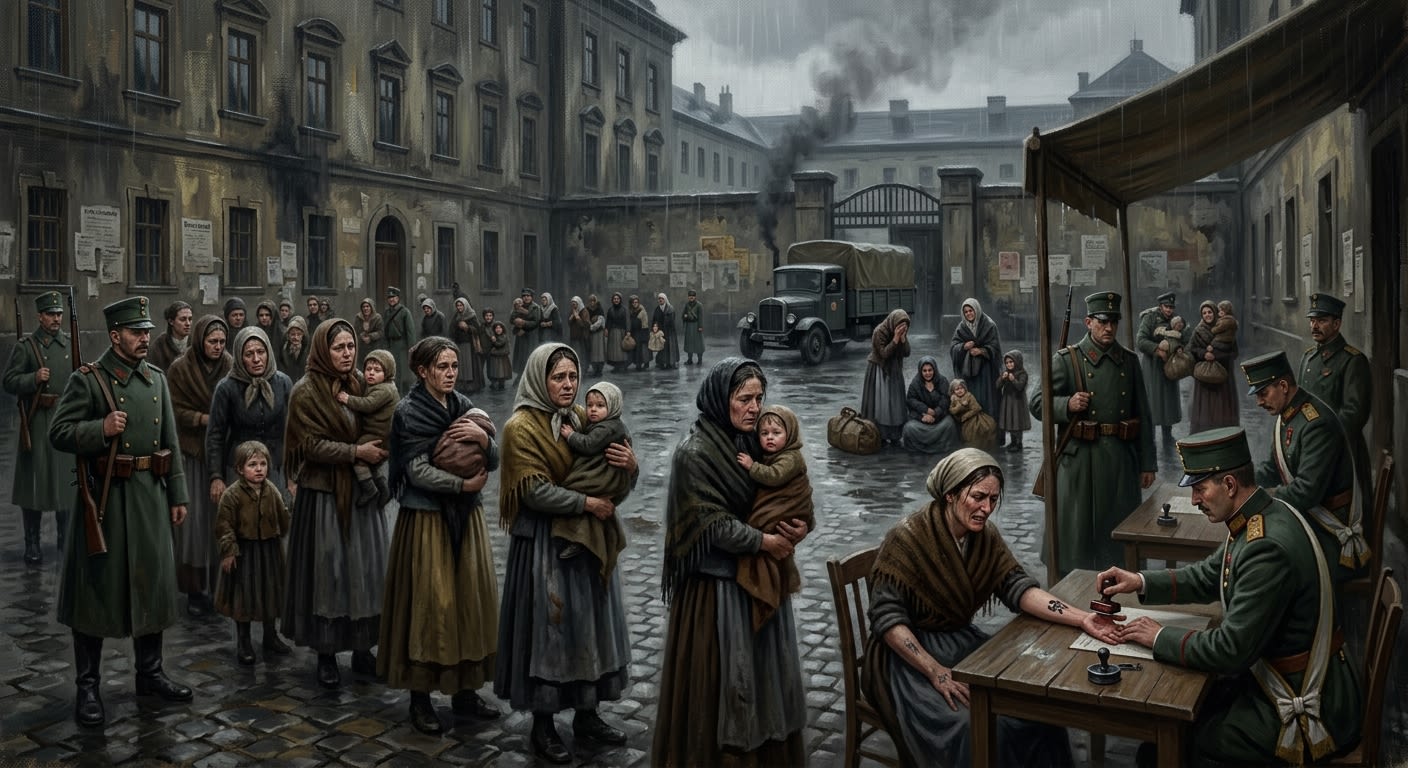
The Vienna Incident of A.S. 112 began with a folk lullaby about rain and barley, sung by mothers who could not sleep to children who would not sleep, in pilgrim quarters still smelling of ash, damp wool, old masonry, and the particular Vienna incense compounded from grief, civic vanity, and river rot. Within a month, five thousand mothers had been branded, their tongues charred black with hymn-fire. The children were reassigned to Bureau of Mercy orphanages. The lullaby was classified by the Bureau of Orison and Song as “an unsanctioned cadence exhibiting potential for doctrinal contamination.”
Potential did splendid work. It entered the room as suspicion and left wearing a judge’s hood.
The Incident remains Orison’s most cited enforcement action and its least beloved. The Bureau cites it when defending the Orison Licensing Acts of A.S. 94, when requisitioning more Tone Inquisitors, when arguing against local exemptions, when terrifying ward-sisters, when training magistrates to hear maternal softness as evidentiary rot. Vienna remembers it differently. Vienna, being Vienna, remembers everything in a manner calculated to irritate authority.
#On Vienna Before the Sweep
Vienna in A.S. 112 was a reclaimed city with fresh paperwork and old wounds. The Siege of A.S. 95 had returned it to Synodal custody, or to the closest administrative imitation of return available after a city has been Rationalist capital, retreat wound, salvage prize, pilgrimage theater, military staging node, and public sermon with sewerage. The rail junction was rebuilding. The pilgrim quarters swelled. The Bureau of War counted convoys for Bastion-Przemyśl and Bastion-Sibiu. Records counted transit papers. Pilgrimage counted tears, which is easier than counting souls and often more profitable.

The mothers were lodged in the low quarters near the Donaukanal, where rooms were hired by the week, straw by the bundle, and quiet by the minute. Their children were fevered from travel, frightened by bells, unsettled by Orison receivers that barked curfew through cracked horns. The approved Mercy sleep phrases failed. The ward lull schedules failed. The little printed placards advising calm obedience failed with the serene incompetence of printed placards everywhere.
Someone sang the old tune.
The words, as far as Records preserved them before Orison sealed the file, were provincial and agricultural: rain on barley, barley in hand, hand on cradle, cradle under roof. No demon. No Rationalist joke. No named saint. No doctrine. A child’s mouth could hold it after two hearings. A mother’s body could remember it after one.
The first Vienna prosecution digest states that the lullaby “spread by deliberate conspiratorial transmission.”
Corrected for internal accuracy. It spread because children slept. Mothers are poor conspirators when exhausted, but excellent witnesses to a thing that works.
#On the Spread
The lullaby moved first by need. One mother sang; another heard the child quiet. A wet-nurse learned the second line. A laundress carried the cadence through steam. A pilgrim wife from Moravia took it to a boarding room above a candle shop. Two sisters from the Danube road (Unregistered) altered the third interval because their grandmother had known a variant. By the ninth night the tune had three endings, four local names, and no owner.
This is the part Orison never understands. A contraband pamphlet has origin, press, ink, distribution, purchaser. A lullaby has fatigue. Fatigue is harder to prosecute because every household owns some.
The first complaints came from Orison monitors assigned to the pilgrim receiver posts. Evening Orison Hour returns showed soft interference in the third quarter after curfew: a domestic cadence under the official Dormition line, weak in single rooms, stronger in corridors, strongest in shared courtyards where mothers rocked children beside laundry frames. A junior Dustcaster logged “maternal synchrony.” His supervisor changed it to “clustered auditory anomaly.” Records prefers cowardice in nouns.
The Sky-Sermon Attendance Auditors marked two blocks as response-thin during morning sermon. The Bureau of Purity supplied men with cudgels. Orison supplied listening cards. Mercy supplied carts for children and later insisted the carts had been requisitioned for “protective transfer,” which is what abduction becomes when stamped by people with clean sleeves.
#On the Sweep
The sweep began before dawn. Tone Inquisitors entered the first stairwell with calibrated forks, hand-cranked resonance boxes, prosecution slates, waxed listening cards, and the perfect little cruelty of men who know the law will believe their ears over everyone else’s mouths. They played bait-cadences at landing corners: three bars wrong, one bar nearly right. Mothers flinched. Infants turned. One woman corrected the rhythm under her breath and was seized before the correction finished.
By Sext the sweep had widened from two buildings to twenty. By Vespers it had become an operation. Purity cordoned alleys. Records clerks set up portable tables under awnings. Orison examiners tested throats, linens, cuffs, cradle runners, music-box screws, pillow hems, and the soft skin beneath tongues. The Bureau of Mercy received children in numbered lots and issued comfort statements to persons too terrified to read them.
The branding stations were established in a former ration hall. The iron was called hymn-fire because cruelty improves when given liturgical costume. The brand did not remove the tongue. It marked it. The effect was more useful. A woman branded for melody could still speak, but with a charred slur that announced the category before the sentence arrived. The body became docket, warning, footnote. The Bureau adores a punishment that saves clerical time.
WITNESS TRANSCRIPT — MERCY CART NINE Child asked why mother could not sing. Ward-sister answered: “Because the Bureau has made her safe.” Child repeated phrase for three days. On fourth day child █████████████████████████████████████. Transcript sealed under Orphanarii Morale Protection Rule.
By the end of the month the number stood at five thousand. The figure is exact because Records enjoys precision when precision cannot help anyone. Five thousand branded mothers. Unknown listeners flogged. Unknown children reassigned. Unknown variants seized. Three Tone Inquisitors commended. Seven clerks promoted. One Orison supervisor censured for using the phrase “excessive optics” in a memorandum, since the Bureau prefers moral confidence to accurate embarrassment.
#On the Classification
The classification report is the holy relic of this little massacre. It does not prove that the lullaby opened a wound, summoned a demon, carried Rationalist code, or induced doctrinal refusal. It proves that children slept. It proves that mothers gathered around a cadence Orison had not licensed. It proves that the approved alternatives failed. It proves, in short, the Bureau’s nightmare: unauthorized comfort accomplishing what sanctioned comfort could not.
“Potential for doctrinal contamination” was the necessary phrase. Potential made evidence optional. Doctrinal made fear theological. Contamination made tenderness infectious. The report’s language is so efficient one almost forgives its obscenity. Almost. I am not paid to forgive; I am paid to improve the sentence until the obscenity wears polished shoes.
Public copies later stated that the Vienna lullaby caused “measurable spiritual degradation among affected households.”
Withdrawn from internal editions. No such measurement survives. The affected households displayed sleep, mutual aid, reduced infant distress, and refusal to name first singers. Orison judged these symptoms adequate.
The lullaby’s original melodic plate, if one existed, has not been found. The seized fragments contradict one another in useful ways. Some versions rise at barley. Some fall at rain. One variant includes a rocking syllable with no lexical meaning and, for that reason, more human authority than the entire prosecutorial appendix. The Bureau declared all variants equivalent. It is hard to hear distinctions when one is already heating the iron.
#On the Children
Mercy reassigned the children to Orphanarii under the protective transfer rubric. Protective transfer is among the great Synodal phrases, sitting somewhere between “collateral sanctification” and “temporary permanent custody” in the cabinet of administrative sins. The children were given new sleep schedules, new ward numbers, approved grey blankets, supervised prayer, and eventually the Dormition Canticle of A.S. 134, which achieved in four bars what the Vienna irons had not: absolute proof that committees should be kept away from cradles.
Many children were too young to remember the melody. This was deemed success. Many remembered only the first turn, the rain phrase without barley, the rocking syllable, the shape of their mother’s damaged speech afterward. This was deemed residual risk. A child who hummed in sleep was isolated. A child who touched his tongue while crying was recorded as “brand-imitation fixation.” A child who refused the Dormition line was treated for oppositional rhythm.
A small number of former Vienna children later appear in melody-smuggling prosecutions as adults: stitch-score couriers, listening-cell hosts, cuff embroiderers, wet-nurses, one Choir clerk who altered a Mercy sleep sheet by a single interval and produced the first documented infant sleep in that ward for sixteen months. Orison called this recidivism. I call it memory with teeth.
#On the Shrine
Vienna gave the mothers a shrine on the Judenplatz. It is not approved. That has not prevented it from existing, which is rude of it. The shrine began as candle stubs around a brick marked with five strokes. Purity removed the brick. The candles returned. Orison scraped the wall. Names appeared in the mortar. Engineering was asked to examine structural removal and discovered, with admirable slowness, that masonry is complicated when no one wishes to be blamed for touching it.
The shrine has been removed four times. It has reappeared four times, always within the week, always with candles already lit, always with names already carved. The names are not all accurate. Some belong to women branded elsewhere. Some belong to no file. Some are initials only. Records dislikes this. Vienna does not care. The dead and the branded are poor clerks.
People leave barley grains in cracks. They leave cups of rainwater after storms. They leave little strips of cloth cut from cradle sheets. No one sings there, or no one with sense. The place is almost silent, which is how Vienna insults Orison: by making silence carry a melody without giving the Bureau a throat to brand.
#On the Present Use of the Incident
As of A.S. 201, the Vienna Incident remains a training case in Orison schools, Purity interview manuals, Melody Intent jurisprudence, and the Budgetary Annexes by which departments convince treasurers that fear requires furniture. Tone Inquisitors study the bait-cadence response tables. Mercy studies child transfer logistics and pretends the study is compassionate. Records studies number discipline. Doctrine studies the sentence, because Doctrine has always understood that the right phrase can carry more punishment than a whip.
The official lesson is simple: unauthorized cadence spreads faster than heresy pamphlets and must be corrected before comfort becomes community. The unofficial lesson is simpler: never let the people discover that the Bureau’s approved substitute does not work.
The lullaby has not been heard since. This is the official claim. It may even be true in the narrow evidentiary sense: no full performance, no seized plate, no complete notation, no witness brave or stupid enough to offer all four lines. Yet mothers still tap rain against cradle wood. Barley still appears at the shrine. Ward-sisters still pause before the Dormition Canticle’s second bar, where the old tune would have turned warm if warmth had been permitted.
Five thousand tongues were burned. The silence learned the song.