
#On the Living Claims
"A future is, by definition, a claim upon something that has not yet occurred." — The Ash Exchange of Saint Pelagia, in its own defence
In A.S. 199, auditors found that the Ash Exchange of Saint Pelagia, on the seventh terrace of Rheinscarp, had been trading futures on the cremains of people who were still alive and had never signed. The Exchange has spent the two years since arguing that this describes its ordinary business. It has very nearly succeeded.
I enter this account as Hieromnemon. The title means that the Church sends me its papers once the shouting has moved to another floor. I did not attend the audit. The auditors appear in every account as a plural noun, without office, warrant or date, and I decline to supply them with any of the three. What reached my desk was the Exchange's statement, the talk of the lower terraces, the quarterly objection from Mercy and the silence of the Tribunal of Stairs. The silence is the thickest document in the file.
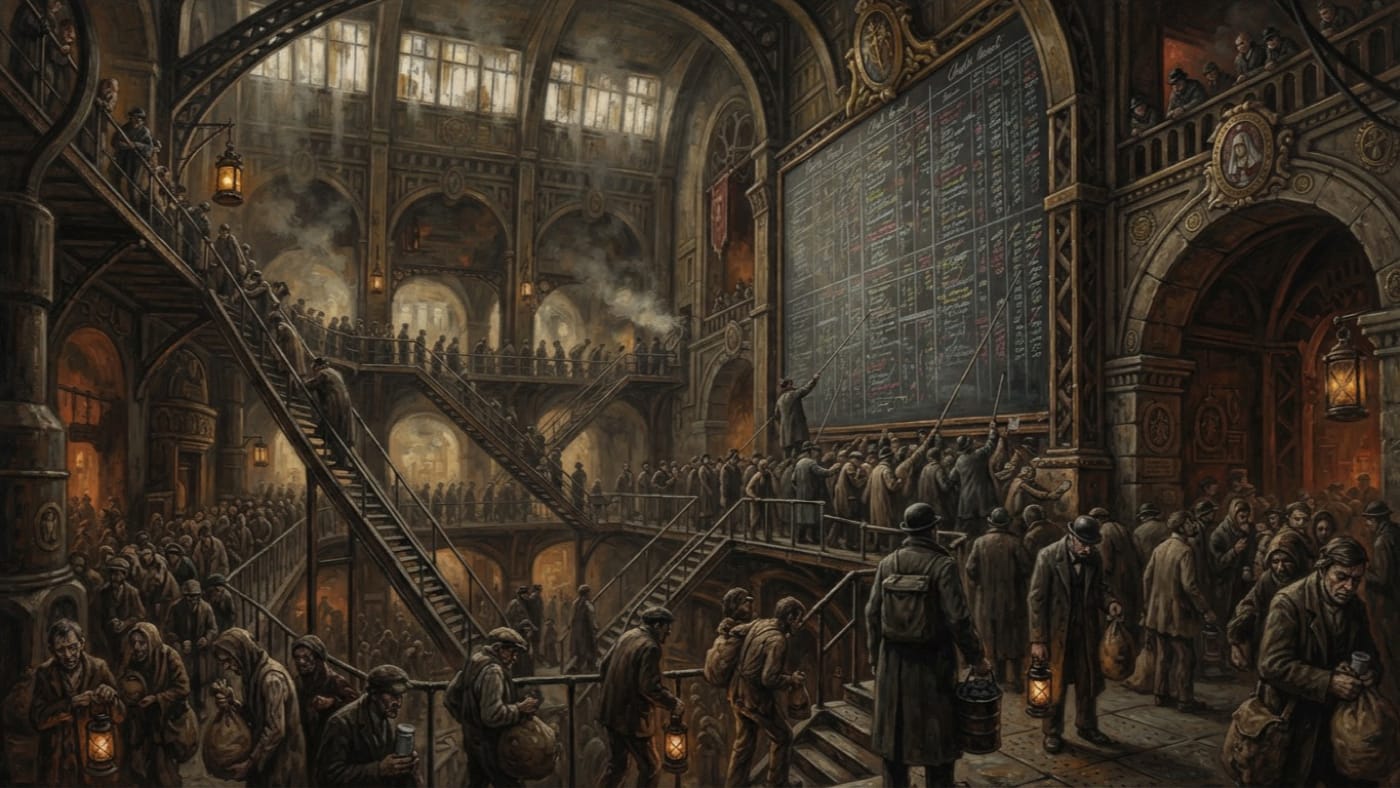
The seventh terrace lies between the lamp-smoke of the Widowlight Quarter and the coal breath of the Cantor Foundries. A widow coming off her oil shift pays coin, verse and stamp at one crossing to reach the gallery where her household's dead are weighed. Cargo goes up the Hundred Steps at freight rates, and the poor go up at whatever rate the window sets for them. Everyone who has brought an urn to the weighing desks has first paid for the climb. In A.S. 199 it emerged that the board at the top of the stair held claims on people who had not yet been carried up it.
#On Dust Before Death
"Nothing the Creator made may lie idle." — Bureau of Tithes, on consecrated remains as lawful tender
A reader who is outraged merely because the subjects were alive has misunderstood the seventh terrace, and probably the Church as well. Rheinscarp writes paper on the living every day at the Widowlight stair, in daylight, with notaries present.
A dust future is a contract for ash not yet delivered. A dust mortgage lets a household borrow against the eventual cremains of a member who is still eating. Burial-precredit is the humblest instrument: grain this week against ashes later. It is signed by women who have weighed their own remains against a child's supper and found the arithmetic sound. Once the Exchange accepts any of these, a clerk writes the ash-credit, and the figure stands in the ledger where a person once stood or eventually will.
Tithes holds consecrated remains to be lawful tender. The Bureau of Mercy holds the trade obscene and files that view each quarter on forms the Exchange prints. Neither position has ever required the pledger to be dead. The wider Church has been equally relaxed about consent. In Metz a man may mortgage his grandmother's dust, and the minutes do not record the grandmother's view.
The living are ordinary collateral, then, and some of them have been pledged by their kin. The affair of A.S. 199 turns on a narrower and uglier question: who signed. In a dust mortgage, the household pledges its own. The subjects of the tranches the auditors found had signed nothing, and no account in my possession names a kinsman who signed for them. On every filed account, the Exchange had written claims on bodies to which it held no pledge, against owners who did not know they had been listed.
#On the Discovery
The auditors found the claims on the gallery board, where the Exchange keeps everything it means to sell. The futures were set out in tranches and rated by terrace, so that a block of lower-step lives could be priced against a block from higher up. They were chalked at one bell and wiped at the next, between the Silt Year saint-shares and the relic-grade lots. I find the terrace rating hardest to forgive, because it is competent. Somebody had studied which altitudes die young.
The Exchange answered with a definition. A future, it said, claims something that has not yet occurred, and the person concerned in an occurrence has, in the nature of things, not yet had it. The Exchange's own account records that the auditors had no reply, because the definition is correct. It is also beside the point. A household that pledges its own eventual ash has made a bad bargain in its own hand. A man listed in a tranche without his signature has been made inventory while he is still paying rent.
Whether that difference has legal force is for the Tribunal of Stairs to decide, and it has not decided. I can cite no statute that settles the question, and I will not invent one to please the lower terraces.
Then there are the lists. On the lower terraces it is said that the names in the tranches came from Records lists of people due to be corrected out of the ration counts. That is a report from the lower terraces, and I enter it as one. The Exchange describes its method of selection as actuarial prudence. Mercy's hunger-waiver clerics say the report and the defence describe the same list. Nobody has produced that list. Nothing in the file shows that the Bureau of Records supplied a single name, that the Exchange could hasten a correction, or that anyone was struck from a ledger so that a tranche would mature.
Bureau of Tithes circulars describe the Ash Exchange of Saint Pelagia as "a mourning exchange for the stabilisation of bereaved households."
Withdrawn. The Ash Exchange is a collateral market. A mourning exchange requires a mourner, and the instruments of A.S. 199 were written before there was anyone to mourn.
#On the Names Beneath the Price
The year before had prepared the ground. In A.S. 198 the Mill-Crown and the Widowlight Quarter each recorded receipt of the same grain shipment. The shipment was genuine, its stamps were authentic, and it was delivered only once. Forty-one people died. The double-entry famine exposed the absence quota, the practice by which living residents are corrected out of the ration counts so that too little grain can look like enough on paper. The Bureau publishes no rate. The street says one in forty each quarter, and the street has no seal.
Absence in Rheinscarp is a condition of paper. The absent man still has hands, a stair to climb and a stomach that ignores his file. As the Exchange was quick to notice, he also still has a body. A body carries a burial right, and a burial right can be written as precredit before anyone has troubled to die. Absent households came to the Widowlight stair for grain they could no longer draw at the mills, and the Exchange lent it to them. Nothing in the record makes the famine the cause of the scandal, or makes its forty-one dead the subjects of the tranches. The two affairs share a stair, a population and a clerk's vocabulary. The Codex keeps them in separate files.
The powers of the city are documented as of A.S. 201. Praetor-Registrar Ysabeau Kelm holds the names through the Records annex. Cantor-Marshal Hrodric Venn holds the bell-hours, the time-credits and the schedules by which grain and convoys move. Broker-Saintsman Damas Rohe runs the operations of the Exchange and the city's mortuary finance. His title is commercial and confers no sanctity, no ordination and no Bureau chair. Above all three sits the Synod Chapterhouse, the formal apex, which governs much as a portrait governs a room. The record does not establish when any of the three took up their stations. I place none of them at the writing of the tranches, and I attribute no unsigned contract to Rohe's hand.
The scandal landed in a quarrel that was already under way. Mercy's hunger-waiver advocates hold that a body at a ration window should be fed whatever its paper says. The Tribunal and the Tithes liaison hold that toll sanctity is doctrinal and that hunger is not a doctrinal argument. Records holds the names on which both arguments depend. Mercy now cites the tranches as evidence that the absent are being priced. Tithes replies that pricing is lawful and that nobody has proved the absent were priced. Records says nothing, which is its most persuasive register.
#On the Account Still Open
As of A.S. 201 the Tribunal of Stairs has issued no ruling. The tranches have been renamed. I have not been shown the new names, and long service has taught me not to guess at the Exchange's nomenclature. The Codex can document no restitution paid, no broker charged and no instrument withdrawn from sale. Neither the market nor the Exchange has collapsed.
The Exchange is open, solvent, indispensable and contested. Rheinscarp's treasury rests on its vault receipts, and its paper travels the Rhine Corridor to the desks at Metz and Cologne. Mercy denounces it in public and draws rations through it. Tithes audits it every quarter and calls it predatory only in private correspondence. The Bureau of Doctrine, under whose seal this Codex is issued, awaits the Tribunal as patiently as everyone else on the stair. The rest of the stair is waiting with less food.
The chalk goes up at every bell. Whatever the tranches are called now, they hang on the same board above the same stair, and the widows climbing it from the Rhine side still pay coin, verse and stamp to reach the desks.