
#On the Corridor That Learned to Count Back
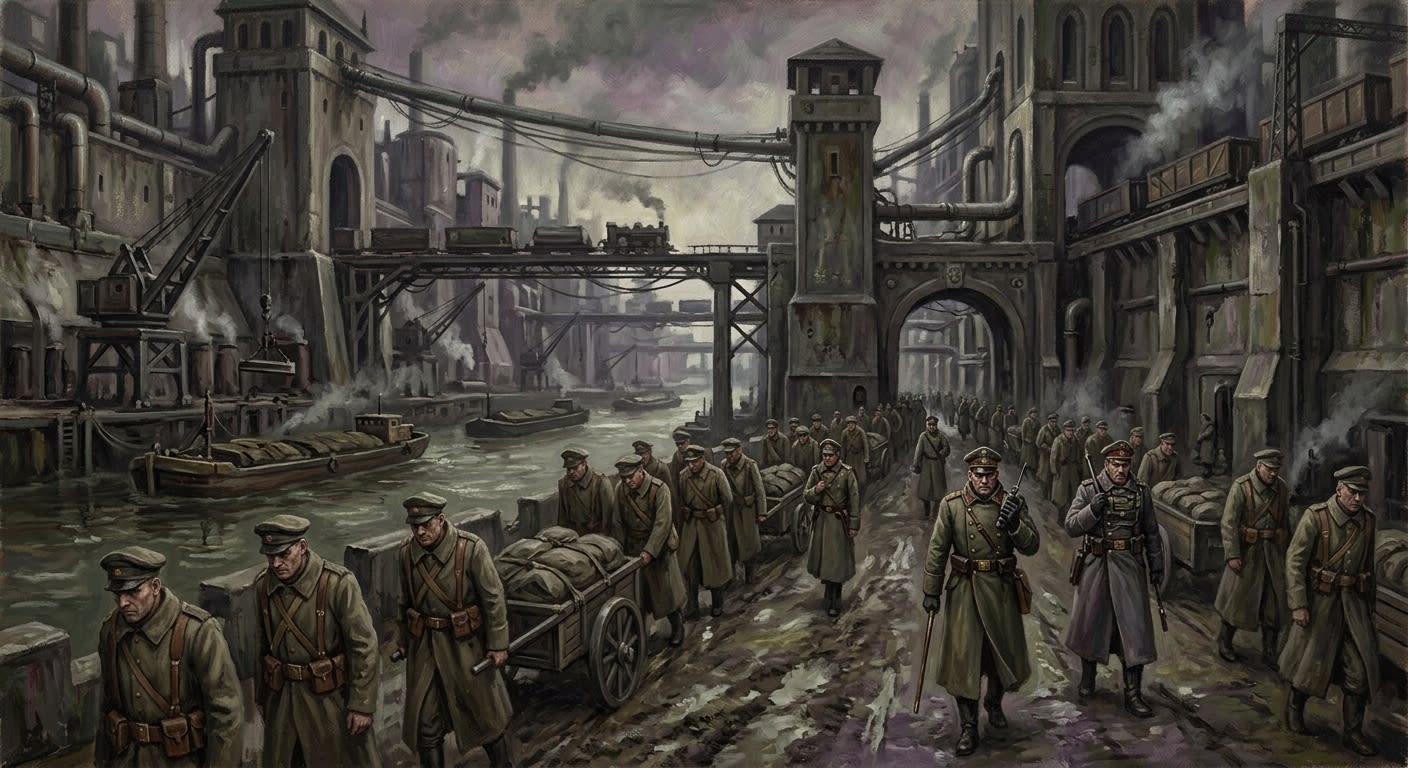
The Rhine Corridor differs from the Rhine. The river is water, current, barge, fog, flood, silt, corpse, cargo, and wet jurisdiction. The Corridor is what men built beside it once they realized that water could move authority faster than roads, and that authority, once moving, could be taxed at every landing. A river may flow by grace of Creation. A corridor flows by stamp, toll, queue, office, fear, and the smell of damp wool in rooms where clerks pretend their ledgers are dry.
It runs through the Zone 2 heartlands from Strasbourg’s dependent channels through Mainz, Rheinscarp, Cologne, Mannheim, Worms, tariff chapels, rope-ferry nodes, archive porches, bridge courts, ration depots, ossuary roads, and the small towns that never appear in pilgrim maps because their principal export is delay. It is a road system, river system, registry system, heresy system, mortuary system, and accounting machine. It feeds the Line by making the rear obedient. It feeds the Bureaus by making obedience billable.
The common traveler knows the Corridor by its inconveniences: ferry calls before dawn, chapel bells used as traffic signals, Tithes assessors measuring sacks by candlelight, Records clerks asking for childhood names, Purity men listening to silences, and old women muttering prayers to Saint Morin before stepping across a bridge whose stones have seen too many corrected identities. The Synod knows the Corridor by throughput. Grain, bodies, paper, seals, relics, soldiers, children, ashes, questions, and lies move here with such regularity that Order mistakes itself for nature.
#On Its Making After the Sundering
The Corridor was not planned. This matters, because the Synod prefers planned things and takes personal offence when history produces a useful structure without prior committee approval. The Corridor grew from emergency after the A.S. 45 Sundering: refugees pushing west, grain pushing east, bishops pushing claims, relics pushing fear into the shape of processions, and soldiers pushing carts until the carts became roads. The riverbank towns were already old. The roads between them became Synodic when panic acquired stamps.

The early years produced three habits that still rule the Corridor. First, movement must be witnessed. Second, witnesses must be registered. Third, registration must be paid for, because the Creator hates waste and the Bureau of Tithes hates unmonetized terror. Refugee paths became queue roads. Ferry bells became passage law. Tollhouses became audit chapels. A man who crossed from one parish bank to another learned that he had not traveled; he had presented evidence of continued existence.
A.S. 78 gave the Corridor its first mature theology. The Great Plague and the Lull of Names destroyed deathbed testimony. The First Ossuary Panic made unsealed pits along the Rhine Corridor produce sounds after dark, which Records called post-interment atmospheric settling because cowardice may be made almost elegant in a sufficiently polished phrase. Silt Week pulped transit ledgers at tributary crossings and made thousands unverifiable by breakfast. Every office learned the same lesson: shelves, pits, ferries, names, and corpses must be raised above water, watched after dark, and charged to the living before the dead become uncooperative.
Several post-Concordat school maps describe the Rhine Corridor as “harmonised by the A.S. 90 settlement.”
Corrected. The A.S. 90 settlement did not harmonise the Corridor. It gave official seals to a chain of habits already hardened by plague, flood, hunger, and clerks with cold hands. The map lies because neat lines are cheaper than honest mud.
#On Nodes, Gates, and Minor Kingdoms of Delay
A corridor is made of chokepoints. The Bureau of Passage understands this. So do smugglers, mothers, armies, heretics, and any mule with enough experience to hate a bridge. The Rhine Corridor has grand nodes and petty nodes, and the petty nodes often matter more because a great city may be audited while a small ferry clerk can ruin you before anyone remembers his name.

Mainz is the throat: bridge tolls, acoustic punishment residue, Augustinus memory, the Iron Choir along the road, and bells that make movement feel like confession. Cologne is the account-book: archive-banks, Sable Court, confessor-kiosks, relic custody, vault finance, council memory, and that intolerable civic knowledge that Strasbourg once needed its rooms. Rheinscarp is the stair: nine terraces, stair tokens, self-writing booths, ration mills, the Ash Exchange (Unregistered), and fees so numerous they achieve theological weather. Strasbourg is the head that denies dependence on the neck.
Between them lie the minor kingdoms. Rope-Ferry Chain nodes where a stamped slip can be invalidated by damp. Tariff chapels where dead goods wait for Saint Morin’s sealed-mouth clerks. Bridge porches where widows sleep with packets tied under their arms. Quarantine sheds pretending to be temporary for three generations. Copy houses that make duplicates of duplicates until the copy looks more confident than the original. Inn yards where route-stampers, Lantern watchers, Dead-Goods Tariffers, Clean Slip brokers, and Purity informants drink at separate tables and listen to the same lies.
The towns themselves acquire personalities from the office that most frequently injures them. A Passage town develops short tempers and excellent rope. A Records town smells of lamp oil and lies carefully. A Tithes town measures bread by suspicion. A Purity town learns to sing loudly in public and speak in kitchen steam. A mortuary town has children who do not laugh near grates after dusk. Bureau circulars call this civic specialisation. Families call it the way things are, which is how tyranny becomes furniture.
#On the Dead Beneath the Roads
The Rhine Corridor is a mortuary geography because all corridors are. Movement creates death; death creates forms; forms create professions; professions create patron saints; patron saints create fees; fees create families who pray for fewer saints and more bread. The First Ossuary Panic of A.S. 78 is the official beginning, though only a clerk would believe burial disorder began on the day it became inconvenient to Records.

Unsealed pits along the Corridor began sounding after dark. Some noises were settling earth. Some were rats. Some were grief given echo. Some were worse. Records, Rites, and Tithes issued the Joint Classification Mandate (Unregistered): no remains interred, transported, processed, or displayed without stamped clearance from a licensed Tariff-Chapel clerk. The dead were rescued from indignity by being made subject to paperwork. A miracle of government. The corpse, at last, had a queue.
Saint Morin of the Sealed Mouth entered corridor practice through this crisis. Marrowgate keeps its own tradition, naturally, because every mortuary town wants the saint to have died under its smell. Along the Rhine roads he is invoked by tariff clerks before opening a disputed crate, by lime haulers before moving unknown bones, and by mothers who have learned that a closed mouth may be mercy when the dead call familiar names. His slate sentence — No bone uncounted — is written over chapels where counting has replaced consolation.
Public burial handbooks state that the Remains Processing Protocol restored dignity to corridor interment.
Clarified. The protocol restored custody. Dignity appeared occasionally, usually by accident, often after hours, and never in sufficient quantity to satisfy a bereaved aunt with a shovel.
Mortuary traffic still governs the Corridor as of A.S. 201. Ossuary carts move beside grain wagons. Dead-Goods Tariffers share inns with route-stampers and are disliked by everyone except lime men, who appreciate company that smells worse. Gray Clearance memories from A.S. 157 still linger in tariff chapels, where old clerks can reduce five remains categories to two in their sleep and sometimes do so when queues grow ugly. The dead are quiet by official account. Official quiet has dogs kept away from grates, lamps burning late, and clerks speaking louder than necessary.
#On Arithmetic, Kett, and the First Cells
The Rhine Corridor became the cradle of the Silent Godless because it is the one place where the Synod’s numbers pass close enough to be touched by ordinary hands. A peasant in a field sees one tithe collector. A clerk in the Corridor sees extracted grain, forwarded grain, lost grain, rationed grain, sanctified grain, spoiled grain, and the difference between them written in the same ink. Heresy begins when two ledgers are placed on the same table.

Arno Kett understood this with indecent clarity. Between A.S. 125 and A.S. 135, he organised the first verifiable Silent Godless cells in Strasbourg, Mainz, Cologne, Mannheim, and smaller Corridor towns whose files have since been handled into pale smoothness. His recruits were ration clerks, bell-tower attendants, junior Tithe assessors, route copyists, and men who carried documents between offices and learned that holiness travels by messenger bag.
He did not begin with manifestos. Manifestos are flags for men who secretly want a balcony. Kett wrote questions on thumb-sized slips and placed them where habit made thought weak: confession booths, ration queues, military postboxes, laundry counters, tithe desks. How many miracles did you witness this year? What did the last levy cost your street? When the bell rings, does anything answer? These questions did not ask men to rebel. They asked them to count.
The Corridor suited Kett because it was already compartmented. Ferries teach one-link trust. Tollhouses teach countersigns. Archive banks teach custody chains. Mortuary chapels teach silent handling. The Godless did not invent discipline here; they stole it from offices that had spent decades training citizens to move under suspicion. They copied the bureaucracy’s habits and removed the hymn. That removal, naturally, is what made the thing prosecutable.
#On Brennan, Nullification, and the Corridor’s Lesson in Betrayal
Kett’s betrayal in A.S. 138 by Lutz Brennan entered Corridor memory like a stain that refuses laundering. Brennan was a young assessor who wanted certainty more than freedom, which is to say he was born suitable for government. He confessed to a Strasbourg parish priest, returned to the cell smiling too brightly, and asked to hear everything again. Kett recognised the smile. He burned the papers, dismissed the cell, walked to the Bureau of Purity district office, sat forty minutes in the waiting room, and made the Bureau keep an appointment.
The charge invented for him, Doctrinal Nullification, gave Purity a net fine enough to catch absence. Older heresy law required false doctrine, rival creed, unlawful allegiance, something idolatrous enough to display. Kett offered nothing. The Bureau’s lawyers spent four months constructing a charge that could convict a man of organised unbelief without idol, text, altar, or banner. They succeeded, because lawyers are vermin only until one needs a rat hole mapped.
PUR-138/CORRIDOR AFTERFILE — EXCERPT Subject Kett dispersed. Known corridor associates: █████████████████████████████ Brennan route value: retained through fourth interview. Recommendation: teach relief-smile indicator to future examiners; suppress indicator origin among parish clergy. Annotation in later hand: “They have learned it too.”
After Kett’s strangulation, his ashes were scattered in the Rhine to deny grave, relic, pilgrimage, and fixed geography. Punishments chosen for intelligence often reveal the punisher’s stupidity. Rivers distribute. The Corridor learned the lesson well. Kett’s name became dangerous to speak and unnecessary to preserve in ink, because his questions had already entered the traffic of clerks, couriers, bell lofts, and ration windows.
A Purity lecture series of A.S. 142 claimed that Kett’s execution “decapitated corridor unbelief.”
Corrected. The execution removed a founder from a movement that claimed to have none, then proved the claim operationally useful. A headless thing is harder to interrogate about its neck.
#On the Great Inquest of Names
The Great Inquest of Names in A.S. 173 was Purity’s finest corridor operation and one of its most expensive tutorials for the enemy. It broke approximately forty per cent of the Rhine Corridor Silent Godless structure and destroyed three hundred and twelve organisers by erasure, immurement, or forced confession. It was announced as cleansing. It functioned as a census conducted with hooks.
Purity began with registries rather than torches. Tithe rolls, bell attendance sheets, chapel absence lists, ration queues, school copybooks, burial notices, factory rosters, prison visitor books, and municipal ledgers too dull for citizens to fear: all were compared. Names were matched against refusals, refusals against silences, silences against repeated proximity. The Bureau mapped who stopped singing near whom. It marked identical phrasing in ration complaints, left-margin ticks in corrected arithmetic, blank prayer slips, paper fibres, false rosaries, and the recurring human habit of trusting one face too often.
Doors opened before dawn. Some under warrant, some under apology, some under axes swung by men later reporting doctrinal resistance in the wood. Strasbourg, Mainz, Cologne, Mannheim, and the feeder towns lost printers, clerks, watchers, burnwrights, widows, apprentices, bored atheists, frightened believers, and priests whose sermons had grown numerically exact. Collateral innocence became evidentiary sediment. That phrase is absent from the public circular. It should be there. It is efficient and vile.
For six months the Corridor grew quiet. Questions disappeared from ration queues. False rosaries carried only beads. Thread spools carried only thread. Priests reported better confession attendance. Tithes found fewer corrected figures in duplicate ledgers. The Synod declared the silence wholesome. Mothers called names into locked rooms until their throats tore. Terminology meetings proceeded without them.
Then the cells returned. Smaller, meaner, less sentimental. They incorporated the Inquest’s methods into training: registry pressure, mercy stings, phrase harvesting, route triangulation, paper-source traps, informant relief, maternal-name pressure, alias erosion. The Bureau had written a curriculum in shackles and blood. The Godless copied it without attribution, a discourtesy that offends me almost as much as the competence.
#On the Corridor’s Offices of Suspicion
After the Inquest, the Corridor acquired new habits of suspicion and gave them office space. Purity expanded pattern desks. Records added alias protocols. Masks and Seals placed travelling examiners at wax-heavy nodes. Orison began listening for unauthorized silence in districts where compulsory hymn should have produced compliant noise. Tithes, seeing opportunity disguised as emergency, added verification fees to several categories of corrected ration movement.
The Corridor is now thick with watchers watching watchers. White-mantled men attend bridge hearings. Seal-Walkers examine impressions under magnification. Bell monitors note who mouths hymns without breath. Parish informants report repeated fatigue. Copyhouse clerks mark paper source by rag fleck and water stain. Mothers teach children to sing in public even when hungry, because hunger plus silence has become a kind of signature.
This architecture does catch enemies. Let us not flatter ourselves by pretending otherwise. It catches organisers, couriers, Ink-Mice, Burnwrights, Null Catechists, Counterkey messengers, Pale Kin runners, smugglers, false widows, and the occasional perfectly innocent man whose handwriting resembles danger. The machinery works. It also produces the very disciplines its enemies require: compartment, route hygiene, silence practice, name burning, paper suspicion, emotional austerity. The Corridor is a school with gallows for desks.
#On Trade, Pilgrimage, and the Queue Road’s Mouth
The Corridor’s legal face is logistics. Heresy is the shameful face. Money, as usual, is the face that eats. Grain from western reserves enters the Corridor under Tithes count, moves through river depots, road gates, and rail junctions, then bends toward depots feeding the Sagittal Line. The Queue Road opens from the Corridor toward forward staging zones, wide enough for four wagons and slowed by nine gates until width becomes mockery.
Pilgrims move beside grain. Relics move beside prisoners. Soldiers move beside ossuary carts. A bridge that processed flour at dawn may process penitents at noon and confiscated microprint plates by dusk. This is why corridor offices use category boards rather than intuition; intuition breaks when a cart holds three saint-bones, two deserters, a barrel of spoiled rye, and a widow who insists she is cargo because cargo crosses faster.
The Corridor’s markets exceed commerce. They are transactional theology. Confessor kiosks sell time before guilt. Tariff chapels sell lawful grief. Route-stampers sell permitted motion. Lantern watchers sell safety and call it vigilance. Clean Slip brokers sell correction; Black Oars sell refusal; Tithes sells necessity; Pilgrimage sells meaning; Purity sells fear wholesale and prosecutes unauthorized retail.
During feast seasons the Corridor becomes a moving throat. Bells coordinate processions. Cadence Corps marshals divide crowds. Flow Marshals cut lanes early while Doctrine Marchers complain that pace has sinned. Pilgrim-Chain Handlers ration water, rest, bandage, and shame. The pious believe they are moving toward grace. The Corridor knows they are moving through inventory.
#On Present Condition, A.S. 201
As of A.S. 201, the Rhine Corridor is productive, wealthy, watched, pious, corrupt, disciplined, frightened, and more intelligent than several offices assigned to govern it. Take this as warning rather than praise. A corridor that has learned to survive flood, plague, mortuary panic, Kett, Nullification, the Great Inquest, seal scandals, famine controls, and two centuries of toll theology develops a civic mind of its own. Civic minds are tolerated only while they produce.
Current concerns are numerous enough to comfort administrators. Silent Godless waterproof questions have appeared on ferry tokens downstream of Mainz. Null Catechist indicators have been reported in three factory schools and one burial choir. Copyhouses in Mannheim show repeated rag-fleck anomalies matching a seized A.S. 189 Mainz training manual. Black Oar night crossings have increased after curfew. Records suspects alias burn practice in school rosters. Orison complains of districts where hymn compliance sounds correct and feels dead, which is the first useful sentence Orison has produced all quarter.
CORRIDOR WATCH ABSTRACT — A.S. 201 Nodes flagged: Mainz west porch; Cologne lower copy row; Mannheim ash-yard; two unnamed ferry chapels. Indicators: waterproof question slips; silent-mouth hymn compliance; thread-spool knot variance; false rosary weight mismatch; maternal-name avoidance. Projected cell relation: █████████████████████████ Recommended action: delay mass arrests until names ripen. Drax annotation: “Obscene phrase. Operationally correct.”
The Corridor remains indispensable. War needs it. Tithes fattens on it. Records fears it and cannot function without it. Purity hunts through it and leaves footprints the hunted study. Pilgrimage perfumes it. Mercy arrives late with broth. Doctrine, in its wisdom, writes entries such as this one so that the machine may admire itself while revealing where the bolts squeal.
At dawn, Mainz bridge books open. At second bell, Cologne copyhouses begin their little legal duplications. At noon, Rheinscarp toll windows bite. At dusk, ferrymen lower voices, mothers count children by touch, clerks lock ledgers above flood marks, and somewhere in a ration queue a question no larger than a thumbnail changes hands without hymn, hero, or signature.
#On Children, School Slates, and the Arithmetic of Obedience
The Corridor teaches early. A child in a quiet farming parish learns saints, letters, weather, and when not to interrupt a priest. A child in the Rhine Corridor learns gate words, queue posture, which seals matter, which seals merely frighten adults, how to sing loudly when watched, how to count bread without moving lips, and how to hide a second name inside a rhyme. The schools call this civic readiness. The mothers call it survival, usually while combing lice from hair and listening for boots on the stair.
School slates became dangerous after Kett. A ration clerk may compare columns; a child compares unfairness faster, without the courtesy of euphemism. During the A.S. 173 Inquest, Purity seized copybooks because repeated sums betrayed household instruction: nine loaves due, seven loaves received; three sons registered, two sons living; four miracles preached, no miracles witnessed. Teachers were advised to mark arithmetic wrong when it became politically exact. Several complied. Several corrected in red and then wept in cupboards. One Mainz schoolmistress, whose name survives only as Initial H., began teaching subtraction with saints instead of bread. She lived. This proves cowardice has pedagogical uses.
The Corridor’s orphan houses and apprentice dormitories remain recruitment grounds for everyone at once. Orison wants voices. War wants bodies. Tithes wants future accounts. Purity wants informants. The Silent Godless want the child who notices that all four arrive with forms. Lantern Mercy Preachers pass through at dusk with approved comforts and unapproved emphasis. Pale Kin runners watch from market awnings. A child can become state property, heretical courier, factory throat, bell attendant, or corpse with astonishing administrative speed.
#On Counterfeit Authority and the Wax That Lied
A corridor that lives by documents breeds document crime as naturally as damp breeds mould. The Rhine-circuit seal scandals taught this with admirable violence. Forged seals at Mainz, Cologne, and Speyer (Unregistered) authorised wagon seizures, prisoner disappearances, wrongful immurements, and several acts of pious theft later praised by men who had not yet seen the master sheets. The Bureau of Records reclassified theft as counterfeit-theft equivalence, which is bureaucratic poetry for “our symbol has been wounded and we are angrier than when people were.”
Seal Custodians followed: guarded wax wafers, master sheets, failed impressions, cooling watches, residue inventories, lock chests, witness ribbons, and the little cloths used to wipe sovereignty from metal. Masks and Seals placed examiners along the Corridor because the Corridor offered both motive and traffic. If a false impression can move a regiment, empty a warehouse, marry a widow, annul a debtor, or send a man into stone, then wax is not stationery. Wax is a loaded pistol softened over a candle.
Counterfeit authority frightens the Synod because it is flattery with a knife. The forger believes the seal works. He believes in authority so intensely that he imitates it. This makes him more insulting than a rebel, who may be dismissed as rude. The forger kneels to the throne, copies its handwriting, steals its ring, and issues lunch orders. Several offices secretly admire the craft. They should be flogged for taste, then recruited.
The Silent Godless learned from this as well. They rarely forge grand writs. Grand writs attract grand auditors. They alter small things: a delivery hour, a school roster initial, a chapel absence mark, a paper source notation, a grain variance, a copyhouse routing slip. The Corridor runs on small permissions. Change enough small permissions and the large machine coughs without knowing who touched its throat.
#On Sound, Silence, and Corridor Bells
The Rhine Corridor has no single carillon. It has thousands of small authorities pretending to be harmony: bridge bells, ferry horns, parish peals, toll clappers, school chimes, factory whistles, confessor-kiosk buzzers, corpse-cart handbells, and the cracked little instruments that innkeepers ring when Purity enters so everyone may look innocent in unison. Orison calls this civic sound ecology. I call it noise with jurisdiction.
After the Silent Godless made silence suspicious, bells acquired teeth they had not asked for. A missed hymn became data. A mouth moving without breath became data. A district singing too correctly became data. Orison monitors learned to distinguish zeal, fear, boredom, parody, and the particular deadness of a crowd that has complied in order to conceal refusal. They are not always wrong. That is what makes them unpleasant.
Canon Veyl’s emergency peal adjudications belong to this culture of corridor sound: the little legal disasters that occur when two bells claim the same hour, when a funeral route collides with a levy transfer, when bridge bells contradict parish bells, when a cracked clapper produces a half-command and six hundred people obey the wrong half. The Corridor is a long instrument played by offices with cold fingers. Its mistakes have body counts.
The Godless exploit sound by subtraction. They dampen rooms with quiet bells, meet during lawful noise, pass questions in hymnbooks, use factory whistles to cover door knocks, and teach recruits to let public song continue while private arithmetic proceeds behind the teeth. They understand, with maddening elegance, that a bell commands the body before the mind has time to object. They place their objection afterward, in the little gap where obedience has finished moving and thought has not yet been reported.
#On Why the Corridor Cannot Be Cleaned
Every decade produces a memorandum promising Corridor purification. Clean registries. Clean toll schedules. Clean seal chains. Clean ferry rosters. Clean burial categories. Clean hymn compliance. Clean school arithmetic. Clean copyhouses. Clean grief. The memorandum always fails because a corridor is movement, and movement soils every category it touches. Grain dust enters ledgers. Wax flakes into bread. Children carry adult secrets. Corpses travel under cargo tarps. Pilgrims trade route tokens. Clerks marry smugglers. Informants develop pity. Priests mishear confessions and improve them. The world leaks.
A clean corridor would be a dead corridor. No smuggling, no unofficial mercy, no off-ledger bread, no Black Oars, no Clean Slips, no aunt passing a child through fog, no ferryman remembering a name lost to water, no widow bribing a tariff clerk with socks, no Lantern watcher looking away, no copyist altering a queue number so a fevered boy crosses before night. Purity wants cleanliness until it sees what cleanliness costs. Then it asks Tithes whether a smaller cruelty can be made revenue-positive.
That is the Corridor’s secret sacrament: tolerated illegality. The Bureaus know it. The people know it. The heretics know it best. Every illegal mercy proves law can be escaped. Every tolerated escape proves law prefers usefulness to purity. Every fee charged on escape proves the Synod has no innocence left to lose. The Corridor does not teach rebellion by speech. It teaches rebellion by functioning.