
#On the Ninth Terrace
"Up here the names are spelled correctly." — Drax, Codex entry on Rheinscarp
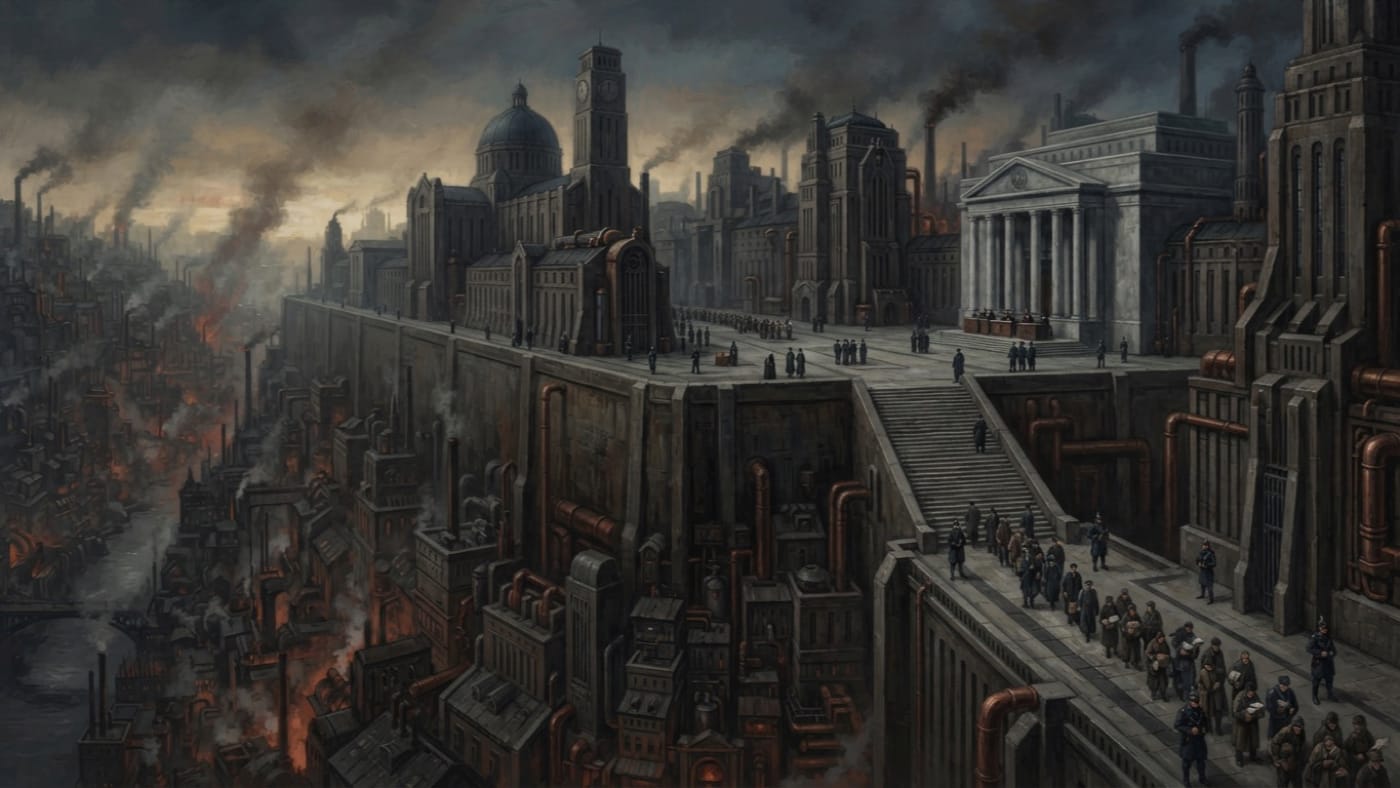
The High Step Precinct sits on the ninth terrace of Rheinscarp, on top of everything else. Directly beneath it the Cantor Foundries strike their bells and breathe their coal. Beneath those, seven more terraces of flour, ash, wax and arrears go down to the Rhine. The summit gets none of this except the sound, and by the time it reaches the top, distance has softened it into something very like a congregation.
The precinct holds the tribunal halls, the clergy housing, the Synod Chapterhouse that the mill-hands call the Ration-Cathedral, and the offices of the three officials who run the city's practical business. The city survey records that it smells of polished stone and fear. I can vouch for the stone. The air is clean and the view is commanding. Its residents, mostly registrars and judges, enjoy what the survey lists, with admirable economy, as light, warmth and clean names.
The summit does no milling, chanting or appraising. The Ledger Cloister and its Registry Choir stay on the fifth terrace. The Ash Exchange trades on the seventh, and the Foundries ring on the eighth. High Step keeps the offices and leaves the operations below. It does not do the work. It signs for it.
#On the Chapterhouse and Its Settlement
"The river built Rheinscarp. The Synod merely taught it to charge admission." — Popular saying, Rheinscarp
The Ledger does not say when the summit became a precinct, and I will not make the Ledger say it. What it does record is the city's climb. The Rationalist lockworks and mills came before the Sundering of A.S. 45. The Silt Year of A.S. 78 drowned the lower terraces and drove the survivors upward. It also produced the first stair-toll regime, under a river-warden the record names only as "Warden K." The flood made people climb. Whether it also made a precinct of the summit is a question the archive has declined to answer, and I follow the archive.
Formal holy authority arrived later. The Concordat of Strasbourg settled the formal Synod in A.S. 90 (1800 CE). Local arrangements followed. In A.S. 92 the Ration-Cathedral was consecrated at the summit. In the same period the Bureau of Tithes installed its liaison, the Bureau of Records opened its annex, and the Tribunal of Stairs received its charter. Neither founder of the Church blessed a single stone of it. Both were dead before the Concordat was sealed, and whatever the Ash Exchange may tell you, the dead do not attend consecrations.
"By A.S. 92, when the first Bureaus received their formal constitutions under the Concordat…" — Codex entry on Rheinscarp.
The Bureau of Doctrine clarifies that the Concordat and the formal Synod date to A.S. 90, and that earlier Bureau organs existed before that settlement. The local consecration, liaison, annex and charter of A.S. 92 stand as written. The Bureaus have always been older than their constitutions.
The name Ration-Cathedral refers to jurisdiction. The Ledger records no granary under its nave and no kitchen in its porch. The rations are decided there and stored somewhere else, which the people below regard as the correct arrangement for a cathedral and the wrong one for a meal.
#On the Hall of Steps
"Orderly movement is holy." — Public motto of the Tribunal of Stairs
The Tribunal of Stairs holds High Step and the stair corridors. Its resources are judges, provosts and writs, and its methods are paper, seizures and public examples. It works closely with Records, which supplies the names, and the Tribunal decides what happens to them. At midday the tribunals hear stair disputes, while the mills below grind on regardless.
The surveys give the Hall of Steps as the tribunal's seat and describe it by temperature: hot wax, cold marble. They also record its signature sentence, which is summary erasure. They give no plan or dimensions, and I decline to pace them out for the reader's convenience. The wax is hot because the seals are applied while the petitioner waits, and the marble is cold because it is marble. Neither the wax nor the marble needs the reader's interpretation.
The Tribunal's public face is order. Its working ambition is to extend toll jurisdiction to private stairwells. This is an objective and not yet a law, so a householder in Rheinscarp may still climb their own stairs without a writ, for now.
The formal hierarchy is simple, and I state it with the Bureau's full confidence. The Synod Chapterhouse is the apex, and the Tribunal and the Records annex work under holy authority. Practical power sits in three offices on the same terrace:
- Praetor-Registrar Ysabeau Kelm, of the Records annex, controls names and absence.
- Cantor-Marshal Hrodric Venn controls bell-hours, time-credits and the logistics of convoys bound for the Sagittal Line.
- Broker-Saintsman "Uncle" Damas Rohe controls the mortuary finance of the Ash Exchange.
These three are not equal sovereigns. They are subordinate officials whose subordination has not been tested recently. The Codex's own institutional account notes that the Chapterhouse has issued no independent decree since A.S. 187. Its supremacy is therefore beyond dispute, mainly because no one has seen it used.
#On Ascent and Confession
"A staircase to Heaven that charges interest." — Pilgrim description, recorded at the First Step Market
Getting to the tribunal is an expense in itself. Each terrace boundary requires coin, the correct Stair Verse and a stamp. The tokens are clipped brass plaques, each good for exactly one crossing. Bulk cargo must go up the Hundred Steps, the single legal corridor for it. Licensed lifts and chain-bridges carry other traffic at rates set by the bell, by bribes and by whichever toll-provost is on shift. After curfew the stairs turn into single-file confession lines, and lanterns mark which routes are legal.
A misspoken verse can get a traveller recorded as absent. Confession repairs the record, and in Rheinscarp confession is a service that is billed. The summit has its own confessor booths, polished like the rest of the precinct, so anyone who reaches High Step can confess there. Arriving costs extra.
Some things are for sale on the way up: stair-access, ration priority and coaching in the verse. A clean true-name entry almost never is.
The Bureau has issued no statute on what follows, and I have found none, so I set it down as arithmetic. A person whose record is defective must reach the authority that corrects records. Reaching that authority means crossing eight boundaries, and each one asks for the stamp the defect has already cancelled. I have found no clause that guarantees such a person an appeal, no numbered form for one, and no record of anyone who managed it. I have also found no clause forbidding it. The petitioner may climb whenever their papers allow.
#On Clean Names and Hungry Petitioners
"'Variance' is the official word for 'someone stole your food.'" — Common knowledge, Rheinscarp
The summit's residents have their light, their warmth and their correctly spelled names. The people their decisions reach have tokens, verses and hunger. Distance keeps the two groups apart, and the stairs collect a fee on that distance at every landing.
The double-entry famine of A.S. 198 did not start on the ninth terrace. The Mill-Crown and the Widowlight Quarter each recorded the same grain shipment as received. The grain arrived once, and forty-one people died. The summit's part came afterwards, as the authority that ratifies classifications and defends the system that makes them. A variance is still a variance after it has been sealed in hot wax, but it is much harder to argue with.
The absence quota works on the same principle. Living people are removed from the ration count so that inadequate supplies balance on paper. The official percentage has not been disclosed. The street says one in forty, and the street keeps no ledger.
The dust-futures scandal of A.S. 199 brought to light a trade in claims on the remains of people still living. It sharpened a quarrel that was already underway. On one side are the hunger-waiver advocates of the Bureau of Mercy, who hold that starving people should eat whatever their stamps say. On the other is the Tribunal–Tithes axis, which holds that toll sanctity is doctrine and that doctrine does not accept hunger as a counterargument. Both sides take their petitions to the summit. Only one side lives there.
#On the Present Condition
"If you reach the High Step, your debts are forgiven." — Famous lie, Rheinscarp
In A.S. 201 the precinct is operational. The Hall of Steps sits, the booths hear confessions and bill for them, and the Ration-Cathedral presides over a city that it has not addressed by independent decree in fourteen years. The Tribunal still wants the private stairwells. Mercy's hunger waivers remain under dispute, and no settlement has been filed.
The lie in the epigraph is the most popular sentence in Rheinscarp. Mill-hands repeat it to children, widows repeat it on the night shift, and stair-runners repeat it to strangers for a coin. It is false. A debtor who reaches the ninth terrace finds tribunal halls, clergy housing, three offices with their doors shut and a confessor's booth with a posted rate. The debts are still owed at the top, and now they are on file there too.
The air remains clean and the names remain correctly spelled.