
#On the Stores and the Port
The Eastern Basin Salt Stores enter the record the way most premises in Marseille enter it: through an audit that went badly. Their name survives in one excerpt, dated A.S. 199 and kept among the papers of the Salt Dues of Marseille. The archive does not say who raised the Stores, in what year, at whose expense, how many roofs they keep, or how many barrels their floors will bear. It keeps a name, a year, and an inventory that no honest warehouse could have produced.
The name is enough to place them. Marseille is the Synod's southern mouth, a limestone port of some six hundred and fifty thousand souls, through which Iberian supply, North African trade, Sardinian iron and pilgrim ships bound for Thessaloniki pass on their way to being weighed. The Stores stand in the eastern basin of that harbour, where cargo waits between the ship's hold and the clerk's attention. Salt waits there with everything else. Salt cures the fish that feeds the convoys, packs the meat that feeds the garrisons and sweetens the water barrels before long crossings. Any building that keeps it is part of the war, whether or not its doors have been told.
#On Salt and Its Assessment
The Bureau of Tithes imposed the Salt Dues in A.S. 92 for Iberian campaign supply security and has administered them ever since through its Mediterranean Revenue Office. The Dues remain temporary. They have been temporary for one hundred and nine years, a continuity of the provisional that any bishop might envy.
The harbour clerk starts from the manifest weight, adjusts for brine purity, subtracts approved devotional spoilage, adds handling, adds dock sanctification and adds the Meta-Levy. Then the clerk looks up. A Tithe Assessor goes to work with scales, measure rods, seal stamps, receipt blanks, an arrears ledger and the brine-testing stone, a fired-clay slab that changes colour when it touches adulterated salt. The Bureau says the stone does not lie. The Bureau says many things in that tone.
A storehouse is where two accounts of the same barrel meet. The first is the manifest, with its declared weight, grade and purpose, signed in a merchant's hand and sealed in a merchant's wax. The second is the barrel itself, which has no hand and signs nothing. An assessor's craft lies in the gap between them: the receipt held against the stack, the seal checked for a second pressing, the weight that does not match its label by the width of a thumbnail of grit. The work leaves salt in the cuffs, wax flakes under the nails and brine-chapped knuckles that crack every winter. It sounds like a quill scratching against damp paper.
When the manifest and the barrel agree, there is revenue. When they disagree, there is a discrepancy. A discrepancy is a far richer thing, because every office in the harbour can find itself mentioned in one.
The Eastern Basin Salt Stores are liable to the Salt Dues for the salt they hold.
Corrected. The Stores are liable for salt cargo, salt-preserved cargo, salt-associated cargo, cargo housed alongside salt, cargo declared as something preserved by salt, and cargo whose presence in a salt store suggests it ought to have paid as salt. The Mediterranean Revenue Office regrets the earlier narrowness and has assessed it.
#On the Claims of Custody
Marseille's harbour suffers from too much authority, never too little. Each Bureau keeps a portfolio, and each portfolio has edges sharp enough to cut a cargo into pieces. Tithes keeps revenue. The Bureau of War keeps military supply, and by Tithes geography that covers anything bound within three hundred miles of the Sagittal Line. The Bureau of Pilgrimage keeps travellers and licensed movement, and it has opposed the Dues every year since A.S. 94 with the devotion of a mourner at a grave that charges admission. The Bureau of Relics keeps authentication and sacred remains. The Bureau of Shadows keeps whatever it is that a Bureau which does not exist keeps.
The A.S. 199 audit names those five claimants. The wider harbour quarrels with Purity and the Harbour-Master besides, but neither appears in this excerpt, and I will not seat guests at a table that never set places for them. The pattern is old and its stages are fixed. An office claims a cargo while the cargo still carries a fee. It defers the cargo once the cargo needs action. It claims the cargo again once someone else has acted wrongly. Since A.S. 167, Pilgrimage and Tithes personnel may not even lend one another ink, so their disagreements are now written in separate inkwells and wait for separate blotting sand.
The Black Ledger keeps two confirmed dock cells in Marseille and feeds on this paralysis as gulls feed at a gutting table. Its methods are well known: altered manifests, borrowed permissions, a second seal pressed over the first. The surviving record does not place either cell inside the Stores, and it does not tie either one to this consignment. I note the cells because they exist. I do not convict them because the excerpt has not.
#On the Audit of A.S. 199
The excerpt reads as follows. The omissions are in the original.
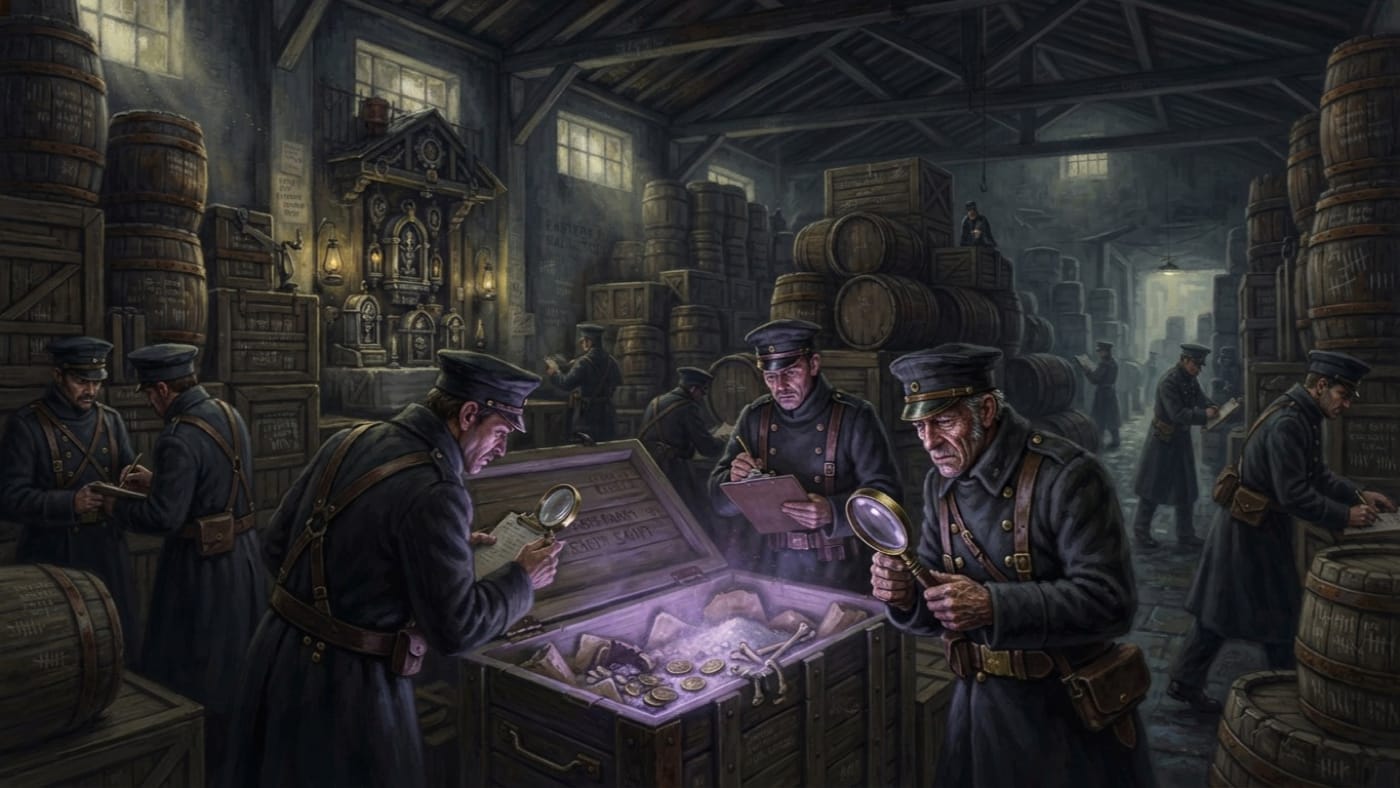
AUDIT EXCERPT — EASTERN BASIN SALT STORES, A.S. 199 Discrepancy: █████ barrels Declared cargo: cured fish, devotional grade Actual contents: salt, coin, bone fragments, two sleeping children, one crate emitting violet light Jurisdiction claimed by: Tithes, War, Pilgrimage, Relics, Shadows Jurisdiction exercised by: █████████ Outcome: filed as spoilage
I have read worse documents. I have read very few more correct ones.
The form is the assessor's ordinary form, and it performed exactly as designed. It has a line for the declaration and a line for the contents, and the gap between those lines is the whole purpose of the office. The declaration was cured fish of devotional grade, a category that already carries a premium and invites a lighter inspection, since few clerks enjoy hurrying a pious barrel. The contents were something else. The record does not say how many barrels held them, whether they shared one hold or several, or in what order the assessor came upon them. It lists them. Listing is what the column is for.
Salt comes first. It is the only item on the list that the name of the Stores could have predicted. Coin follows, with no denomination, sum or mint, which in a revenue document amounts to sacrilege by omission. Bone fragments follow the coin, and the Bureau of Relics' claim tells us that Relics took an interest. It does not tell us whether the bones were holy, ordinary or merely old. Those are three different fees, and the excerpt charges none of them.
Then come two sleeping children.
The column is headed Actual contents. They appear in it between the bone and the crate, in the same hand and at the same weight of ink. The excerpt says they were sleeping. It does not say whose they were, where they were going, who put them there or who woke them. The form has no field for a name. It was never asked to have one. The fault lies with the form, which was drafted for fish.
Last comes one crate emitting violet light. The record calls the light violet and leaves the colour without a cause. The Bureau of Doctrine has attached no mechanism to it, and Drax does not certify one by guessing. Guesses about violet light in Mediterranean cargo have kept the pyres of three cities busy and settled nothing.
The discrepancy itself is struck out: some number of barrels, ink laid over ink. Someone thought the count was worth hiding. The same someone, or a colleague with equal authority and less care, decided the children could stay in plain sight.
#On the Recorded Outcome
Filed as spoilage. The phrase belongs to the arithmetic of the Dues. Approved devotional spoilage is subtracted from the assessable weight, and a spoiled cargo owes less because it is worth less. Filing a consignment under spoilage takes it out of the column where it would owe and puts it in the column where it is forgiven. The phrase records how the account was closed. It records nothing about what became of the salt, the coin, the bone, the crate or the two children. Nobody should read spoilage as rot, fire or the harbour floor. It is a ledger word, and ledger words are dangerous because they look like events.
The exercised jurisdiction is also struck out. The form required a name there and received one, and the name was then covered. Five offices claimed the cargo, one acted, and the record will not say which. Some readers would prefer that line to read none. That would be a comfort, and the excerpt offers no comforts. Something was exercised. The ink proves it, and the ink over the ink proves the rest.
The Dues continue. As of A.S. 201 they are still collected without interruption and still opposed without effect, still budgeted around by the Palatine Counting House and still called temporary. The Stores keep their name in the Salt Dues papers. Whatever they hold today, no audit in my file has listed it.