
#On the Object of Envy
"Greed wants your purse. Envy wants your name on it."
Men envied their brothers long before the Sundering of A.S. 45 gave the sin a general, a territory and a seat among the Seven. Morwen commands Envy now. She did not invent it, and the Bureau will not flatter her by pretending she did.
Envy is comparison carried to the point of abdication. The envious man looks at his neighbour, then at himself, and concludes that the wrong one of them is alive. He does not want the neighbour's horse. He wants the neighbour's stride as he leads it, the neighbour's voice as he names it, and the neighbour's place in the memory of everyone who has watched the two of them pass.
Precision is required here, since the Bureau of Purity has none. A sergeant who admires his captain has committed no sin. A clerk who studies a better clerk's hand and copies its economy is learning. A widow who wants a dry roof wants a dry roof. Ambition, emulation and the wish for better bread are the furniture of any working parish, and an inquisitor who brings me a man condemned for them will find his own name entered in a column he will not enjoy.
The neighbouring sins want different things. Velmora converts persons into holdings and meaning into a bill of sale. Atheron must stand above and cannot abide an equal. Velkara uses people for sensation until the sensation goes numb. Envy wants to stand in the place of, and it ruins the particular person it covets, because a replacement requires a vacancy. Morwen's hatred of Velkara is a pure specimen of the sin: she wants the face and cares nothing for the appetite.
#On the Offered Improvement
"It was me. It was only better at it."
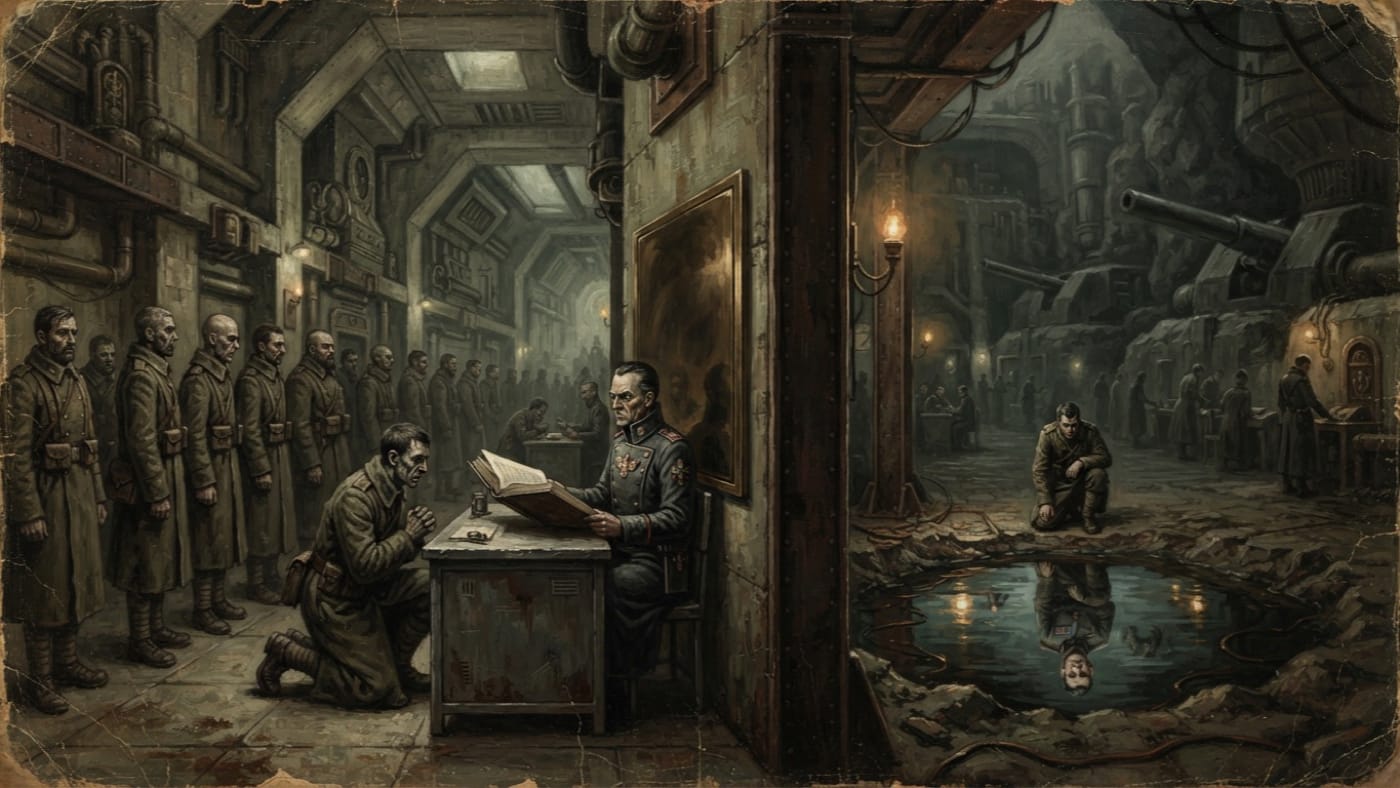
Kneel at a lake in the Hollow Vale and the water returns your face. The jaw is yours, and the scar, and the regimental collar. The eyes are steadier. The mouth has stopped apologising. It is the man you would have been had you answered your father, posted the letter, taken the commission when it was offered. The Vale withholds the true reflection because the true reflection sells nothing.
Morwen's influence-demons trade on that face, and what they offer works. Transformation: the stammering signaller wakes with the clean diction of the officer he resented, and the diction holds under shellfire. Belonging: the outsider is greeted at the mess table as though he had always sat there, and no one remembers that he did not. Recognition: the citation, the credit for the survey, the sweetheart's attention all arrive at last at the right address, or at least at the address the petitioner has decided is right. Sometimes the rival simply falls, and the petitioner learns that a vacancy will serve him as well as a promotion.
At the Vale's centre stands the Palace of Echoes, which those few who have described it call a house of stolen dreams, its corridors opening onto other selves. I do not certify its floor plan. I certify its prospectus.
A gift that works breeds gratitude, and gratitude runs errands: a bar left unshot, a roster copied, a name supplied. The bargain binds nothing. No pact struck in the Vale holds a soul the Creator made, and the man who struck it may repudiate it at any hour. He seldom does, because in that hour he would have to go back to being the man in the first reflection.
#On Mimetic Theft
"He knew every hymn. He sang them in another man's breath."
The cost arrives when the petitioner's usefulness ends, and it is less a punishment than a continuation. The borrowing does not stop. The signaller with the officer's diction begins to fold his hands like the chaplain and take his tea as the quartermaster does, and he remembers an orchard in a province he has never seen. Memory grows porous. Habits arrive unannounced. He wanted one other life; now he wants every life in the dugout, and each acquisition shows him a fresh want. In the end he cannot say which of his recollections were issued to him at birth. Even then he chooses, hour by hour, what to do with what remains. The Bureau has seen men reclaim their own names at a cost that would make a martyr wince.
The bargain is one road. The Vale keeps others, and the reader is not to confuse them. A Hollow One posted near a sentry for a week takes his phrases and his mother's name without asking his leave. A Face-Thief studies a staff officer for months and then attends his briefings, and the officer consented to nothing. A Mirror-Stalker climbs out of a flooded shell-hole as an improved copy of the man who looked too long into it, whose only fault may have been thirst. The Beloved come wearing the dead and ask only to be held. The soldier who accepts that comfort has accepted something, but grief is not a signature.
Worse is the copy that believes. Some of them, when caught, weep and give the original's name, and they are sincere. They have no other self to lie from.
The Lore Book records that in the Hollow Vale a bishop's voice was taken in the middle of a sermon and went on preaching without him, spreading blasphemy in his exact tone to a congregation that knelt at the familiar sound.
#On the Congregations of Borrowed Selves
"Every member of the cell recognised every other. That was the difficulty."
Morwen's cults are cells, each separate, each hoping to be noticed. A few enjoy the occasional patronage of an influence-demon. Most have only rumour and appetite. Nothing in the Bureau's files shows the Weeping Host appointing their officers or reading their reports, and I will thank the Bureau of War to stop drawing her organisation charts.
Members advance by degrees of borrowing. The Seeker still owns a face and hates it. The Vessel has accepted one improvement and is shopping for the next. The Mask keeps several lives in rotation, a clerk at morning muster and a widow's brother at evensong, and keeps the paperwork current for each. The Mirror has given away so much that the cell uses them as a blank, to be filled with whoever the occasion requires.
The damage runs outward into everything that depends on a man being himself. Two copies of a battery commander issue contradictory fire orders in the same voice with the same countersign. A witness swears to an event in perfect detail, and the detail belongs to someone else. At a depot gate a mother is shown two sons, both weeping, both correct about the dog's name, and asked to choose.
#On the Synod's Remedies
"We can hold the walls. We cannot hold ourselves." — a garrison chaplain of the Irongate
The Synod answers with procedure, as it answers everything. Identity rituals put challenge and countersign to the doubtful: the home parish, the first sergeant's name, a private joke. Confession of identity requires each soul to recite its history and its particular sins. The Ledgers of Self record appearance, habit and confessed fault for later consultation. Mirror Discipline strips reflective surfaces from forward positions facing the Vale, and the men shave by touch.
Each measure holds until it meets a good copy. A Face-Thief who has studied for months answers the catechism better than the original, who is tired and frightened and forgets his sergeant. Confessors have accepted a false history because it was told more fluently than the true one. A Ledger is ink, and ink can be amended. Men who cannot see their faces forget them, and a man who has forgotten his face is the easiest man on the Sagittal Line to sell a better one.
Bastion-Irongate suffers all of this at once. Morwen presses the Danube gorge for its strategic worth, which is real, and for a reason the engineers find harder to file. The batteries cut into the living rock are beautiful, and she means to hollow them because she cannot be them. Envy turned on a fortress behaves as it does in a man. Where it cannot replace, it ruins.
Where two claimants cannot be resolved, Synodal policy executes both. The Bureau calls the measure final, and so it is. It is also a reliable way to kill an original whenever the enemy produces a copy at the right moment, and the enemy has noticed.
The Bureau of Doctrine's assessment held that the Singleton Doctrine afforded "absolute theological protection" against the theft of identity.
The Bureau's reassessment describes the same Doctrine as affording "significant theological comfort." The Doctrine is unchanged. The garrison has changed.
#On the Present Judgment
"Remain the one you were issued."
It is the Bureau's position, and I state it on the Bureau's behalf, that no envious soul has passed beyond choosing. A man who bartered his face may refuse the next errand, put down the borrowed manner and walk to the confessional under his own name, however thin it has worn. The Creator keeps that hour open. The Synod rarely keeps it open long enough for anyone to reach the screen. Recanted cultists are tried as cultists. The penitent copy is tried as a copy. The original who cannot prove himself is tried beside them both, and the Bureau regrets the arithmetic.
The lakes of the Vale go on improving whoever kneels at them. The Irongate counts its men twice.
You have a face, reader. It is not a good one. Keep it.