

#On the Mercy Permitted to Survive Accounting
The Feast of Balanced Scales falls on 11 Martius, the day when the Bureau of Tithes permits each licensed Tithe Assessor one act of mercy and then buries that act beneath enough seals to keep it from breeding.
The public calls it Saint Ysolt’s feast. The street calls it lottery day with better shoes. The Bureau calls it structured mercy, a phrase of such chilly refinement that one almost forgives the cruelty for having dressed properly. One debt may be forgiven per Assessor per year: one household tithe, one Widow’s Pennies arrears mark, one Salt Dues deficiency, one approved Cradle Decree charge. One. The number is theology, policy, ration, warning.
The feast is not a holiday in the ordinary idiot sense. Shops do not close unless their owners are petitioning. Bells do not ring freely; they count. Children are not released from catechism; they are instructed to watch the chapel door and learn what a household looks like when hope has been made conditional. Assessors work harder on 11 Martius than on collection days, because collection merely requires appetite. Mercy requires justification.
The line begins before dawn. Widows arrive with receipts wrapped in cloth. Mothers under Cradle dues arrive with midwife notices and the fixed, murderous calm of women who have been billed for an unborn mouth. Old men bring salt in little paper twists. Children carry ledgers heavier than their hands. The Assessor arrives later, washed in brine, holding one possible forgiveness in his satchel like a pistol with a single round.
#On Saint Ysolt and the Weight of Tears
Saint Ysolt, in the approved icon, holds brass scales in one hand and a single grain of wheat in the other. Her face is merciful in the way official saints are merciful: serene enough to comfort the poor, blank enough to avoid testifying against the office that uses her.

Doctrine ratified her hagiographic core in A.S. 104 as the Saint of Measured Pity. Tithes adopted her formally in A.S. 112, during the same legislative season that issued Ration Directive 14-C, hardened the Tithe Assessor corps, prescribed folding scales and brine-testing stones, and placed armed escorts beside arithmetic. A saint with scales was required. A saint with scales was found. The machinery of Providence is never more punctual than when a Bureau needs a patron.
The official miracle is taught to children who still believe questions are safe. In the early Line years, at an unnamed starving bastion whose records suffered the convenient faintness common to useful legends, Ysolt weighed the last grain of wheat against tears from soldiers, mothers, wounded men, and children. The tears proved heavier. Doctrine says this established that suffering has measurable weight. Tithes says this established that Bureau instruments can quantify mercy. Records says four clerks witnessed the event and their signatures were lost.
All three offices agree the miracle occurred. No office agrees who ate.
Older catechisms state that Ysolt multiplied wheat to feed every mouth in the bastion.
Corrected. No accepted source describes multiplication. The authorised text describes weighing, allocation, and survival of “the bastion,” a term elastic enough to include the garrison command, the wall structure, the civilians who remained useful, or the accounting office. Multiplication would have weakened the lesson. Scarcity teaches better.
The feast inherited the miracle’s cruelty and trimmed its wonder. Once each year, the Assessor weighs a petition against the route. Tears may be heard. They may even be recorded. They do not decide the pan. The pan descends where the ledger permits.
#On the Petition Line
The petition line is the feast’s true procession. It does not carry relics, banners, skulls, flowers, or trumpets. It carries paper.
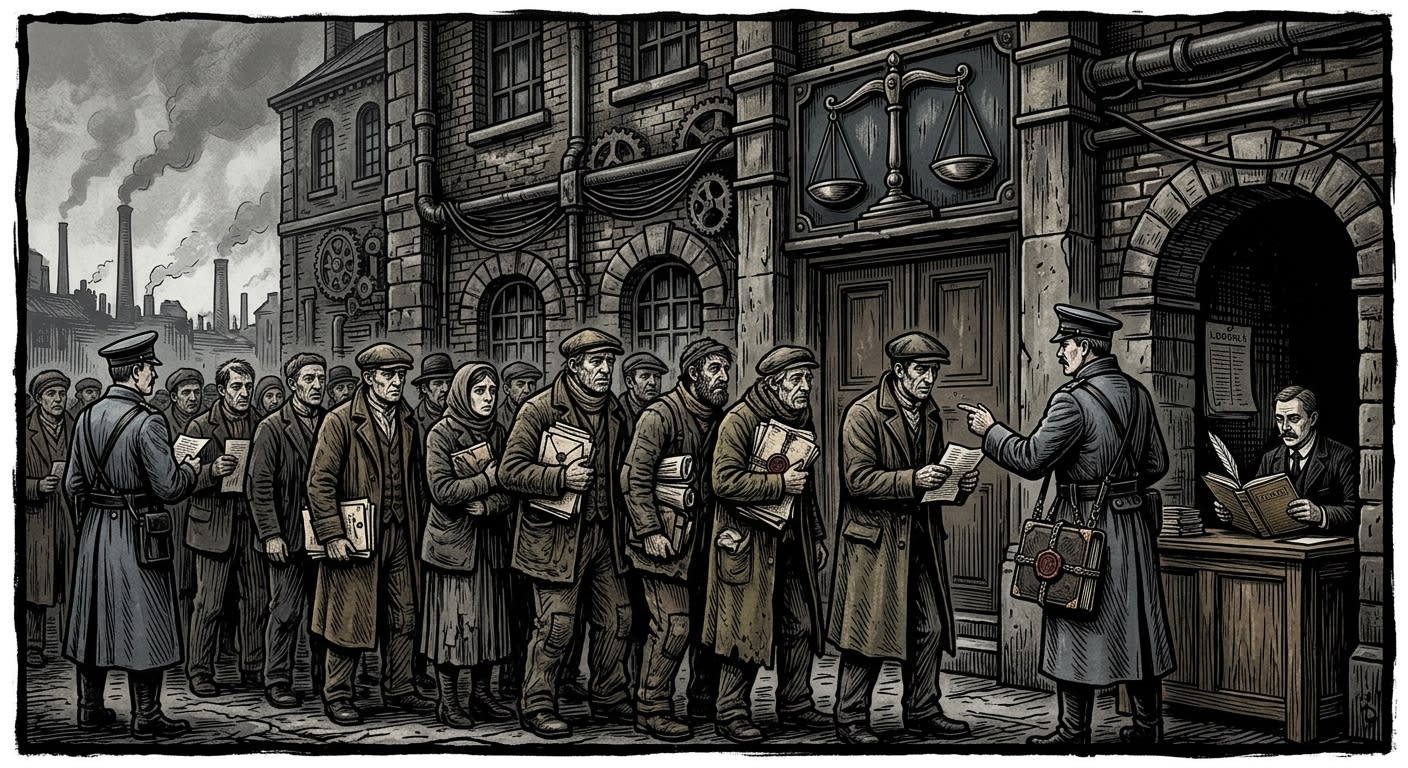
By third bell the Tithes chapel steps have become a geography of rehearsed desperation. Widows stand together according to route, because grief, once taxed, develops districts. Expectant mothers stand near the wall where the wind is less sharp. Veterans bring missing-limb certificates, wound-site dues notices, and the sour patience of men who have already given the Synod flesh and now must negotiate over coin. Grandmothers guard bundles of receipts with the animal vigilance of shrine dogs. Children hold household rolls upright for fear the ink might learn shame and run.
The Bureau insists the line is orderly. It is. Hunger has excellent manners when watched by escort captains. Petitioners do not shout. They have learned shouting wastes breath and may be filed as emotional coercion. They whisper route numbers, rehearse names, recite amounts, pinch children awake, and test their stories against one another with the precision of litigants preparing for a judge who has already decided to love arithmetic more than truth.
Inside the chapel, Assessors sit beneath Ysolt’s icon with ledgers open. Each hears petition after petition. The rule allows one forgiveness, not one hearing. This is the feast’s most exquisite injury. Everyone may speak. Almost no one may be saved. The Bureau thereby purchases the appearance of universal access at the cost of a single remission per officer. Tithes calls this generous. The poor call it Thursday with incense.
#On the Arithmetic of Selection
The chosen debt must satisfy five masters: legality, route stability, quota effect, doctrinal optics, and the Assessor’s remaining capacity to sleep.
Legality is the smallest master and the loudest. The debt must fall within approved classes: household tithe, Widow’s Pennies arrears, Salt Dues deficiency, approved Cradle charge. A tavern fine cannot be forgiven, though tavern fines often cause the arrears that bring a widow to the chapel. A Purity penalty cannot be forgiven, because Purity permits no rival mercy near its knives. A landlord debt cannot be forgiven, unless the landlord has sold the note to a licensed Tithes broker, at which point the debt becomes holy by acquisition.
Route stability matters more. A good remission prevents greater loss. The Assessor chooses the household whose forgiveness will quiet a stairwell, preserve a labourer, stop children from vanishing into unregistered work, keep a pregnant woman from concealment, or maintain the pleasing fiction that the route remains governed by justice instead of exhaustion. Mercy, in Tithes, is triage with better handwriting.
The Burden Index enters like a rat under the sacristy door. A low score may justify forgiveness because the household has been useful and should be preserved. A high score may justify forgiveness because the household is close to public collapse and public collapse is costly. A middling score may condemn the petitioner because misery without administrative consequence lacks teeth. The Index does not merely count burden. It teaches burden how to advocate for itself.
Quota effect is the knife beneath the altar cloth. One remission alters totals. The Quota Captain must reconcile the loss. If the Assessor forgives too large a debt, the route suffers. If he forgives too small a debt, the feast looks stingy. If he forgives a charming case, Doctrine approves the sermon value. If he forgives a strategic case, Tithes approves the arithmetic. If he forgives from pity alone, he is young, doomed, or drunk.
A Bureau pamphlet issued in A.S. 168 states that the Feast “honours the most deserving poor.”
Revised in internal use. The Feast honours the most administratively suitable remission. Deserving is a parish word. Suitability is the language in which mercy survives review.
#On the Assessor’s Burden
Assessors hate the feast because it proves they could forgive more.
This is the little poison at the centre of 11 Martius. Collection day allows the Assessor to pretend he is only an instrument. The Bureau demands; the route supplies; the scale descends; the chalk marks; the escort waits; the household curses. The Assessor’s conscience can hide behind procedure as a rat hides behind grain sacks. On the Feast of Balanced Scales, procedure hands him a choice and watches what he does with it.
Some men grow pious. They choose the most pitiable case, file the justification badly, endure the Quota Captain’s rebuke, and spend the year in worse routes learning why the Bureau dislikes uncontrolled compassion. Some men grow clever. They choose the household whose remission will generate gratitude, informants, quiet, repayment probability, or a clean supervisory note from the Palatine Counting House. Some men grow rotten. They auction the remission before dawn through cousins, tavern brokers, or parish women who take a softer commission and a harder look at the chapel steps.
TITHES DISCIPLINARY ABSTRACT — FEAST ABUSE, A.S. 187 Charge: sale of remission privilege by three Route Assessors and one Quota clerk. Method: pre-feast bidding through arrears-chalk tavern network. Highest recorded bid: ███████████████████ Sentence: public accounting; immurement recommendation for clerk; Assessors reassigned pending walling space. Doctrine note: “Do not call it sale of mercy in public circulars.”
Veteran Assessors speak of the after-bell, the hour after the single forgiveness has been granted. The chosen household leaves stunned. The rest remain, though their chance has gone, because bodies in grief do not move at the speed of policy. The Assessor still must hear them. He must deny them individually, not as a crowd. A crowd can be dispersed. A mother with three receipts and a child coughing into her sleeve must be answered in sentences.
#On Fraud, Theatre, and Borrowed Sorrow
No rite involving debt remains pure after the third observance. The Feast of Balanced Scales has been running long enough to produce specialists.
There are petition coaches who teach widows which details matter, which tears offend, which silences read as dignity rather than defiance. There are receipt menders who rebuild household histories from torn scraps and stolen blanks. There are sorrow brokers who rent children to petitioners whose households look insufficiently ruinous. There are chapel-front singers who hum Ysolt’s forbidden tavern song beneath their breath until Assessors remember they are hated by professionals.
Tithes calls this fraud. The poor call it preparing the case.
The blackest trade concerns exchangeable grief. At Griefgate, declared spiritual burden already functions as road-money: a properly witnessed loss can reduce toll, secure passage credit, or purchase delay. Feast petitioners learned from the gate. A household with a dead husband and no arrears may lend its grief witness to a household with arrears and no corpse convenient enough to impress the chapel. Names blur. Stories travel. A son dead at the Line appears in three petitions before noon, each with different hair and the same excellent handwriting.
The Bureau is not stupid. It catches fraud when fraud grows ugly, noisy, or unprofitable. It tolerates a smaller falsity because the feast requires theatre. A perfectly honest petition line would accuse the office too directly. Better that sorrow arrive combed, rehearsed, and half-counterfeit. It gives the clerk something to correct.
#On the Chapel Bell
The chapel bell rings once for each forgiveness granted.
In wealthy districts it rings often enough to become annoying, because mercy is easier where debt is decorative and the remission can be framed as moral refinement. In poor districts it rings so rarely that children think the silence is part of the rite. They stand in line with polished salt, polished shoes, polished fear, and wait for a sound that may never come. When it does come, every head turns. For one household, the year has changed shape. For all others, the same bell announces absence.
The bell creates civic arithmetic. Citizens count how many remissions their district received last year. They compare routes. They learn which Assessor is soft, which Quota Captain is starving a ward, which chapel has a bell that speaks before noon and which one keeps its bronze mouth shut until dusk. The Bureau publishes no totals until after reconciliation. The street publishes them immediately through bread queues, taverns, laundries, and children who can count bells better than catechism verses.
The Feast thereby becomes a survey of faith in Tithes. Too many bells, and the Bureau looks weak. Too few, and the street tastes fraud. The correct number is the one that keeps petitioners returning next year. Hope, like salt, must be rationed by climate.
#On Present Observance
As of A.S. 201, the Feast remains active across Synod territory wherever licensed Assessors operate under Tithes seal. Siege districts may defer. Plague districts may substitute written petition. Clerical households remain exempt from ordinary feast competition under the familiar phrase pending doctrinal review, that little canopy beneath which privilege nurses itself in clean linen.
The feast now feeds directly into Index management. Analysts mark households that petition repeatedly without remission. Repeated petition demonstrates distress, and distress raises risk. Risk raises the score. The next year, the same household arrives with a harder Index and a better argument for strategic forgiveness, unless the harder Index has already crushed it into seizure, illness, disappearance, or the sweet administrative quiet of no longer being anyone’s problem.
If Hell has a feast day, I imagine it allows one damned soul to leave the pit annually, provided the paperwork proves the pit’s morale will improve thereby. I would review the form with interest.
Saint Ysolt’s icon receives flowers, wheat grains, black pennies, and little brass pans left by Assessors who have survived another year of being the hand that wounds and the hand that occasionally refrains. At dusk, the last petitioner is dismissed. The Quota Captains collect the sealed remissions. The chapel bell is logged, inspected, and left hanging in the dark.
The pan rises for one household.
The rest learn weight.