
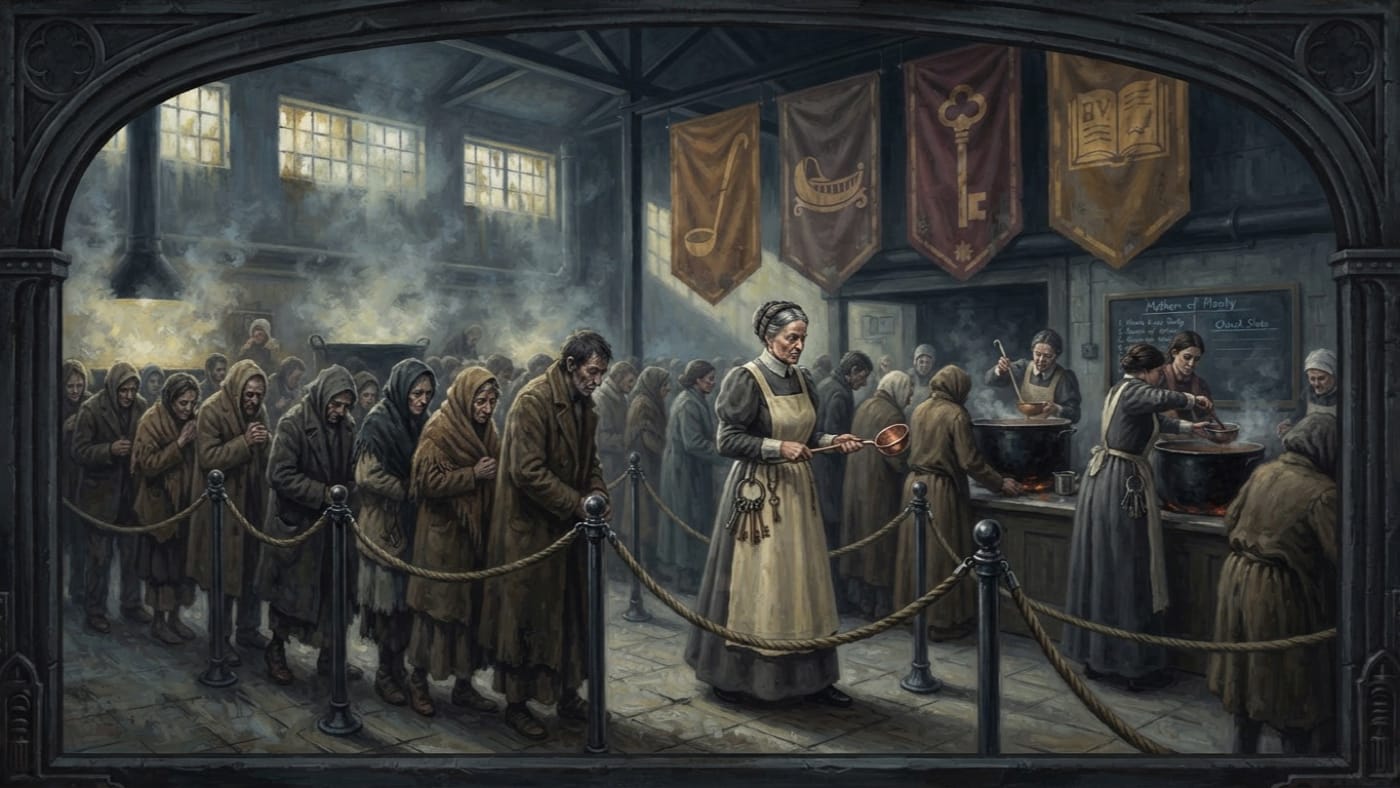
#On the Observance
The Feast of Saint Halva of the Warm Ladle falls on 14 Brumaire. It is kept in every Plenty House, ration hall and maternity ward in Synod territory, which means wherever the Mothers of Plenty hold a key and a queue rope. Halva is their patron, and patron also of ration-keepers, queue marshals and matrons of hearth. The decree made the feast hers. The queue is what keeps it.
Her legend can be told in one breath, and on the Feast it usually is. During the ration panics after the Sundering, a widow of uncertain province is said to have fed two hundred from a pot of broth meant for twelve, while behind the storehouse wall she exchanged ledger packets to buy her district another month. The Bureau of Doctrine canonized her with no miracle attested and no body produced. I have written her dossier elsewhere. She is not my subject here. My subject is the bowl.
On 14 Brumaire every ration portion receives an additional quarter-measure. That is the whole of the feast's generosity, and it is more than most saints manage.
Bureau of Doctrine, Tract Series 44, "On the Antiquity of the Mothers," held that Saint Halva was canonized "in the first century of the Faith," and that her cult predated the Concordat by "many generations."
Corrected: Halva was canonized in A.S. 94, Third Quarter, under Sub-Office IV, in the same administrative season that formalized the Mothers' charter. That was four years after the Concordat of Strasbourg. The year of the first 14 Brumaire is not recorded. Anyone who takes the date of the canonization as the date of the first feast does so without the Bureau's seal.
#On the Quarter-Measure
The Mothers' measure cup is the instrument that defines enough. On three hundred and some days of the year it defines it narrowly. On the Feast it defines enough with a quarter added, and the sisters who pour know to the finger-width how much that is, though no ordinance I have found sets the volume. The cup is tapped three times before the hall opens. This is a superstition of the ladle sisters. The Mothers do not forbid it, because nothing forbidden is ever done so punctually.
At dawn the bell-call goes out and the line forms. The Plenty Sisters walk it with chalk slates, checking chits and watching faces. Each chit answers to a household the Bureau of Records has written down, and the quarter-measure goes to the chit before it goes to the mouth. A woman with three children on her chit and a fourth on her hip, a child who has no writ yet, finds that the feast makes no particular allowance for him. The hall prefers not to raise the matter on a saint's day. So does the woman.
The Bureau of Tithes approves the expenditure every year, on the strength of one arrangement: fuel rations are reduced the following week. The children eat in one week and are cold in the next. Nobody in the line is told this as a single sentence. They work it out from the coal-chits, as their mothers did.
#On the Ration Psalm
The day's liturgy begins with the Ration Psalm. It has twelve verses and no author, and it is set to no melody. The congregation recites it in a monotone that the Bureau of Orison and Song approves as "appropriately functional." Its subjects are bread, water, warmth, children and faith, and in each verse the reciter declares that there is enough of the thing in question. The word enough occurs forty-three times.
A hall full of hungry people saying enough forty-three times at the speed of a tally clerk sounds like no other noise in the Church. It is too flat for a hymn and too united for a crowd. The best name I have for it is an inventory read aloud by the items. Steam from the kitchens is already rising over the queue-posts. Wet wool steams beside it. Infants who do not yet know the text cry through it, and nobody hushes them, since crying children are among the things the Psalm declares sufficient.
Children learn the Ration Psalm before they learn the Creed. The Creed comes later and tells them what to believe. The Psalm comes first and tells them what to expect.
The Psalm's verse on warmth is recited, every year, in the week before the fuel reduction. I drew the Bureau of Orison's attention to this once. They replied that the Psalm does not specify which week.
#On the Stirring
At midday the hall is fullest, the broth is not yet ready, and patience is at its thinnest. At that hour a senior Mother of Plenty begins the Stirring. Where a Matron of Plenty is posted, she takes it on herself. She comes out in her cream apron over grey, her cuffs stamped, her hair bound tight, the cord of keys at her waist. In both hands she holds a copper ladle, polished and oversized and plainly ceremonial. It is too heavy to serve with and too shallow to hold anything worth serving. She walks the length of the queue and taps the ladle once against each iron queue-post she passes.
At each tap the queue advances one pace.
That is the entire rite. Nobody announces it and nobody explains it, and the people in the queue do not need to be told. A child of four will step forward at the sound of copper on iron before she can recite the second verse of the Psalm. The posts ring dully. The ladle's bowl catches the light from the high windows. Where the Mother has passed, the line closes up neatly, and where she has not yet come it waits with the stillness of people who know the tap is coming.
The Bureau of Festivals describes the Stirring as "affirmation of order through rhythmic repetition," which is also its description of most things it cannot account for. The origins of the rite are unclear and I will not invent any. Its function is visible from the back of any hall. A queue that moves one pace at a time at the sound of copper cannot surge, and a crowd that is waiting for a sound is not yet doing anything else. A Matron once told me, while scraping a measure cup, the first lesson she teaches her novices: If you can't control the line, you can't control anything. The Stirring is that lesson with a saint's name attached.
The processional ladle belongs to its hall. It is not the cracked copper ladle in the chapel at Mainz, which the Bureau of Relics holds at Tier III, Devotional Sufficiency. As I have recorded elsewhere, that ladle is cauldron-sized, Essen-stamped, re-riveted twice and eighty years too late. It stays in its case, and nothing in any file I have read sends it out on procession. The working ladles that serve the broth are a third kind again: dented, stained, and washed every night.
#On the Evening Broth
The evening meal of the Feast is broth. At that supper there is no bread or meat, and nothing solid enough to look like generosity. The Mothers say the broth honours Saint Halva's multiplication, the pot for twelve that fed two hundred. The Bureau of Tithes says it honours the quarterly budget. Both explanations are on file, and neither office has asked the other to withdraw its own.
Broth can be watered and stretched, and it can be served to a line whose length nobody predicted at dawn. Once the noon portions are done the kitchens clear and the cauldrons go back on, and the hall fills with the smell that every Plenty House has in the evening: steam, sour grain, lye soap from the morning's scrubbing, smoke from fuel that the next week will not supply. The ladle sisters have been on their feet since the bell-call. Their hands are stained faint yellow from broth and disinfectant, and the stain does not wash out. One sister serves while another chalks the count, and a third watches the door.
They obey one rule that no Bureau wrote. The last pot is never ladled dry. A finger of broth is left in it, because a hall that sees the bottom of the pot will riot the next morning. The Mothers learned this the way all institutions learn, from the incidents.
After the line has gone, the sisters wash the ladles, chalk the day's quota onto the slate, and say the words the Mothers keep for closing: Enough, if obedient. I have heard the phrase in a dozen halls. Nobody has ever said it to me as a joke.
#On Gratitude and Its Accounts
On the evening of 14 Brumaire every office concerned can say that it has done its part. Doctrine supplied the saint, and Orison approved the recitation. Festivals interpreted the tapping, and Records knew in advance whose bowl was whose. Tithes balanced the broth against the coal. The Mothers did the work, with sore feet and yellow hands, and the people in the line received a quarter-measure more than usual. A hungry child does not regard that as an abstraction.
The feast hands the Mothers one more instrument besides. On any other day, a woman who complains that her portion is short is complaining about a measure cup. On the Feast of Saint Halva she is complaining about a widow who gave everything, under the saint's own banners. Those banners carry the four approved objects of Halva's official death: the ladle, the cradle, the storehouse key, and the psalm. To complain beneath them about the portion is to suggest that the saint's sacrifice fell short, and ingratitude of that kind falls within the competence of the Bureau of Purity. The Mothers rarely have to call Purity in. It is usually enough to look up at the banners.