
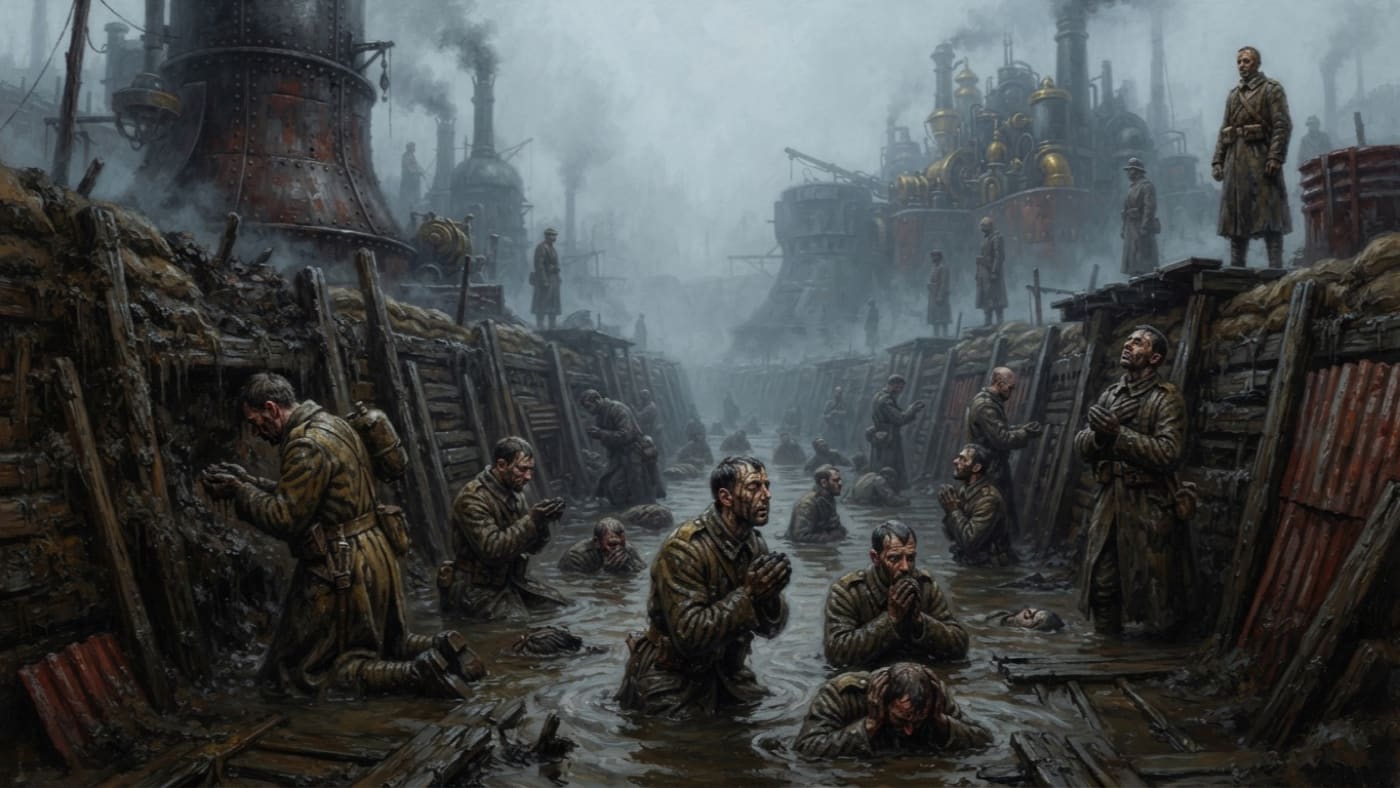
#On the Command to Enter the Mud
No soldier on the Sagittal Line needs an order to get dirty. The trench sees to that before breakfast. Water comes up through the duckboards, the parapet slumps onto the fire-step, and by his second week a recruit's uniform has the colour and smell of the ground he is defending. On the Line, filth is weather. Nobody signs for it.
The Feast of the Mud corrects this oversight. During the Feast, soldiers are ordered to wallow in the trenches, cover themselves in muck and chant litanies of endurance while they do it. They would have worn the mud anyway. Now they wear it under instruction. In the morning it was squalor, and by afternoon it is observance. The only material change is that an order has been given.
This survey describes the rite as it stands in A.S. 201. I do not record its first celebration, its author or its place in the calendar. The files that would tell me are either silent or held by offices with longer memories and shorter tempers than mine.
#On the Trench as Cathedral
Outsiders call the Feast degradation. The Church calls it the exaltation of the trench as cathedral, and the Church has the better stationery.
Compare the furnishings. A cathedral has a nave. The trench has a wet corridor of boards and sandbags that runs two thousand miles from the Baltic to the Bosphorus. A cathedral has a font. The trench has sumps, shell-holes and drainage ditches carrying rain, blood, sewage and relic wash in no approved proportion. A cathedral has a congregation that kneels. During the Feast the trench has one too, and it kneels in water up to the thigh.
At Brest the arrangement takes on its proper severity. The Bug sector is the flattest ground on the Line, and flat ground under perpetual river mist does not drain. It waits. The men there already smell of damp wool and rust, and the brass ribs above the river sweat in the fog. During the Feast they lower themselves into the muck on command, scoop it up in their hands and press it over tunic, throat and face until rank, regiment and name are hard to read at a pace's distance. Then they chant. The litanies are of endurance. I leave their wording to the Bureau of Orison and Song, which owns the words and guards them like a dowry.
Beyond No Man's Land, the Nameless Tide goes on accumulating. Field reports state that it does not answer hymns. It has not been invited to answer this one.
To the eye, a soldier wet on an ordinary morning and a soldier wet during the Feast look the same. To the ledger, the difference is everything. On an ordinary morning his filth is a hardship, and hardship breeds complaint, which breeds paperwork of the wrong kind. During the Feast his filth is an act, and an act breeds attendance.
#On the Ordering of Endurance
The Feast belongs to the Bureau of Festivals, which orders it. That office exists to rewrite folk play into catechism. Joy is rationed there, sorrow audited and laughter taxed. In the Feast of the Mud, as these pages show, mud is conscripted.
Festivals grasped something the Rationalists never did. The body learns faster than the mind and forgets more slowly. A man who has knelt in a sump once on command, singing, has rehearsed the posture that every later command will ask of him. He will kneel more readily for a shell, a ration queue or a confessor. The Feast is drill wearing a chasuble.
The wider machinery will be familiar to anyone raised in the West. Bells tell a population when to wake, when to move and when to stop. Licensed chorus-masters direct approved words in approved order. Records notes who sang and who stood with his mouth shut. I decline to say which of these offices lays a hand on this particular rite, or with what forms, because its arrangements have not reached my desk in a condition fit for quotation. The principle needs no form. Collective bodily action, ordered from above and performed below, turns a condition into a duty.
Turning things is the Church's oldest craft. Fear is turned into reverence and hunger into a fast. A trench that would have bred mutiny breeds a liturgy instead. I have seldom admired an administrative act more.
#On the Children's Clay
Behind the Line, the Feast changes its clothes.
In clean civilian squares, far from any sump, children smear ceremonial clay on their cheeks. The squares are swept beforehand. The children stand in rows, mark themselves and are told they now share in the trench. Doctrine has declared the two observances spiritually connected. Persons with access to soap may not inspect Doctrine's declarations.
The connection is real in the only sense the Church requires, because it has been ordered. A boy in a rearward square presses a thumb of clay to his face. At Brest, on the same Line the boy is being taught to love, a soldier scrapes real mud out of a wound with a spoon. The cheek will be washed before supper. Whether the wound closes depends on what the mud carried into it.
Reformers call this obscene. They have misread the purpose. Nobody expects the child to understand the trench. He is being fitted for it. A child who wears clay on command at seven will wear mud on command at eighteen, and he will arrive at the Line already tuned, as I have written elsewhere. The clay costs almost nothing, and the habit it lays down will be collected in full.
The citizens of Strasbourg buy engravings of the Line and take their patriotism in lecture halls. Clay is a better teacher than either. An engraving is looked at once. A lecture is heard once and argued over at dinner. A gesture made by small hands, in rows, under supervision, goes into the joints and stays there. No one has yet been shot for forgetting a lecture.
#On Saint-Soil
The mud does not stay in the trench. After the Feast it becomes a relic, is carried back to the villages and is sold there as saint-soil.
Note what this achieves. The Bureau of War spends fortunes pumping this substance out of saps, and it is the cheapest substance on the continent. Now it has a price. The soil itself is unchanged. It is the same mixture of earth, river water and worse that sat under a soldier's knees the day before. What is new is that men knelt in it under orders, sang over it and wore it, and the Church holds that matter touched by commanded endurance deserves keeping. Endurance spoils. Mud, once dried, keeps forever.
I can state precisely what the buyer receives: a portion of the Sagittal Line small enough for a mantel. What the buyer believes it does is the buyer's own affair. Doctrine recognises its devotional standing. I have found no ruling that it heals, guards a house or turns a shell. Any village priest tempted to promise such things should recall that Doctrine dislikes promises it did not draft.
The trade closes a circle that gives me real pleasure. The villages send sons to the Line, and the Line sends back mud. For a consideration, the household that gave a boy receives a pinch of the ground he knelt in and sets it on the mantel beside his likeness. Some families keep both for years. Some are left with only the soil.
I cannot certify whether the clay of the children's squares and the saint-soil of the villages come from the same source. The Bureau of Tithes may know. Tithes knows the price of everything and lends its ledgers to no one.
#On the Present Observance
As of A.S. 201, the Line holds and the Feast is kept.
Neither sentence promises comfort. The trenches flood as they always have, and the men at Brest still wake wet and sleep wet. On ordinary days they endure it because they have no choice. During the Feast they endure it because they have been told to, and only the second kind goes in the ledger. The children still mark their cheeks, and the villages still buy.
I am sometimes asked whether the soldiers believe in the Feast. The question is badly put. A man belly-deep in a Brest sump, chanting under orders with mist on his eyelashes, has no occasion to believe or disbelieve. He has an order, a litany and a parapet. Belief is a pastime of the rear. The Feast was built to run without it.