

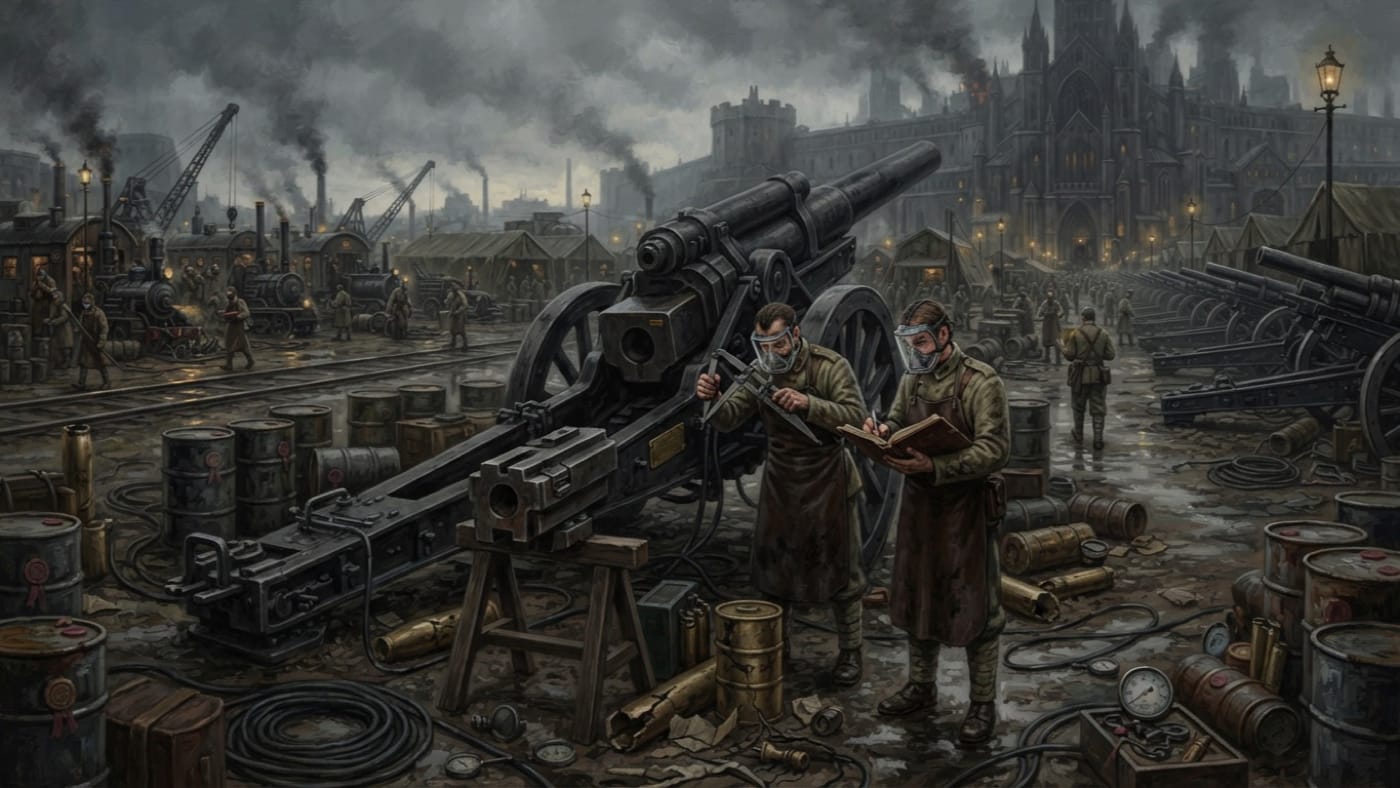
#On the Directorate Surveyed
Compiled in A.S. 201 / 1911 CE for the Sacred Ledger from the published structure of the parent Bureau, the Przemyśl inquiry copies, and the one Ordnance annex that Ordnance has allowed to be quoted.
This compilation describes Field Rectification as the papers of A.S. 201 present it. It gives the directorate no founding year, because none has been produced. It names no director, because no director signs. It cites no charter, because none has crossed my desk, and I do not invent charters for offices that have failed to send me one.
The Ordnance Bureau lists five directorates. Furnaces makes the heat. Metals gives the heat a body, Munitions gives it appetite, and Manifests gives it permission to travel. Field Rectification takes in whatever the other four sent out and got back wrong. The parent Bureau's writ runs from production through custody, blessing, numbering, testing, transport and rationing, and ends in recovery. Recovery is the last clause in that list and the least pleasant. Nobody has shown me a written procedure for how a failed object passes from Munitions or Manifests into Rectification's hands. The wall chart draws a line between them, and lines on wall charts are drawn by men who have never carried a cracked casing down a ridge.
#On What Comes Back
The attested collection is short and miserable. It covers misfired guns, spoiled fuel, cracked casings, bad seals and contradictory gauges, along with the artillery pieces whose crews report hearing an answer from inside the breech.
Each item fails in its own grammar. A misfire is an event, and it has a bell-hour and a casualty list. Spoiled fuel is a condition, and nobody can say when it began. A cracked casing is metal giving evidence against its foundry. A bad seal is a custody question disguised as wax. Contradictory gauges are the most theologically awkward of the lot, because two serial-sealed instruments that disagree cannot both be obedient, and the Church dislikes choosing between its own witnesses.
Then there are the crews. Rectification records what the crews report. The crews say the breech answered. The papers do not say what the breech said, and they do not say it said anything. Brast-fed machinery has a published reputation for sticking, stalling and replying to hymns with rude readings, and the Sulking Engines still carry their public Category Two designation. A gunner who has served beside such machines will hear an answer in any ticking barrel. A gunner who has never served beside them may hear one too. Rectification has to take both reports on the same form.
Nothing in the collection list says that every recovered object is possessed, anomalous or guilty. Most are simply broken. The work lies in a distinction no gauge measures: a material failure has a cause, an accountable explanation has a culprit, and the second can usually be written up more cheaply than the first can be found.
#On Masks, Calipers and the Confessional Spanner
The parent Bureau calls Rectifiers mechanics with confession authority and priests with spanners. It is the most honest sentence Ordnance has published. Two offices that the Church prefers to keep in separate buildings reach the same ruined breech, and the mechanic reads the bore while the confessor hears the crew. The directorate expects them to come away with one account.
They seldom do. A caliper finds a hairline fault in the metal. The crew confesses that the last rite was hurried because an officer demanded the shot before second bell. At that moment maintenance becomes the most convenient defendant in the theatre. The officer has rank, the rite has Doctrine behind it, and the caliper has no friends at all. Rectifiers travel, in the parent Bureau's phrase, with the expression of people who know every command failure will be blamed on maintenance. I find no record of arrest powers, sentencing rights or a standard confession form, so I assign them none. What they have is the authority to hear. Hearing has ended more careers than hanging has.
The papers do not say what the chalk marks or what the oil anoints, lubricates or hides. I will not supply a rubric they omitted. The silence is useful anyway. A kit that comes without instructions leaves room for the person carrying it to decide.
#On the Przemyśl Annex
The directorate's best documented work concerns the Przemyśl Battery Misfire of A.S. 199 / 1909 CE. A Brast-fed, choir-certified battery on the western service rise below Bastion-Przemyśl put four rounds into a friendly rail junction and an incoming supply train. Eleven people died. The junction stayed blocked for nine hours. The inquiry opened the same year and has entered no verdict as of this compilation.
The fuel came from the Chrismole Furnaces of Brast, and its custody chain reached the battery with every seal unbroken. An intact seal proves that nobody opened the drum on the road. It does not prove that the feedstock was sound, that the calibration held, or what caused the misfire. The Bureau of Records holds the admissible copies, the Bureau of Engineering holds the measurements, and the Bureau of Doctrine holds the interpretation. Ordnance holds its annex under its own seal. The Ash-Hospice Sisters keep Ledger B-19, and nothing shows that Field Rectification has ever held that ledger, a copy of it, or a polite answer about it.
The annex extract survives as follows:
FIELD RECTIFICATION ANNEX — BRAST / PRZEMYŚL MISFIRE INQUIRY, A.S. 199 Recovered pressure-slip from Battery Saint Othmar: "answered between." Wax residue: Brast origin. Choir cadence: correct at source. Receiving hymn: incorrect by two beats. Intervening signal: █████████████████ Recommendation: do not ask the barrel what it heard.
Battery Saint Othmar is where the recovered slip came from. I extend that identification to no other gun in the incident.
Ilyra Kest of the Calibration Choir testified that the hymn was correct at Brast, wrong at the receiving battery, and answered somewhere between. That remains testimony. Her register put the fourth-bell measure at Brast within three beats per minute. The annex puts the receiving hymn two beats wrong. The two figures come from different stages, and anyone who adds them, subtracts them or treats them as the same number should be removed from the arithmetic and set to sweeping.
Ordnance alleged sabotage. The Choir alleged degraded feedstock. The Distillers' Compact blamed the Choir, and Engineering spoke of harmonic drift. All four remain allegations, and Rectification's annex settles none of them, although it embarrasses at least one.
A preliminary Ordnance note described the battery's behaviour as "uncommanded deviation during hostile atmospheric interference."
Withdrawn. Tower Nine logged no hostile contact, and the Orchard current ran steady. The atmosphere's only offence was being present when Ordnance needed an excuse.
#On Measures Taken Without a Verdict
The response came in A.S. 199, long before any finding. Przemyśl-bound drums received double hymn verification. Choir-trained assistants joined the receiving batteries. Crews were told to introduce themselves to their guns by name, rank and task, with an apology for the disturbance. Fuel transfers went silent. Gauges that formed letterlike condensation went to review, and insults toward artillery were discouraged.
These measures belong to the post-misfire response. The papers do not say Field Rectification wrote them or enforces them, and a Bureau that adopts every remedy at once has diagnosed nothing. The cost comes in throat-hours, seconded choristers, and sergeants made to apologise to bronze.
The directorate also has a namesake that should not be confused with it. The Assignors of the Bureau of Settlement have a senior rank of Field Rectifier, and Settlement has asked for more field staff and wider powers. That request concerns census and ledger work. It does not combine Settlement's officers with Ordnance's breech-confessors into a single profession, and I have no wish to see the two training together.
Lux Thane Mire is a separate matter again. He is a Bureau of Purity proof specialist, and in A.S. 201 he was dispatched as Inquisitor-Mechanic. His warrant, his tools and his locked third case belong to him. He did not found the directorate, he does not direct it, and he has completed no investigation for it. His train is still delayed.
#On the Present Condition
As of A.S. 201, Field Rectification is still receiving failed guns, spoiled fuel, cracked casings, bad seals and contradictory gauges. The Przemyśl annex remains under Ordnance seal, and the verdict line remains blank. Later Brast troubles, among them the missing drums, the night recording and the fever ash, are filed elsewhere and were never before the A.S. 199 hearing. The directorate still has its masks, its calipers, its oil and its chalk, and it has no instructions for any of them. The barrel at Battery Saint Othmar has not been asked what it heard, and the recommendation stands.