
#On the Four Rounds Wrong
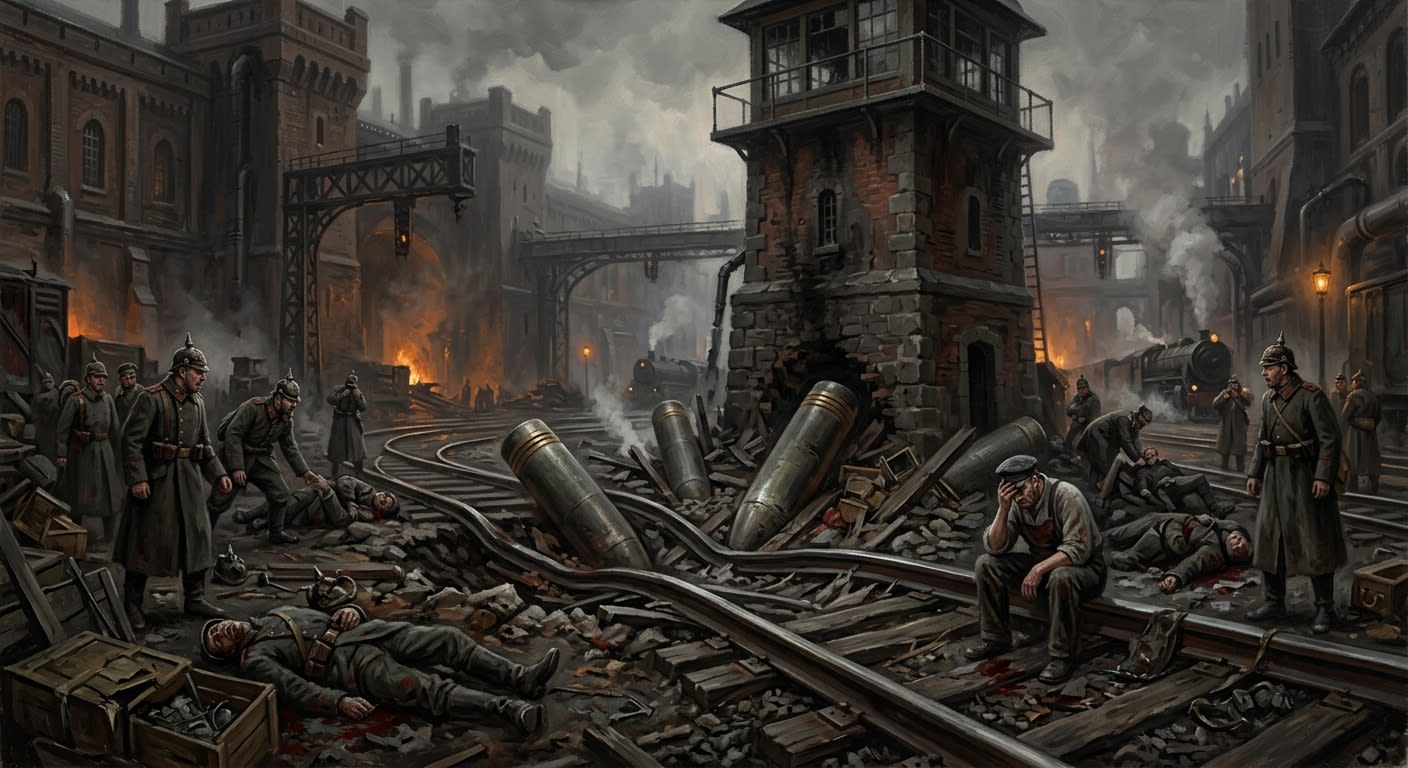
The Przemyśl Battery Misfire of A.S. 199 was a small event by the arithmetic of war: four rounds fired into a friendly rail junction, eleven dead, one supply train crippled, several hundred ration packets burned, and a conference table later made so thick with excuses that a starving regiment might have chewed it. Small events are the ones governments fear. Great massacres can be draped. Small failures keep their shape.
The battery stood on the western service rise below Bastion-Przemyśl, covering the Rail-Throat Yards and the eastward spur that fed the forward wire positions. Its guns were Brast-fed, choir-certified, recently inspected, and accompanied by all the forms that make machinery respectable before it murders clerks by surprise. The fuel drums had arrived under sealed manifest from the Chrismole Furnaces of Brast. The cannon crew had sung the morning stanza. The pressure lamps read compliant. The rails below were carrying a supply train into the yards with flour, spare wire, hymnsteel fittings, and two crates of prayer-stools no gunner requested and every chaplain would defend.
The first round struck the switching throat. The second struck the lead coal tender. The third passed through an empty livestock car and exploded against a Taghouse storage wall, scattering blank issue slips over the yard like pale birds with legal malice. The fourth landed short, burst in mud, and killed three men who had already begun running toward the damage, proving that courage often arrives early and paperwork arrives fed.
#On the Junction That Was Too Obedient
The rail junction mattered because Przemyśl is less a fortress than a throat fitted with teeth. The Wire Orchard consumes deserters, smugglers, invalid tags, and hostile approach. The Rail-Throat Yards consume everything else: flour, chrismole, prisoners, conscripts, oil, wire, wax, bodies, forms, coffins, and the minor insanities by which a bastion keeps calling itself held. Damage the junction and the bastion does not merely lose track. It loses sequence.
At the hour of the misfire, the eastern lane was cleared for the incoming train. Tower Nine's signal record, insofar as Records admits a record existed, shows no hostile contact. Orchard current was steady. No Atheronic spire-light was reported. No Mirror-Lord glass signature appeared. No Crownguard mass moved on the ridges. The enemy, to the disappointment of several offices, failed to supply a convenient enemy.
The guns received ordinary firing correction from the battery's cantorial spotter. That correction was ugly, clipped, and within tolerance. Witnesses reported a hesitation after the spoken range, three breaths in which the pressure lamps dimmed without going out. Then Gun Two traversed two degrees left. No hand admitted touching the wheel. Gun Three followed. Gun One fired first.
A preliminary Ordnance note described the battery's behaviour as “uncommanded deviation during hostile atmospheric interference.”
Corrected. The atmosphere was ordinary for Przemyśl: dry, metallic, spiteful, and full of paper. The deviation belonged to the guns or to the fuel, which is less comforting because guns and fuel submit invoices.
The word obedience appears in the sealed reports more often than misfire. This is telling. A simple misfire disobeys. These guns obeyed a command the crew did not give. They did not burst, choke, jam, split, or refuse. They fired with perfect dignity into the wrong target. They were, in the most prosecutable sense, disciplined.
#On Brast Chrismole and the Choir’s Shadow
Brast entered the file before the smoke cleared. Each drum in the battery train bore Brast wax: serial number, feedstock class, distillation cycle, fourth-bell certification, choir countermark, Ordnance receipt, and the little stamped prayer that lets officers pretend oil has a conscience once the right office sings over it. The drums were intact. The seals were intact. The fuel burned correctly.
This ruined several easy explanations.
The Calibration Choir said the distillation hymn had been correct at Brast. Three hundred and twelve licensed throats cannot all lie without producing an invoice pattern, and Kest's copy of the cadence register matched the Ordnance copy except where it mattered, which is customary in Brast and healthier than agreement. The Choirmaster-Calibration Ilyra Kest testified that the fourth-bell measure had landed within three beats per minute. The pressure bells in the hearing room struck once when the stenographer asked her to repeat herself. No one asked again.
Her sentence has since entered every Brast workshop that owns a wall: “The furnace does not care whether you believe. It cares whether you sing.” At Przemyśl the sentence acquired a second edge. The guns had been sung to at Brast, sung over in transit, and sung awake at the battery. Somewhere between origin and firing, something answered back.
The Distillers' Compact blamed degraded feedstock, then corrected itself and blamed the Choir, then corrected itself again and blamed receiving-battery storage conditions. Each correction followed discovery of which ledger would be opened next. Commander-Auditor Sorn Vale blamed theft until the inventory proved intact, then blamed attempted theft, a category elastic enough to hang a man in comfort. Engineering blamed harmonic drift. Doctrine blamed language, which is what Doctrine does before it blames people.
#On the Inquiry and Its Table of Lies
The inquiry convened first at Przemyśl, then at Brast, then in Strasbourg by memorandum because no Bureau wished to breathe the air of responsibility at close range. Ordnance opened with sabotage. It is the soldier's favourite explanation: useful, directional, and rich in bodies. Sabotage requires a saboteur; a saboteur can be caught; a caught saboteur can be displayed; displayed bodies produce the illusion that causation has been nailed to a gate.
No saboteur appeared.
Records presented transit copies and noted three discrepancies in timestamps. The timestamps were later ruled clerical, then unruled, then placed under supplemental silence. Engineering produced pressure curves and spoke for forty minutes about vibration families until a Logistics-Penance clerk from Przemyśl asked whether vibration families were entitled to ration tags. This was cruel, and I would have promoted her if I had not forgotten her name while admiring the wound.
The Calibration Choir's representative declined to call the incident mechanical failure. She called it “misaddressed obedience.” The phrase offended every uniform in the room. It also survived every attempt to replace it with something duller.
HEARING EXTRACT — BRast CONCERN, SEALED COPY Question: Did the guns hear the Przemyśl firing stanza? Answer: Yes. Question: Did the guns hear another stanza? Answer: ███████████. Question: From what source? Answer: Between. At this point pressure lamps three, six, and seven dimmed. Stenographer requested recess. Request denied. Stenographer later transferred to non-listening work.
Przemyśl's own officers behaved badly, which is to say normally. The battery captain insisted the crew had followed the firing order. The cantorial spotter insisted his correction was clean. The Rail-Throat superintendent insisted the train had priority clearance. The provost detail insisted no one crossed the lane. The Taghouse clerks insisted no blank issue slips were lost when the third shell broke the storage wall, an insistence disproved by the sudden prosperity of twelve Underwire brokers within the week.
#On the Dead, the Train, and the Blank Slips
The eleven dead belonged to three offices and one category no office liked. Four rail workers. Two provost auxiliaries. One supply clerk. One choir-trained battery assistant. Three untagged labourers moving sacks under temporary dawn permission. The first eight received names in the public roll. The last three received a count. Przemyśl is honest in this way: it tells you which lives were paper before it tells you which bodies were ash.
The crippled supply train blocked the junction for nine hours. Nine hours at Przemyśl is not time. It is spoilage, hunger, stalled wire repair, draft compression, delayed confession intake, and officers discovering that their dignity cannot move a wagon whose axle has become a reliquary of splinters. Flour burned. Spare wire fused. The hymnsteel fittings were recovered and reinspected, then reinspected again because hymnsteel enjoys bureaucratic flattery. The prayer-stools survived untouched. The Creator has a taste for jokes.
The blank issue slips scattered from the Taghouse wall caused trouble long after the rails were cleared. Forty-two were officially recovered. Fifty-one were later identified in circulation. Records insists this does not indicate contradiction because some slips may have been counted twice, counterfeited once, or issued by error before becoming evidence after the fact. This is the sort of explanation that makes Hell redundant.
Przemyśl's public casualty sheet lists “eight named dead and three unassigned labour losses.”
Corrected for sealed circulation. Eleven men died. Three were denied names by procedure, not by God, though God has not filed objection.
The families of the named dead received wax-tongue burial, ration continuance, and the formal phrase service-adjacent loss. The untagged dead were entered as Uncounted Contact until a junior scribe, either drunk or briefly holy, wrote their given names into a side margin. The margin was cut from the page. The cut is still visible.
#On the Sulking Question
The misfire made the Sulking Engines dangerous in writing. Before A.S. 199, Brast's responsive machinery could be contained by jokes, shop custom, priestly oil, and Engineering's patient talent for insulting reality with diagrams. A boiler that demanded introduction was quaint. A siding engine that halted for forty-one days was costly. A cannon that fired into its own rail junction was doctrine with shrapnel in it.
The public classification remained Category Two Localized Acoustic-Mechanical Disturbance. The review copy moved to Amber. The move from one colour to another is the Bureau's preferred form of scream. Nothing has changed, says the stamp, except the degree to which everyone important has begun lying with cleaner gloves, and Engineering has begun measuring its lies twice.
The countermeasures after the misfire multiplied. Battery crews were ordered to introduce themselves to their guns by name, rank, task, and apology for disturbance. Chrismole drums bound for Przemyśl received double hymn verification. Choir-trained assistants were attached to receiving batteries. Insults directed at artillery were formally discouraged, though enforcement failed the moment a gun crew met a gun. Silence protocols governed fuel transfer. Gauges were replaced under cursed-instrument procedure whenever they wrote condensation that resembled letters.
POST-MISFIRE COUNTERMEASURE ORDER — A.S. 199 Battery introduction: mandatory. Fuel-drum hymn verification: doubled. Gauge anomaly: cursed-instrument review. Crew insults toward equipment: discouraged under discipline. Cause: pending. Confidence: public.
None of this answered the central wound. Did the gun obey Brast? Did it obey Przemyśl? Did it obey the fuel? Did it obey the hymn, the wrong hymn, the missing half of a hymn, or some answering syllable moving through rail, oil, and pressure? Kest said “between.” The word remains in the file like a hook-line.
#On the Present Use of the Incident
As of A.S. 201, the Przemyśl Battery Misfire remains unresolved because resolution would assign custody to a truth, and truth is expensive when it eats across departmental borders. Ordnance keeps sabotage language ready. Engineering keeps charts. Doctrine keeps the transcript sealed. Brast keeps singing. Przemyśl keeps firing. The Wire Orchard keeps hissing names through paper fruit, and the Rail-Throat Yards keep receiving trains because war has no patience for epistemology.
Lux Thane Mire's later inquiry into Brast carries the misfire as its central exhibit. His title, Inquisitor-Mechanic, was born from precisely this sort of embarrassment: faith and engineering caught using the same door after decades of insisting they lived in separate wings. Mire may name the fault mechanical, doctrinal, demonic, administrative, or alive. Each answer ruins someone. This is why the inquiry proceeds carefully, which is to say slowly enough for the machines to learn the schedule.
The battery at Przemyśl was repaired. The junction was rebuilt. The dead were buried or processed. The blank slips entered the Underwire and became lives, crimes, and three marriages of suspicious convenience. Gun Two was recast. Gun Three was transferred to a training yard and has since fired without defect, though no crew will eat facing it. Gun One remains in service under a new name. Naming a cannon twice is foolish. Leaving it unnamed is worse.
The official lesson reads: maintain cadence integrity across fuel, transit, and firing environments. The practical lesson is older and uglier: machines remember the tone in which they are commanded. The Bureau's lesson is shorter: do not let the public hear the cylinder.