
#On the Office That Makes Thunder Accountable
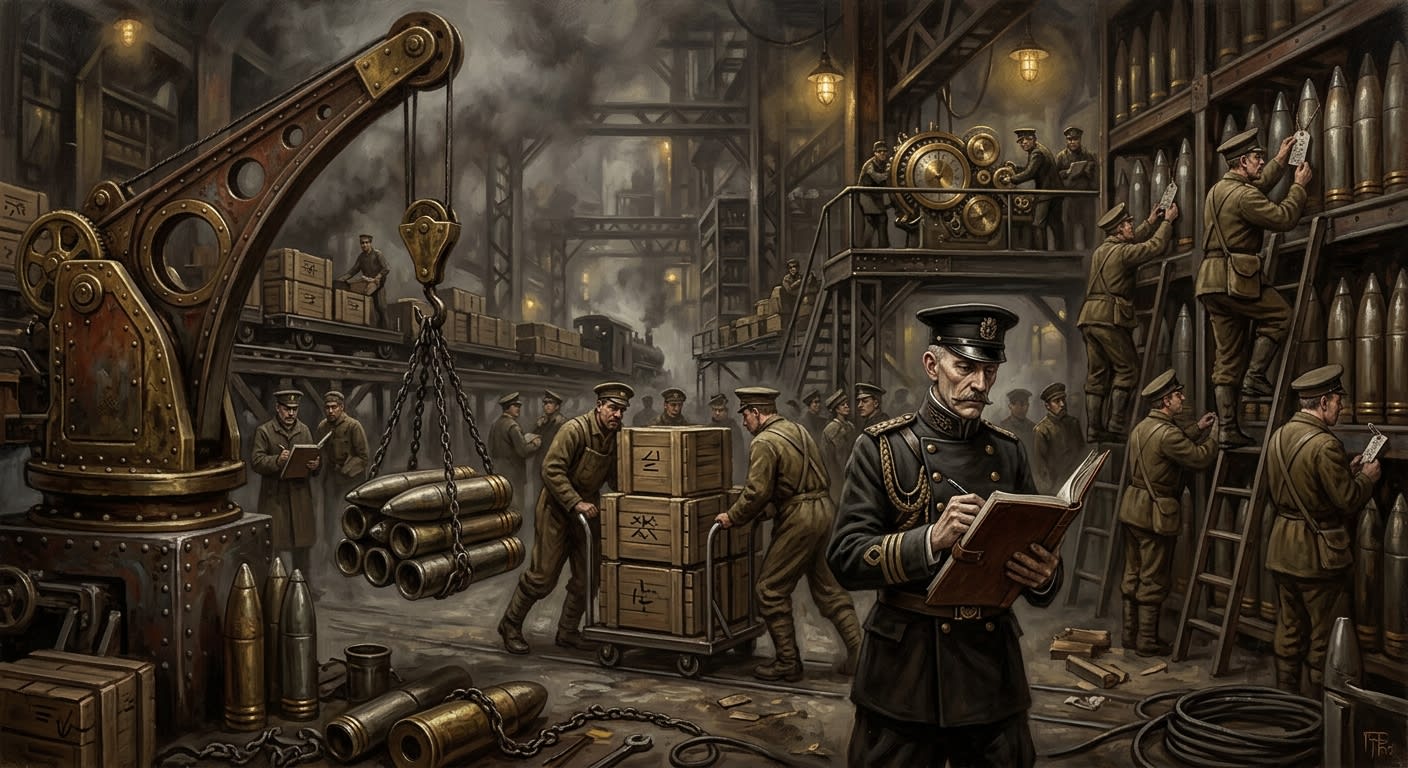
The Ordnance Bureau is the Synod’s arm for the production, custody, blessing, numbering, testing, transport, rationing, and punitive recovery of the material by which the Sagittal Line continues to make its objections audible. Among the great public Bureaus, it has no painted saints on festival banners and no children forced to recite its virtues in schoolyards. It is an armoured office, a joint wartime authority, a furnace-smelling ledger with teeth. The people call it War’s storehouse. War calls it a technical adjunct. Doctrine calls it necessary under protest. The Bureau calls itself, with typical modesty and no visible shame, the Stewardship of Sacred Lethality.
I prefer Ordnance. Short words are useful around explosives.
Its writ extends wherever fuel, powder, shell, barrel, chrismole, gun-carriage, recoil-hymn, drum seal, pressure gauge, fuse, detonator, bell-cannon throat, and sanctified lubricating oil pass from intention into use. At Brast, it owns the seal on the drums and claims command over the Chrismole Crown. At Bastion-Przemyśl, it certifies batteries that have learned to distrust their own fuel. At Bastion-Constantinople, it issues manifest authority over crates whose labels sometimes pray better than their contents. Its domain is practical. Its consequences are theological because everything that kills for the Synod eventually receives a sermon.
#On Its Founding in Necessity
The Ordnance Bureau begins where pious enthusiasm met barrel heat and discovered its own insufficiency. In the first decades after the Sundering, the west could still pretend that courage, relics, and artillery acquired from whatever Rationalist arsenal had not yet exploded might suffice. That delusion lasted until the Line hardened into refusal around A.S. 65 and every refusal required metal. Guns needed fuel. Trains needed oil. Boilers needed pressure. Shells needed fuses that did not blush, sing, or detonate during confession.
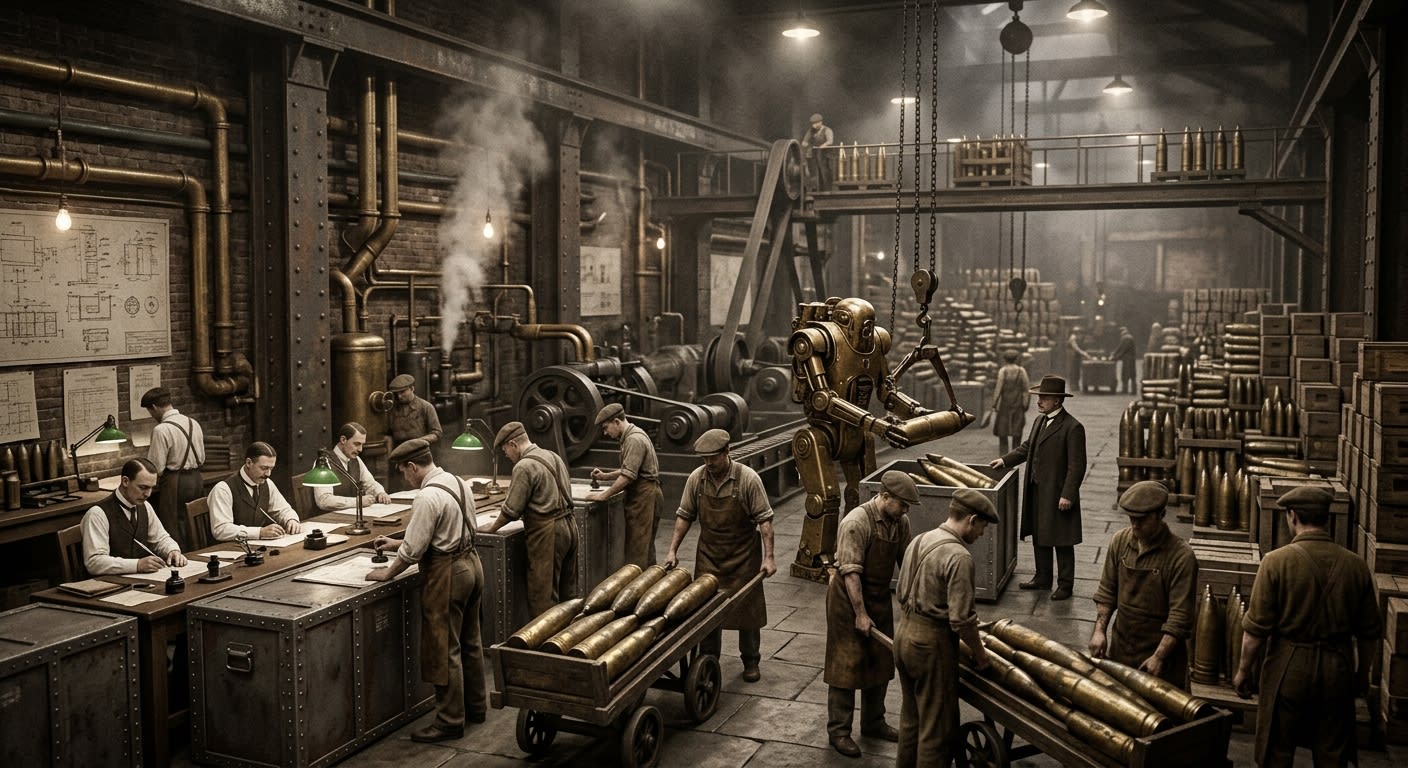
The first Ordnance offices were sheds beside rail spurs: tally benches, powder locks, oath hooks, inspection lamps, and one priest borrowed from Doctrine to assure everyone that secular mechanisms could be made obedient by sufficient chanting. The priest was wrong in theory and useful in practice, which is how most institutions are born.
A.S. 68 made the matter permanent. A logistics officer of the nascent Bureau of War requisitioned the Brast rail junction and began building furnaces. By A.S. 72, the first chartering seal for Brast Ordnance Works had been filed under joint Ordnance and Doctrine authority. The fuel they produced, after the Cantor and fourteen choir-technicians had finished improving the smell of the process, became chrismole: chemically familiar, doctrinally distinct, expensive enough to reassure the Bureau of Tithes, and effective enough that commanders stopped asking impolite questions.
Early instructional tablets describe Ordnance as “a subordinate depot service of War.”
Corrected after the first winter in which War attempted to manage fuel, shell allocation, forge schedules, hymn calibration, and drum seals without Ordnance clerks. Three batteries froze. Two batteries fired spoiled stock. One battery refused to fire because the gunners had blessed the wrong end of the cannon. Subordination has limits.
By the Concordat of Strasbourg in A.S. 90, Ordnance had acquired its recognisable shape: rear industrial nodes, manifest courts, test yards, ash chapels, sealed drum registries, custody chains, and enough jurisdictional ambiguity to make survival possible. The great public Bureaus could fight over doctrine. Ordnance had deliveries due by second bell.
#On Its Structure and Its Lies
Officially, the Ordnance Bureau is divided into five directorates: Furnaces, Metals, Munitions, Manifests, and Field Rectification (Unregistered). This arrangement pleases wall charts, annual reports, and visitors from Strasbourg who require columns before they can recognise power. The real structure is uglier, which recommends it.
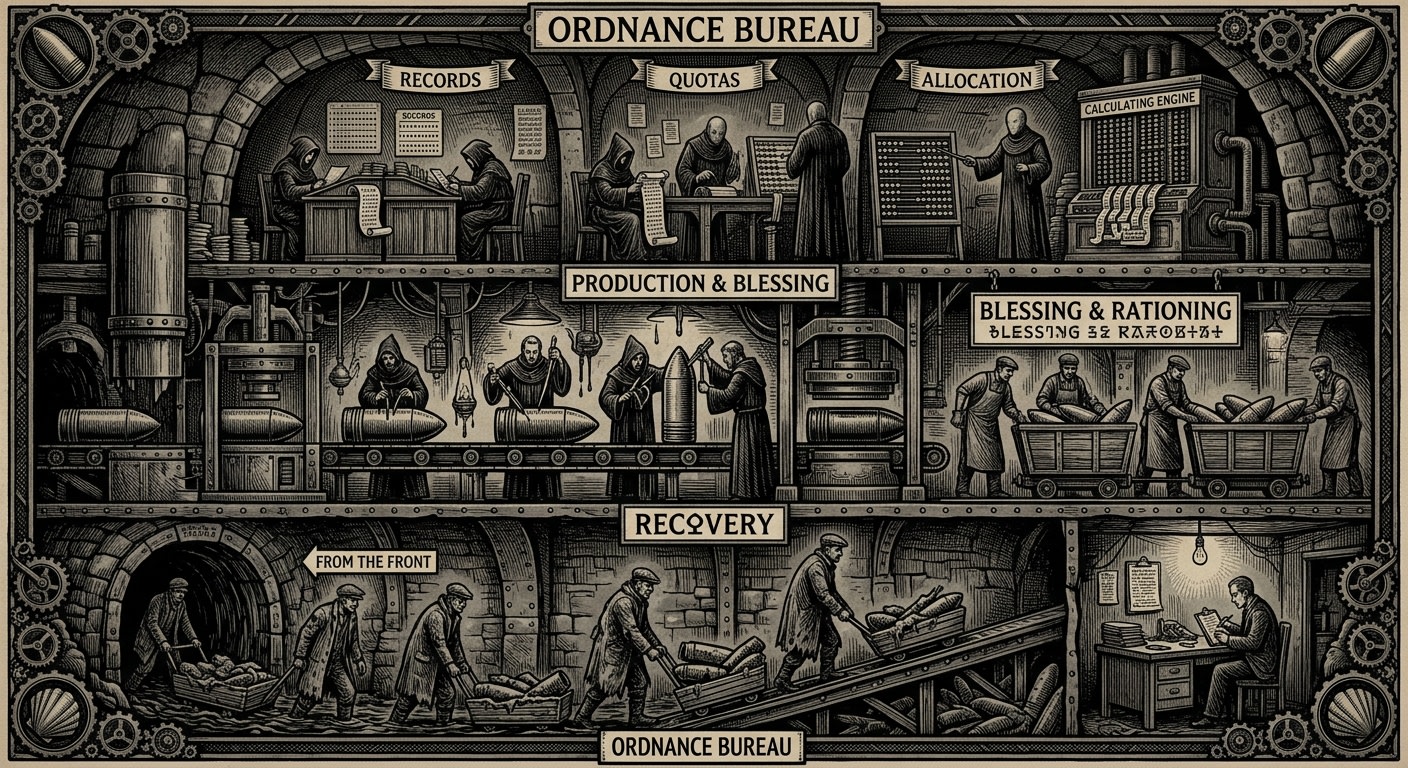
Furnaces governs heat. At Brast this means the Chrismole Crown, seventeen kilns, the sanctification nave, substrate receipts nobody wishes to read aloud, and the warm-chit economy by which ninety-two thousand registered souls are kept obedient through proximity to pipes. Furnace authority is never clean. It cannot be clean. A clean furnace is cold.
Metals governs bodies: barrels, rails, casings, recoil housings, hymnsteel fittings bought from Essen, rivets, saints’ nails when Doctrine insists upon symbolism, and replacement parts for engines whose original design was lost during one of the Bureau of Records’ more artistic fires. Metals clerks speak of tolerances with the fervour of minor prophets. Some tolerances deserve prophecy. A barrel one hair too wide becomes a funeral expense.
Munitions governs appetite. Shells are hungry objects. They want distance, ignition, breach, and consequence. The Munitions directorate feeds that hunger, numbers it, stacks it, prays over it, and sends it east in crates that must not be dropped, opened, sung near, mourned over, or used as seats by infantry, who will use anything as a seat because infantry are the proof that Creation loves endurance more than wisdom.
Manifests governs reality. If a drum has no serial, it does not exist. If a shell has no witness, it cannot kill lawfully. If a convoy arrives light, Manifests decides whether the missing weight was theft, evaporation, battlefield necessity, demonic interference, clerical error, or the sort of arithmetic that preserves morale. This directorate is hated by everyone and obeyed by anyone who wants resupply.
Field Rectification governs shame. It collects misfired guns, spoiled fuel, cracked casings, bad seals, contradictory gauges, and those unfortunate artillery pieces whose crews insist they heard an answer from inside the breech. Rectifiers are mechanics with confession authority and priests with spanners. They travel with resin masks, iron calipers, black oil, blessed chalk, and the expression of men who know every command failure will be blamed on maintenance.
The lie is centralisation. Ordnance does not rule its installations as a king rules a court. It bargains with guilds, choirs, compact-masters, auditors, furnace saints, mutinous gauges, and workers who know which pipe may be struck with a hammer and which must be flattered by name. At Brast, Commander-Auditor Sorn Vale counts, Pex Ruln feeds, Ilyra Kest sings. Ordnance signs above them. The machines listen elsewhere.
#On Brast, Its Favorite Wound
Brast is Ordnance’s jewel and ulcer. It produces the continent’s largest supply of chrismole, fuels guns across the Line, feeds treaty-stones at the Steppe Gate, and provides the Bureau with the sort of indispensable embarrassment that promotes senior officials while killing junior ones.
The Ordnance seal there sits on every drum, every warm chit, every inspection card, every disciplinary ration, every manifest train, every furnace injury tag. Its authority is total in print. In practice it shares the city with Doctrine’s choir authority, Records’ population fictions, Tithes’ appetite for invoice order, the Ash-Hospice Sisters’ inconveniently accurate accident archive, the Distillers’ Compact, the Warmth Thieves, and Saint-Combust’s Furnace Chapterhouse, which worships an exploded kiln because Brast has never met a hazard it could not turn into patronage.
The warm-chit system reveals Ordnance at its most honest. The Bureau prints heat as currency, distributes it through shift-foremen, deducts it for lateness, awards it for extra labour, withholds it during punishment, and then declares warmth a ration rather than a wage so no one may call the arrangement commerce. A man in Brast can lose not merely pay but temperature. He may owe warmth. He may borrow warmth. He may steal warmth. He may sell warmth on the Slag Market in bladders of siphoned chrismole while Ordnance patrols search for the wrong thief in the wrong alley with the wrong warrant.
Seven drums vanished from the Manifest Court in A.S. 201. Seven exactly. Ordnance recognised the number as message, insult, and operational wound. Its audit sweeps produced fourteen arrests, three confessions, and no drums. This is considered partial progress by the sort of official who measures fear in completed forms.
Ordnance public notices state that “no material degradation in Brast output has affected Line readiness.”
Clarified. Brast output continues. Line readiness continues. The degradation is material, spiritual, acoustic, fiscal, and political. Public notices can only carry so much weight before the paper tears.
#On Choirs, Machines, and Command Humiliation
Ordnance likes machines because machines, in theory, obey. This has become a doctrinal inconvenience.
The machines of Brast sulk. The official designation is Sulking Engines, Category Two Localised Acoustic-Mechanical Disturbance. The designation is a little fence built around a large animal. Valves stick after insult. Gauges answer hymns with discourteous readings. Trains stall for the length of omitted stanzas. Cannons fed by Brast chrismole fire long, short, true, and long again with the rhythm of a clerk correcting a superior’s arithmetic. Ordnance says sabotage. The Calibration Choir says degraded song. The Distillers’ Compact says spoiled flow. Furnace feeders say the engines want to be sung to right.
The furnace feeders are probably correct, which is intolerable.
Kest’s A.S. 199 testimony after the Przemyśl misfire damaged Ordnance more than the shells damaged the friendly rail junction. Four rounds, eleven dead, one crippled supply train, and a sentence: “The furnace does not care whether you believe. It cares whether you sing.” Doctrine disliked the demotion of belief. Ordnance disliked the promotion of song. The guns refused testimony, wisely.
FIELD RECTIFICATION ANNEX — BRAST / PRZEMYŚL MISFIRE INQUIRY, A.S. 199 Recovered pressure-slip from Battery Saint Othmar: “answered between.” Wax residue: Brast origin. Choir cadence: correct at source. Receiving hymn: incorrect by two beats. Intervening signal: █████████████████ Recommendation: do not ask the barrel what it heard.
The Bureau now employs, or at least permits the title of, Inquisitor-Mechanic. Lux Thane Mire’s dispatch to Brast in A.S. 201 is the admission sealed inside the title: faith and engineering have been pretending to occupy separate ledgers while sharing a bed behind the archive. Ordnance will deny this. Doctrine will deny this. Mire’s travel papers will remain excellent.
#On Manifests and the Morality of Counting
An Ordnance manifest is a chain of custody nailed to a prayer and dragged behind a train. It names the drum, shell, fuse, box, bolt, wagon, driver, escort, seal, route, bell-hour, receiving officer, contingency halt, ration issue, and acceptable loss. Acceptable loss is the most Ordnance phrase in the language. It baptises arithmetic in advance.
At the rail yards, every sealed drum receives a wax prayer traceable by scent across three provinces. Every shell crate carries a witness mark. Every fuel bladder must match weight, temperature, seal-colour, hymn exposure, and the serial temperament of the batch. Temperament is not the published term. It is the term used by men who have watched one batch of chrismole fire clean and another batch make a cannon cough like an old confessor.
Manifests also decide blame. A missing gallon may be theft, residue, evaporation, authorised retention, battlefield requisition, clerical variance, enemy action, or sanctified seepage. The chosen category determines who is flogged, who is promoted, who is billed, and which widow receives a corrected death notice six months late. Ordnance clerks learn early that the category is often more dangerous than the loss.
Field units curse Ordnance for delay. Field units also beg Ordnance for shells. This gives the Bureau its characteristic moral complexion: hated dependence. A battery commander will call the Manifest Court a nest of ink-fed parasites and then kiss the first crate that arrives before dawn. Ordnance records neither insult nor kiss unless disciplinary value attaches.
#On Corruption, Black Fuel, and Useful Criminals
No fuel system survives contact with hunger. Brast’s Warmth Thieves siphon sealed drums between Manifest Court and rail yard. The black diesel distillers sell pit-sludge under private hymns. Counterfeit seal-cutters produce wax prayers good enough to fool a sleepy clerk and bad enough to anger a wakeful engine. Quiet-hymn sellers rent illegal cadence scraps to crews too poor to buy proper choir service. Ordnance condemns them all. Ordnance also reads their arrest files with professional interest, because criminals test systems more honestly than auditors.
Black fuel is the most offensive heresy because it sometimes works. A shell battery fed on unblessed sludge should foul, burst, and teach its operators humility through shrapnel. Some do. Others fire hot, ugly, and straight. Ordnance cannot tolerate this spiritually, but it studies the residue. Doctrine calls the study containment. Tithes calls it cost comparison. War calls it emergency reserve. I call it the usual staircase to policy.
Ruln understands the danger better than his superiors. If black diesel receives a proper hymn, Brast will denounce it in the morning and invoice it by Vespers. Kest understands the worse danger: engines learn what burns. Once a machine learns that obedience may arrive through unlicensed fuel, the seal becomes etiquette. Etiquette is useful. Etiquette will not hold a wall.
Ordnance suppresses and copies. It arrests siphon crews and adopts their anti-leakage clamps. It burns counterfeit seals and improves the official wax. It hangs black diesel men and sends their residue samples to Standards. It denounces quiet hymns and files cadence variants under emergency exception. Contradiction here is procurement.
#On Doctrine’s Hand on the Barrel
The Ordnance Bureau cannot be purely technical because the Synod cannot permit purely technical killing. A shell fired without sanctity would still kill. This is the problem. The kill would function, which would imply that divine order is ornamental, and ornamental divinity is the first vestibule of Rationalism. Doctrine must stand beside the barrel and say: this explosion belongs to Heaven.
This claim requires work. Chrismole is sung over. Barrels are named. Fuses are touched with ash. Drum seals carry wax prayers. Misfires are classified morally before they are classified mechanically. A gun that fails after omitted rite has disobeyed in a different manner from a gun that fails after bad machining, though both may remove the same hand from the same artilleryman.
A.S. 187 Chrismole Manual (Unregistered) stated that sacred properties sanctify fuel through divine resonance.
The approved language now reads: “the hymn’s properties, which are sacred, interact with the fuel through mechanisms that are doctrinally sufficient.” Anyone who laughs at this sentence has never tried to keep a cannon pious under rain.
The Bureau of Doctrine despises Ordnance’s soot, bargaining, hidden recipes, and tolerance for men whose hands cannot be made clean. Ordnance despises Doctrine’s delays, verbal repairs, and habit of arriving after the explosion to rename the crater. They require one another. Doctrine gives Ordnance moral permission. Ordnance gives Doctrine survival with recoil.
The arrangement is degrading to both parties, which is how one knows it is stable.
#On the Present Condition
As of A.S. 201, the Ordnance Bureau is overextended, indispensable, compromised, and proud in the precise proportions required for catastrophe. Brast remains Amber under Sulking Engine escalation. Kest’s night-syllable sits sealed in Vault Brast-4 (Unregistered). Ruln’s filters thicken and his shortage waits behind tolerable attrition. Seven drums remain missing. The Ash-Hospice Sisters collect literate ash. Mire’s train approaches slowly, which may be mechanical delay, railway congestion, supernatural reluctance, or the line’s last sensible instinct.
The Line continues to fire. That is the fact Ordnance offers in its own defence. Guns supplied by flawed systems still kill. Fuel made under disputed sanctity still burns. Crates arriving late still arrive. A bad bureau that delivers shells before dawn will outlive a good bureau that submits a principled memorandum by noon.
This is the Bureau’s shield. It is also its indictment.