
#On the Chamber
The Fifth Lung is a chamber of Bastion-Irongate. It is one of the five that the old surveys hang off the main bore like organs off a windpipe, and the only one of them to reach the Codex by way of a hymnal instruction. I record this with some embarrassment. In better-ordered fortresses a chamber earns its entry with a siege, a consecration or at least a respectable massacre. The Fifth Lung earned its entry in a subordinate clause of the Gasket Choir's service order, somewhere between a damp easterly and a convoy surge.
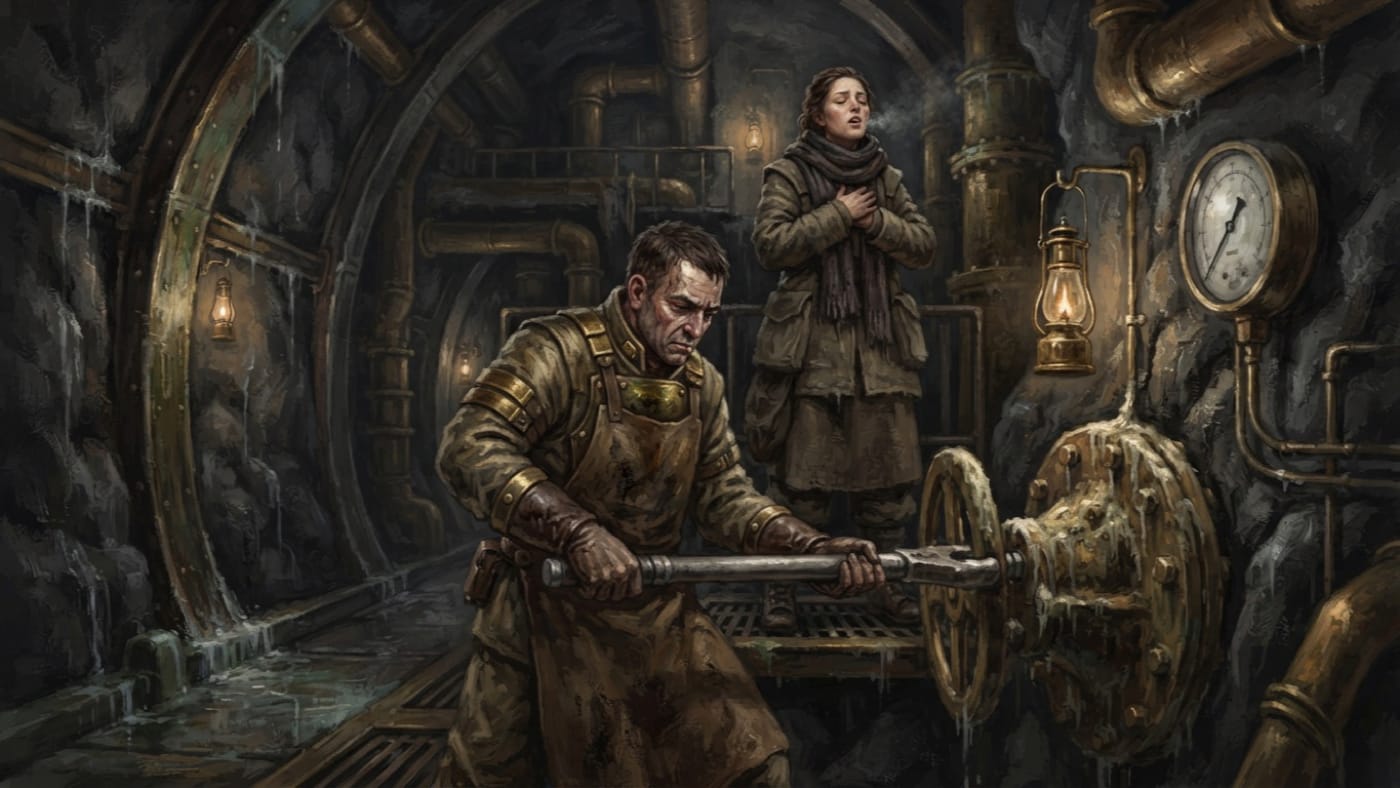
The survey preserves very little. It records black basalt and iron ribs set into the rock. It records brass valve-plates and the flanges that hold them, bolt seats crusted with old wax, and condensation on every cold surface. That water runs down to the floor gutters as if the mountain were sweating under questioning. The chamber joins the rest of Irongate by way of the Transit Spine, and every convoy, cart and pressure change in the gorge eventually passes along that bore. No file I have been permitted to open gives its depth, its dimensions or the point where it branches from the Spine. I will not furnish them. The Bureau of Engineering already supplies enough confident diagrams of rock that may or may not be there.
Why the numbering runs as it does, the surviving papers decline to say. Irongate's place as fifth bastion of the Sagittal Line has nothing to do with it, whatever the pilgrims insist.
#On the Silence Already Recorded
The reason a valve in the Fifth Lung cannot be changed in quiet lies in another chamber's grave.
In A.S. 94 a pressure inversion settled over the Danube gorge, and for nine hours the wind stopped speaking through the tunnel-mouths. The small constant shiver that kept Irongate's gaskets seated went with it. Seals slackened. Bolts walked. Before dawn a pressure door failed, and the shock travelled down the Transit Spine looking for every weakened joint in its path. It found the Third Lung. Three thousand died, the digging took eleven months, and the chamber was never fully reopened. The full account is filed under The Gasket Choir. I decline to reprint a massacre merely to pad a smaller entry.
The Fifth Lung inherits only the lesson the Synod drew from it. Irongate holds by vibration as much as by rock, and when wind and traffic cannot be trusted to supply that vibration, men and women must. Opening a seal creates an hour of local silence. For that hour a gasket sits loose in its housing, and the mountain is free to reconsider its position. Replacing a valve means creating that silence on purpose and filling it before the mountain notices.
#On the Held Contralto
The Choir Magistracy's pressure hymnals assign stanzas to chambers and tempos to weather. For valve replacement in the Fifth Lung they prescribe a held contralto line timed to the torque pattern of the Gasket-Hymn Mechanics. It is the one particular we possess about the place, and it is enough to hang a theology on.
The work follows the order the profession has always kept. The mechanic diagnoses the old seal by its witness marks and by its smell, because counterfeit rubber has a stink that sanctioned stock lacks. The flange faces are cleansed with solvent and chalk-salt, and the old wax is scraped away. The mechanics call this step "erasing the lie," and they say it without irony. Pins align the plate. The new gasket goes in without a twist, and its orientation is checked twice, because a gasket seated wrong will hold for a week and then fail in front of an auditor.
Then the line begins, and the hands wait for it.
The contralto is sung where the Choir sings. Brass baffles and channels cut through the basalt carry it to the valve-plate, and the mechanic feels it arrive as a hum in the iron before hearing it as music. The hymnal does not say why a contralto rather than some other register. The Magistracy treats curiosity on the point as a tuning fault.
The mechanic torques in a star, each bolt followed by the one opposite. A flange drawn down around its rim like a purse-string warps and weeps. Each pass is timed to the line: a quarter-turn on the singer's breath, a pause while the note sustains, and the key lifted only when the measure turns. At final torque a witness line is chalked across each bolt head and onto the flange, so that the next mechanic or the next auditor can see at a glance whether anything has crept. Then come the wax, the purity tag and the signature. Verification follows with the pressure test, the vibration test and a long minute of listening for knock-back from the seat.
If the singer breaks before the last bolt is drawn, the mechanic stops. If the mechanic gets ahead of the line, the singer is ordered to hold longer. Neither may finish first. The Choir's defenders call this harmony, and Engineering calls it a coupled tolerance. I call it the most binding marriage contract in the bastion: two people sealed to one boundary, and neither permitted to leave the room.
Certain early manuals describe gasket maintenance as "mechanical support for the Choir."
Corrected: the Choir and the gaskets are one apparatus. In the Fifth Lung the correction can be checked with a torque key. The bolt does not turn until the note arrives, and the note has no office until the bolt turns. The clerks responsible for the original phrasing have been reassigned to listen.
#On the Licensed Hands and Throats
Five parties hold the Fifth Lung shut, and the stone is the only one that never signs anything.
The mechanic owns the hands, the key, the wax and the liability. The rite sheet carries the mechanic's name, and if an audit later finds a skipped verse or a rented witness, the name is what hangs. The singer owns the line and the throat behind it. That throat is licensed by tier through the Transit and Breath Office, under the oversight of the Choir Magistracy. The gauge-watchers own the needle and must report whatever it does, whether or not anyone wishes to hear. Above them sits the Magistracy, which owns the hymnal page, the tempo and the license, and through them everyone else.
Cantor Ys Varr and Commandant Hadrik Sorn govern the whole of Irongate. No surviving record gives the Fifth Lung a custodian of its own. When something goes wrong there, responsibility runs uphill until it meets a bench warm enough to deflect it.
The singers keep the Choir's three eight-hour watches, doubled when pressure weather comes down the gorge. A held line is harder labour than a moving one. The diaphragm cramps, the throat dries, and the damp gets into the chest and stays. Ice-lung takes voices every quarter. A cracked note during a valve replacement is logged against the singer's tier, and a lost tier means lost heat, thinner rations and fewer bunk hours. A singer who cannot hold the Fifth Lung's line this season may find the Breatheries holding a bed for them the next.
The mechanic is spared the audition bench and repaid with the audit instead. Shortages tempt the whole profession to reuse a gasket "one more time." Every mechanic does it. Every mechanic also knows whose name will be on the sheet when a reused ring in the Fifth Lung begins to weep.
#On Other Frequencies and the Present Service
The Counterkey Circle writes in grease on basalt and taps on pipe from the Underchords. It insists that the prescribed harmonics are wrong. By its account they are sufficient to hold, costly enough to consume endless voices, and unstable enough to keep the Magistracy indispensable. The Fifth Lung's held contralto is exactly the kind of prescription the Circle means. Suppose another frequency could seat the same flange with less breath, or a Diesel Resonance Plumber's tuned pipe could carry what a throat now carries. Then a good deal of Irongate's suffering is being performed for the benefit of those who license it.
The claim is disputed, and it should be. A forbidden harmonic can unseat a seal as readily as hold one. No record places a Counterkey cell, mark or trial in the chamber. I mention the Circle only because its question is, in the end, a question about this valve.
The Bureau of War suspects that Morwen polishes the Circle's grievances. The suspicion would suit an Envy that works through imitation and borrowed faces. The Circle denies it. Nothing in the file connects Morwen to the Fifth Lung, and I have no intention of improving the file.
As of A.S. 201, valve work in the Fifth Lung proceeds under the prescribed line. The Bureau of Bells keeps the classification and the Bureau of Doctrine keeps the blessing. The gauges, in Engineering's preferred word, remain acceptable.