
#On the Hood's Station
"Providence dictates the Papers; the courier is merely the wind." — courier doctrine, as recited in the wax-rooms
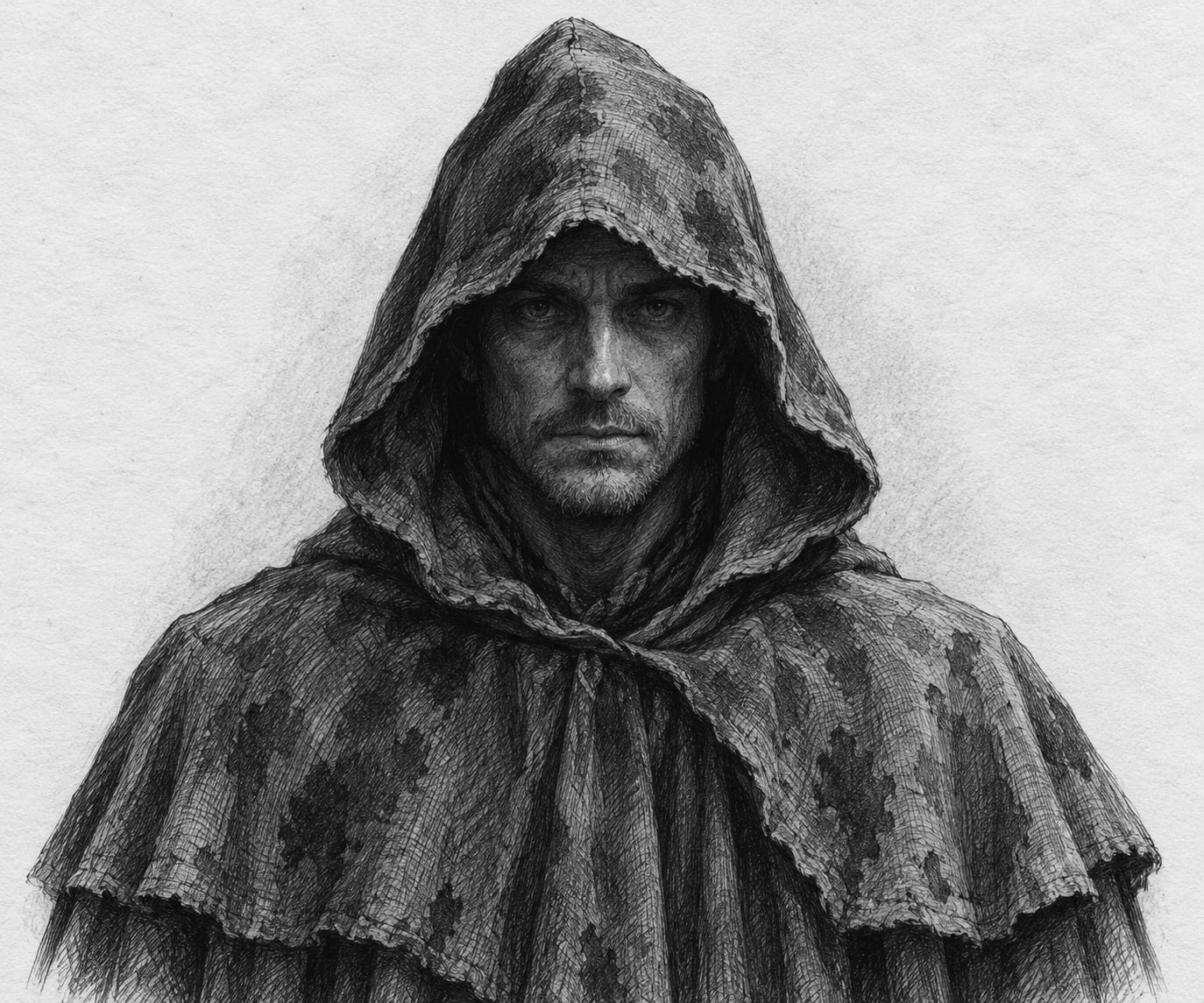
Every guild wants a founder, and every founder wants a tomb, a feast, a portrait and a descendant petitioning for the pension. The Night Papers Couriers have a founder and none of the furniture. They call it the First Hood. That title is the whole of the dossier. There is no name, no parish, no age, no sex the record will admit, no family, no grave, no century, and no body anyone has thought to ask for.
I have opened files on bishops with less. I have opened files on bishops with more and regretted every page.
The First Hood is a legend, and I enter it in the archive as a legend. Couriers repeat it. The Bureau of Shadows has never denied it, chiefly because the Bureau denies nothing aloud; its own existence is already under a standing denial, and it dislikes paperwork that might compete. What follows is the dossier of a figure the Church has never canonised and never located, and has every administrative reason to leave as it is.
#On the Paper Before the Writing
Couriers tell the tale briefly. It is told in wax-rooms between the lighting of one candle and the next, and nobody there has time for a long one.
A runner in a hood came to a general by night and pressed a slip of grey vellum into his hand. The general read it by flame and obeyed at once. He asked the runner nothing and sent no query back up the chain of seals. By the time the deed was done the runner had gone, and nobody could say which way. At dawn the Paper was found lying in its proper wax-room, where Papers lie, already blank, already fulfilled, and already filed as never having been issued.
The tale insists that it had been delivered before anyone wrote it.
That is the entire legend. It names no battle, city, year or general, and it never says what the order commanded. It does not say whether anyone wrote the thing afterward, or whether the writing was considered unnecessary once the obedience was done. Every teller adds weather. I strike out the weather. Weather is a courier's vanity, and the Hood has none.
Look at what the tale has made. An order is obeyed before it exists. The instrument travels home by itself to be filed as an event that did not occur. The record proves only its own absence. The Bureau of Records has spent generations learning to do with clerks, pumice and ink what this Paper is said to have done unaided. I count it the most bureaucratic miracle in the Church's whole cabinet. The Synod has never ratified it, which is the bureaucratic part.
#On Authority Without an Author
The Bureau of Doctrine teaches that Providence dictates the Papers and that the courier is only the wind that carries them. This is teaching. It proves nothing about who holds the pen, though it settles very neatly who may be asked. A Records note that I am not permitted to have read records the authorship as unknown and adds that the handwriting changes with the seasons. Providence, it seems, is subject to rotation of staff.
The First Hood is that doctrine given legs. If a Paper can arrive before the writing, then no clerk drafted it and no seal-master pressed it, and there is nobody to summon to a tribunal and nobody to hang if the tribunal goes badly. No patent of office has ever granted a more useful privilege than this legend does.
The practical need is an old one. After the Concordat of Strasbourg in A.S. 90 the Synod had magnificent machinery, and every part of it was slow. A proper warrant passed through draft, review, seal, counterseal, witness and appeal, and by the time it reached a bastion the suspect had gone and the district had formed opinions. The Bureau of Shadows answered with grey vellum. A Night Paper is sealed in grave-dust wax and delivered without herald into the recipient's own hand. Its text shows only by candle-flame, and it normally dies at dawn unless Shadows countersigns it into permanence. While it lives it authorises arrest, burning, confiscation and death, and it has no use for an appeal.
Such an instrument wants a particular sort of recipient, and the legend supplies him. The general in the tale reads, obeys and asks nothing. He never says who sent this?, the question every courier is trained to leave unanswered. He is the model for every officer who has received a Paper since. In the tale obedience comes first and the record is a formality that arrives afterward, blank. An order obeyed before it was written can never be withdrawn, amended or blamed on anyone.
#On the Hands Employed
The legend has two people in it and gives them unequal parts. The Hood carries. The general acts.
Every courier I have questioned says I only carry, as though the phrase were stitched inside the hood. The First Hood is that phrase made into scripture. The runner vanishes before the deed, so the deed belongs to the hand that did it. The authority belongs to nobody, because its author never existed and its bearer has no name. This is the Synod's quiet genius. It cuts guilt to the length of a night and hands it to whoever happens to be standing nearest the candle.
Couriers love the tale for another reason. They say, and the Bureau of Shadows has never confirmed, that a Paper still unfulfilled at dawn turns on the one holding it. The First Hood's Paper ran no such risk, since it was fulfilled before it existed. It is the only Paper in courier lore that could never catch its bearer at sunrise. The profession prays to the one runner who never had to run.
The Hood's legend belongs to couriers, and other night-workers do not share it. Gauze-Masked Custodians collect and remove. Night Wagon drivers transport whatever the night has made portable, and they keep their own patron, the First Carter, who is equally hard to find. Index Damnatus runners carry condemnations that Purity wishes to see recorded and nailed up at street corners, which is the very opposite of the Hood's ambition. These offices may share a route and even a doorway on the same night. They do not share a saint, because none of them has one.
#On the Years Misfiled
The First Hood's deed has no year, and clerks have tried to give it one anyway.
Some would put it before the Concordat. Those who want the Hood to carry a commission from the men who founded the Church's settlement should consult the death registers first: both men were in the ground before A.S. 90 / 1800 CE, and the dead countersign nothing. The Codex's occupational survey of the couriers places their practical development after that settlement and gives the profession its present shape by A.S. 134. That is a date for routes, tokens and rules, and the Hood has never needed any of them. The Bureau of Shadows has its own constitutional history, and that history is a matter of seals and settlements. None of it records a founding runner.
The worst error came from the Year of Smoke.
Earlier courier digests dated the First Hood's delivery to the Year of Smoke, A.S. 180, and described the profession as born out of that winter.
Corrected: The Year of Smoke, A.S. 180 / 1890 CE, marks an intensification of Shadows activity, recorded at Lübeck. It counts how many Papers ran, and it cannot say when the first one did. The First Hood's delivery remains undated.
The error is easy to forgive and was fatal to accuracy. In A.S. 180 the Bureau of Records wrote Shadows activity intensifies while also maintaining that no such activity, office or wax-room existed. A clerk who copies both sentences in good faith will soon be looking for a beginning, and a legend with no date is a great temptation to anyone holding a calendar. I have struck the date out. The legend is more useful without it, and the Bureau of Shadows would never have filed one.
#On the Hood Still Required
As of A.S. 201 the couriers still run, and they still tell the tale. Candle-Runners hear it on their training routes while instructors change the bell peals to imitate a dawn closing in. Hand Couriers repeat it in the wax-rooms. Veterans who have outlived several dawns recite it in the flat voice usually kept for the price of bread. None of them claims to have seen the First Hood, and none expects to. The legend makes no promise of a second coming. It never needed a first appearance either, beyond the one it describes.
The Hood is still needed because the arrangement it blesses is still in use. Grey vellum still arrives without a herald. Generals still read by flame. Papers still go blank at dawn, except the ones Shadows decides to keep. Somewhere tonight a recipient will be tempted to ask who sent the order, and the legend has already taught him that a good officer does not ask.