
#On the Authority of the Seal
The Church never lacked holy remains. It kept them in parish chests and convent cupboards, under altar stones prised up by Rationalist crowbars and quietly reset by Cellar hands, in wax-sealed boxes carried through forty years of war by widows who could not read the labels. Bones were plentiful. A government could live with that. What troubled a government was the smaller question of who could say which bones counted.
The Concordat of Strasbourg gave the Synod its constitution in A.S. 90. Two years later, in A.S. 92 (1802 CE), the First Ratification gave the Bureau of Relics its answer to that question. The bones were older than the answer by centuries, and the answer has since outlived a good many of the bones.
#On the First Ratification
"A relic authenticated is a relic made holy. A relic unauthenticated is kindling." — Bureau of Relics, Standing Edict, First Ratification (A.S. 92)
That is the axiom. The Bureau admits the sentence is older than its charter. It went round shrine corridors and examiners' lodgings before anyone pressed wax beneath it, the way most dangerous sentences circulate before they are licensed. What A.S. 92 added was an office, a staff, a seal and a cellar. A proverb that only threatened became a statute that could carry out its threat.
The particulars I would most like to give are the ones I cannot give. No copy of the instrument I have been shown records the day of ratification, the room, the signatories, the attendance or the count. The Registry gives the year and nothing else. Popular accounts fill the gap with a council in full vestment, candles guttering, a founder's reliquary blazing on the table while the ink dried. Those accounts are decoration, and I have filed them as such.
An earlier entry of this Codex stated that the Bureau of Relics was constituted in A.S. 92 by Augustinus personally, among twelve sister Bureaus "hammered from prayer and steel," while his own reliquary blazed beside the charter.
Corrected: Augustinus was dead before the Concordat of A.S. 90 and ratified nothing in A.S. 92. The Bureau was constituted under the Synod's post-Concordat authority. The blazing reliquary is pious ornament and is withdrawn from evidence. The figure of twelve sister Bureaus does not establish a common founding schedule and is withdrawn with it.
The Ratification's force lay in its circularity. Authenticity confers sanctity, the Bureau confers authenticity, and the Bureau's own authority to do so comes from the same ratified charter. Nothing outside that loop can be appealed to, and so nobody appealed.
#On the Four Mandates
The Bureau's charter names four duties: custody, authentication, classification and distribution. They read like a list. In practice they run in order, each feeding the next.
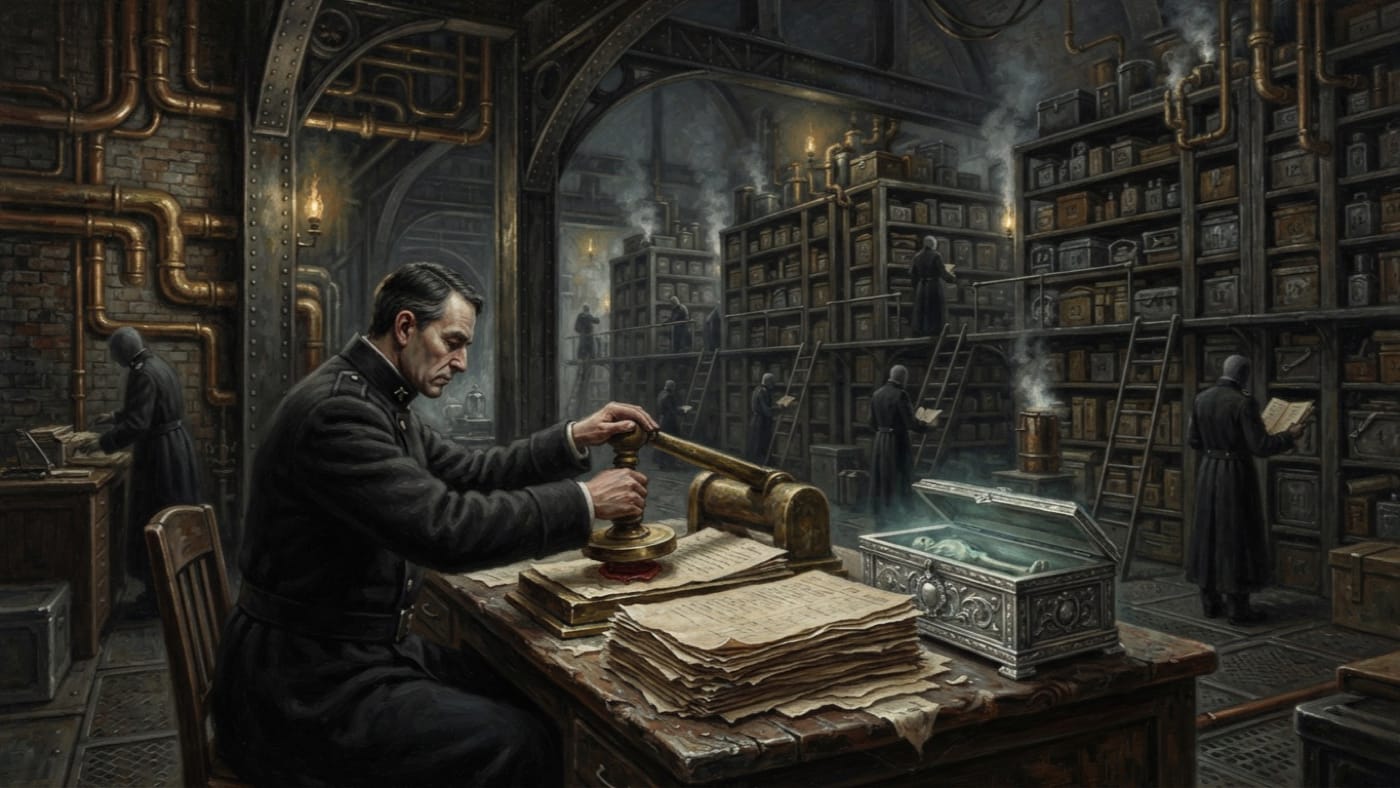
Custody comes first because a relic has to be held before it can be judged. Once ratified, the Bureau could require objects to come into its keeping: removed from chests, carried under seal, logged at the door. Its headquarters sit beneath Strasbourg's Cathedral Close in the Vault of Sacred Custody, which gained its present authority after the Ratification. That fixes when the Vault's authority began. It says nothing about when the chambers were first dug, and the masons' accounts have nothing to do with this article.
Authentication was given its office and seal in the same year. The Authentication Hall dates its establishment to A.S. 92 as an office and a seal, and nothing more architectural than that. A clerk at a table with a press counts as a Hall in the eyes of the law.
Classification decides what an authenticated object is for. Distribution sends it there: to shrine, bastion, field chapel, or a trench niche on the Sagittal Line. Once a bone has been authenticated, its seal works as a licence. Pilgrims may gather in its name, a bishop's legitimacy may lean on it, a ward may be built around it, and a regiment may march behind it.
The Vault keeps a different list: custody, classification, distribution and silence. It drops authentication, which belongs to the Hall, and adds silence, which belongs to everyone and is acknowledged by nobody. The two lists cover different subjects. The charter describes the Bureau. The Vault's list describes the cellar, and the cellar has learned something the charter never had to put in writing.
#On the Unauthenticated
"Kindling" is the half of the axiom that gets quoted at clerks. Nobody quotes it at donors.
When the Bureau says an unauthenticated relic is kindling, it is describing the object's standing, and that is what makes the word frightening. The bone stays where it is, the reliquary keeps its silver, and the parish still feels about it as it did the day before. It simply loses its authorised public standing. It may no longer be displayed, carried in procession or invoked in liturgy under the Synod's protection. An object refused in this way passes into Bureau custody and does not come back. The Bureau calls this "retired from service."
The procedure was assembled in stages and should be described in stages. A shrine submits an Authenticity Writ, which is an application and nothing else. Examination follows. The verdict follows that, and the certificate eventually issued to a successful object is known among Relic Authenticators as a Sanctity Writ. The Ratification gave the Bureau the right to demand the application. Nobody has established when the first Writ was stamped, and I will not establish it here.
Certain parish histories state that every relic refused after the First Ratification was burned that same year in the Cathedral Close.
Withdrawn: in A.S. 92 the word "kindling" defined a relic's standing and gave no instruction to fire. Refused objects were confiscated and retained. Their regulated reduction into lime for mortar was legislated four years later under the Saint-Bone Melting Acts, and protected fragments were sorted from eligible ones on paper before any kiln was lit.
#On the Object's Reply
The ratified Bureau was given authority over objects. Two years later an object gave its view on that.
In A.S. 94 a disputed relic reached the Authentication Hall with its provenance broken in three places. Caldre, then a Reliquary Notary of modest rank, kept a solitary vigil with it in the Vault and filed a report of one sentence: Authentic. The object has opinions. He died the following week. The Bureau classified his death as martyrdom, administrative category, and the full dossier is filed under his name.
Caldre did not cause the Ratification, and his vigil was no part of its ceremony. He was an early product of the machinery it set running: a notary, a seal and a verdict, all exactly as the charter required, applied to something that had views of its own. The Bureau has never published what the object was, which saint it belonged to, or where it is now kept, and I follow its example.
In A.S. 138 Caldre's own seal-press was submitted for authentication. It was refused, on the ground that the Bureau cannot authenticate its own instruments. The press sits ungraded in a locked cabinet in the Vault, warm to the touch.
#On the Authority That Remained
What the Ratification established should be kept apart from what was added to it later. The Candle Proof was standardised in A.S. 98. Earlier candles had been watched, but no formulary governed them. The Melting Acts came in A.S. 96. The Reliquary Schisms ran from roughly A.S. 140 to 160, when femurs multiplied faster than examiners could count them, and the Femur Principle was ratified in A.S. 147 to stop the bloodshed. In the reductions that followed the Schisms, authentication fell from hundreds a year to eleven. The grade taxonomy now in use (Ward-safe, Votive, Contaminant, Fraud) was published in revised form in A.S. 165. I use those words because clerks use them, and they should not be read back into a charter whose surviving wording does not contain them.
None of these later measures is a clause of the First Ratification. All of them depend on it. Each test, schedule and grade assumes the thing that was settled in A.S. 92: that sacred standing is granted under seal, by one Bureau, and recorded in one ledger.
That assumption continues in practical form. Custody keeps the object. Records keep the chain of provenance. Seals carry the authority. Licensed use moves the bone, and a verdict on its disposition ends its public career. The Archon-Custodian's Office keeps the keys. The Cathedral stands above the cellar, and the cellar does the governing.
The bones are a separate matter. They glowed before the Bureau existed and have not asked its permission since. The Ratification never claimed to explain them. It claimed jurisdiction over them, and it got jurisdiction. Whether the bones submitted to it is still an open question.