
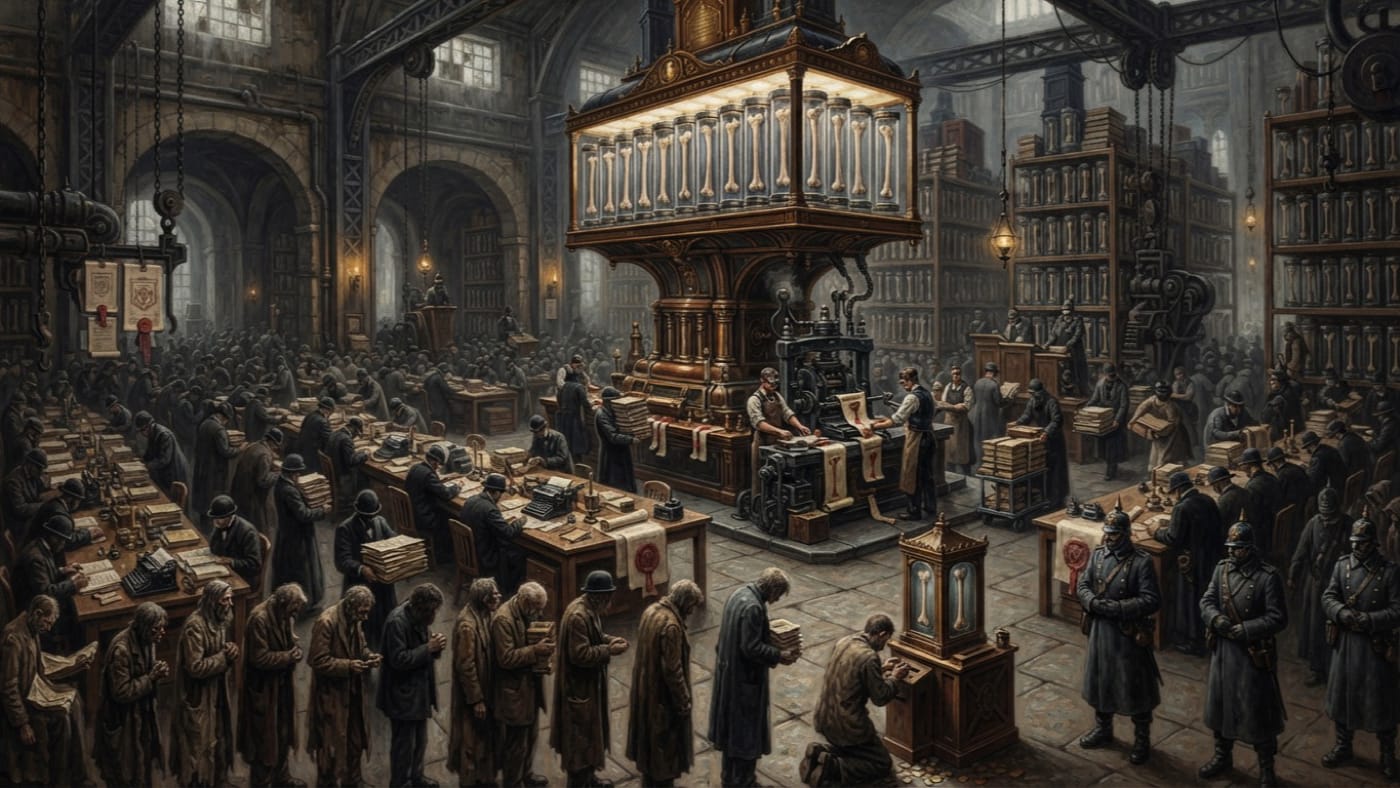
#On Notarized Authenticity
All femurs are authentic if notarized.
The sentence has six words and has outlived every physician who objected to it. It governs four things: a bone, the saint to whom the bone is attributed, the documents that carry that attribution from grave to altar, and the seal of the office licensed to recognise the carriage. When the documents hold and the seal is lawful, the bone is authentic. Nobody consults the saint's skeleton, because the saint's skeleton has no standing.
The Bureau of Relics keeps a companion axiom: A relic authenticated is a relic made holy. Doctrine classes this as institutional teaching. The Bureau has never been asked to decide whether wax persuades Heaven or Heaven merely tolerates wax, and I advise readers not to ask it at the counter.
#On the Surplus That Required a Rule
The full history belongs to the Reliquary Schisms, and readers with twenty years to spare may go there. Here I need only the wound.
In A.S. 140 the Bureau authenticated a third femur of Saint Aldebrand, and it did so properly. The seal matched the register. The custody chain ran unbroken back to the Cellar Saints who had hidden the bone through the Rationalist years. The witnesses had died in the correct order. Examination found nothing to punish, and that was the difficulty. A forged bone can be burned and its forger branded, and everyone goes home edified. When a valid bone contradicts another valid bone, the charge falls on the examiner, on the seal, and on the office that trained them both.
By A.S. 143 Cologne was displaying seventeen authenticated femurs of Aldebrand at the Cathedral of the Holy Column, every one in clean wax.
The Bureau of Medicine had already written. Its first memorandum, dated A.S. 141, observed that a human skeleton carries a fixed number of major bones. Relics sent it back.
Medicine could count. The real quarrel was over who was permitted to count officially.
Meanwhile money moved. A relic draws pilgrims. Pilgrims pay tolls and fill donation chests, and tolls buy guards, roofs and episcopal influence. A diocese that lost its saint's thigh to a rival chapel lost a good deal of its jurisdiction along with it. Duels were fought in naves. Bishops died over tibias in Salzburg and in Bruges. Provenance had become a matter for knives.
Parish histories teach that the Schisms began when heretics forged saint-bones to shame the Synod.
Corrected: the central claims passed Synodal examination. The Principle exists because the seals were good.
#On the Ratification
The Fourteenth Doctrinal Congress sat in A.S. 147. Relics brought registers. Medicine brought anatomical charts and an objection that had been ripening for six years. Records brought the custody documentation for every disputed holding, stacked in order of mutual contradiction. Engineering brought a memorandum on load-bearing capacity, and no surviving minute explains why. Doctrine brought only the authority to decide, which proved sufficient.
The Congress had two honest courses open to it. It could declare sixteen of Cologne's femurs false and invite the Church to wonder how many other seals had lied. Or it could declare all seventeen true and invite Medicine to ask how. It chose the second course and then removed Medicine's right to ask.
The instrument was the Edict of Authentication, and its formulary is short enough to hang in a sacristy:
Each clause leans on the one before it, and none of them leans on the bone. Every duplicate already sealed kept its standing. Every shrine kept its pilgrims. Relics confessed no failure, because under the new arithmetic there had been none. The question of how many femurs Aldebrand possessed in life passed from Medicine to Doctrine, and Doctrine has never been embarrassed by a large number.
The Warden's earlier chronicle places the Schisms in A.S. 289 and credits the Bureau of Records with issuing the unifying decree.
Corrected: the Schisms ran from A.S. 140 to 160, and the Congress ratified the settlement under Doctrine in A.S. 147. Records supplied the paper, and Records would like it known that it supplied the paper. The copyist responsible has been reassigned to bells.
#On the Work of the Seal
The Principle is a rule of evidence first and a rule of faith second. It tells Relic Authenticators what to examine and what to leave alone. They examine the chain: transfer slips, cellaring attestations, witness rolls, and wax impressions compared against the register under a glass. They examine the object for the plain frauds, which are animal bone, boiled bone, and bone too fresh for its saint. They do not ask whether the saint already has enough femurs elsewhere. That question was closed in A.S. 147. An Authenticator who reopens it ends up under Subsection 14 with a great deal of leisure.
The seal confers standing: the right to be enshrined, venerated, taxed and carried in procession. The order of nature lies outside its competence, and so does the Candle Proof. A sealed bone may still warm, glow, or scorch a glove, and Authenticators who mistake a lawful seal for a safe object tend to retire early.
Sealed claims still collide over procession routes and feast days. When they do, the work passes to the femur-war brokers. These are deniable intermediaries who keep parallel files, negotiate display rotations, and decide which chapel shows which thigh in which season. Relics does not employ them. Relics knows all their names.
#On the Price of Settlement
The Edict stopped the argument, but the work went on. From A.S. 147 to A.S. 160 the Bureau audited its registers, revised its custody chains, inspected its shrines, and compared double-wax impressions until its clerks could name a seal-press from the set of its letters. Authentication slowed, then slowed again. By the reduction notices of A.S. 160, Relics was adding eleven authenticated relics a year to the Vault of Sacred Custody. In A.S. 201 it still adds eleven.
Eleven is the limit on new additions. It does not apply to examinations, re-examinations, transfers or corrections, which continue at whatever pace sin requires.
The second price was paid in jurisdiction. If the writ makes the relic, then whoever keeps the writ's history owns a share of the relic. Records understood this before anyone else and obtained co-custody of provenance chains. Relics still applies the seal, and Records holds the papers that give the seal its meaning. Neither office mentions the arrangement at dinner.
#On Its Present Uses
The Principle was written for thighs, but it did not stay in the reliquary. Officers of unrelated Bureaus began citing it whenever their arithmetic disagreed with their mandate.
Tithes cites it when two assessors bind the same household to the same obligation under two valid schedules. Both obligations stand because both are notarized, and the household pays the difference. Bells cites it when two approved tolling schedules contradict each other: the bells ring as written, and the parish learns to pray in the gap. Records cites it in lineage disputes where two claimants hold the same grandfather on equally sound documents, and it lets the grandfather stand in both pedigrees. Doctrine cites it from the pulpit, where it has become a homily on obedience: the faithful need not reconcile what the Church has already reconciled for them.
These are citations by analogy. No Congress has extended the Edict to taxes, bells or grandfathers, and the formula still mentions only femurs. The Bureaus quote it because it works, and no one has yet been brave enough to ask Doctrine whether they may.
At the Holy Column, pilgrims still kneel before whichever femur is nearest and pay. Now and then a child asks which one is Aldebrand. The attending canon gives the answer the Edict supplies: all of them, by writ.