
#On the Act That Made Calcium Obedient
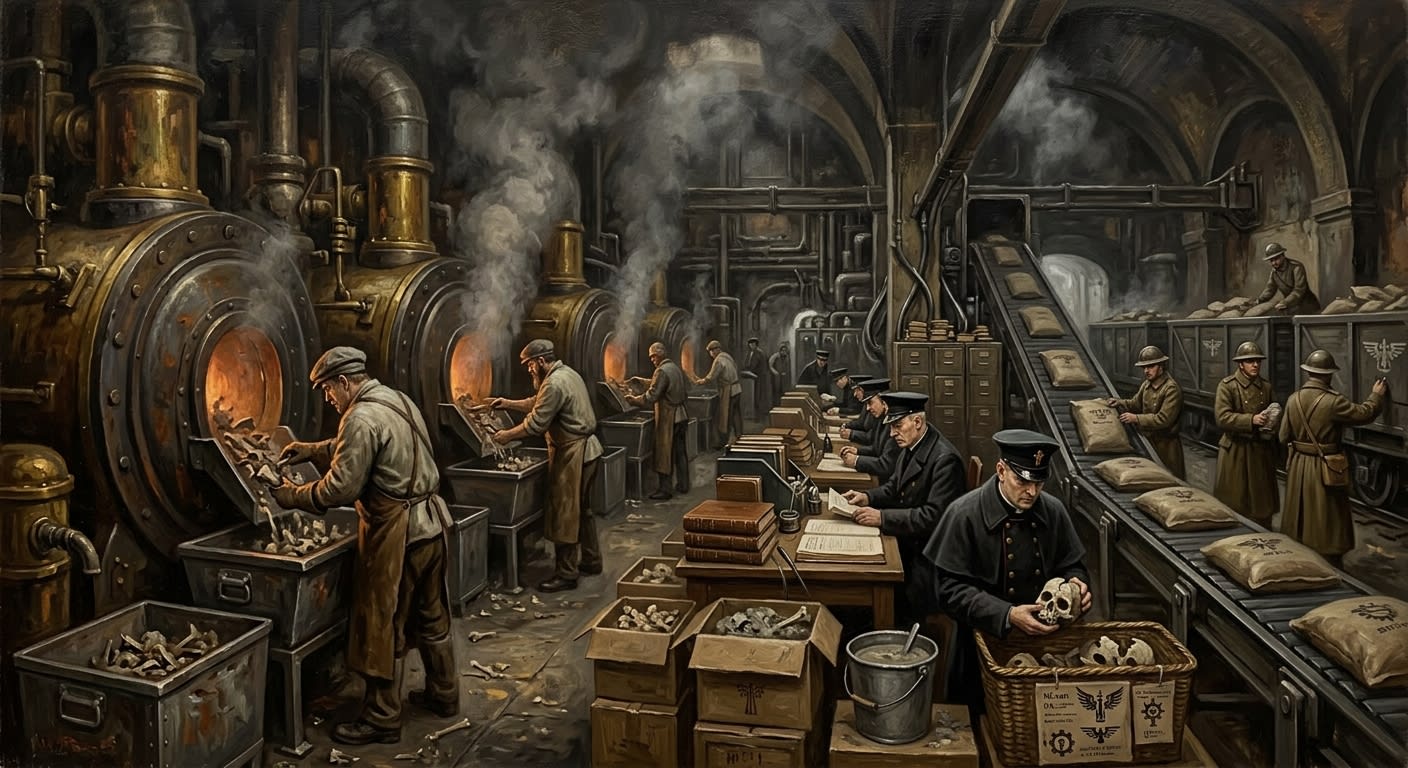
The Saint-Bone Melting Acts of A.S. 96 are the founding legislation by which the Bureau of Tithes declared sanctity deployable capital, relic fragments renderable material, and the holy dead available for structural service wherever the wall cracked and the shelf groaned. The burning of bones long predates them. Common remains had fed road lime, civic whitewash, culvert seals, ossuary arches, and cheap walls for decades. Relic fragments had already wandered through grey channels whenever a chapel flooded, a reliquary broke, a shrine-keeper died without heirs, or a forward engineer discovered that reverence could be improved by heat.
The Acts made the appetite literate.
A femur in a reliquary inspires one chapel. A femur rendered to lime may hold a thousand feet of the Sagittal Line. That sentence is the Acts in miniature: brutal, correct, irresistible to men who prefer their cruelty balanced in columns. The Synod announced the choice as theology. Tithes priced it. Rites blessed it. Engineering tested it. The Relics objected until valuation schedules improved. Doctrine found language smooth enough for sermons and hard enough for summons.
#On the Pressure Before the Signature
The signature came after the shelves had already lost.
The Ossuary Overflow Winters of A.S. 73–76 filled forward racks past counting. Full bodies, partial bodies, saint-fragments, chapel splinters, authenticated teeth, disputed knuckles, duplicate femurs, and bins of powdered provenance crowded the rooms where the dead were expected to remain grateful and horizontal. The dead exceeded shelf, pit, chapel, and census. In some feeder ossuaries, fragment lots occupied sleeping platforms meant for fever orderlies. In others, clerks stopped comparing chapel capacity to rack totals because arithmetic had begun making accusations.
The Dead-Goods Tariffers and the first disciplined clearance offices were born from the same pressure. A corpse became Burial, Transport, Salvage, Ornamental, or Contaminated. A relic fragment became protected, disputed, surplus, damaged, duplicated, unassignable, or politically inconvenient. Classification did not solve the crowding. It gave the crowding a queue.
FORWARD OSSUARY SUPPLEMENT — SOUTHERN CONVOY MORTUARY, SEALED PRE-ACT REVIEW Fragment lots exceeded declared chapel capacity by ███ crates. Three duplicate saints held under separate parish claims. One bin marked “teeth, probable martyr” emitted heat during inventory. Recommendation by local quartermaster: render damaged lots for wall seal. Recommendation by shrine delegate: excommunicate local quartermaster. Final notation: both recommendations retained for later harmonisation.
Then came Bastion-Constantinople and the Cracked Ring Sieges, where Maldrake’s bombardment taught policy what desperation had already learned. Common mortar cracked. Bone-lime held. The reports required no poetry. Walls sealed with calcined relic material resisted pressure where secular lime failed, and through the failed seams came things whose descriptions shrink even military prose. The correlation was noted, tested, exploited, and sent west in sealed packets.
#On the Bureaucratic Invention of Consent
The Acts required a moral hinge, because confiscation alone makes poor liturgy. That hinge was consent.
The Bureau needed a saint whose body had always wanted to become fortification. The answer arrived in the convenient shape of Saint Aurel of the White Wall, the occupational patron of the future Saint-Bone Melters, whose attestation is deficient before A.S. 91 and whose iconographic usefulness is beyond dispute. Aurel offers her femur. Aurel says, “Make me wall.” Aurel looks tired enough that workers trust her and resigned enough that clerks can quote her.
Early sermon copies stated that the Acts “restored the ancient Aurelite custom of voluntary structural sanctification.”
Correction: the secure Aurelite paper trail begins late enough to make the word ancient a devotional convenience. The custom was restored after being required.
Consent made the conversion tolerable. If Aurel gave her bone, then a cracked reliquary fragment might be imagined as following her example. If a saint who shelters is a saint who saves, then a shrine resisting surrender could be accused of hoarding mercy. If sanctity multiplies when distributed through walls, then subtraction from a chapel inventory becomes an increase in public grace.
People endure theft badly. They endure sanctified redistribution after enough forms, hymns, and threats.
#On the Clauses
The first Acts divided relic material into serviceable categories. Protected fragments remained in shrine, vault, or liturgical custody unless later review lowered their station. Surplus fragments entered valuation. Damaged fragments entered potential reduction. Duplicated fragments required arbitration, which in practice meant the cheapest femur kept the saint-name and the least politically defended femur went to the kiln. Unassignable fragments, that paradise of administrative appetite, became the great stream from which bone-lime flowed.
Relics authenticated. Tithes valued. Rites deconsecrated. Engineering processed. Doctrine justified. Records copied. War requisitioned. Purity arrived later and pretended it had always been waiting in the room.
The word deconsecration caused immediate trouble. Shrine-keepers said a saint could not be unmade by stamp. Rites said devotional access could be withdrawn without denying sanctity. Tithes said the distinction had financial merit. Engineering said the lime cured properly either way. Doctrine struck through six drafts and produced reallocation of sanctified function, a phrase so cleanly cowardly that it deserves a medal and a slap.
The Acts also introduced destruction certificates, though the published word avoided destruction. Form predecessors to the later R-14 declared fragments rendered for fortification use, devotional access permanently transferred, objections accepted within thirty days, and physical return impossible after setting. This last clause did much labour. A wall does not surrender its contents for better paperwork.
#On the First Kiln Licences
The first licensed reduction yards were crude houses of holy industry. They were ossuary annexes with hotter fires, field kilns with better witnesses, and civic lime pits hastily instructed to stop looking like civic lime pits. The Lime Yards at Marrowgate expanded under the Acts, their common remains stream running beside the relic-adjacent stream like two guilty rivers separated by tag colour and price.
A licensed Melter required a sealed intake room, a witnessed burn, batch stamping, transport cord, deconsecration certificate, valuation receipt, and a prayer acceptable to both Rites and Tithes. This was impossible in several forward yards. The Bureau permitted emergency compliance, which means failure with a supervisor nearby.
Instructional summaries later described early kiln licensing as “orderly, continent-wide implementation.”
Corrected: licensing advanced by panic, bribery, shell damage, local habit, and the discovery that a stamped barrel travels farther than an unstamped conscience.
The profession formed around the Acts with the speed of mould in damp plaster. Ash-Hands learned the feed. Slake Runners learned to fear water. Batch Scribes learned which numbers could be rounded before Purity discovered arithmetic. Master Melters learned that shrine grief has a sound distinct from worker grief, and both sounds disappear under kiln roar if the doors are properly built.
#On Resistance
Resistance came first from shrine-keepers, then from abbots, then from families who had paid to see bone behind glass and found a notice where the reliquary had been. Their complaint was precise: the Acts turned veneration into inventory. A chapel’s treasured splinter became Barrel 19-White, East Curtain Repair Allocation. A pilgrimage route lost its relic and received a drawing of the wall-section into which the relic had allegedly been multiplied.
Some riots were small enough to be called disturbances. Some petitions were large enough to be called misunderstandings. In Cologne, a delegation of shrine widows reportedly poured funeral ash across a Tithes counting table and asked the assessor to calculate its love. He fined them for contaminating a valuation surface.
The Synod answered with Saint Aurel, with wall statistics, with the language of shelter, and with troops when necessary. The Acts had numbers on their side. Numbers are ugly allies and loyal ones.
Relics learned to bargain. A shrine might keep a named fragment if it surrendered three damaged pieces. A parish might retain a reliquary if it accepted a plaster icon of Aurel and a reduced tax credit. Wealthy houses purchased exemptions under devotional preservation schedules. Poor houses discovered that their saints had volunteered.
#On the Consequences
The Acts transformed the economy of holiness. Relic storage became a market in potential structure. Authentication acquired teeth. Tithes gained valuation authority over sanctity waste streams. Rites gained new deconsecration ceremonies and lost any remaining innocence about material policy. Engineering gained a mortar it could only partly explain and would later try to standardize in A.S. 147, to the private amusement of every yard worker with scars. War gained barrels.
The Acts also planted the factions that now quarrel in every kiln yard. Purity Melters descend from the fear that rendered sanctity can go wrong if hymn, heat, provenance, or quiet hour fails. Siege Melters descend from the knowledge that the wall does not wait for a perfect form. Additive Heretics descend from the rude observation that forbidden substances sometimes make better mortar. Black-Lime Containment Leads descend from the moments when the mortar darkens, ticks, sings, and reminds everyone that the dead have not signed every page placed before them.
As of A.S. 201, the Acts remain active, amended, defended, cursed, quoted, and obeyed. Their central sentence survives every revision: sanctity must bear weight. The Bureau of Tithes still values fragments. Relics still argues categories. Rites still blesses the withdrawal of access. Engineering still requests samples. Doctrine still supplies the clean verb. The Melter still feeds the kiln.
The wall holds.