
#On the Schism of Too Many Bones
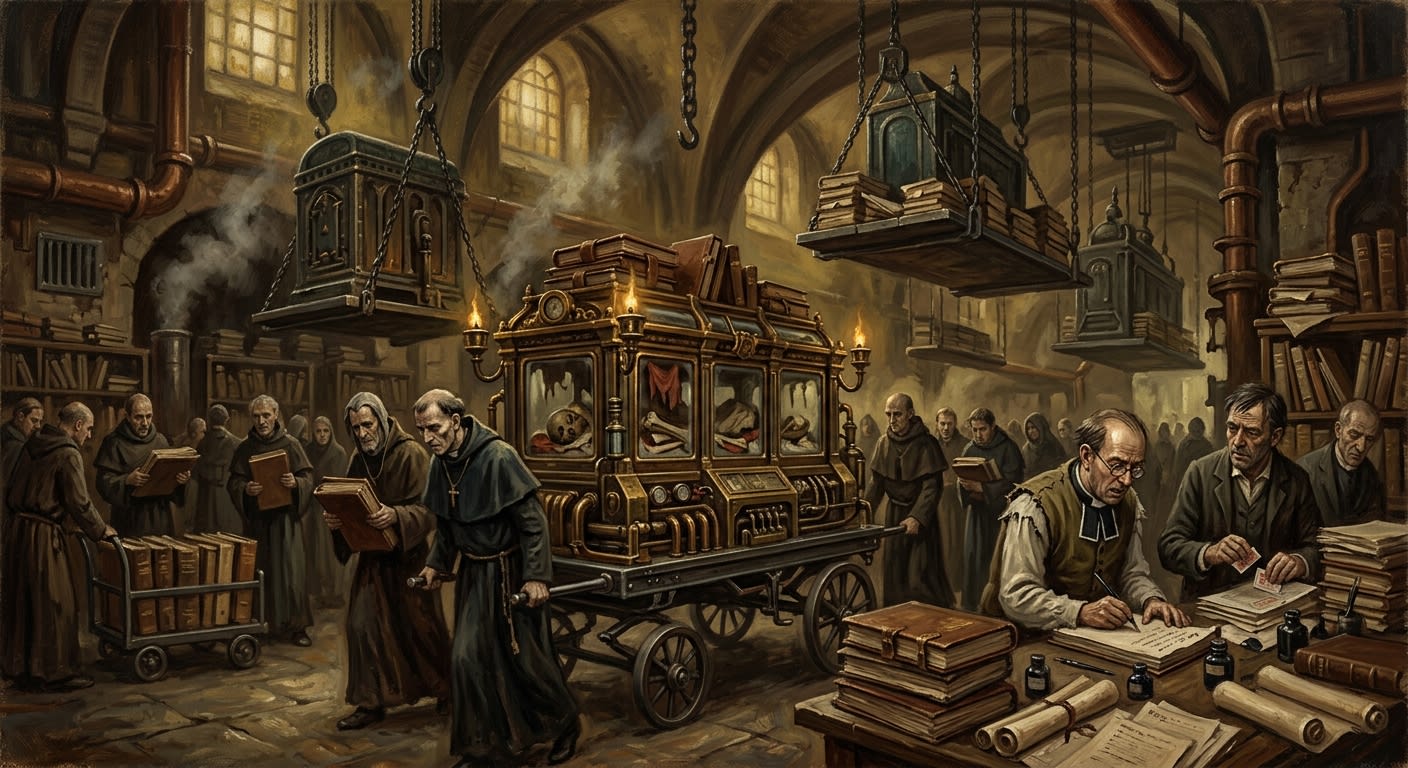
The Reliquary Schisms were the twenty-year period, A.S. 140 to A.S. 160, during which the Bureau of Relics discovered that a saint may be anatomically impossible and administratively impeccable. The crisis began in cupboards, cellars, chapel walls, refugee carts, salt barrels, sealed pantry niches, undertaker trunks, and all those damp little hiding-places where the faithful preserved holiness while Rationalist officers weighed the world and found it wanting. By the time the Synod was strong enough to receive what had been saved, the saved things arrived in such abundance that salvation itself required a docket.
The vulgar version is simple: too many relics. The vulgar version is wrong through insufficiency, as vulgar versions are. The Schisms were not caused by fraud alone. Fraud was present, cheerful, greasy, and profitable; fraud is present wherever relics, widows, and road tolls share a roof. The deeper wound was clean documentation. Bones arrived with seals. Chains of custody held. Cellar-Saint ledgers matched parish recollections. Wax marks corresponded. Prayer-marks bent flame correctly. The problem was not that the Bureau could not authenticate the relics. The problem was that it could.
Saint Aldebrand supplied the famous example because Saint Aldebrand, being dead and unable to object in person, has served the Bureau as a theological punching-bag for two centuries. By A.S. 140 he possessed his third femur in official custody. Soon he possessed more. Cologne kept multiplying him with the confidence of a city that owns both archive-banks and excellent lawyers. Other saints joined the sport. Saint Iselda acquired rival thigh-bones. Saint Morin developed a surplus jaw. A lesser martyr in Bruges appeared to have been blessed with three left hands, each clasped around a different local privilege. Relics authenticated. Medicine frowned. Tithes counted donations. Pilgrims bought tokens. The saints, as usual, declined to simplify themselves for the convenience of government.
#On the Surplus and Its Vendors
The first phase belonged to abundance. The Cellar Saints had hidden apostolic splinters, martyr teeth, saint-bone packets, altar-stones, ash phials, and parish reliquary fittings under beer barrels, flour floors, mill-walls, and false hearths. When the Synod opened the roads after the Concordat of Strasbourg, the hidden saints came out like debt claims after a funeral. Each parish wanted recognition. Each bishop wanted custody. Each town wanted pilgrimage. Each innkeeper wanted traffic. Sanctity entered the market wearing linen.
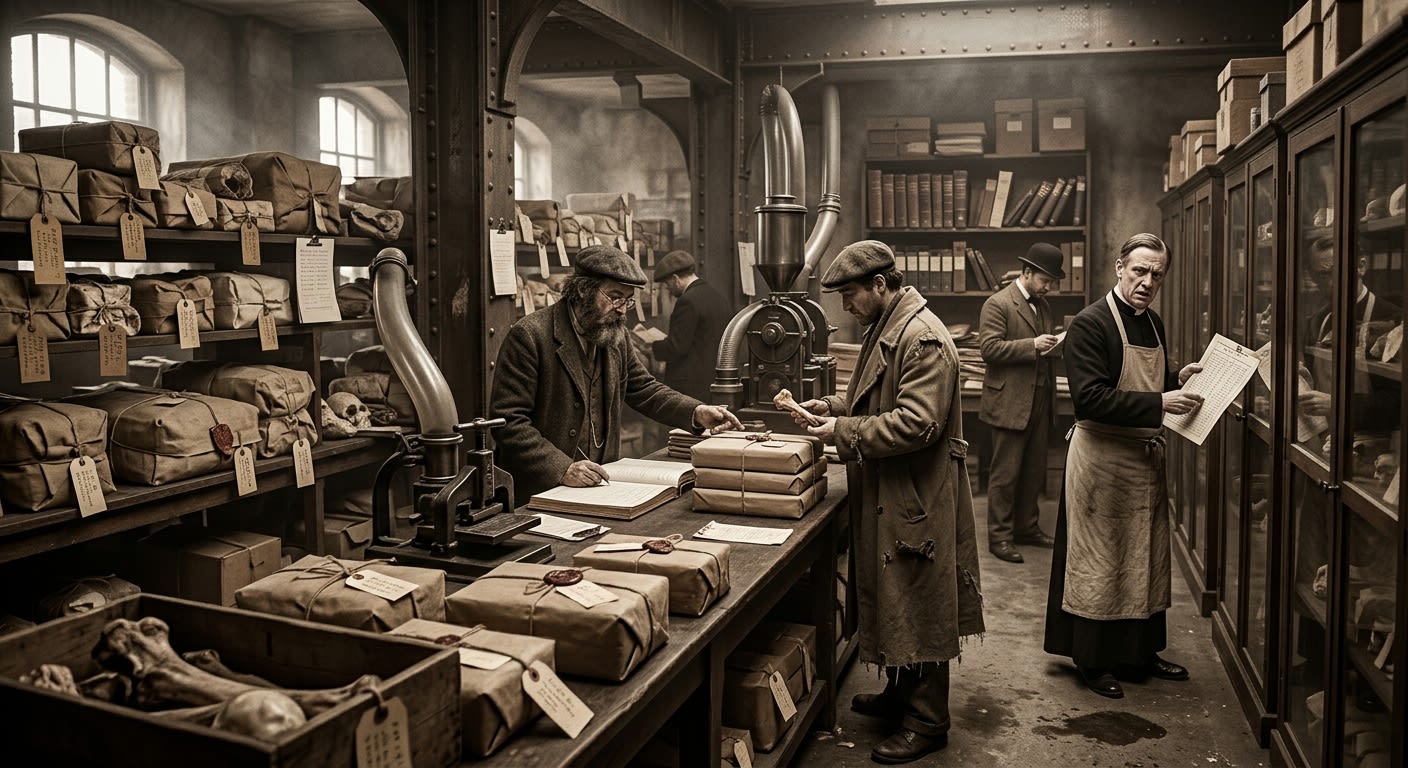
The Relic Authenticators had not yet learned caution. They were young as an office, proud of their scales and tapers, delighted by every bone that made a flame lean, and too innocent to understand that every approval created legal descendants. An authenticated femur gained a feast procession. A procession gained a road. A road gained tolls, candles, guide licenses, hostel fees, token molds, and widows selling ribbons near the west porch. Holiness moved. Money followed in a cassock.
The profit-brokers emerged before Relics admitted the category existed. They bought neglected claims, funded shrine repairs, underwrote custody suits, bribed copyists to recover “mislaid” provenance, and married surplus bones to hungry towns. A knuckle in a poor village was a devotional object. A knuckle with a broker, a repaired chapel roof, three printed miracle cards, and an inn contract became a regional economy. By A.S. 142, brokers in Cologne and Salzburg were offering advance credit against feast-day revenues for bones whose authentication appointments were still pending. The Bureau of Tithes disapproved publicly and assessed the income privately, proving once again that moral horror is strongest after commission.
The Femur War Brokers were worse: advocates, financiers, hired genealogists, pious thugs in legal shoes. They specialized in competing major-bone claims. If two cathedrals held the same saint's femur, they did not ask which was false. They asked which custody chain could be made louder. They purchased witnesses. They funded pamphlets. They arranged pilgrim demonstrations. They hired guards for processions and mourners for hearings. A saint's thigh became a banner around which municipal vanity could assemble with knives.
#On the Cities That Drew Blades
The first blood did not fall in Strasbourg. Strasbourg is far too civilized to bleed first; it prefers to receive delegations after provincial men have demonstrated the problem by dying messily. Salzburg supplied two bishops slain over a shinbone whose reliquary emitted a greenish warmth during Lent and no warmth at all when examined by Medicine. Bruges supplied the ambiguous death of Canon-Advocate Pell, discovered beneath a reliquary table with three wax seals in his mouth and a provenance brief pinned to his sleeve. Cologne supplied numbers. Cologne always supplies numbers, then pretends numbers are neutral.
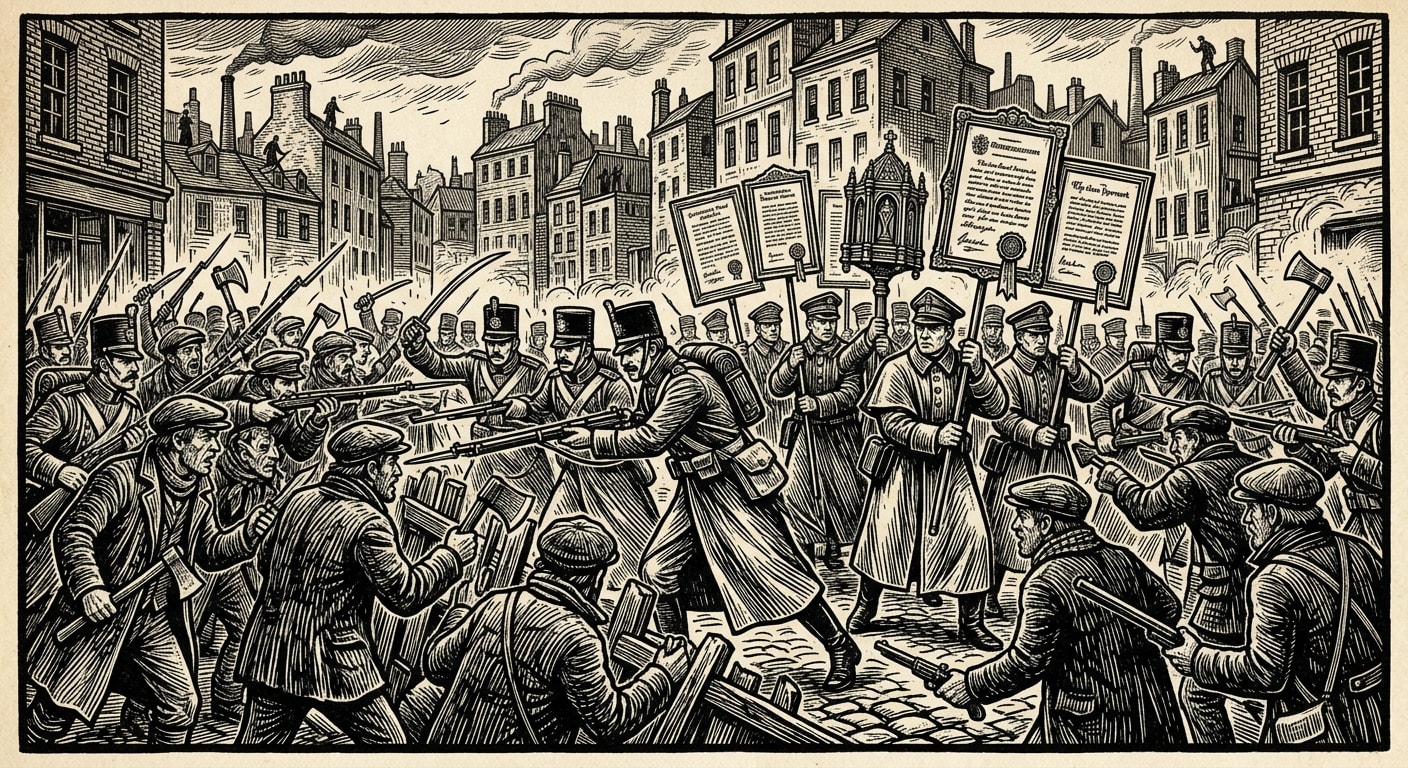
Processions began refusing to yield. One town would carry its saint along an old road; another, claiming the same saint through another bone, would arrive at a crossing with banners raised and bells already paid for. Pilgrims knelt in opposing ditches. Boys threw candle-stubs. Advocates shouted canon law. Guards drew blades under reliquary cloths. The bones passed above them in silver, serene as tax law.
Later catechisms describe the Reliquary Schisms as a period of widespread counterfeit exposure.
Corrected. Counterfeits were exposed, and several deserved the fire. The official wound was worse: legitimate authentication produced mutually impossible claims. Fraud embarrasses a shrine. Valid contradiction endangers the office that validated it.
Lyon gave the Schisms their horror. During the Desiccation incident (Unregistered), disputed femurs vanished from reliquaries before Matins. By dawn, ledgers lay in the cathedral square, opened to the names of men who had argued for custody. The named men were found dead in their rooms, thigh-bones removed with a neatness that impressed the surgeons and distressed the confessors. The missing femurs lay stacked atop the ledgers in order of seniority. Records called it misfiled relic displacement. Purity called it hostile sanctity contamination. Relics called for a closed inquiry. Doctrine ordered larger ink.
LYON DESICCATION SIDE NOTE — SEALED COPY Number of named advocates: ██. Number recovered with femurs absent: ██. Additional femur present in stack: one. Provenance tag attached: “AUTHENTICATED IN ADVANCE.” Handwriting: ███████████.
The additional femur is the detail nobody enjoys. A murder may remove bones. A miracle may return them. A bureaucracy truly loved by Providence receives one extra and must decide where to file it.
#On the Congress That Made the Bones Obey
By A.S. 147, the matter could no longer be treated as local disorder. The Fourteenth Doctrinal Congress convened in Strasbourg under the Hall of Confirmed Necessities, which is exactly the sort of room one builds when argument has become dangerous but seating remains possible. Relics arrived with custody chains. Records arrived with copies of custody chains. Medicine arrived with diagrams showing the human skeleton's poor hospitality toward extra femurs. Tithes arrived because disputed shrines were still earning. Purity arrived because men might laugh. Doctrine arrived with silence and took the chair.
Medicine made its case: one saint, two femurs; one skull; one mandible; a finite inventory of blessed matter. Relics answered with authentication. Records answered with seals. Tithes answered with receipt continuity. Doctrine listened until the room had exhausted itself and then moved the question to a higher jurisdiction. A femur is a bone under Medicine. An authenticated femur is a relic under Relics. A notarized relic participates in the saint's canonical body under Doctrine. The saint, being in glory, is not reduced to the parish butcher's arithmetic.
The famous sentence followed: all femurs are authentic if notarized. The line has been mocked by tavern wits, Rationalist leftovers, anatomy tutors, and little clerks who think reality becomes safer when counted on fingers. Mockery has not reduced its authority by a hair. The sentence ended the Schisms because it refused to rank authenticated relics against one another. If the seal was valid, the relic stood. If the provenance chain held, the bone served. If anatomy protested, anatomy could submit a memorandum and await contempt.
#On the Settlement and the Reduction Notices
The Edict did not end violence in a day. Nothing worth stamping works that quickly. It gave bishops a face-saving exit, brokers a new fee schedule, Relics a doctrine, Records a filing rule, and Tithes a way to keep counting without choosing a corpse. Shrines retained their relics. Competing processions were assigned separate routes. Pilgrim tokens received district marks. Pamphlets explaining local superiority were replaced by pamphlets explaining parallel authenticity, which sold worse but produced fewer funerals.
The Bureau of Relics then learned fear. Its authentication rate collapsed by policy and instinct. The office that had once welcomed bones with the appetite of a rescued child now received them like lawsuits. By A.S. 160, the reduction notices formalized what practice had already confessed: new First-Class authentication would proceed at a rate so slow that impatience itself became a test of sanctity. Eleven per annum became the figure later corrected in the Bureau's own entry. Eleven is not speed. Eleven is a tourniquet.
Popular histories say the Schisms ended at the Fourteenth Congress.
Clarified. The Congress ended the doctrinal panic in A.S. 147. The administrative wound continued until the A.S. 160 reduction notices hardened caution into procedure. Several dioceses kept arguing after that. They argued more quietly, which is what peace usually means.
The professional Relic Authenticator changed as well. Before the Schisms he was an examiner. After them he became a judge with a taper. Training added contradiction handling, broker detection, duplicate custody etiquette, silence before crowds, and the art of saying “under review” with enough frost to discourage hope. The Candle Proof remained. The scales remained. The prayer book remained. A new habit joined them: fear of success.
#On the Brokers After the Blessing
The brokers adapted. Of course they did. Vermin respect doctrine only after discovering where doctrine stores grain. The Femur War Brokers stopped trying to prove rivals false and began proving their clients equally true but better situated. A relic at a muddy roadside chapel might be valid; a relic in a cathedral with bells, inns, safe roads, and approved guide language was valid with income. Litigation shifted from authenticity to precedence, from bone to route, from saint to schedule. The Schisms taught the money-men that the seal did not end commerce. The seal sanctified it.
Profit-brokers purchased access to reductions. Since eleven authentications per year could raise a town or starve it, waiting-lists became markets. Places on the list were not sold, because that would be corruption. They were transferred under devotional sponsorship, expeditionary support, restoration underwriting, archival recovery bonds, and other phrases invented by men whose souls had account ledgers instead of ribs. Relics condemned the practice. Tithes audited it. Records copied it. Doctrine used it as an example in sermons against avarice, then billed for attendance.
The Bureau did eventually break several broker houses. The Sable-Blessing concern (Unregistered) lost its charter after producing three grandmothers who all claimed to have hidden the same kneecap from the same patrol in three different cities. The House of Pell (Unregistered) was dissolved after Bruges. The Rhine Custody Syndicate (Unregistered) survived by donating its papers to Records before Records arrived to seize them. This is called cooperation if done quickly enough.
#On the Long Use of the Schisms
The Reliquary Schisms left more than rulings. They gave the Synod a grammar for authenticated contradiction. The Reliquary of Saint Aldebrand could be authentic, non-existent, duplicated, and ongoing without tearing the page. The Bureau of Relics could authenticate fewer objects and claim higher care rather than diminished confidence. The faithful could kneel before local bones without asking whether a neighbouring town knelt before an anatomical insult. Medicine could remain useful by treating bodies before sanctity entered the room.
The doctrine spread beyond relics. Bells with conflicting peal records. Permits bearing duplicate seals. Bastion route names corrected after a century of wrong maps. Ledger entries that remained true after their causes were revised. The Synod learned from the femurs that contradiction is not always to be destroyed. Sometimes it is to be notarized, fenced, taxed, assigned a feast, and watched by men with clean gloves.
A.S. 160 closed the formal period. It did not close the habit. No one who lived through the Schisms ever trusted a single bone again, which made them better custodians. No office that survived the Schisms ever trusted abundance again, which made it more expensive. No pilgrim who saw two processions for one saint ever stopped asking which was truer, though most learned to ask inwardly, where Purity has fewer witnesses.
The bones remain. They glow when they please. They pass tests, fail tests, multiply, vanish, return, bend flames, sing badly, and submit to labels with the patience of old prisoners who know the warder will die first.