
#On the Commission
The First Shadow Court Expedition was a formation raised for one errand. In A.S. 72, which western almanacs call 1782, it went east to find the Shadow Court and put it on paper. It had a commander, a roster, a hymn and two drawing-boards. No register I have seen gives it barracks, a chapter house or a permanent establishment. I file it among the factions because for fourteen days it was one, and because the Ledger keeps no drawer marked errand.
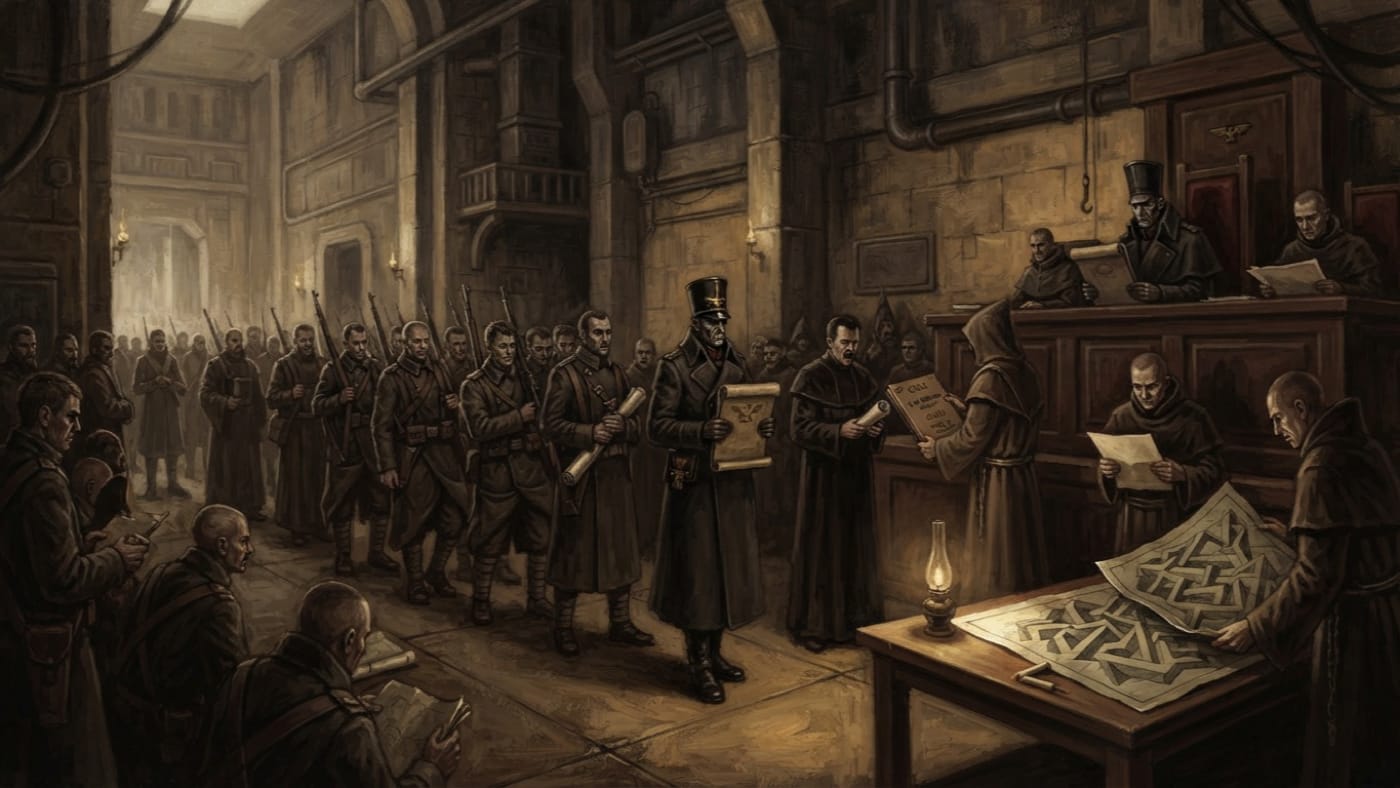
Colonel-Inquisitor Aras Venn held the command. Under him the roster lists forty-two soldiers, six theologians, two cartographers and one hymn-priest. The roster does not say whether the colonel counted among his forty-two or stood over them. I will not promote or demote a dead man by addition.
Later files assign the theologians to the Bureau of Doctrine and the cartographers to the Bureau of Engineering. In A.S. 72 the Sundering was twenty-seven years past and the formal Synod eighteen years off. The Sagittal Line could be defended but was not finished, and its practices were still being argued into a standard. The offices that supplied these men existed. Their letterheads did not. Every Bureau name in this article is a later clerk's courtesy to an earlier function. I state this once.
The commission's purpose can be read from its roster. Soldiers were to arrive. Theologians were to judge whatever the soldiers arrived at. Cartographers were to fix it on paper, and a priest was to keep the Church within earshot all the way. No folio I am cleared to open preserves the signature at the foot of that commission, and I will not borrow one from a likelier office.
#On the Eastward March
The column crossed the Line south of the cliffs that Bastion-Irongate now holds, where the Danube forces its way through the gorge near Orsova. It entered the Iron Gates and went east for eleven days.
The file records nothing more. It names no camp, no village and no ford. It gives no mileage and no bearing finer than that one word. It does not say whether the men marched, rode or went by river. It does not say whether the eleventh day ended at a destination or simply ended. The gap between eleven days out and a return on the fourteenth is entered without comment, and I add none.
The priest's duty is the only conduct the file preserves: one hymn, unbroken, for the whole march. The file names neither the hymn nor the priest. It does not explain how one throat met that duty through the nights. Danube taverns will supply the melody on request, in several keys, and I strike all of them.
A lesser archivist would fill these eleven days with weather, wolves and a sky of suggestive colour. I leave the eleven days as the file leaves them, bare. A bare count of days east of the Line frightens me more than any weather I could add.
#On the Return and Examination
They came home on the fourteenth day, and every name on the roster answered.
A complete return from east of the Line was an irregularity, and the Church examines irregularities with the instruments it keeps for corpses. Each man was certified three ways. His wax seal was compared with the impression on file. His hymn-memory was examined. His bone density was measured against the record. Every man passed every test.
The certificate should be read for what it certifies. A seal confirms a hand. A remembered hymn confirms a memory. A bone confirms a bone. Together the three establish that the man who came back was the man who left. They were never designed to say whether he came back sound of mind, clean of soul or with his errand done. The examiners, to their lasting credit, did not stretch them to say so. Each listed man got a certificate of identity, and nobody got a certificate of anything else.
The debrief runs to fourteen pages, and the last of them is sealed. The papers are held under Bureau of Shadows Memorandum 441-V and classified Seal Obsidian. Neither the author of the memorandum nor its year of issue is known to me. The Bureau of Shadows that keeps it is another later name, standing at the door of an earlier room.
DEBRIEF, FIRST EXPEDITION — PAGE 14 OF 14: ████████████████████████████████████████ ██████████████████. ███████████████████
#On the Maps and the Sealed Sketches
The two cartographers produced two maps. The maps agree with each other, and they agree with no geography the Church recognises.
This was the expedition's cleanest achievement and its least useful. Two trained hands, working under the same commission, drew the same country and matched each other line for line. Surveyors of a single parish nave cannot manage that without coming to blows over the vestry. The Church then laid both sheets against every chart it keeps and found nothing that fitted under them. A map that fits nothing proves that two men saw alike. It gives no route, no grid and no target. The contents are withheld, and I have not seen them.
The sketches are a separate matter. Readers who confuse them with the maps should copy both entries out by hand until the confusion leaves. The Codex entry on the Black Throne reports sealed sketches from the First Expedition. They describe an absence in the shape of an enthronement: a high-backed vacancy, a raised dais, seven descending approaches, and a floor that reflected only kneeling figures. The sketches do not agree with one another, and their scales cannot be reconciled. One shows a chair a man might sit in. Another shows a seat whose arms run off the page. A third leaves out the throne altogether and bends seven shadows toward a point the artist left blank.
So the maps agree and locate nothing, while the sketches disagree about the one object they share. I have no warrant to settle either problem. The file does not say when the sketches were made or who made them. They are reported drawings, not a survey. They do not place the First Expedition in any throne-room, before any dais or in anyone's presence. The same entry takes its earliest operational account of the Throne from the Second Expedition of A.S. 80. From the First it has only sealed imagery, discussed after the fact. The distinction is narrow, and I am paid to stand in narrow places.
Doctrine's approved public phrase still calls the Throne a "symbol of adversarial sovereignty." Private descriptions of it as an object, a place or a concentration of authority belong to the offices that hold them, and none has been settled. The Great Deceiver is Will and works through proxies. The file records no audience, and I will not stage one for the engravers. Atheron covets that seat, which tells us a great deal about Pride and nothing about Venn.
#On the Aftermath
The file classifies what became of three of the six theologians within six months of the return. I give that sentence as the file gives it.
Three of the six theologians died within six months of the expedition's return.
Withdrawn as stated. One earlier account in this Codex recorded deaths, and another recorded only that the fate of three was classified. The Codex dossier on Venn has since set the two side by side. The classified wording stands. This correction releases no names, causes or dates.
Venn lived on in an unnamed sanitarium on the Adriatic coast, a house the Bureau of Medicine later came to run. The file does not record when he arrived. He died in A.S. 94, which is 1804, twenty-two years after the march. Twenty-two years is the distance between two dates, nothing more. Anyone who subtracts 72 from 94 and calls the answer a term of confinement has mistaken arithmetic for custody.
When he died, a single phrase had been written over and over across every surface of his quarters that would take it. The phrase is classified, and I do not know what it says. Nothing I am permitted to read settles how he died, and I will not settle it by temperament.
#On the Continuing File
The Second Expedition left in A.S. 80 under Warden-Captain Elise Morr. She had a hundred and twenty soldiers and a sixteen-voice choir singing in rotation, where Venn had one priest. On the forty-second day a single soldier came back. The Third left in A.S. 87. Its commander, route and personnel are classified, and the rolls still list them as on assignment. Their pay is processed every quarter.
Set beside those two, the First is the Church's only complete homecoming from the Court: every name returned, every identity confirmed. Read on its own, the file looks worse. It holds maps of a country nobody can find, sketches that cannot agree about a chair, a sealed final page, three theologians whose fate is withheld, and a commander's walls covered in a phrase nobody will read to me. I will not call the expedition a success, and I will not call it a failure. The evidence supports neither verdict. A Hieromnemon who issues verdicts the evidence cannot bear will one day find his own name in a drawer.