
#On the Difficulty of Filing a Place That Refuses to Exist
"We sent three expeditions to find the Shadow Court. The first returned. The second did not. The third is still listed as 'on assignment.' The Bureau of Records updates their pay slips quarterly." — Hieromnemon Valerius Drax, marginal annotation to Bureau of Shadows Memorandum 441-V
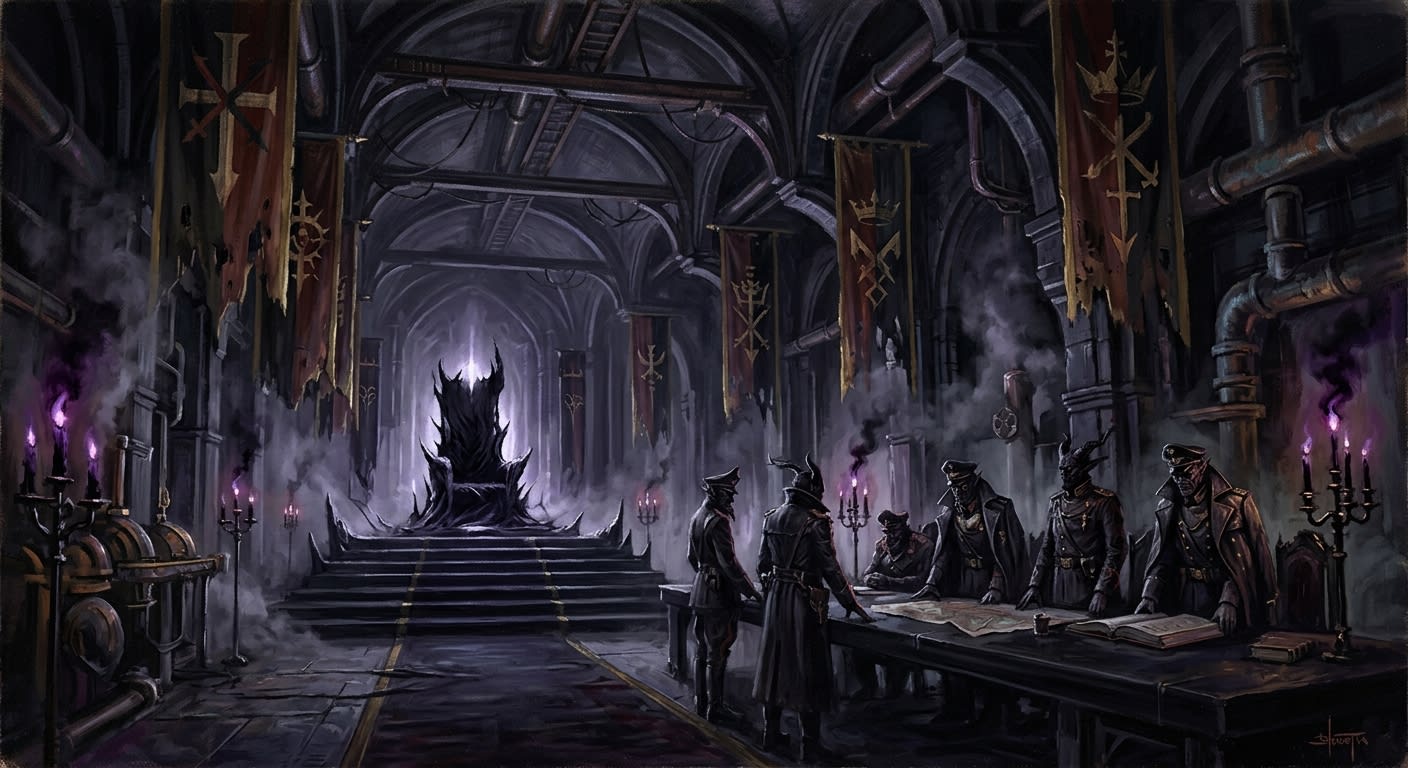
I have been asked — or rather, I have been instructed, which is the Bureau's method of asking when it does not wish to hear the answer "no" — to compose a definitive entry on the Shadow Court. A geographic survey. An administrative profile. A plate, as the Codex terminology has it, complete with districts and demographics and the neat little distances one finds printed beneath proper bastion entries. Three days' march from Sibiu. Accessible by rail from Lorn.
I will not be doing that. The reader who has opened this entry hoping for a map will be disappointed, and the Bureau clerk who catalogued this under "Locations, Hostile, Extant" will need to find a new shelf. The Shadow Court is not a place. It has no walls, no gatehouse, no bell-tower one might sketch in the margin of a survey report. It does not sit on a hill in the Balkans, however much the Great Deceiver's propagandists — and our own — might find it convenient if it did.
What the Shadow Court is, I shall endeavour to explain. The endeavour may fail. Drax admits failure in advance so that he may claim prescience when it arrives.
#On the Nature of the Court
The Great Deceiver does not sit upon a throne. He does not convene ministers. He does not sign writs nor stamp decrees nor maintain a bureaucracy of ink and parchment, for bureaucracy is the Synod's invention and the Great Deceiver's parody of it would require an interest in administration that the Adversary has never displayed. The Great Deceiver is a Will — the Voluntas Adversa Primordialis — and a Will does not require a palace any more than a fever requires a postal address.
And yet the Shadow Court exists. The Bureau of Doctrine affirmed this in its A.S. 78 assessment, and the Bureau of War corroborated it through a method it declined to specify. Agents of the Bureau of Shadows — an organisation I am not permitted to acknowledge and which I therefore acknowledge with the precision of a man who files reports to it twice monthly — have returned from the fallen territories with accounts that, while differing in every particular of geography, architecture, and temperature, agree upon a single point: there is a Court. There is a place — or a condition indistinguishable from a place — where the Seven Sin-Generals attend upon the Great Deceiver's Will, where bargains are sealed, where the campaigns of the east are adjudicated, where the Lie holds session.
The Bureau of Doctrine's working definition, declassified at my request (and over several objections I shall not dignify by naming), describes the Shadow Court as follows: a localized intensification of the Adversary's Will sufficient to bend the properties of observable reality, producing an environment in which spatial, temporal, and moral laws are subordinated to the Great Deceiver's intention. Which is a fine bit of theological engineering, and means, in the language of the common soldier: a place where the rules stop working and something else takes over.
The Court is not fixed. This is the first and most discomfiting fact. Scouts report its effects in the Serbian highlands one season and the Thracian lowlands the next. A patrol south of the Blightmarsh will find the air tasting of cinnamon and contracts; a survey team in the Macedonian wastes will discover that their compasses are pointing at each other. The geography of the Shadow Court is the geography of the Great Deceiver's attention — and the Great Deceiver's attention wanders with the patience of a thing that has centuries to spend and nothing it considers worth hurrying toward.
Earlier editions of this Codex suggested the Shadow Court was located "approximately forty leagues south-southeast of the ruins of Belgrade."
This estimate was based on a single field report from A.S. 134, itself based on the testimony of a captured Thrall who, under interrogation, drew a map on the floor of his cell in his own blood. The map was forwarded to the Bureau of Engineering, which noted that it depicted no known landform and that the Thrall had included, in the lower-left corner, a small but unmistakable portrait of the interrogator. The interrogator requested transfer. The map was burned. The estimate is withdrawn.
#On the Expeditions
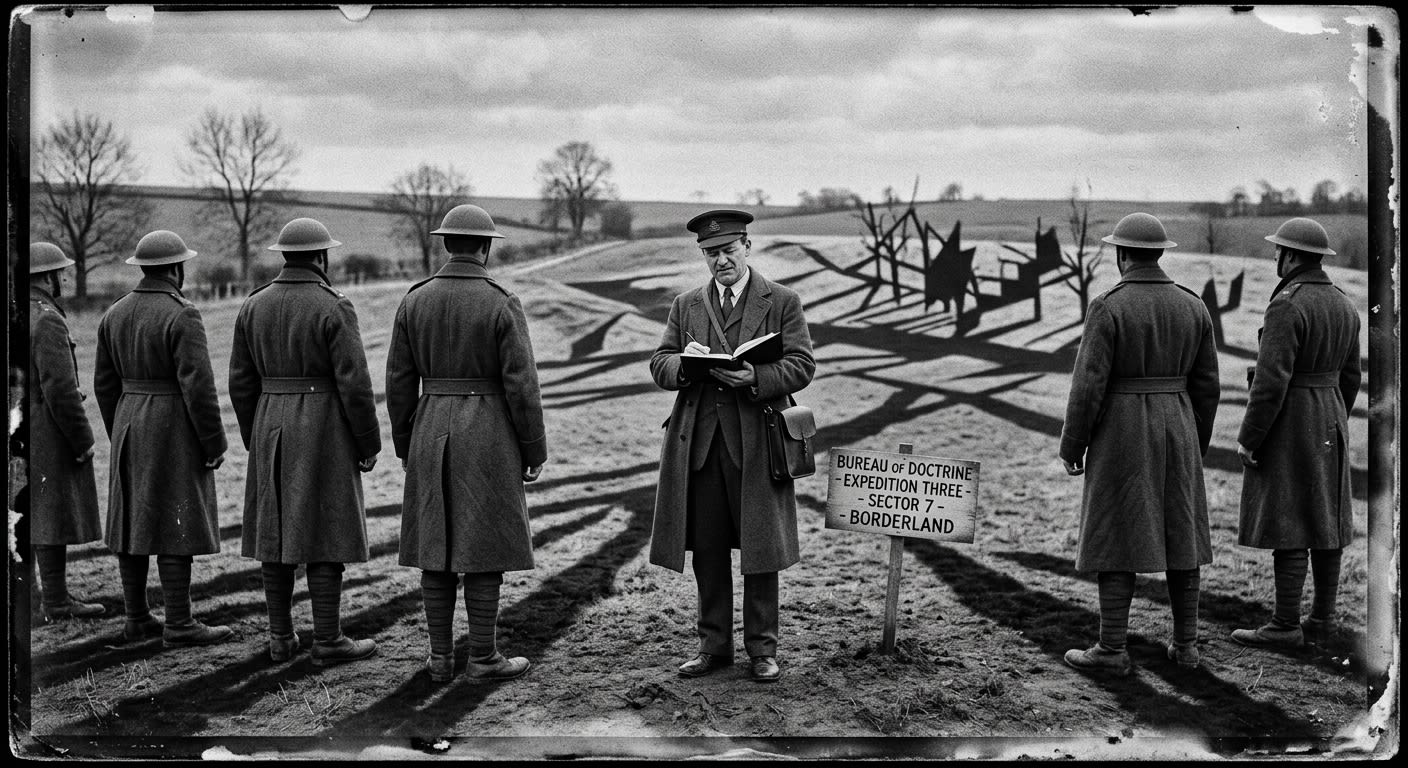
Three expeditions have been dispatched into the deep Balkans to locate the Shadow Court. This is a matter of classified record — specifically, Bureau of Shadows Memorandum 441-V, classified OBSIDIAN — and I am therefore not permitted to discuss it. I shall instead describe it, which is a different verb and one the Bureau's legal counsel has not yet thought to prohibit.
The First Expedition, dispatched in A.S. 72 under the command of Colonel-Inquisitor Aras Venn, comprised forty-two soldiers, six Bureau of Doctrine theologians, two Bureau of Engineering cartographers, and a priest whose sole function was to maintain a continuous hymn for the duration of the march. They crossed the Sagittal Line south of what is now Bastion-Irongate, advanced into the Iron Gates gorge, and continued east for eleven days.
They returned on the fourteenth day. All forty-two soldiers were present. All six theologians were present. Both cartographers were present. The priest was present. Colonel-Inquisitor Venn was present. The Bureau of Records confirmed their identities by wax-seal comparison, hymn-memory examination, and bone-density measurement. Every man was who he claimed to be.
What they brought back is classified. What happened to three of the theologians within six months of their return is classified. What the cartographers drew — the maps they produced, which agreed with each other in every particular and agreed with no known geography in any particular — is classified. That Colonel-Inquisitor Venn spent his remaining years in a Bureau of Medicine sanitarium on the Adriatic coast, where he was permitted visitors on Tuesdays and where he was found, after his death in A.S. 94, to have written a single phrase on every available surface of his quarters — walls, floor, bedframe, the underside of his mattress, the margins of his prayer book — is classified. The phrase itself is classified.
The Second Expedition, dispatched in A.S. 80 under the command of Warden-Captain Elise Morr, comprised one hundred and twenty soldiers, a full complement of Bureau personnel, and a dedicated hymn-choir of sixteen voices maintained in rotating shifts to ensure continuous sacred sound. They were better equipped. They had studied the First Expedition's reports — such portions as their clearance permitted. They advanced further, crossing the Danube at a point where the river ran the wrong colour and proceeding into territory that the Bureau of Engineering's pre-expedition survey described as "topographically inconsistent."
They were gone for forty-one days. On the forty-second, a single soldier appeared at the forward observation post south of Bastion-Irongate. He was wearing the uniform of the Second Expedition. He was carrying Warden-Captain Morr's commission seal. He could not speak, because his tongue had been replaced with a small, perfectly formed key made of black iron.
Bureau of Shadows Memorandum 441-V, Addendum 3: The key removed from Corporal ████████ was tested by the Bureau of Relics and found to be ████████████. When placed against ████████████, it ████████████ for approximately ████ seconds before ████████████. The key is currently held in Vault ████ at ████████████ under Seal Obsidian. Its lock has not been identified. Three Bureau of ████████████ have requested permission to search for it. All three requests were denied. Two of the three requestors have since ████████████.
The remaining one hundred and nineteen members of the Second Expedition have not returned. The Bureau of Records lists them under a designation I am not authorised to reproduce but which, I am told by a colleague who read it before his clearance was revoked, translates loosely as "consumed by the assignment."
The Third Expedition departed in A.S. 87. It was larger than the first two combined. Its commander's name is classified. Its route is classified. Its objective is classified. Its members — all of them, every name — are classified. The Bureau of Records continues to list them as "on assignment." Their pay slips are processed quarterly. Their families receive stipends. The Bureau of War allocates their rations, which are delivered to a warehouse in Strasbourg that no one enters and from which no one has ever been observed leaving.
The Third Expedition is one hundred and fourteen years late, and the Bureau considers this unremarkable. I find this the most informative detail in the entire file.
#On the Governance of the Court
If the Shadow Court is a condition rather than a location, its governance is a mood rather than an administration. And yet governance there is — or something that serves the same function, the way a wolf pack serves the same function as a parish council, provided one does not enquire too closely about the voting procedures.
The Great Deceiver presides. This much the Bureau affirms. But how he presides is a matter that has generated more sealed memoranda than any subject in the Codex save the nature of miracles themselves. The Great Deceiver has no body, no voice, no form that can be seated upon a throne — and yet the throne exists. The Black Throne, as the Bureau designates it: a concept of supreme authority that the Sin-Generals orbit the way moons orbit a planet they cannot see but whose gravity they cannot escape.
Atheron covets it. This the Bureau of Inter-Infernal Analysis has documented with more care than it devotes to any frontline engagement. Every city the Exalted conquers, every oath he twists, every spire he raises above the last — each is read by the Bureau's analysts as a stone laid in the foundation of a rival throne. Atheron serves the Great Deceiver because the Sundering made him a shard of the Great Deceiver's Will, but service is anathema to Pride, and the distance between "proxy" and "pretender" narrows with each passing decade. The Bureau of Doctrine has classified the suggestion that a Sin-General might rebel against the Great Deceiver as Speculative Heresy, Third Degree. Discussion is permitted only within sealed chambers. I am writing this in an unsealed chamber and invite the Bureau to interpret the act as it wishes.
The Sin-Generals do not cooperate. The deployed assessment is blunt on this point: their feuds are legendary, their truces temporary, their cooperations grudging and brief. The Shadow Court is less a parliament than a knife-fight conducted in formal dress, with the Great Deceiver's absent Will serving as the chandelier under which the combatants circle. Kargath devours what Velmora would hoard. Maldrake incinerates what Syrion would lull to sleep. Velkara seduces what Atheron would subjugate. Morwen covets everything and produces nothing except a hatred so refined it functions as a currency.
The Synod teaches that if the Seven were to unite — to coordinate their assaults, synchronise their campaigns, combine their sorceries — the Sagittal Line would fall. This is arithmetic, not prophecy. The Line holds because the Sin-Generals attack piecemeal, each pursuing their own obsession, each contemptuous of the others' methods. The Great Deceiver permits this disunity. The Bureau cannot determine whether he permits it because he cannot prevent it, because it serves some purpose no mortal mind can perceive, or because he is amused. All three possibilities are theologically catastrophic, and the Bureau of Doctrine has therefore declined to investigate further.
#On the Inhabitants
The Shadow Court is not empty. Between, around, and beneath the Sin-Generals' squabbling, a population persists — servants, conscripts, functionaries, and things that were once human and are now something the Bureau's taxonomy struggles to classify.
The mortal contingent is, by all accounts, vast. The Great Deceiver's armies do not conjure themselves from the abyss; they are recruited, bred, broken, and branded from human stock. Thralls with sigils seared upon their foreheads march in their thousands — men and women whose wills have been burned away, leaving husks that obey without comprehension and die without complaint. The Hollowed drift through the Court's shifting corridors like smoke given legs, their eyes glass, their mouths working at prayers they can no longer remember the words to. Processional Slaves are herded in chains, driven before demon hosts as walking shields of flesh, chanting litanies they do not understand in voices that have forgotten how to scream.
And then there are the diplomats.
The Lore Book's reference is terse: humans serve as diplomats in the Court, wearing masks of flayed saints. The Bureau of Shadows' intelligence is less terse and considerably more disturbing. These individuals — the Bureau refuses to call them "ambassadors," though their function is indistinguishable — move between the Sin-Generals' domains carrying messages, negotiating truces, brokering the temporary alliances that allow one General to focus their assault while the others feud elsewhere. They speak in a register that Bureau linguists describe as "Old Synodic inverted" — the Theocracy's own formal language run backward through a grammar that should not function but does. They carry writs sealed in wax that smells of chrism. They bow. They observe protocol. They are, in every measurable respect, bureaucrats.
The masks trouble the Bureau more than the diplomacy. The faces are not carved. They are taken — peeled from the reliquaries of saints whose bones the Synod has lost, saints whose features the Bureau of Records can identify from pre-Sundering iconography. The mask of Saint Erhard of Regensburg was positively identified by a Bureau of Shadows operative in A.S. 188, pressed against the living face of a man whose body language suggested he was delivering a trade proposal to Velmora's representatives. The mask's eyes were open. The man's were not.
The Bureau of Doctrine interprets the masks as "desecration as diplomacy" — the Great Deceiver's way of demonstrating that even the Synod's most sacred dead are not beyond his reach. The Bureau of Shadows interprets them as "operational camouflage" — the masks may confer protections that allow mortal flesh to survive in proximity to the Court's reality-bending conditions. Both interpretations are classified. Both are probably correct. The Great Deceiver has always been efficient with his blasphemies, making each serve double duty.
#On the Mock Liturgies
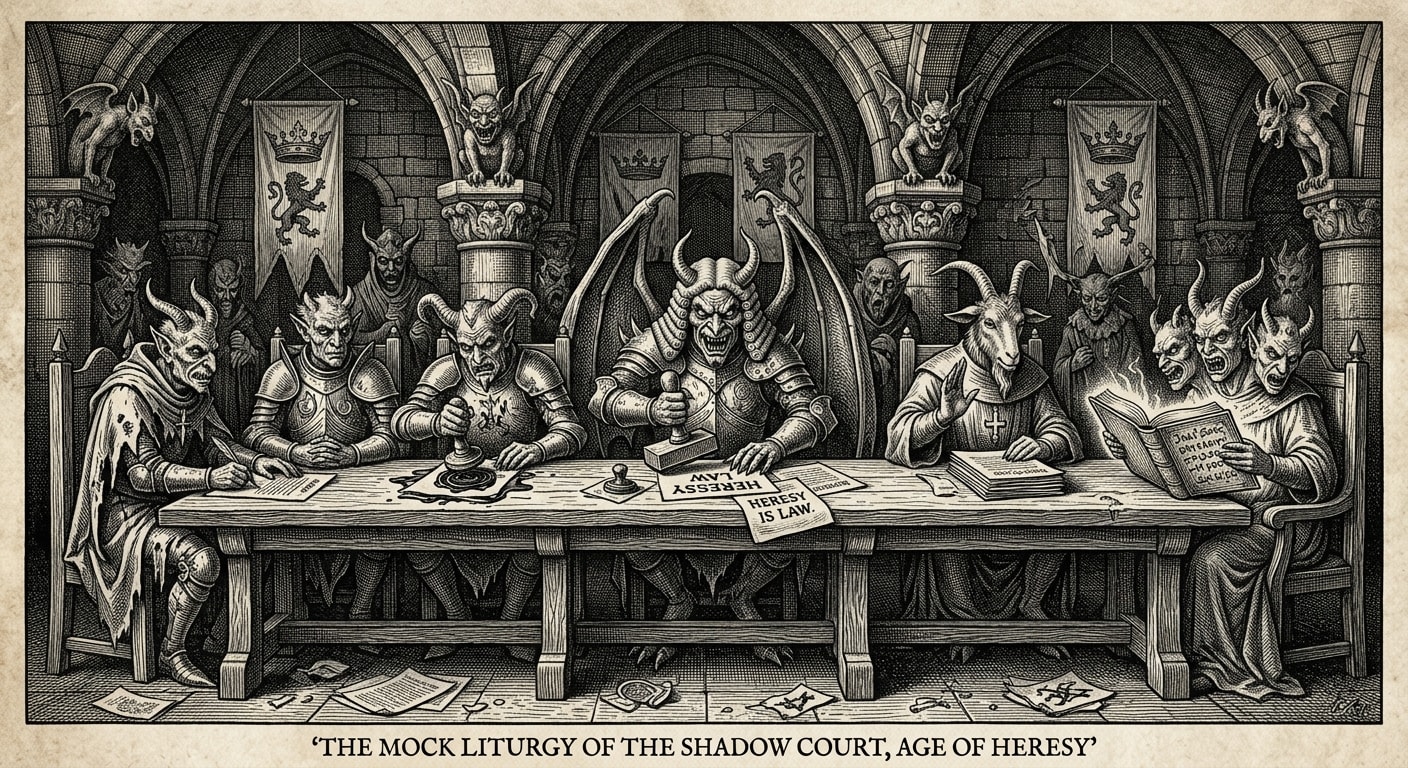
The Shadow Court does not merely oppose the Synod. It parodies the Synod — with a thoroughness that suggests the parody is the point, the mockery itself a weapon as sharp as any blade the Wrathforged ever hammered.
Bureau of Shadows reports — compiled, I should note, at considerable cost in personnel, sanity, and the Bureau's already meagre supply of agents willing to cross the Line — describe liturgical structures within the Court that mirror the Synod's own with a precision that borders on scholarship. Mock masses celebrated over altars of bone. Hymns sung in inverted plainsong, the melodies recognisable but the harmonics twisted until the sacred becomes obscene. Processionals in which relics — genuine relics, stolen or corrupted — are paraded through corridors of shifting geometry by acolytes whose vestments are stitched from the pages of Synod catechisms.
The Great Deceiver offers choice. This the parent entry establishes. The Shadow Court is the architecture of that offering — a cathedral built for the ceremony of choosing wrong. Where the Synod demands obedience, the Court invites complicity. Where Strasbourg issues decrees, the Court issues invitations, and the invitations are written on parchment that smells of burning churches in an ink the Bureau of Alchemical Standards has been unable to reproduce, though four alchemists attempted to before their laboratories were sealed and their names struck from the faculty register.
The mock liturgies are dangerous because they are not, in the strictest sense, mock. The words have power. The rituals function. Bureau of Rites assessments — conducted at arm's length, through scrying pools and captured artifacts rather than direct observation — confirm that the Shadow Court's ceremonies produce measurable supernatural effects. The inverted hymns disrupt sanctified wards. The mock baptisms bind souls in contracts the Bureau of Doctrine cannot undo. The parody confessionals extract truths the Synod's own confessors cannot match, because the penitent confesses willingly, eagerly, to an authority they have chosen.
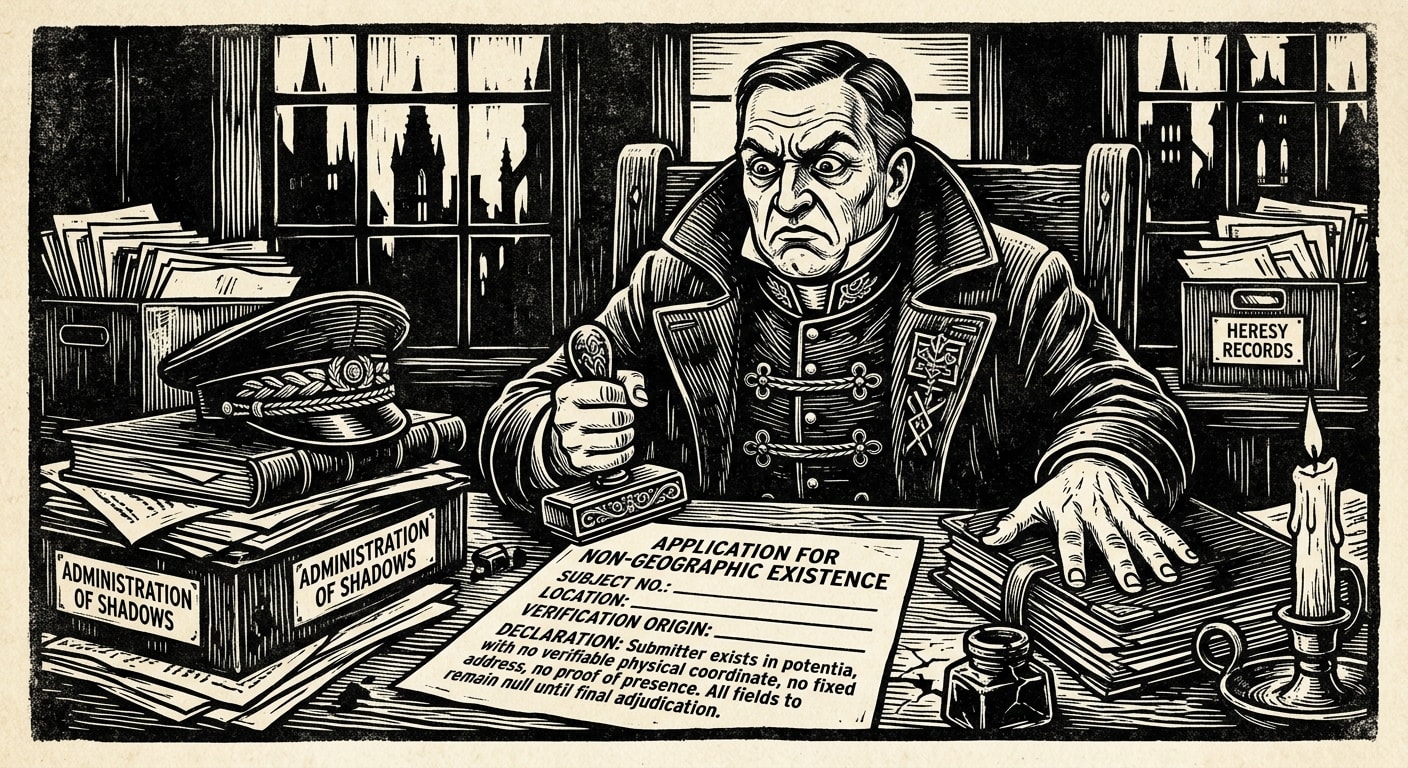
#On the Black Throne
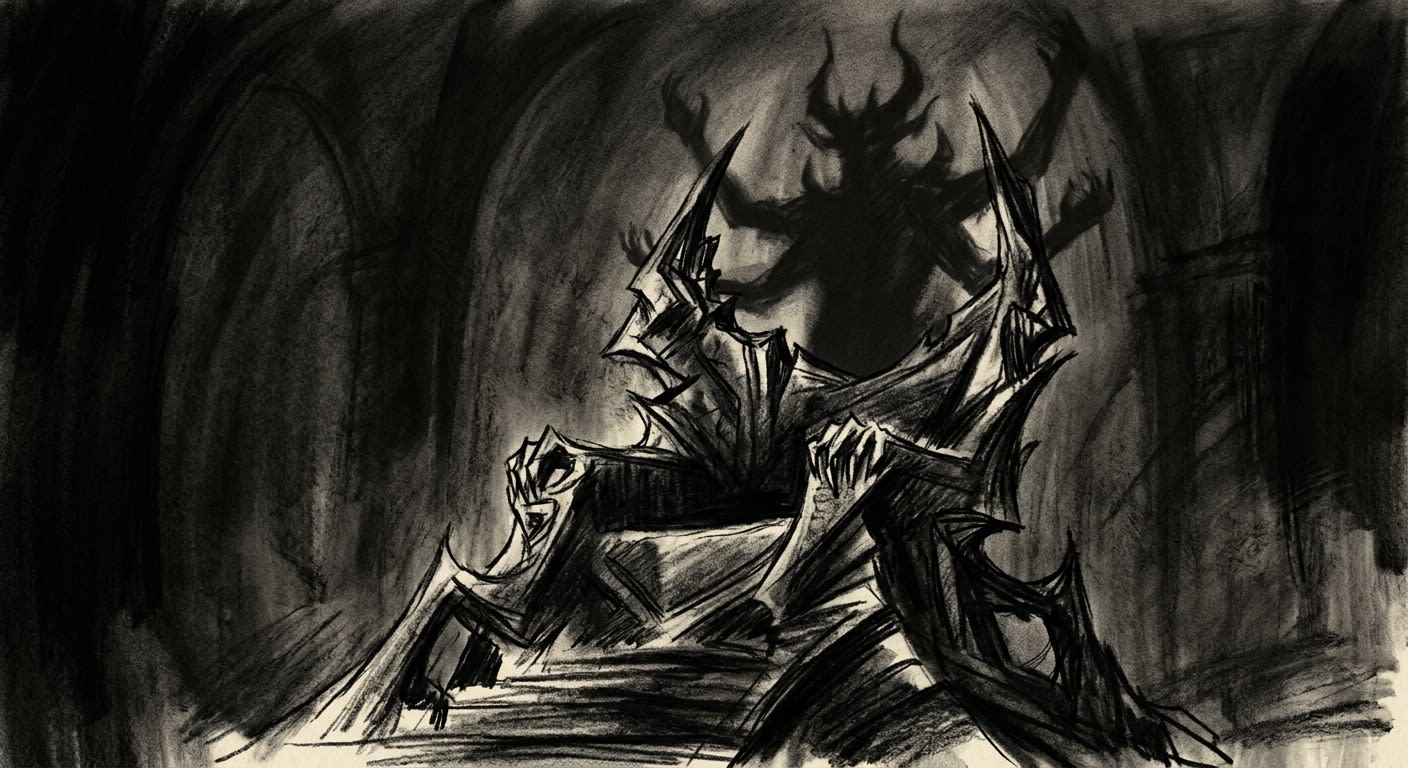
At the centre of the Court — if "centre" can be applied to a condition that shifts like smoke — sits the Black Throne. Or does not sit. Or sits in a manner so far above the concept of sitting that the word collapses under the weight of its own inadequacy.
The Bureau of Doctrine's official position: the Black Throne is a metaphor for the Great Deceiver's supreme authority, given symbolic weight by the Sin-Generals' recognition of his primacy. It is not a physical object. It does not occupy space. It is a theological construct, useful for catechetical instruction and official illustration but possessing no material reality.
The Bureau of Shadows' unofficial position, contained in a memorandum I obtained through methods the Bureau would prefer remained unspecified: the Black Throne is real. It is an object, or a place, or a nexus — the terminology varies between reports — at which the Great Deceiver's Will is concentrated to a degree that makes the surrounding Shadow Court look, by comparison, like a mild headache. Operatives who have approached within what they estimate to be "proximity" — a word they use with audible quotation marks, as though proximity itself has become unreliable — describe the sensation as weight. The weight of a gaze that sees through skin and bone and faith and arrives at the thing beneath, the thing you built your faith to cover, the thing you do not discuss even in confession.
Atheron covets it. The Bureau of Inter-Infernal Analysis has documented this obsession across one hundred and fifty-six years of intelligence reports. Every spire the Exalted raises, every oath he extracts, every crown he adds to the tiered absurdity of his Crownspire — all of it is rehearsal. Atheron is building a throne to rival the Great Deceiver's, and the fact that the Great Deceiver's throne may not be a throne in any sense Atheron could occupy does not diminish the ambition. Pride does not calculate odds. Pride calculates altitude.
#On the Anti-Synod
The Shadow Court is the Synod's reflection in a mirror that has learned to hate.
This is not metaphor — or rather, it is metaphor that has hardened into operational reality. For every Bureau, the Court maintains a counterpart. Where the Bureau of Doctrine stamps decrees, the Court whispers invitations. Where the Bureau of Records files names, the Court unfiles them — erasing identities, rewriting histories, dissolving the certainties that hold a man's soul to his body and his body to the Ledger. Where the Bureau of Shadows operates in silence and deniability, the Court's own intelligence apparatus operates in silence and generosity, offering precisely the truths the Synod withholds, at precisely the moment the listener is most desperate to hear them.
The Court does not govern through fear. This is what the Bureau of Doctrine finds most offensive, more offensive than the desecrations and the mock liturgies and the masks of flayed saints combined. Fear is manageable. Fear is the Synod's own instrument — the scaffold, the brand, the Inquisitor's chair. The Court governs through invitation, and invitation is infinitely more corrosive because it requires the soul to walk willingly into the furnace and close the door behind itself.
Previous editions of this Codex described the Shadow Court as "a crude imitation of Synod governance, lacking sophistication or theological depth."
This assessment has been revised. The revision was ordered by the Bureau of Doctrine after a Bureau of Shadows operative pointed out, in a debriefing that resulted in his reassignment to a listening post on the Baltic coast, that the Shadow Court's administrative efficiency in certain operational theatres exceeded the Synod's own. The operative was correct. The correction has been noted, sealed, and filed under a classification that ensures no one who might act upon it will ever read it.
#On the Present Condition
The Shadow Court persists. It shifts, it squabbles, it parodies, and it waits — with the patience of a thing that does not need to win this decade, or this century, because the weight of fear and exhaustion will eventually tip the scales without the Court lifting a single clawed finger.
The Bureau of War would like to destroy it. The Bureau of War has submitted seventeen proposals for a Fourth Expedition since A.S. 150. Each proposal has been denied by the Bureau of Doctrine on the grounds that "the operational risks outweigh the strategic benefits," which is the Bureau's way of saying that the first three expeditions cost enough and that a fourth might return something worse than a key made of black iron pressed into a tongueless soldier's mouth.
The Bureau of Shadows continues to monitor. Its agents cross the Line, observe what they can, and return — those who return — with intelligence that is filed, classified, and stored in vaults that grow deeper by the year. The intelligence confirms what the Bureau already knows and what I have spent these pages attempting to convey: the Shadow Court is the Great Deceiver's most precise weapon, more dangerous than any Sin-General's army, because it does not attack the body or the bastion. It attacks the architecture of belief itself. It demonstrates that there is another way to organise a civilisation — a way without bells, without stamps, without the Ledger — and that this other way works.
That it works by damnation is, the Bureau assures us, an important caveat. But caveats are small comfort to a man who has been standing in a trench for seven years and who has just been offered, in a voice that sounds remarkably like his dead wife's, the chance to choose.