
#On the Seat That Does Not Sit
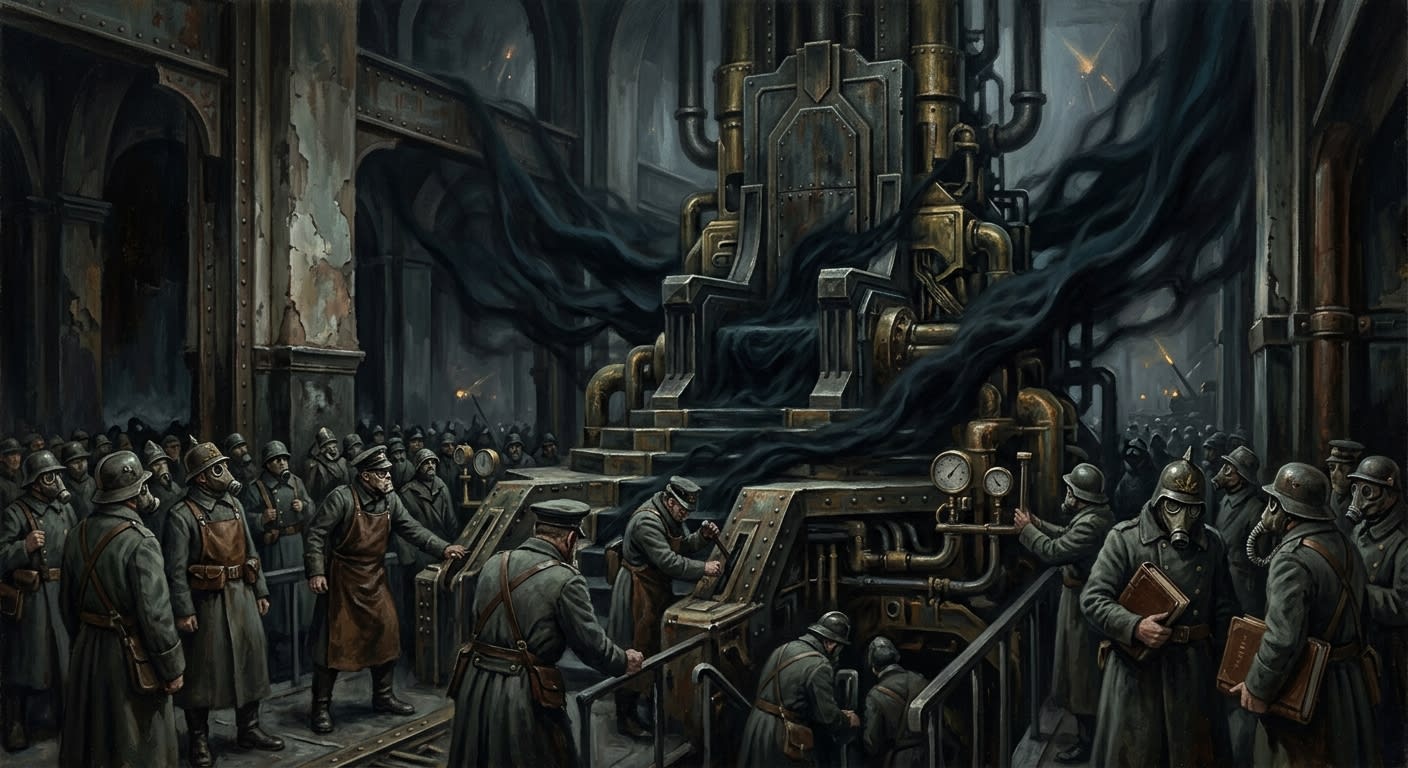
The Black Throne is the Great Deceiver’s seat at the centre of the Shadow Court, provided one uses seat, centre, and Throne with the caution normally reserved for loaded pistols, unstable relics, and compliments from Purity.
The Bureau of Doctrine maintains the official position that the Black Throne is not a physical object. It is a metaphor for the Great Deceiver’s supreme authority, a theological construct given pedagogical usefulness by the fact that peasants understand chairs more readily than metaphysical dominion. This position appears in catechisms, wall-plates, sanctioned engravings, and those dreadful schoolroom tableaux in which Hell is represented as a badly furnished court with moral labels on the drapery.
The Bureau of Shadows maintains another position. It does so in memoranda whose ink is blacker than regulation ink and whose margins make the skin beneath one’s fingernails itch. Their reports call the Black Throne an object, a place, a nexus, a pressure, a wound in authority, and once — in a field hand so steady it frightened me — “the chair Reality leaves empty for its conqueror.”
#On Proximity
No reliable measurement exists for distance from the Black Throne, because proximity itself becomes unreliable inside the Court. Operatives describe approaching it without moving, retreating toward it, kneeling before it while standing in an outer corridor, and seeing its outline behind their own eyelids after extraction. One A.S. 80 account from the Second Shadow Court Expedition recorded a corridor “twenty paces long, then seven years long, then intimate.” The scribe who copied the phrase later requested confession and received only a locked room.
The common sensation is weight.
Not physical burden. That would be mercifully vulgar. The Throne presses as an attention, a gaze that passes through clothing, skin, bone, oath, prayer, and trained piety, arriving at whatever little animal the soul has hidden beneath its vestments. Men near the Throne do not report being seen as sinners. They report being seen before sin acquired names.
The First Expedition’s sealed sketches describe an absence shaped like enthronement: a high-backed vacancy, a raised dais, seven descending approaches, a floor that reflected nothing except kneeling figures. None of the sketches agree in scale. One shows a chair tall enough for a man. One shows a seat whose arms vanish beyond the page. One shows no throne at all, only seven shadows bending toward a point the artist left blank. The blank spot has not yellowed with age.
A.S. 78 instructional plates represented the Black Throne as carved obsidian with horned ornamentation.
Withdrawn from officer schools after three cadets drew the same ornamentation from memory before seeing the plate. The Bureau of Arts blamed plagiarism. The Bureau of Doctrine blamed Arts.
#On Authority Without Body
The Great Deceiver has no body and no need of one. Bodies are liabilities: they bleed, hunger, fatigue, and must be placed somewhere. The Great Deceiver is Will. A Will rules by arranging desire, fear, choice, and consequence until all roads enter its seal.
The Black Throne is the sign of that arrangement hardened into locality. Around it, the Seven Sin-Generals become legible as fragments rather than monarchs. Kargath devours, Velmora accumulates, Maldrake burns, Syrion stills, Velkara seduces, Morwen envies, Atheron ascends. Before the Throne, each appetite reveals itself as a grammatical mood of a single adversarial sentence.
This offends them. Good.
Atheron’s offence matters most. Pride cannot orbit. Pride cannot kneel without designing a taller kneeling. The Bureau of Inter-Infernal Analysis has recorded one hundred and fifty-six years of Atheron’s aspirational usurpation: spires raised above spires, oaths stacked into ladders, captured cities refashioned as rehearsal platforms. He covets the Black Throne because it is the only height he has not claimed. Whether it can be claimed is irrelevant to Pride, in the way falling is irrelevant to a man who has already jumped.
BUREAU OF INTER-INFERNAL ANALYSIS — DOSSIER VERMILLION, EXTRACT SEALED: A.S. ███: Atheronic herald observed before a black dais, crown lowered by one hand-width. Ambient pressure increased. Herald’s second shadow detached and ███████████████. Surviving witness wrote, “The chair noticed the crown.” Witness died without injury.
#On the Anti-Synodic Chair
The Black Throne parodies every seat of Synod authority at once. It is the Hierarch’s chair, the judge’s bench, the confessor’s stool, the executioner’s platform, the notary’s desk, and the empty place at the head of a family table after the conscription cart has passed. It gathers the forms by which humans recognise command and empties them of mercy.
Strasbourg rules through occupied chairs. The Seven Seals of Faith have holders, or absences dressed as holders, or holders whose absence has become too expensive to name. The Hierarchy of the Synod depends upon the proposition that authority may be seated, sealed, observed, and obeyed. The Black Throne answers with a worse proposition: authority need not sit to make others kneel.
The Throne’s danger lies in recognition. Soldiers understand it before theologians do. Every army has a chair no one approaches, a table end no subordinate occupies, a space in the command tent where fear collects. The Black Throne takes that little human reflex and raises it to cosmic scale. One does not need to believe in the Great Deceiver to feel the room arrange itself around him.
Earlier catechisms taught that the faithful may resist the Black Throne by imagining the Creator seated above it.
Removed A.S. 174 under Directive 77-C. In hostile liturgical conditions, imagination is an unsecured instrument. The Bureau recommends prayer by approved text only, eyes lowered, no visual embellishment.
#On Countermeasure and Silence
The approved countermeasure is distance, silence, and denial in public speech. Do not sketch it. Do not model it. Do not use a black chair as dramatic furniture in frontier sermons, school plays, cautionary engravings, or Bureau training exercises. The Bureau learned this through humiliating experience and one puppet show in Lyon which caused seventeen children to bow in their sleep.
War has requested bombardment coordinates. Shadows has declined to provide them. Doctrine has declined to admit coordinates could exist. Records has opened a file for future coordinates and labelled it pending. This, absurd as it sounds, is the best posture the Synod has achieved: four Bureaus disagreeing so completely that no single mistake can proceed at speed.
The Black Throne remains unapproached, unmeasured, unfiled, and unburned. It waits inside the Court, or beneath it, or above it, or wherever the Great Deceiver’s Will gathers itself until place becomes obedient.