
#On Their Nature
The Fishmarket cats of Hamburg entered the Codex by a single clause. It sits in the dossier of Admiral-Prefect Gerta Halske, at the end of a list of places the Hamburg sub-office of the Bureau of Purity would like to enter and cannot: ships, warehouses, taverns, foreign residences, dock chapels, guild halls, and the cats. The clause adds that their theological position remains admirably opaque. I wrote that clause. I stand by every word of it, and persons who should know better have asked me to expand it.
Very well. They are cats. They have four legs, a tail apiece in most cases, an appetite for fish, and a contempt for the clergy that the clergy has done little to earn and a great deal to deserve. They live in and about the Fishmarket, one of the four quarters into which the Synod's survey divides Hamburg. They are distinct from the populations of the Dock Quarter, which are human and more troublesome. Nobody has counted them, and they are named in no document I am prepared to sign. Whether they possess souls has never been determined, because the Bureau of Doctrine, with a wisdom it rarely displays, has declined to schedule the question.
What concerns me is the administrative problem. In the strict language of my office, a creature that cannot be catechised, cannot be taxed and will not stand still for a seal is unfiled. The Synod tolerates many horrors. It tolerates very few blank lines.
#On the Fishmarket
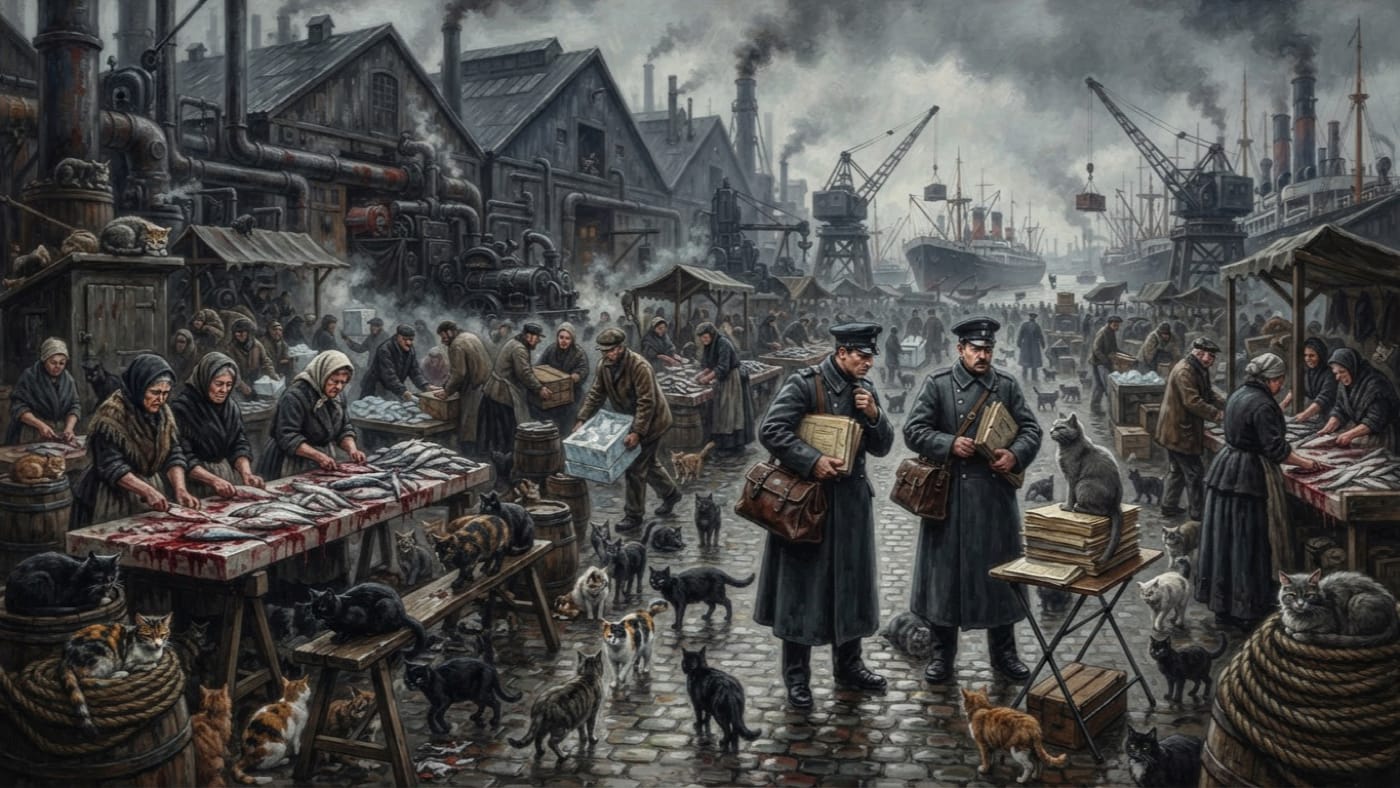
The Fishmarket is wet. This is its first and most honest characteristic. Before first bell the stalls go up under oil lamps and the herring and cod come off boats that worked the North Sea overnight. The paving takes on the colour of old pewter and the smell of a reliquary nobody has aired since the Sundering. Women gut. Men shout prices. Boys carry ice and salt, and sometimes carry them off. Beyond the market roofs the harbour cranes swing on steam, and down the Elbe a whistle announces that another ship has arrived carrying more than fish.
Hamburg is the Synod's great northern mouth. British grain, Dutch paper, Scandinavian timber and seal-oil all pass through it before they are turned into rail sequence along the Northern Corridor toward Kanzleiburg and the front. Within this machine the Fishmarket is the part that feeds the city rather than the war, and it has the manners of a place that knows the difference. Its goods spoil quickly. Its patience spoils faster.
The cats are there because the fish are there. So far as anyone can prove, that is the whole of their theology. They sleep under trestles and on crates, on coiled rope, on the warm iron of a boiler housing. Now and then one sleeps on a manifest that someone set down for a moment, and the manifest is never legible again. They groom with the deliberation of canons reviewing a disputed will. And they watch.
#On Their Occupations
At a fish stall a cat does three things: it waits, it takes, and it leaves. Clerks who want to find an occupation in this have settled on rat-catching. I will grant that the Fishmarket has rats and that the cats have teeth. I will grant nothing further. There is no contract and no ration. No warehouse factor has ever entered a cat in his books as an asset, and the Bureau of Tithes, which has assessed stranger things, has never thought to try.
Anyone trained in my office feels the pull to read these animals as a workforce. The tabby asleep on the salt barrel looks like a watchman off duty. The grey sitting upright beside the gutting tables looks like an inspector. The black one that crosses the square just as a Purity officer crosses it the other way looks, to the officer, like a great deal more. Bad doctrine is made out of resemblances. I have spent a career reading it, and I know the hand.
What can actually be said is narrow. The cats attend the market. They take what is dropped and some of what is not. They regard officials with the same steady, unimpressed interest the fishwives keep for officials. Nobody has yet asked for a boarding party to examine the fishwives on that ground, though I would not bet on the Hamburg sub-office's restraint.
#On Purity's Access
The Bureau of Purity has eleven officers posted to Hamburg. Nine hundred thousand people live there, which leaves each officer rather more than eighty thousand souls. The officers have answered this arithmetic the way Purity always answers arithmetic, by asking for more doors. Their complaint lists ships, warehouses, taverns, foreign residences, dock chapels and guild halls. Then, as though the pen had run on past the point of reason, it lists the Fishmarket cats.
The complaint is real. Its consequences are undocumented. No cat has been inspected, no finding entered, no verdict sealed. The Codex records a request for access and nothing more. Anyone who has heard otherwise in a Hamburg tavern has heard a tavern.
Why Purity wants the cats is a question the sub-office has never answered, so I will answer it for them. The cats move freely between quarters Purity cannot enter. They board ships before any boarding party does. They sleep in warehouses Purity has been refused. They slip under chapel doors at the hour of bells and leave when they please. Picture an officer who has been told later by the Admiral-Prefect's clerks for the eleventh time in a week. To him, an animal that is never told later must look like a standing insult to jurisdiction. An insult with whiskers.
What the officers would do once admitted is not recorded. Interrogation fails at the first question, because confession requires speech. The Index has no column for a creature that, depending on Doctrine's eventual ruling, may be beneath sin or outside it altogether. Purity is not permitted to answer that question on Doctrine's behalf, however much it would enjoy the practice.
The posture of trained animals in Synodal territory testifies to their assent. Kings kneel, bakers kneel, even cats kneel if trained properly. All kneel before Strasbourg.
Corrected. A cat trained to kneel has been trained. The remark was rhetoric, not observation. It is withdrawn as evidence in any proceeding touching the Fishmarket cats, whose posture is in any case most often horizontal.
#On the Admiral-Prefect's Priorities
Halske has never ruled on the cats. She rules on cargo, which in Hamburg is a larger jurisdiction than heaven and better documented. Since A.S. 194 she has held the Northern Maritime Chapterhouse's authority over harbour routing, naval import schedules, emergency dock orders, war-cargo priority and the scheduling of foreign factors. On paper she answers to Kanzleiburg's civil authority and to the Bureau of War. In practice she answers to whatever the harbour requires, and the harbour has expressed no opinion on cats.
Her rule for Purity is her rule for everyone: access once the cargo has moved. Sometimes. The northern front wants fourteen hundred tons of grain a day and gets twelve hundred on honest days. That shortfall is the margin by which Bastion-Königsberg and Bastion-Brest go hungry. Halske will not widen it so that eleven men can follow a cat through a granary, and she will not hand a boarding party the hours while grain sweats in a hold. Grain from the British Crown moves first, and so does anything bought on credit from the Netherlands. The cats are never in a hurry. They end up last on a list that never reaches its end.
None of this is tenderness. Halske enforces devotion severely wherever enforcement does not obstruct unloading. She has never claimed the cats, never fed them on the Chapterhouse account and never exempted them from anything. She has simply scheduled them behind the grain, as she schedules relic-freight, and Purity with it. The cats did not ask for this protection. They benefit from it the way the gulls do, and with the same gratitude.
#On the Present Classification
The question Purity wants to ask remains unasked. The question Doctrine ought to ask remains unscheduled. The cats go on living under the trestles and eating what falls. They cross between quarters as the tide permits and the bells allow, and they look at officials the way a magistrate looks at a defence he has heard before.
I have considered classifying them as vermin, which would satisfy Purity, or as livestock, which would satisfy Tithes. I have also considered classifying them as parishioners, which would satisfy nobody and start a riot in the Synod Quarter. Every classification creates an office, and every office would want its own eleven men. Hamburg cannot spare the men, and Halske cannot spare the hours.
So they remain opaque. The Ledger can survive one blank line. It has survived worse, most of them signed.