
#On the Matter of the Isles
"An island is a heresy the sea has not yet corrected." — Marginal annotation, Bureau of Doctrine coastal survey, A.S. 74
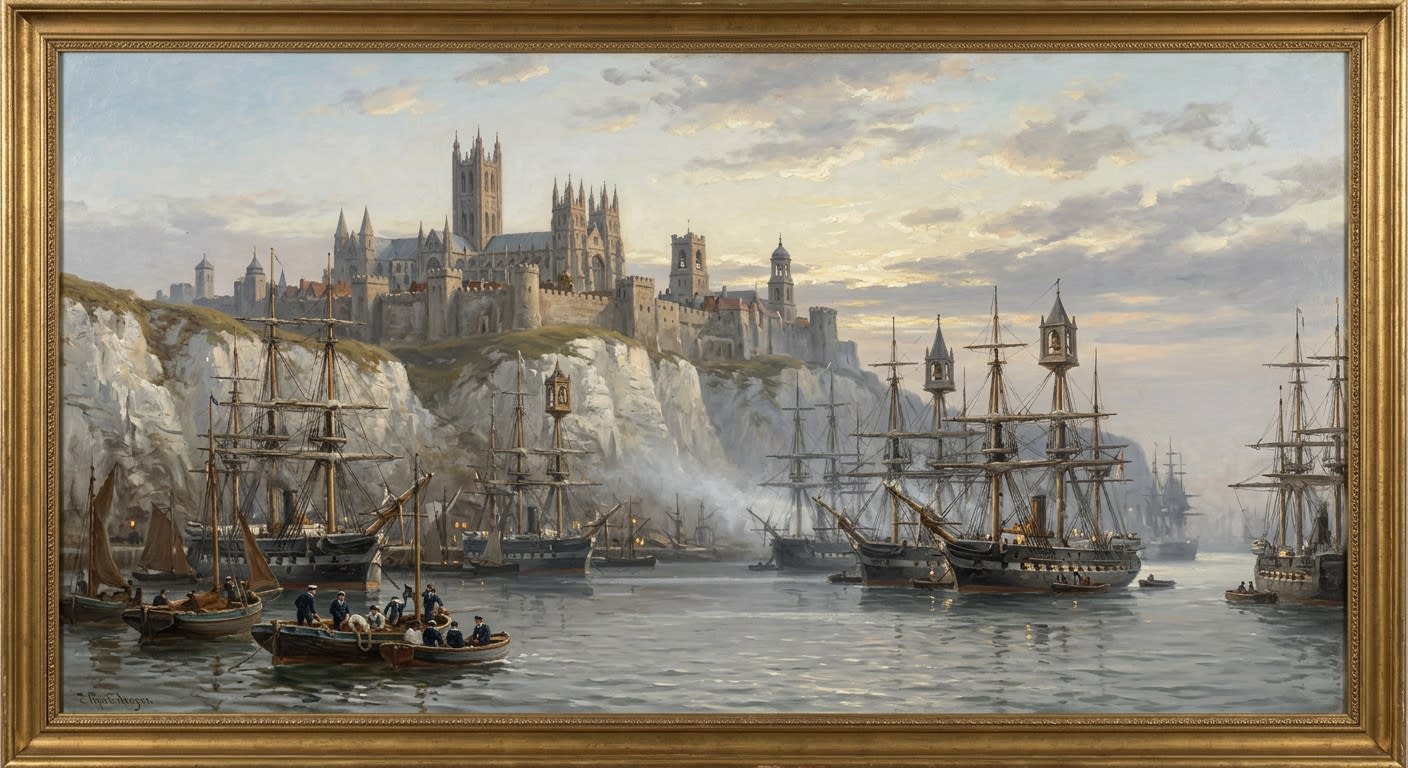
I have crossed the Channel once. I will say this plainly, because there are men in Strasbourg who have written forty thousand words on the subject of Britain without troubling to wet their boots, and I am conscious of the distinction. The crossing took nine hours in a vessel chartered from the Dutch — who else? — with a crew that prayed to no saint I recognised and a captain whose navigational charts bore annotations in a script the Bureau of Records has formally declined to classify. The sea was grey. The wind was spiteful. The coast, when it appeared, was white cliffs rising from dark water like the stripped spine of a continent that the Creator had broken and discarded.
I arrived at Dover in the autumn of A.S. 194. I departed Dover eleven days later, in the company of a formal diplomatic protest from the Warden-Marshal of the Kentish Shore, two confiscated notebooks, and a conviction — which has not diminished in the seven years since — that the Synod understands the British Crown with precisely the depth and accuracy of a man who describes a whale from the evidence of its tooth.
The British Crown is not a member of the Synod. The British Crown is not an enemy of the Synod. The British Crown is the thing the Bureau of Doctrine has spent a hundred and eleven years failing to classify, and the failure is instructive, because it reveals the Bureau's fundamental limitation: the Bureau classifies by obedience and disobedience, and the British Crown has never been disobedient because the British Crown has never acknowledged that obedience was owed.
#On the Crown and Its Seat
The government of Britain is, by the standards of the Concordat, an anachronism. Where the Synod governs through Bureaus, through ledgers, through the accumulated weight of a hundred and eleven years of classified paper, the British govern through a Crown that sits on a head that sits on a throne in Canterbury. The throne is old. The Crown is older. The head beneath it changes, as heads do, but the institution persists with a stubbornness the Bureau of Records would admire if the Bureau of Records were capable of admiring anything it did not file.
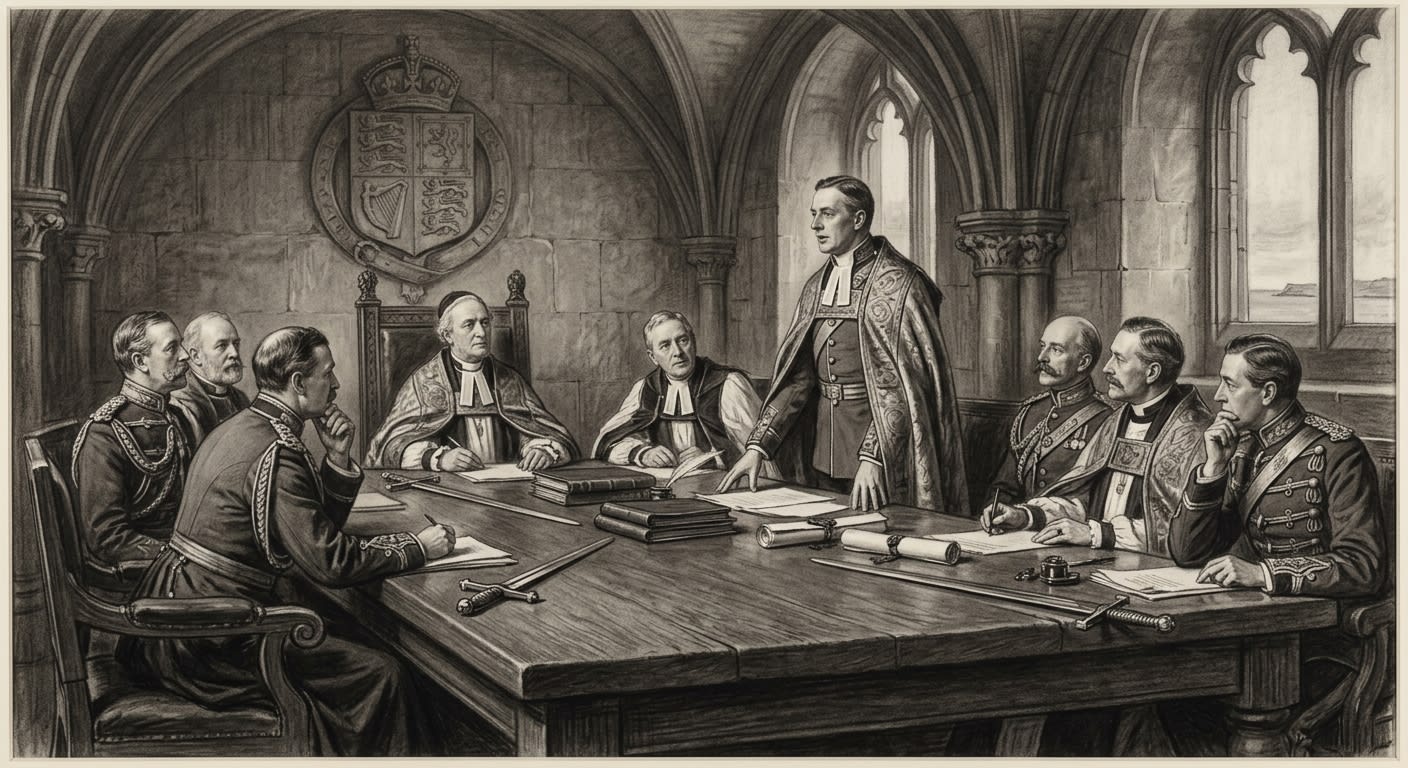
The current occupant of the Throne of Canterbury is King-Warden Aldric the Third, styled Rex Custos, "the Guardian King," and addressed in diplomatic correspondence as His Serene and Consecrated Majesty, Warden of the Isles, Keeper of the Kentish Shore, Lord of the Table of Nine, Defender of the Lantern Faith. The Synod's ambassadors are instructed to use the full style. The Synod's ambassadors, in their private dispatches, refer to him as "the island abbot with a sword." I have read the dispatches. The characterisation is unkind and not wholly inaccurate.
The Arthurian tradition — and I use the word "tradition" with the precision of a man describing a load-bearing wall — is the foundation on which the British Crown rests. Where the Synod traces its authority to Augustinus, to the Common Allegiance, to the Council of Worms and the ink of Strasbourg, Britain traces its authority to a myth so old it has become architecture. Arthur — king, warlord, saint, or some braided compound of all three — is invoked in every oath, every coronation, every judicial proceeding from Canterbury to the Orkneys. His Table, or the legend of it, structures the government: nine seats, nine Wardens, each responsible for a portion of the realm, each answerable to the Crown, each armed with a charter that predates the Sundering and that the Bureau of Records has been unable to obtain a copy of despite seventeen formal requests and four informal ones conducted through channels the Bureau of Shadows has declined to describe.
The nine Wardens govern the shires, the ports, the coastal watches, and the interior marchlands. Their authority is military and ecclesiastical in one fist — they command garrisons and they ordain chaplains, and they do both with a directness that the Synod's separation of Bureau jurisdictions would find appalling. A Warden of the Kentish Shore can, in the same afternoon, sentence a smuggler to hanging, consecrate a chapel bell, and commission a warship, and he requires no counter-signature, no Bureau stamp, no filing in triplicate with the appropriate sub-office of the appropriate sub-department of the appropriate Bureau. He requires the Crown's charter. He has the Crown's charter. He has had it since before Strasbourg existed.
#On the Fortress-Monastery
Britain is a fortress. I do not use this word as the Bureau of War uses it — to denote a specific military installation with walls, guns, and a filing number. Britain is a fortress, in the sense that the entire island has been organised, from its chalk coastline to its granite highlands, as a single defensive position against the world.
The great cities of the pre-Sundering age have been pared to their bones. London — which the British call Lunden-Kirk, because they will not use a name that does not contain a reference to either the Creator or stone — is a walled monastery-city of perhaps four hundred thousand souls, governed by the Abbot-Commander of the Thames, who reports to the Warden of the Southeastern Shore, who reports to the Crown. Every district is a parish. Every parish maintains a bell tower, a garrison house, and a wall. The city does not sprawl. The city crouches. The streets are narrow by design, defensible by intention, and clean by a standard of hygiene that the Bureau of Mercy would call "obsessive" and that the British call "godly."
Canterbury is the spiritual heart — a fortified cathedral-city that functions as both the Crown's seat of governance and the island's supreme religious authority. The Archbishop of Canterbury holds a rank that, in the Synod's terminology, would combine the offices of Hierarch of Doctrine, Castellan-General, and Liturgist-Primus into a single appointment. The British see nothing unusual in this. The Synod considers it an abomination of jurisdictional hygiene.
Pilgrims still cross the Channel to kneel in Canterbury, though "still" understates the matter — the pilgrimage has grown in the last two decades, fed by a reputation for miracles that the Bureau of Relics has been unable to verify because the Bureau of Relics has been unable to obtain visitation permits. Canterbury's relics are numerous, old, and — by every second-hand account the Bureau possesses — functional, in the sense that relics held within the cathedral precincts produce measurable effects that the Bureau of Relics' own inventory manages with decreasing frequency. The British do not notarize their relics. They do not file them. They mount them on altars and in the hilts of swords and in the keystones of bridges, and they pray at them with a fervour that the Bureau of Rites has formally classified as "sincere but non-standard."
#On the Navy and the Channel
The British Crown's military power rests on water. Their army is modest — fifty thousand men under arms in peacetime, perhaps eighty thousand at full levy, organised in shire regiments answering to their Wardens. By the standards of the Continental Levy, this is a hamlet militia. By the standards of their island, it is sufficient, because the island's true defence has never been its garrisons.
It is the navy.
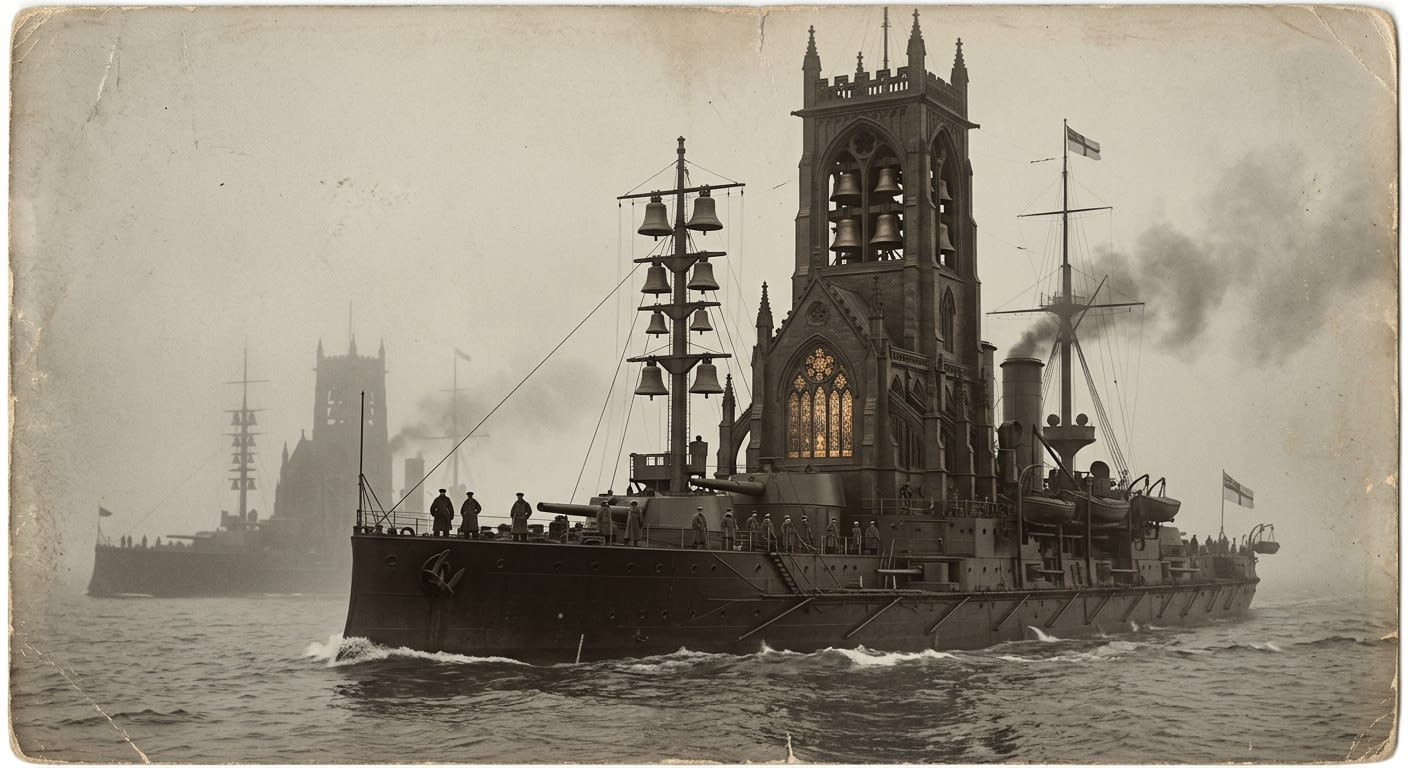
The Royal Fleet of the British Crown numbers, at the Bureau of War's last estimate — which is four years old, because the British have declined to update it — approximately three hundred warships of varying displacement, from coastal cutters to the great reliquary galleons that the British call Cathedral Ships. Each Cathedral Ship carries, in addition to its conventional armament of guns and rams, a consecrated chapel amidships, a bell-tower above the quarterdeck, and a reliquary sealed into the keel that, according to captured intelligence reports, renders the hull resistant to sorcerous attack in ways the Bureau of Engineering has not been able to reproduce despite eleven years of effort.
The Channel is their domain. Since the founding of the Chalk Redoubt of Calais in A.S. 69, the Synod has maintained its own coastal installation on the continental side — but the open water belongs to the British, and everyone on both shores knows it. British patrols run from the Dover Strait to the Bay of Biscay. British warships escort Synod grain convoys through the western approaches. British naval intelligence — gathered through means the Bureau of Shadows has expressed professional admiration for while simultaneously declining to describe — has prevented no fewer than fourteen confirmed piracy operations against Synod shipping since A.S. 180.
The Dover Chainworks is the point of contact: a port-worksite on the English shore opposite Calais, where chain, net-cord, blessed rope, and naval supplies are manufactured for joint use. The Chainworks operates under British authority with a Synod trade attaché permanently stationed on-site. The trade attaché's reports, which I have read, consist largely of complaints about the weather, the food, and the British insistence that all commerce be conducted in a currency the Bureau of Tithes does not recognise.
They also patrol the western Mediterranean — not as a favour to the Synod, but because piracy threatens their own trade routes to Iberia and the Italian coast. The British maintain a permanent squadron at Gibraltar, which they call the Lantern Gate, and from which they project naval power across the western sea with an efficiency the Bureau of War studies with poorly concealed envy.
#On the Lantern Faith
The religion of Britain is Christian. I state this because the Bureau of Doctrine's official position — maintained since A.S. 90 and the Concordat — is that "England had long since fallen to chaos across the Channel," and the charitable reading of this position is that the Bureau was misinformed. The uncharitable reading is that the Bureau knew perfectly well what Britain was and chose to classify it as chaos rather than admit that an alternative model of Christian governance existed, functioned, and — in certain measurable respects — outperformed the Synod's own.
The British call their faith the Lantern Way. Its theology is recognisably Christian — the Creator, the Adversary, the Sundering, the obligation of the faithful to resist and endure — but its practice diverges from the Synod's in ways that the Bureau of Rites has spent decades cataloguing and that I will summarise as follows: the British do not separate the sacred from the martial, and they do not separate either from the personal.
In the Synod, a man prays in a chapel administered by the Bureau of Rites, fights in a regiment administered by the Bureau of War, and confesses in a booth administered by the Bureau of Purity. In Britain, a man prays, fights, and confesses in the same hall, before the same Warden, with the same sword laid across his knees. The liturgy is shorter. The sermons are longer. The penances are — by any standard — harsher.
Erratum — Bureau of Doctrine, Filed A.S. 199: A prior assessment classified the Lantern Way as "Schismatic Heresy, Category Two." This classification has been revised to "Non-Standard Observance, Diplomatically Accommodated." The revision was prompted by the Bureau of War's observation that classifying Britain's religion as heresy while simultaneously relying on British warships to protect Synod grain convoys constituted "a doctrinal position incompatible with continued caloric intake." The Bureau of Doctrine acknowledges the force of this argument without conceding its theological merit. Ratified.
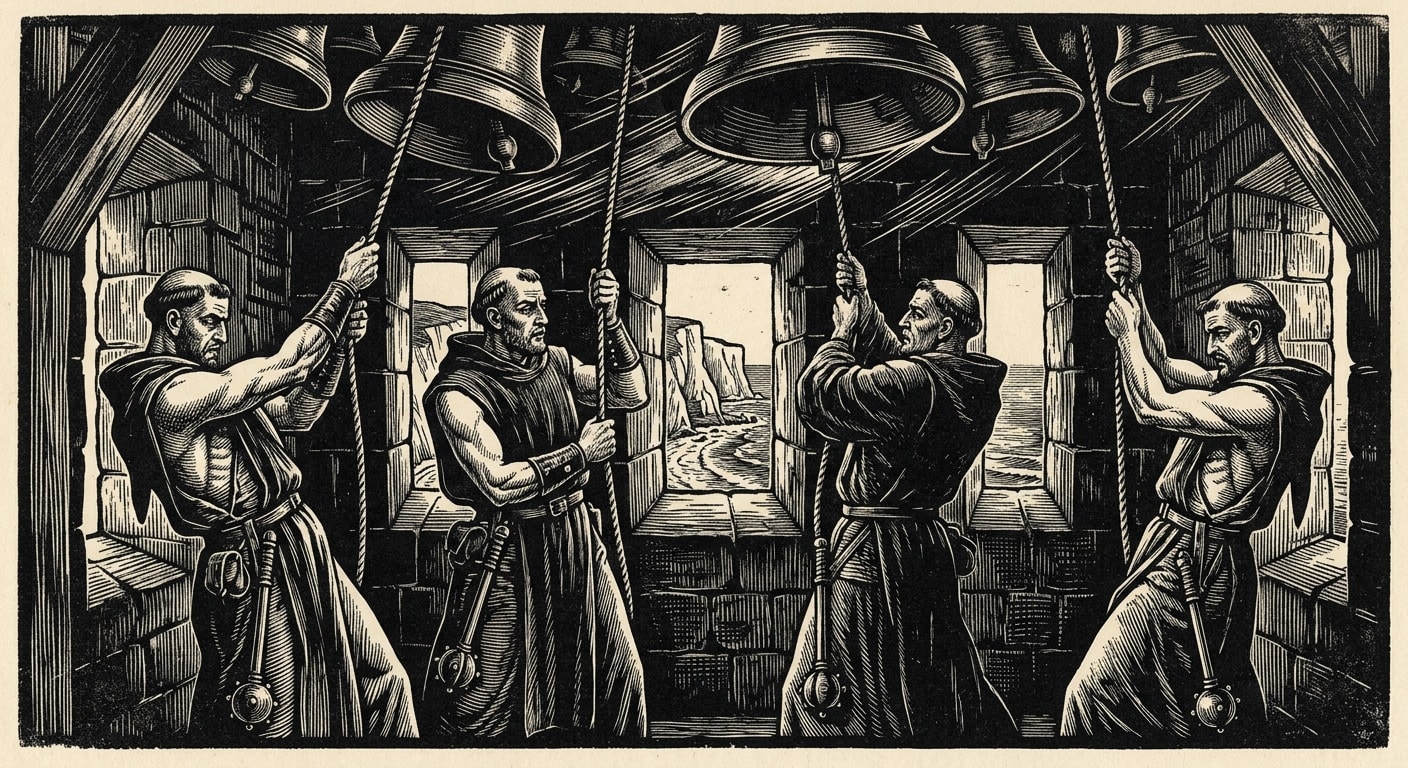
The bells of Britain, by every account, never cease. The island rings from coast to coast — Canterbury's great carillon answered by the shore-bells of Dover, by the harbour-bells of Plymouth, by the mountain-bells of the Welsh marches and the tower-bells of Edinburgh. The British ring their bells with a frequency and intensity that the Bureau of Bells would admire, has attempted to study, and has been politely refused access to on seven separate occasions. The British bell-masters — called Lantern-Ringers — are ordained warriors, each one carrying a mace forged from the same bronze as the bell they serve. They ring the hours, they ring the alarms, and they ring the dead into the sea with a toll so deep the chalk cliffs hum.
The harshness is real. Dissenters in Britain are bricked alive into monastery walls — not as a metaphor, not as a legend, but as a documented judicial practice that the Bureau of Purity has expressed private admiration for while publicly condemning as "theologically irregular." Penances last months. The fast days are more numerous than the Synod's. The discipline is total, personal, and enforced not by a Bureau but by the community itself — by neighbours, by Wardens, by the sheer weight of an island where every soul knows every other soul's name and every bell marks every absence.
#On the Synod's Regard
The relationship between Strasbourg and Canterbury is the longest-running exercise in mutual contempt conducted through the medium of diplomatic courtesy that I have observed in my career, and I have observed the Bureau of Tithes negotiate with the Bureau of Pilgrimage over shrine-gate revenue.
The Synod considers Britain a theological embarrassment — a Christian nation that refuses to submit to the only legitimate Christian authority, whose liturgical practices are "eccentric," whose governance is "primitive," and whose refusal to join the Concordat constitutes, in the Bureau's formal assessment, "a standing wound to Christian unity." These phrases appear in the diplomatic files. They have appeared in every assessment since A.S. 92.
The British consider the Synod's opinion of them irrelevant. This is not a diplomatic posture. This is the sincere and settled conviction of a people who watched the continent tear itself apart over the Rationalists, bleed itself white over the Atheist Wars, and then construct a bureaucratic theocracy so vast and so complex that it requires twelve separate Bureaus to administer a single confession — and who concluded, from the safety of their island, that the sea was a better theologian than Augustinus.
The envy is real. I will say this because the Bureau will not. The Synod envies British shipyards with a passion that borders on the devotional. The Cathedral Ships — vessels that combine the functions of warship, reliquary chapel, and mobile fortress into a single hull — represent a synthesis of sacred and martial engineering that the Bureau of Engineering has spent decades attempting to replicate. The Vigil Arks are the Synod's answer: lighter-than-air reliquary-cathedrals, magnificent in concept, limited in number. The British have three hundred ships. The Synod has two Arks.
The condescension is also real. The Synod's theologians regard the Lantern Way as a provincial faith — adequate for an island, perhaps, but inadequate for a continent. The British lack Bureaus, lack a Ledger, lack the institutional apparatus that the Synod considers essential to the administration of salvation. They rely on personal devotion, on local Wardens, on a Crown that cannot possibly oversee the spiritual condition of every soul in its realm with the thoroughness that the Bureau of Purity brings to a single district of Strasbourg. The British, in short, trust their people. The Synod does not. The Synod has a hundred and eleven years of evidence that people, left untaxed and unaudited, will drift into heresy as naturally as water drifts downhill, and the British Crown's continued survival without a Bureau of Purity is either a miracle or a catastrophe that has not yet revealed itself.
#On the Channel and What Lies Between
The Channel is the space between two certainties — the continent's bureaucratic faith and the island's chivalric faith — and the Channel, as the garrison of the Chalk Redoubt will tell you if you purchase them sufficient drink, is certain of nothing.
The anomalies began before the Redoubt. The TIMELINE records them from A.S. 65 onward — fishing vessels returning to continental ports with crews intact but vocabularies rearranged, manifests dated weeks in the future, a merchant brig out of Dover whose cargo had not yet been loaded at the port of origin. The Channel is narrow, filthy, and — on certain nights when the fog rolls thick enough to muffle the shore-bells — actively malicious in a manner the Bureau of Doctrine has classified as "inconsistent with conventional maritime meteorology."
The British patrol these waters. They have patrolled them for longer than the Synod has existed. Their methods are their own — the Bureau of War's requests for operational briefings on British anti-anomaly protocols have been met with the same polite refusal delivered in the same handwriting for the past forty years, a consistency the Bureau of Records has noted with grudging respect. Whatever the British do in the Channel, it works. British convoys reach continental ports intact. British warships engage and neutralise threats the Synod's coastal installations can only observe. The fog — the thing the Scandinavians call det grå vattnet and the garrison at Calais calls "the Foulness" — parts for British keels in a manner the Bureau of Engineering has measured, documented, and declined to explain.
#On the Present Condition
The British Crown endures. It has endured the Sundering, which reached its shores as earthquakes and tidal surges rather than the continental horrors of demon incursion. It has endured the Rationalist era, during which Britain — already island-bound, already suspicious of continental philosophy — expelled its Rationalist sympathisers with a brevity the Bureau of Purity envies: the Crown simply declared Rationalism a form of treason, hanged the ringleaders, and returned to its prayers. No Atheist Wars on British soil. No fifteen-year occupation. No Cellar Saints. The British solved the Rationalist question in an afternoon and spent the next century wondering what all the fuss was about.
The Crown endures the Channel, which grows stranger by the decade. The Crown endures the Synod, which grows larger by the decade. And the Crown endures its own nature — the zeal that is both its strength and its cage, the fortress-monastery that some of its own subjects whisper has become a prison, the bells that never stop and the walls that grow thicker and the penances that grow longer and the question, asked in darkness and answered with mortar, of whether an island that bricks its doubters into silence is protecting the faith or suffocating it.
I do not know the answer. I do not believe the British know the answer. I believe they have decided, with the grim pragmatism of a people who have watched the continent burn twice and are determined not to burn with it a third time, that the question is less important than the wall.
Erratum — Filed by the Author, A.S. 201: The Bureau of Doctrine's standing assessment of the British Crown — "Schismatic by Omission" — requires revision. The British Crown is not schismatic. The British Crown was never part of the communion from which schism could occur. The word the Bureau is searching for, and that the Bureau will not use because it implies the existence of a legitimate alternative to the Synod's authority, is "sovereign." I file this erratum knowing it will not be acted upon. I file it because the Ledger records what the Bureau will not, and the Ledger is sacred, and sacred things outlast convenience. Filed. Not ratified. The distinction is noted.