
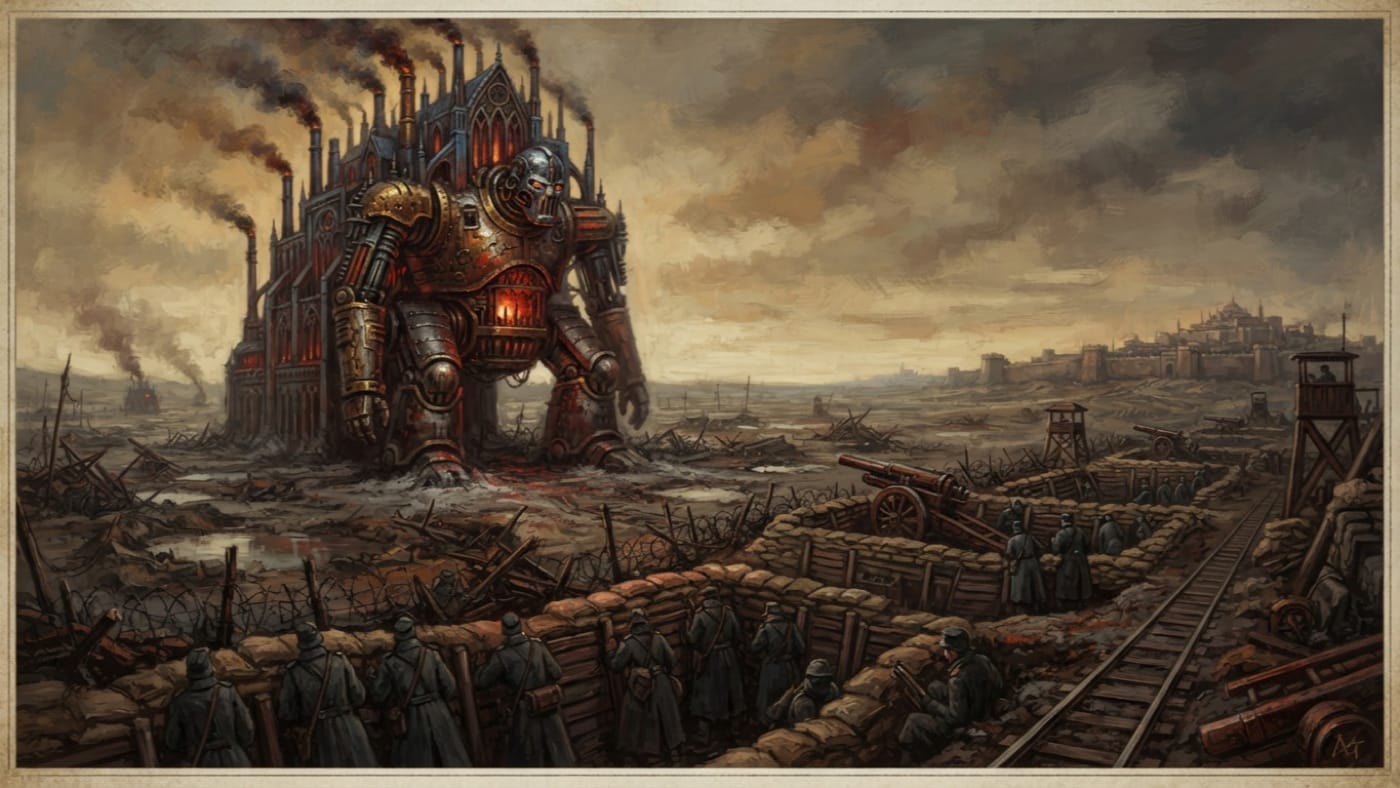
#On Its Nature
The Flameheart Colossus is the war machine of Maldrake, the Wrathforged, Sin-General of Wrath, and there is only one of it. I insist on the singular. Clerks in the lower registries are used to demons that arrive by the thousand and get counted by the cartload. Twice they have sent me requisitions mentioning "the Colossi," and twice I have sent them back with the offending letters struck out in vermilion. The Bureau forgives many errors of fact. It does not forgive a plural where the enemy has gone to the trouble of making only one.
What the Codex knows of it comes in two bundles, and the reader must keep them in separate hands. The first is descriptive: the older accounts of Maldrake's host, which speak of a furnace-wrought giant striding above the ranks with firestorms at its feet. The second is observational. It is much thinner, and considerably worse. It records a position and a year, and it records that nothing has happened since.
I have not stood before it. My authority is the file, and the file is enough to keep a sensible man at his desk.
#On the Furnace-Wrought Body
The descriptive accounts agree on the substance and quarrel only over adjectives. The Colossus is a living furnace, a giant wrought in the forge, its body a walking pyre that sets alight the field it crosses. Each step, the accounts say, births a firestorm. Its shadow immolates. I record both claims as given. The second deserves a moment's thought from any reader who has stood in the shade of something large on a hot afternoon and felt grateful for it.
Three observers, writing independently, reached for the same comparison: a cathedral that walks. The phrase has survived every revision of the file. No Bureau has proposed a better one, and several have tried.
The comparison tells us how big it looked, and nothing about where it came from, and I state this for readers who confuse the two. It does not mean the Colossus was once a church. It does not mean that any consecrated hand helped build it, or that its proportions follow nave and transept. It means that three men looked at it across the Thracian Plain and found nothing else in their vocabulary large enough to measure it by.
The Codex holds nothing authorised on its forging, fuel, crew, mind or interior. Demonic machinery answers to the power that animates it, not to the arithmetic of the Bureau of Engineering. That much is established for Wrath's engines in general. Beyond that rule I decline to draw the Colossus's innards just to fill a page. Other Hieromnemons have filled pages that way, and their pages are kept in a separate drawer, under a separate key, by a separate and very tired archivist.
#On Its Position Before the Hinge
Bastion-Constantinople is the southern anchor of the Sagittal Line, and the only bastion that faces two Sin-Generals at once: Kargath through the marshes and the Black Sea lanes, Maldrake across the open ground to the north and west. That open ground is the Thracian Plain. Before the Sundering it was grainland, a cavalry road and an imperial drilling field. Now it is ash over glass over iron, cut by trenchwork, pocked with shell craters and scored by slag wherever Maldrake's campaigns have cooled. The Bureau of War designates it Operational Zone Ferrum-North. The garrison calls it the Plate.
The Plain must not be confused with the Iron Wastes that lie beyond it. The Wastes are Maldrake's forge-country, where the anvils ring without pause. The Plain is the forward floor, where he brings whatever the anvils have made. He values it for the same reason Constantinople dreads it, which is room: room for the Hellbow Legion to deploy in breadth, for the pyre-smiths to work among the ranks, and for siege machinery too large for any road. The Colossus belongs to that host as a campaigning weapon. No authorised record places it at any particular breach, bombardment or fallen wall, and I will not hand it one to round out a paragraph.
Maldrake does not press the Line without pause, as Kargath does. He comes in campaigns. Each time, the city loses a wall and builds it back taller. Between campaigns the Plain holds the wreckage of the last offensive and the preparations for the next.
One thing on it belongs to neither.
#On the Years Without Movement
Grid reference 4-9-7, Thracian Plain. The Bureau of Engineering fixed the Colossus there in its survey engraving of A.S. 194. My dossier on Maldrake, sealed in A.S. 201, records that it had not moved in the seven years since. The Thracian command's briefings give the same grid reference and the same condition.
The reader will want a reason, and there is none on file. The observers record a position and the absence of any change in it. Everything beyond that is inference, and the inference has split two Bureaus in a way I find instructive and they find intolerable.
The Bureau of War holds that the stillness is worse than movement would be. Its reasoning is the reasoning of men who draw lines on maps for a living. A weapon that walks can be tracked. Its pace can be timed and its route predicted, and its arrival can be folded into the artillery tables and the masonry schedules. A weapon still standing where it stood seven years ago offers no route, no pace and no arrival. It offers a date that has not yet been written. Every defensive plan drafted at Constantinople since A.S. 194 has had to keep a column open for it.
The Bureau of Doctrine came at the problem from the opposite bank. By Doctrine's reading, Wrath burns forward, and patience is not among its properties. A patient weapon of Wrath is therefore a theological embarrassment before it is a military one, and Doctrine has answered it the way it answers everything: with seventeen memoranda on the implications. The Bureau of War has answered Doctrine with seventeen requests that it stop drafting memoranda and start supplying artillery coordinates. The two numbers match. That is either coincidence or the longest act of bureaucratic spite on the southern front. I suspect the second, and I admire it.
Doctrine's premise has a crack in it, and the crack is in the Codex's own pages. Maldrake commands a true army, with officers and supply. His Crucible-Born plan campaigns, lay ambushes and wait. The Great Deceiver's general of Wrath has never been shown to lack restraint, only the inclination to explain it. What remains undocumented is why this weapon waits. On that question, seventeen memoranda and seventeen requests have together produced no findings at all.
The geographic register of the southern Line states that Maldrake has made fourteen confirmed breaches "since A.S. 40."
Maldrake emerged at the Sundering, 1 November A.S. 45. A count that begins five years before he existed is a count of nothing, and the count of fourteen runs from A.S. 45. This correction concerns Maldrake's campaign record only. It supplies no earlier date for the Colossus. Its documented position dates from A.S. 194, and the Codex holds no authorised account of its history before that entry.
#On the Defences Opposite
Constantinople's answer to the Plain is the answer it gives to everything Maldrake sends: guns, earth, masonry and men. The Ravelin of Vigilance looks north across the Plate. Marshal Vaubret commands the Thracian theatre from a reinforced bunker beneath the Ravelin of Fortitude. In his briefings, by the account of those who attend them, he names the grid reference, notes that the Colossus has not moved, and adds that this is worse than if it had. His subordinates pray at the back of the room on his behalf. He counts wire.
The Bureau of Records counts shells. By A.S. 201 more than twelve million had been fired against the Thracian approaches. The count does not say how many went toward 4-9-7. The repair crews keep their own count, of courses relaid and parapets raised after each campaign, and their ledger is the honest one, because masonry cannot be persuaded that a wall did not fall.
Against Wrath in general, the Church has its disciplines. Under the Doctrine of Cool Hatred, chaplains in the Thracian sector teach that righteous violence must be cold and passionless. Soldiers returning from Maldrake's engagements get cold water, enforced stillness and rage fasts. These measures are aimed at the soldier's heart, which Wrath reaches by way of grievance. They have nothing to say about a furnace the size of a cathedral.
I have found no page, in any manual I am cleared to read, that describes a weak point in the Colossus, a method of cooling it, or a procedure for bringing it down. No successful action against it is on file. The Bureau of War does not admit this in so many words. It admits it by keeping the column open.
#The Ratification
The Flameheart Colossus, war machine of Maldrake the Wrathforged, singular, furnace-wrought, a walking pyre by every descriptive account, stands at grid reference 4-9-7 on the Thracian Plain. It was fixed there in A.S. 194, and as of the dossier sealed in A.S. 201 it had not moved. Its origin is unrecorded. So are its mechanism and its intentions. Its readiness is unknown.
Doctrine holds that it cannot be patient. War holds that it is.
The column stays open.