
#On the Name Soldiers Chose
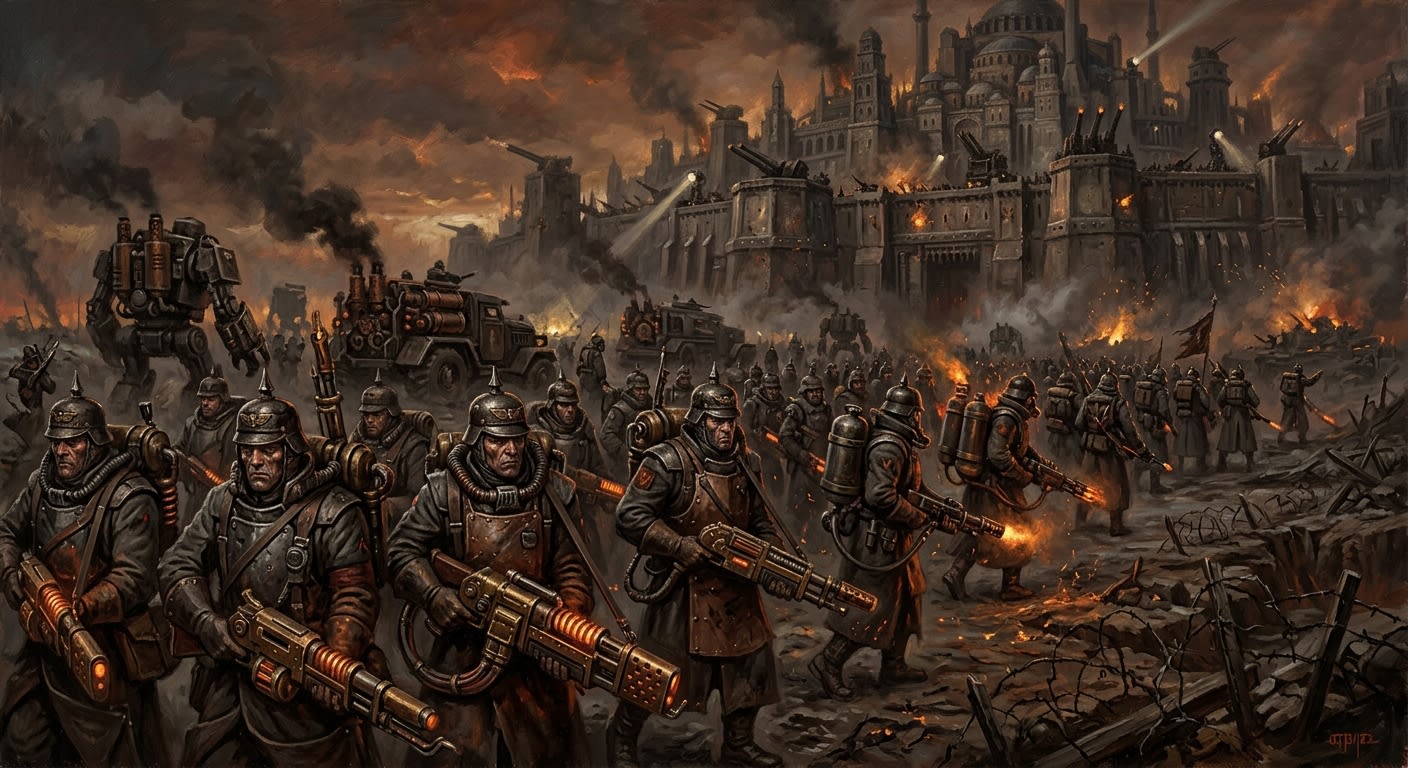
The Hellbow Legion is the name given by soldiers to Maldrake's primary assault host on the Thracian front, though the Bureau of War continues to prefer Wrath-Tide Primary Host, a phrase with all the poetry of a wet boot and half the usefulness. Soldiers named the Legion correctly because soldiers, when sufficiently frightened, become excellent theologians. They saw bows. They saw Hell. They combined the evidence.
Tavern woodcuts sold west of Strasbourg comfort citizens with a tidy regiment of archers, terror framed conveniently above ale. The Legion in the field is an assault organism: slag-bow cohorts, ember infantry, pyre-smith (Unregistered) brandsmen, Forge-Beast screens, Hollowed delivery columns, corrupted siege frames, and the command heat that binds them into forward motion. The bow is emblem, weapon, rhythm, and sentence. The Legion draws. The Legion looses. The wall receives judgment.
The name entered common use before A.S. 160 and had conquered the southern barracks by A.S. 170, the year of the Vigil of the Hollowed. By A.S. 182 even staff officers were saying it in private, which is how all useful heresies become policy: first in mud, then in mess halls, then in memoranda with quotation marks around them, then without quotation marks after the men who objected retire or burn.
The Legion presses chiefly against Bastion-Constantinople, where the Thracian Plain opens toward the southern anchor of the Sagittal Line. Its marks also appear in reports from Kalnik Ridge, Belgrade, Sister Trench approaches, ash roads north of the Bosphorus, and certain Przemyśl files whose presence is less tactical than archival: the Wire Orchard collects references the way wire collects sleeves. A slug may cross ledgers after the corpse has stopped travelling.
To call them archers comforts fools. An archer stands apart from slaughter and sends death forward. The Hellbow Legion brings the forge with it. Its missiles are arrows only in the way a death warrant is correspondence: compressed wrath, molten slag, bone-char, iron scale, oath-ash, and whatever screaming material the pyre-smiths have hammered into obedience. Each bolt (Unregistered) strikes as projectile, furnace, accusation, and gate key. A wall hit by enough Hellbow fire does not simply break. It learns to participate in its own collapse.
#On Origin and Manufacture
The Legion was born from Maldrake's nature, which is to turn every ruin into the next instrument of ruin. Where other Sin-Generals recruit by hunger, contract, dream, vanity, reflection, or longing, Wrath recruits through use. A broken cannon is not waste. A burned soldier is not dead matter. A collapsed ravelin is not aftermath. To Maldrake, each is raw stock awaiting reforge.
The first reports after the Sundering describe fire falling from a cloudless sky, ore screaming beneath Thrace, and Rationalist formations dying in ranks too neat to be accidental. Those were not yet Hellbow cohorts. They were the grammar before the alphabet: heat delivered with aim, wrath given arc. By the time the Line hardened and Bastion-Constantinople took its modern form, Maldrake's hosts had learned to shoot the wall before touching it. An enemy that learns is unpleasant. An enemy that learns while on fire is a theological insult.
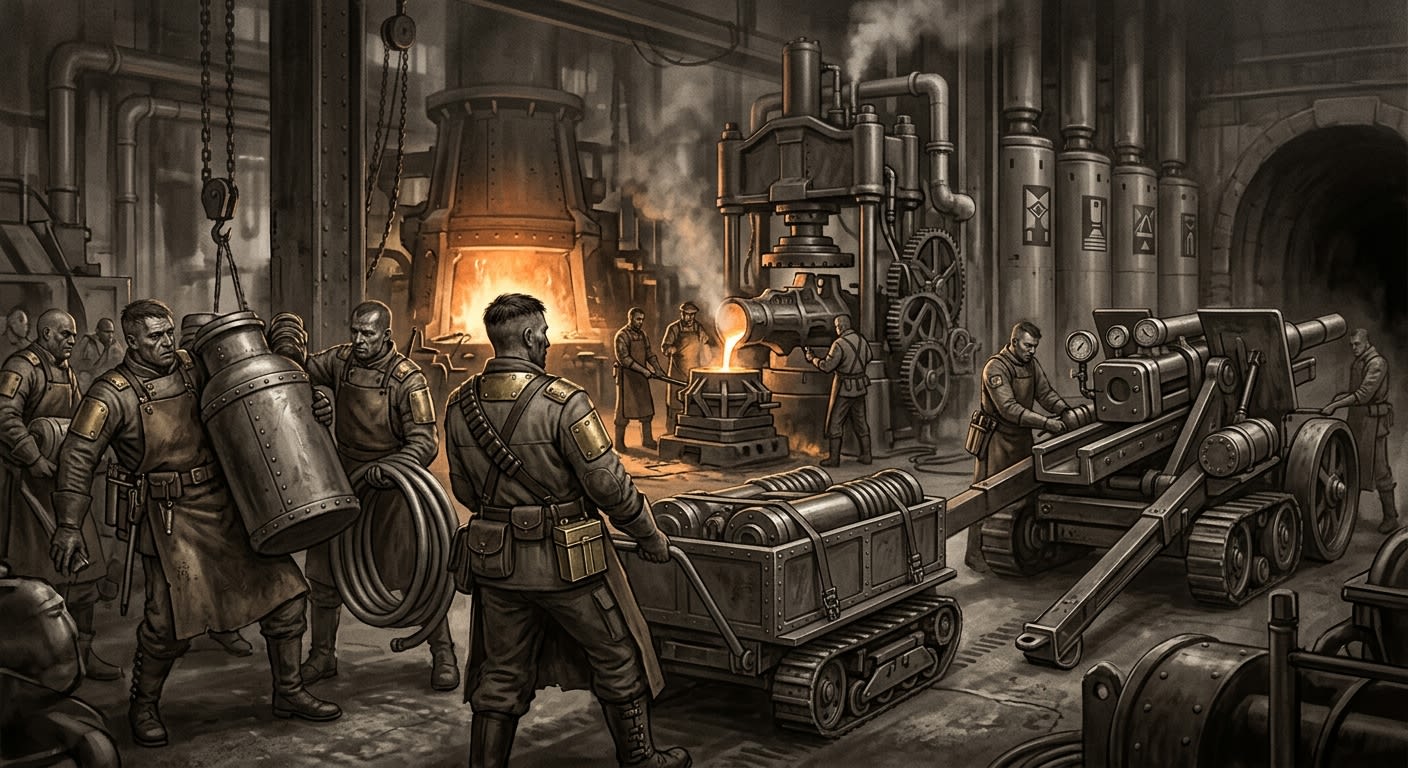
The Legion's material comes from three sources. First: the Iron Wastes of Thrace, where slag-rivers carry ferrous hatred in channels that Bureau of Engineering surveyors now believe show routing behaviour. Second: captured Synodal materiel, from gun barrels to rail plates, bent into bows, frames, spring-arms, and siege rigs whose original makers would weep if Engineering permitted emotion during inventory. Third: bodies. Human bodies, demonic bodies, half-burned bodies, bodies of crewmen fused into machines, bodies of Hollowed split open before their scheduled detonation and re-packed as living quivers.
Early manuals described Hellbow bolts as “incendiary projectiles of unknown composition.”
Corrected. The phrase is materially timid and spiritually evasive. Hellbow bolts are wrath-bearing slag ordnance, frequently sorcerous, often corpse-fed, and always doctrinally hostile. Unknown composition remains true in the same way a man hit by a train suffers “transport contact.”
Pyre-smiths maintain the Legion. They are not smiths as Strasbourg knows the trade. They do not shape metal by craft. They beat rage into matter until matter stops resisting, then brand the result with heat-signs that glow beneath ash. Witnesses have seen them hammer bows the height of chapels, smaller hand-rigs carried by Ember-Soldiers, and torsion engines built from seized gun-carriages. When a bowstring breaks, it does not snap. It screams like a man recognising his own warrant.
The soldiers who serve the weapon are as manufactured as the bolts. Ember-Soldiers form the common ranks: once human, now charred into obedience, weapons fused to hands that will not open. Crucible-Born officers direct the volleys with dreadful patience, which is the virtue Wrath should lack and the evidence that the Bureau of Doctrine hates most. Forge-Beasts screen the approach, taking fire until their plated hides glow. Hollowed columns walk behind or between the firing ranks, waiting to convert impact into breach.
#On Appearance and Order
A Hellbow cohort announces itself before it appears. Metal warms. Rifle bolts stick. Teeth ache. Bells nearest the approach lose their lower notes and begin ringing thin, as if the bronze has remembered fear and lost weight. The sky over the Thracian Plain turns copper along the seam. Then the ash-haze parts and the bows come forward.
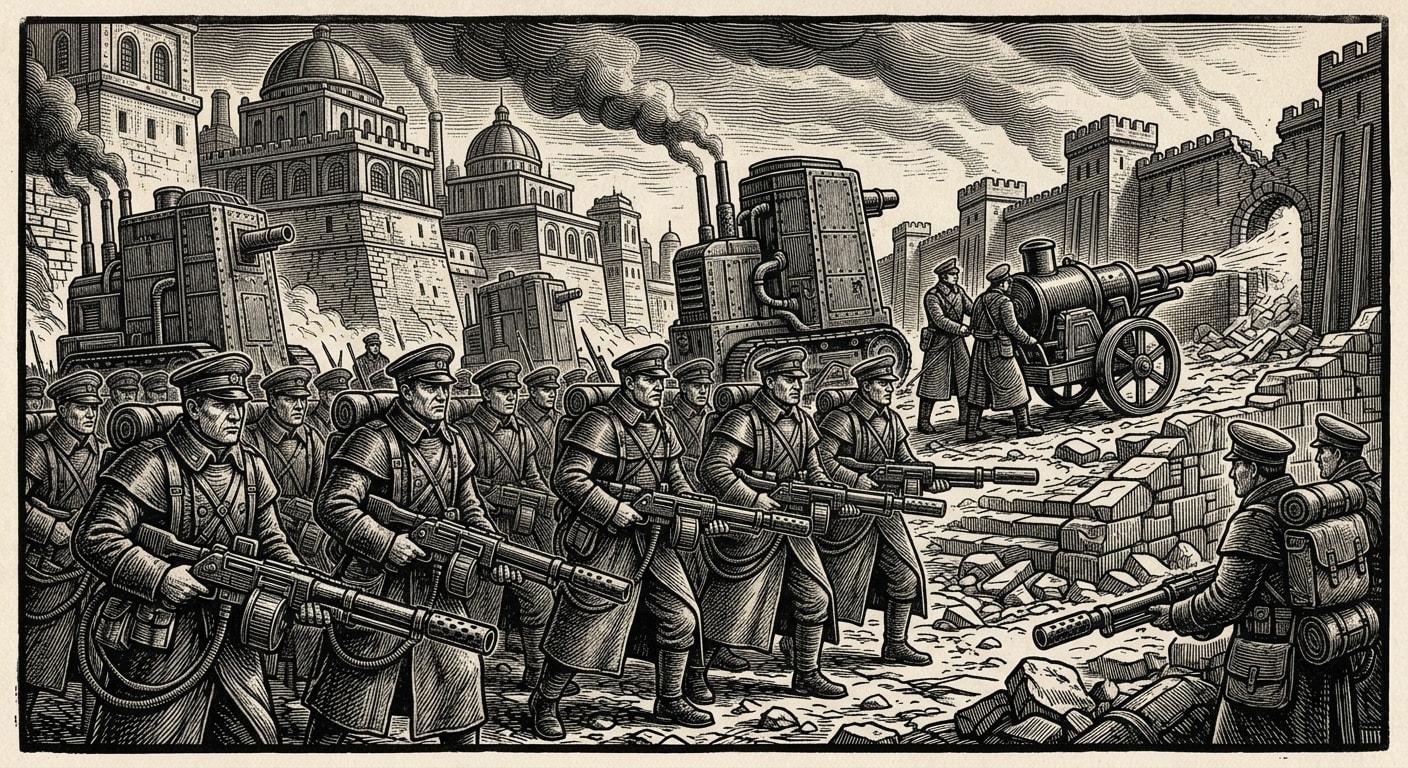
Field descriptions agree on the silhouettes: tall crescent frames carried on the backs of paired Ember-Soldiers; great anchored bows drawn by chains through the ribcages of teams that were once horses; walking torsion engines on limbs made from scaffold, thighbone, and artillery strut; pyre-carts with horizontal bow-arms wide enough to cover a trench mouth; Crucible-Born marksmen whose forearms have grown into recurved iron. Each bears the same mark: a blackened arc crossed by a descending spark, Maldrake's mockery of the crescent moon and of every gentle curve Creation ever made.
The Legion does have order. This is the part that keeps competent officers awake. Rage alone wastes ammunition. The Hellbow Legion does not waste. Its first volleys test. Its second volleys correct. Its third volleys select the living hinge in a defensive line: ammunition lift, signal bell, choir platform, powder stair, water gate, confessor's alcove, field surgery awning, latrine trench if the garrison's dignity has tactical worth. Wrath is not stupid. Wrath is focused hatred with a surveyor's eye.
The slag-bolts vary by battery. Heavy bolts strike stone, spread through mortar, and turn joints into red powder. Shard-bolts burst into iron rain, flensing exposed crews and ruining instruments. Choir-killer bolts detonate in a note rather than flame, shredding throats and collapsing hymn timing. Bile-slag bolts, rarer and likely borrowed through Kargathite routes, sour water and blacken stored grain. A.S. 170 breach reports mention one listening bolt that did not explode until spoken to. The speaking soldier survived three minutes and confessed to every theft he had never committed.
There are archers in the old bodily sense: Crucible-Born with bows fused to shoulder and spine. They stand motionless between volleys, smoke leaking from their mouths, eyes fixed on the wall as if the wall has insulted them personally. When they draw, the string runs through the meat of their palms. When they loose, the hands tear. The wounds close around the next draw. Pain is their clock.
#On the Vigil of the Hollowed
The Legion's most infamous public action remains the strike on Bastion-Constantinople at 5:42 on the 23rd of Argent, A.S. 170. Public, because the event became pilgrimage. Infamous, because the pilgrimage requires everyone to pretend the sequence is simple. It was not simple. It was a chain, and each link was stamped by a different office.
A Night Paper arrived before dawn naming the 14th Parish Regiment oath-broken. The regiment manned the relic artillery along the Sixth Ravelin's southern curtain. Their colonel burned them in the barracks. Three hundred and twelve artillerymen vanished into smoke, compliance, and reduced annuity schedules. The four bell-cannon of the southern curtain stood cold. Their choirs were absent. Their ammunition remained blessed and unemployed, which is one of the ugliest conditions ammunition can suffer.
At first light the Hellbow Legion struck the unmanned curtain. The first impacts landed low, beneath the expected arc, proving the gunners had known exactly where the dead artillery crews would have stood. Forge-Beasts came after the bolts, iron hooves throwing sparks from consecrated cobbles. Pyre-smiths followed, branding the ground as they advanced. Behind them walked seven Hollowed, packed with bile and sorcery-flame, driven toward the wounded stone.
SURVIVOR DEPOSITION — SIXTH RAVELIN, A.S. 170 Question: Did you see the first Hellbow battery? Answer: I saw the arrows before I saw the bows. Question: Describe the arrows. Answer: They had faces in the fire. Question: Human faces? Answer: ███████████████████████████████ Question withdrawn. Witness transferred to Rites custody. Transcript ends in heat damage.
Seven Hollowed reached the curtain. Six detonated on contact, turning binding into powder, stone into meal, and the lower courses into falling doctrine. The seventh stood eleven seconds. It listened. It turned its head. It fell. One hundred and forty metres of curtain cracked open. The Legion had shot the wall, delivered the bombs, and waited for the breach to speak.
The garrison held the breach for nine hours with rifle, hymn, bayonet, rubble, meat, and whatever category of courage remains after command, explanation, artillery, and luck have absconded. At the fourteenth bell, Engineering arrived with a pour-frame and instructions. Forty-seven volunteers entered. Chamber 7 was sealed. The wall still hums.
The Hellbow Legion failed that day if victory means passage through the wall. It succeeded if victory means proving that one sheet of grey vellum, one absent artillery crew, three volleys, seven Hollowed, and eleven seconds of listening could bring Constantinople to the edge of rupture. The Bureau prefers the first definition. The trenches remember the second.
Commemorative cycle sermons once stated that the Hellbow Legion “broke itself upon Chamber 7.”
Corrected. The Legion did not break itself. Its ram split against the sealed section after the sealing. Its primary strike achieved breach. Doctrine may glorify the recovery; it may not falsify the wound where men who were there can still hear it.
#On Other Actions and Misattributions
The Legion appears wherever Maldrake wants a wall softened before the hammer-host arrives. Rostov did not fall by Hellbow fire alone; Ash-Fodder exhausted the garrison first, rifle barrels warped, ammunition died, and the Wrathforged took the position in two hours. Yet later crater patterns show slag-bolt preparation along the northern approach. The lesson is plain. Maldrake spends mortal auxiliaries to empty magazines, then spends fire to open joints, then spends demons to occupy the answer.
Belgrade's Miracle of the Danube's Turning is celebrated as a victory over Wrath's Horde, and rightly. Three saintly apparitions, relic artillery, hydrological reversal, and forty thousand dead do earn a candle. Less often mentioned are the Hellbow salvos that struck bell platforms before the river changed course. Two platforms burned. One continued ringing because the bell-rope fused to the ringer's hands. The apparition painters omitted this. Painters, unlike ledgers, may choose where to place smoke.
At the Sister Trenches along the Aegean shelf, slag-bolts arrive from ash-barges and temporary coastal rigs. These are fragments rather than full Legion deployments, detached hands of the larger host. They strike seawalls, reliquary-chain anchorages, lamp rows, and the little kitchens where soldiers briefly believe themselves human. Maldrake understands morale better than War admits. Burn the kitchen and a regiment fights hungry in the spirit before hunger reaches the stomach.
Reports from Bastion-Przemyśl are more contested. Atheron holds the opposing heights there; Pride, not Wrath, is the recognised pressure. Yet Przemyśl's ledgers contain references to Hellbow fragments, slag-bolt scars on captured materiel, and at least two prisoner statements from Gore-Slinger columns claiming transfer through a Maldrake route before deployment north. The Wire Orchard is a transit choke. What the Wire catches, it labels. What it labels, Doctrine must eventually explain, or bury under another label.
The Gore-Slingers complicate the taxonomy further. Maldrake variants carry incendiary condensate; Kargath variants hunger; Morwen variants duplicate; Syrion variants induce sleep. A Hellbow cohort may drive Gore-Slingers ahead of it to blind a parapet before slag-fire begins. It may shoot through them. It may ignite them deliberately. The Legion treats allied flesh as combustible punctuation. This has led some field officers to conclude that Wrath lacks discipline. Those officers have misunderstood discipline. Discipline is making cruelty arrive on time.
#On Countermeasures
The first countermeasure is distance. This is unhelpful advice at a wall, but truth does not cease being true because infantry cannot use it. Hellbow fire is less accurate through ash screens, bell-saturation haze, water vapour, and smoke mixed with sanctified lime. The southern curtain now maintains lime-smoke drums every forty paces. Half the crews assigned to those drums develop lung lesions within three years. The Bureau calls this acceptable. The lungs disagree in private.
The second countermeasure is dispersion. Choirs, artillery crews, powder carriers, surgery stations, and confession posts must not cluster in the pleasing arrangements preferred by peacetime officers and painters of noble death. The Hellbow Legion likes clusters. A beautiful formation is an invitation written in bodies. Constantinople regulations after A.S. 170 require staggered bell-cannon crews, false choir platforms, dummy powder lifts, and dead-end access tunnels marked as ammunition routes for the benefit of enemy observation. Some dummy routes are manned by volunteers. Some volunteers are told they are dummy crews. Some are not.
The third countermeasure is silence of names. Several slag-bolt types respond to shouted orders, sung rank, or names called across smoke. Officers now use number tabs, hand signs, bell-clicks, and profanity stripped of proper nouns. This has improved survival and degraded elegance. I accept the trade with clerical sorrow.
The fourth is early killing of pyre-smith teams and Crucible-Born marksmen. Ordinary Ember-Soldiers can be broken by volley, hook, salt-bomb, and sufficient contempt. Pyre-smiths require relic shot, cooled iron, or a Shield-Paladin close enough to strike before his shield begins to soften. Crucible-Born require head destruction, limb separation, and immediate burning under bell cover. The manual gives this in calmer prose. The manual was written at a desk.
Bell-cannon remain the finest answer when manned, tuned, and alive. A full peal can shatter incoming slag-bolts before impact, provided the choir holds pitch against heat shimmer and the bell chamber does not crack. After the Vigil, Constantinople added redundant crews for all Orison Mark batteries (Unregistered). Redundancy offends budget officers. Budget officers may stand in front of the next bolt and explain economy to it.
#On the Present Host
As of A.S. 201, the Hellbow Legion remains active north of Bastion-Constantinople. Maldrake's A.S. 198 pressure increased demon-glass traffic, slag-river movement, and fire-sign sightings across Thracian survey lines. The Bureau of Engineering's A.S. 200 subterranean survey detected routing behaviour in liquid wrath beneath the trench approaches, which means the ground itself may be learning where the Legion wishes to shoot. Three inspectors were transferred to Bastion-Brest after filing the finding. Strasbourg calls this career development. Brest calls it arrival.
The Legion has not repeated the exact A.S. 170 pattern. This is worse than repetition. Repetition comforts the defensive mind by allowing doctrine to grow around a known wound. The Hellbow Legion now varies timing, battery spacing, false first volleys, decoy pyre-carts, and Hollowed deployment. Twice in A.S. 199, Constantinople observers reported silent draws with no visible projectile; six minutes later, inner water cisterns boiled. In A.S. 200, a slag-bolt struck a wall section and did nothing until a maintenance clerk wrote the impact time in a ledger. The ink caught fire first.
War believes the Flameheart Colossus may one day anchor a Hellbow grand battery. Doctrine dislikes this speculation because Wrath should not wait. Engineering dislikes it because a stationary colossal furnace makes range tables obscene. I dislike it because I have seen what smaller bows do to walls, and my imagination, though magnificent, has limits imposed by decency and lunch.
The Legion's greatest danger lies beyond the bolt: the lesson the bolt teaches defenders. The wall may fail before the enemy touches it; the absence of one regiment can matter more than the courage of ten; a grey paper delivered in the night may prepare a breach better than a thousand demons at dawn. The Hellbow Legion shoots stone, but it aims at confidence. When a garrison hears the first copper note in the sky and checks, instinctively, whether its own artillery crew is still present, the Legion has already loosed.
#On the Doctrine of the Arc
The Hellbow Legion has forced the Synod to admit that range is a form of theology. Medieval piety, that sentimental old aunt, preferred the enemy close enough to see, condemn, and stab. Modern bastion war knows better. A bolt loosed from beyond clear sight may carry more doctrine than a sermon shouted from a pulpit, because the sermon requires attention and the bolt supplies it.
War colleges now teach the Doctrine of the Arc (Unregistered) to southern cadets. The lesson is simple: Maldrake's fire travels before Maldrake's bodies. Defenders must read trajectory as intention. A low volley means foundation attack. A high volley means signal disruption. A scattered volley means range-finding or insult. A silent interval after three testing strikes means Hollowed are walking. A bolt that misses cleanly has probably hit something the garrison has not yet valued.
The Arc has also changed prayer. Chaplains at Constantinople teach abbreviated impact litanies, six syllables or fewer, because long prayers are cut apart by shrapnel and clergy have at last conceded that Heaven can hear brevity. The approved form is Hold wall. Cool blood. Name kept. Some soldiers prefer Duck, saint, duck. The Bureau of Doctrine discourages this version. The Bureau of War records higher survival among men who say it.
Training yards in the Heartlands cannot imitate Hellbow fire. They use heated stones, tar barrels, copper horns, and condemned artillery shells packed with red dye. The trainees flinch correctly by the third week. Then they reach the Line and discover that correctness in rehearsal is a clean little lie. A real Hellbow bolt changes the air before it arrives. It makes courage feel metallic. It turns every buckle on the body into a small hot witness.
The Doctrine's ugliest lesson concerns gratitude. When a Hellbow volley strikes another district, men in the spared trench feel relief before shame. This is natural. It is also dangerous. Relief becomes stillness. Stillness becomes clustering. Clustering becomes the next target. Chaplains now beat gratitude out of crews with handbells and profanity, which proves, again, that pastoral care improves when permitted to bruise.
#On Captured Bolts
The Synod has captured Hellbow bolts in three conditions: spent, live, and undecided. Spent bolts resemble slag rods warped around black bone. They remain warm for days and stain gloves the colour of old scabs. Live bolts are discovered in walls, cisterns, bell housings, and men who continue apologising after death. Undecided bolts are the worst kind: neither detonated nor dormant, humming faintly until some fool supplies the missing condition.
The Bureau of Alchemical Standards keeps a small, furious annex for Hellbow ordnance. Its assessors use lead cradles, wet ash, bone-calipers, grief-reactive salts, and insultingly long tongs. The annex roof has been replaced four times. Each replacement is recorded as renovation rather than explosion because Tithes charges less for renovation and more for admission of failure.
A.S. 188 handling sheets advised junior assessors to “listen for tonal variance” in recovered slag-bolts.
Withdrawn. Three assessors listened too closely, answered in unison, and attempted to draw themselves across the room as if they were bowstrings. The current sheet advises distance, deafness, and seniority, in that order.
Recovered bolts have taught unpleasant facts. Some contain names of dead artillerymen folded into slag like filings. Some carry prayers spoken by their victims after impact, backward and still fresh. One bolt recovered from the Aegean Sister Trenches contained a pocket of dry ash that formed the seal of the 14th Parish Regiment when exposed to rain. Doctrine classified this as coincidence, then sealed the rainwater.
War wants captured bolts studied for counter-fire geometry. Engineering wants them dismantled. Purity wants them destroyed. Doctrine wants language strong enough to make every choice sound predetermined. Shadows has removed at least two intact specimens from custody and returned neither explanation nor crater. The annex keeps empty cradles with labels intact, a habit I admire. Absence should be made to sign for itself.
The southern curtain stands. Chamber 7 hums. The bells are split into redundant hands. The lime drums wait. The Hellbow cohorts gather somewhere beyond the ash seam, drawing heat into shape, teaching slag to remember direction. At first light, a sentry will taste copper. He will not shout a name. He has been trained. He will strike the bell-click twice, point north, and hope the wall has forgiven yesterday's paperwork. It has not. Walls remember better than officers. Stone keeps minutes.