

#On the Question the River Puts
Every spring the Rhône rises, falls back and leaves the Synod a question in mud: where was the bank? It sounds like a question for surveyors, but it is a lawsuit. If a bank moves six feet, a toll can pass from one ferry house to another. If a boundary stone washes downstream, a debtor may be freed from a field, or the field may be taken out from under the debt. In the winter ledger, a vineyard wall, a fish trap, the edge of a grave and the step of a chapel are each a settled fact. By Easter each one is a dispute.
This entry surveys the bodies that hear that question. Its dateline is A.S. 201 because the survey was made in A.S. 201. The record gives no founding year for the Flood Courts, so I give none. A dateline without a birthday looks lonely, but loneliness is not grounds for forgery.
#On Records and the Benches That Will Not Say Court
The Bureau of Records maintains the Flood Courts. The Rhône entry says so plainly, and I wrote that entry. Records keeps the courts at the principal nodes of the river and calls several of them seasonal reconciliation benches.
No form I have handled prints the reason for the second name. My own reading, filed in the Rhône entry and not withdrawn, is simple. A court that sits only when the water obliges admits that the water keeps its calendar, and a Bureau that admits the river holds appellate power has admitted too much. "Bench" sounds humbler. "Seasonal" puts the blame on the weather. "Reconciliation" suggests that the parties came to agree with one another, when they came because the river had disagreed with all of them. The peasants who must plough the result have a shorter name for it, which Orison would not let me print.
The record says that several Flood Courts carry the second name. It leaves blank whether every court does, and whether a bench holds less authority than a court. Apart from the issuing of an order, it lists no powers for either. Records has drawn no line between the two, and I will not draw one for it.
The Rhône entry states that Records maintains Flood Courts “at the principal nodes.”
Clarified, not withdrawn. The sentence stands. It invites a reader to put a court at every node of the corridor: Lyon, Avignon, Vienne, the Arles approaches, the lower Provençal reaches and the roads toward Marseille. Those nodes belong to the river. The record assigns no bench to any of them. The Vienne survey found no flood court named for that town, and I find no list for the others. Place the courts where the record places them, which is nowhere in particular.
The record does not give these courts the whole river either. They hear what flood disturbs. No one has written down whether a fishery seizure, a song licence or a Purity matter could ever come before a reconciliation bench. I will not write it down on their behalf.
#On What the Witnesses Carry
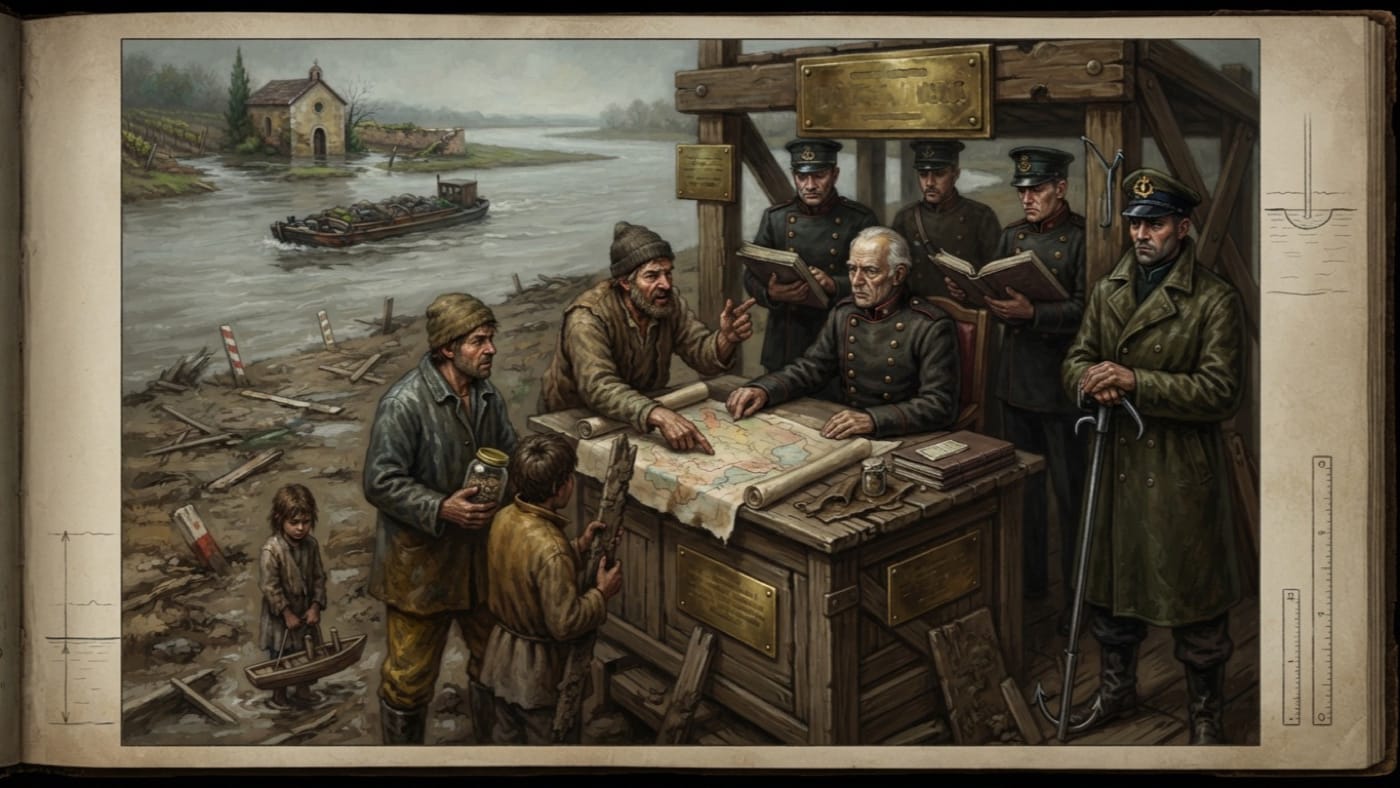
A hearing is a market of damp objects. Witnesses bring soaked plats, the survey drawings on which a field once had edges. The ink has run, and the line that matters has run furthest. They bring broken stakes, which prove that a boundary stood somewhere and say nothing about where. They bring jars of silt, as if the river could be made to testify against itself by being bottled. They bring boatmen's oaths and fishers' insults. They bring children who remember where a tree stood before the spring rise.
The child is the most dangerous witness in the room. A plat can be checked against an older plat, and a stake can be measured. A child remembers the tree because the child climbed it, and no Records draughtsman has ever drawn a tree as carefully as a boy who once fell out of one.
Then comes the judge. The record is brief: the judge listens, compares maps, consults older maps, distrusts all maps and issues an order. I set down the sequence as the Rhône entry gave it, and I give it as an account of practice. Records has published no rule of evidence for these benches. It ranks neither plat over oath nor stake over child. I will invent no such ranking to make the hearing look tidier than the mud.
The difficulty is concrete. The judge must rebuild a bank that no longer exists. The materials are drawings made by men who assumed the bank would stay put, and oaths sworn by people whose tolls, debts or fields depend on where it is found. The older map is consulted because it is older than the present quarrel. It is distrusted because it is older than the present river. The Bureau of Cartography could supply a newer map, and next spring would retire it.
#On the Petitions and the Standing Principle
The Rhône spring-session abstract lists the common petitions. I reproduce it as filed.
Behind each heading is a household.
Boundary movement is a farmer whose field has grown by a furrow, and a neighbour whose field has shrunk by the same furrow. Ferry-right alteration is a crossing whose landing now sits in somebody else's mud. Tax-bank reassignment is the Bureau of Tithes finding that a bank which paid into one column now belongs in another. Cargo loss by holy current is a merchant praying that the river took the bales and Providence will bear the cost. A shrine step found downstream may become a relic, debris or theft by current, and the Bureau of Relics takes an interest in the first possibility that the farmer who found the step does not share.
The Rhône entry records that flood years expose graves, some of them in no cemetery record. Records, Relics and Purity each send collectors after them. The abstract counts the exposure as a petition, but it does not say what the bench may do with the grave.
The standing principle is a whole theology in five words: water may move; obligation remains. A debt does not dissolve because its boundary stone has gone to sea. A toll owed at a bank is still owed at that bank, wherever the bank has gone. That is the abstract's formula. Whether a given washed-out boundary frees a given debtor or ruins him is a matter for the order, and I have no order in front of me to report.
The secondary principle gives Tithes first notice wherever water creates ambiguity. The phrase is narrow, and Tithes does well out of narrow phrases. It means that Tithes hears of the ambiguity before anyone else does. The abstract gives Tithes no power to decide the petition. Collection is a separate question. Anyone who has stood in a Tithes queue may be forgiven for suspecting that notice and collection travel in the same cart.
#On the Spring Session
The courts sit in spring. That is the season named in the abstract, and it is the season the River Watch keeps for them. The Rhône entry puts flood courts among the Watch's spring rounds, between chain days at Avignon and visits to the lower bends whenever rumours of clay discs spread faster than confiscation. The Watch is a habit of joint patrol by wardens from several Bureaus and has no single office. Its visits do not make it the courts' guard. It arrives with hooks, damp-proof ledgers and waxed evidence sacks. When a bench is hearing arguments over shrine steps and opened graves, the Watch likes to have been seen nearby.
Then comes the order. It is written on paper and has the force of Records behind it, and it fixes the bank where the judge has found it. The plats are dried and filed. The stakes go back into the ground, or into somebody's stove. The toll house collects at the line the order names. The debtor learns whether the field still owes.
The river was not a party to the petition and signed nothing, and it keeps moving. The Rhône entry says the order is one the river will violate at leisure. Next spring the plat will be soaked again and the stake broken again. The child who remembered the tree will be a year older, and the tree will be a year further downstream.