
#On the City That Became a Correction
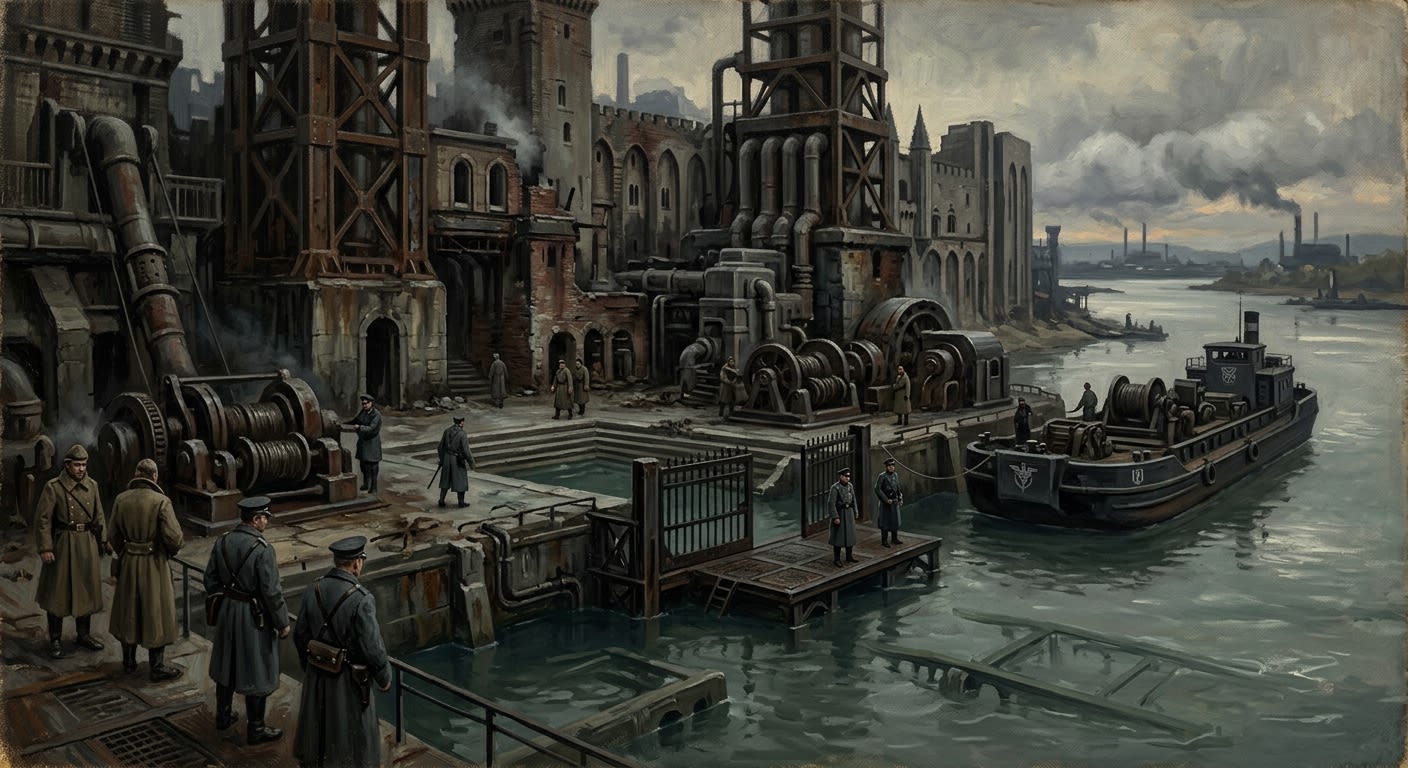
Avignon is a ruin on the Rhône, Zone One by map, former terrain feature by Records, penitential site by Pilgrimage, and disciplinary headache by every Bureau still forced to explain why a city that did not host a rival pontiff requires so many prohibitions, guards, locked reliquaries, and fishery inspections. The old walls sit where the river bends with that Provençal insolence which sunlight gives to stone. The stones that remain are too large to haul north, too watched to steal, and too guilty to weather innocently.
The official gazetteer calls Avignon “ruins.” This is accurate in the mean little way an invoice may be accurate. A ruin may be empty. Avignon is never empty. It contains absence in staffed quantities: erased names, confiscated seals, river-silt theology, broken stairs, missing bells, sealed depositions, pilgrim tolls, and the thin civic embarrassment that clings to places where the Synod won so thoroughly that it has had to keep winning ever since.
Before it became caution, Avignon was a southern ecclesiastical city of real consequence: river seat, corridor hinge, archive harbour, sermon-market, and the rear organ of the faithful southern front during the Atheist Wars. Cardinal-Marshal Severin used its corridors to feed Montreval, shelter relics, move quarrelsome abbots out of artillery range, and preserve several archives whose contents later helped Strasbourg pretend continuity had been inevitable. Sister Agata Wiśniewska's testimony on the Night of Knives in Kraków reached ecclesiastical custody by way of Avignon in A.S. 18, hidden in a psalter binding, because even before the Synod hardened into its present splendour, Avignon knew how to carry dangerous paper under a pious cover.
Then the city mistook usefulness for immunity. This is the commonest disease of provincial importance.
#On Old Avignon and the Southern Corridors
Old Avignon smelled of hot stone, river mud, beeswax, mule-sweat, incense warmed past dignity, and the sour wine of clerks who wrote better after dusk and lied better before Prime. Its palace houses rose around episcopal courts, counting rooms, relic cupboards, bridge toll offices, kitchens large enough to feed siege sermons, and chapter chambers where southern clergy cultivated the fatal belief that distance from Strasbourg made thought safer.
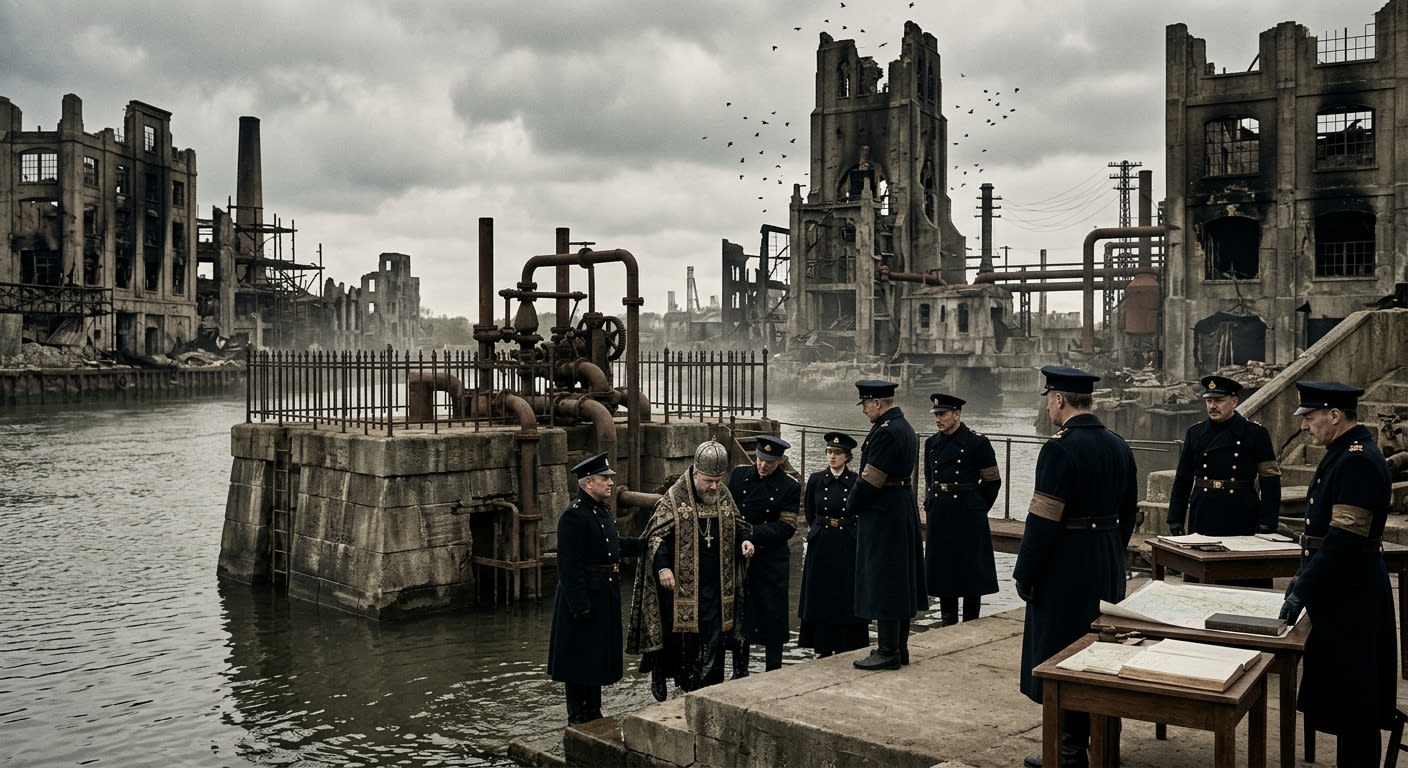
The city’s value lay in passage. Roads from Lyon, Marseille, Languedoc, the alpine approaches (Unregistered), and the lower Rhône met there before running eastward toward the zones that would later be named, fortified, tolled, and made miserable with admirable precision. Pilgrims passed through. Relics passed through. Couriers passed through. Prisoners passed through in numbers small enough to be called penitents and large enough to require rope. A city that controls passage begins, sooner or later, to imagine itself a seal.
Severin understood this. His Montreval command in A.S. 15 depended on Avignon's rear: grain, oil, chapel cloth, field priests, quarrel arbitration, replacement horses, and the carefully rationed courage supplied by knowing that a city behind you still had bells. When the Betrayal of Aachen cut the northern faithful front in A.S. 25, Severin's orders preserved the Avignon corridors long enough for archives and clergy to escape Rationalist pressure. The city remembers this with plaques. The Bureau remembers it with ledgers. Plaques flatter; ledgers bite.
The old chapter houses served as safe cupboards for testimony. Agata’s psalter came through them. Provincial calendars came through them. Anti-Rationalist lists, saint-vita drafts, bridge martyr accounts, and the sort of episcopal correspondence that begins “in confidence” and ends in a trial all passed through Avignon’s rooms. The city learned the power of custody. It failed to learn the humility of custody. A cupboard that stores enough crowns may begin to hear coronation music.
#On the First Opening and the Road East
The devotional cycle of Saint Varric of the Twelve Blisters begins in Avignon Yard. Here, if the hagiographers are to be believed — and hagiographers are to be believed at the point where belief becomes useful — Varric gathered six hundred condemned and began the first great chain-pilgrimage eastward toward Constantinople before the Sagittal Line acquired its present iron grammar.
The Yard no longer exists as a yard. The surface was stripped during the Razing, relaid by Pilgrimage in penitential limestone, cracked by frost, mended badly, and ringed with twelve low markers corresponding to the Stations of Obedience (Unregistered). At the first marker, relatives of chained pilgrims purchase remission candles priced by offence class. At the fourth, a clerk records voluntary offerings with involuntary exactitude. At the twelfth, a Handler taps the chain on stone and recites the little invocation to Varric, patron of men entrusted with the unpleasant mercy of keeping a column attached to itself.
Several route pamphlets describe Avignon as the birthplace of the modern pilgrim-chain.
Corrected. The chain entered Jubilee use in A.S. 109 and the Pilgrim-Chain Handler profession was formalised in A.S. 112. Varric’s Avignon origin is hagiographic custody, not licensing history. Pilgrims may continue paying at the First Opening because correction does not imply refund.
The Varrican stations are among Avignon's few profitable survivals. Pilgrimage maintains them, Tithes bleeds them, Relics disapproves of their blister-cloths, Handlers curse them for slowing columns, and every roadside chapel attached to the cycle insists that Varric paused precisely where its donation box now stands. Faith has always possessed a remarkable instinct for frontage.
The road east from Avignon once crossed unsettled corridors where demons wore pilgrim faces in stories and thieves wore them in fact. Modern route books soften this with phrases like “pre-fortification eastern corridor” and “designation pending.” Old songs know better. They speak of frost, wolves, false saints, empty shrine wagons, and confession strips written in unfamiliar hands. Avignon sent penitents into that road long before the Synod could protect them. Some arrived. Some became local legends. Some became numbers useful enough to sanctify the route retroactively.
#On the Crowning Beneath the Rhône
The Schism began in A.S. 111, twenty-one years after the Concordat of Strasbourg and eleven years after the Council of Cologne tightened the southern yoke. A faction of Provençal clergy declared the Concordat void, denounced Strasbourg’s supremacy as northern seizure, and produced, from river, catacomb, or ambition, the figure called the Pontifex Submersis.
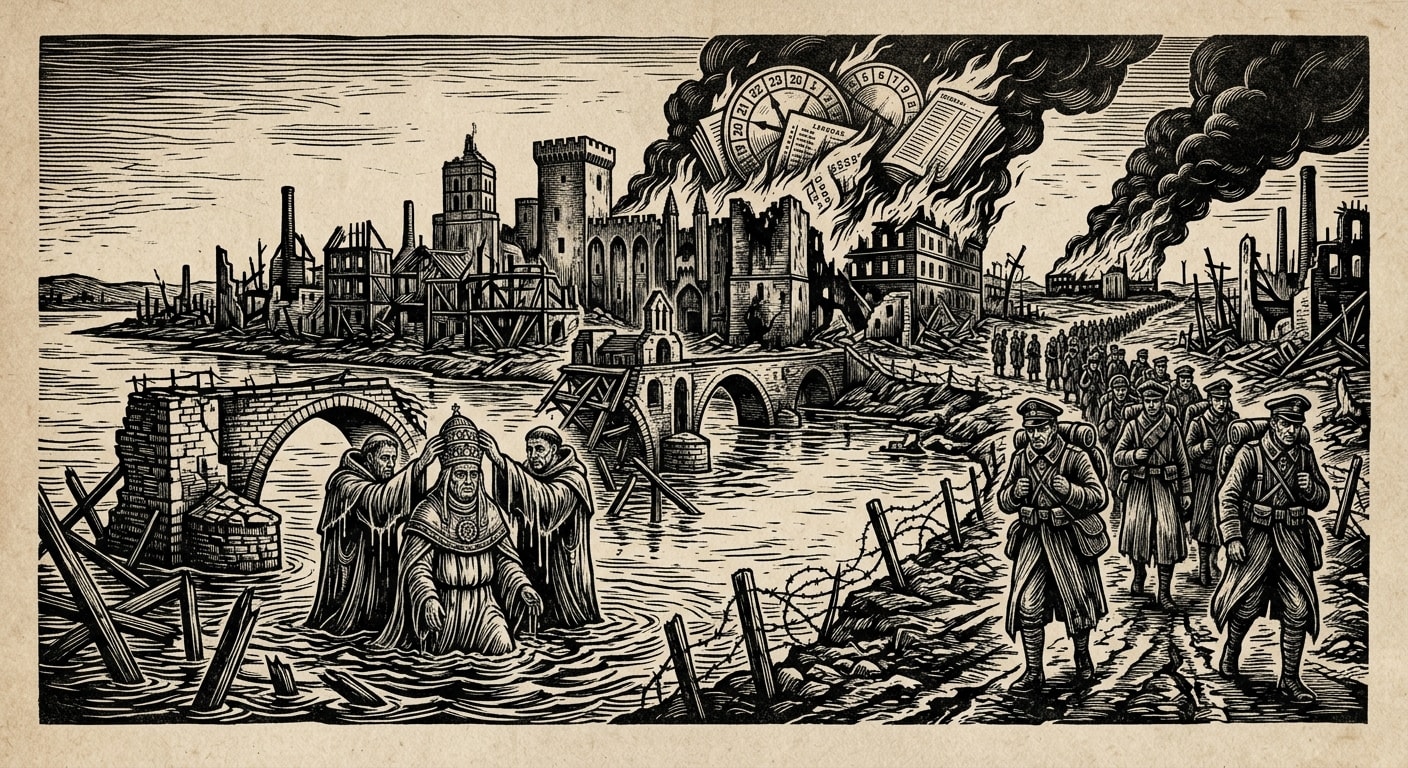
He was crowned beneath the Rhône. That is the phrase preserved in the dangerous accounts, and it has survived because it is too ridiculous to kill and too exact to ignore. Some reports place the rite in the river itself, congregation waist-deep and crowned with waterweed. Others locate it in flooded catacombs beneath the city, accessible at low tide, where old stones carried old marks and the words of consecration bubbled upward through brown water. The Bureau of Doctrine rejects both accounts. The Bureau of Doctrine rejects many things shortly before building policy around them.
The Drowned Pontiff's theology was river-theology: succession through flow rather than stone, apostolic authority carried by water older than cathedral, blank clay disc as anti-stamp, the Concordat denounced as ossification, the Great Ledger condemned as a stone laid on the chest of the faithful. Heretical, clever, corrosive. One hears the danger immediately. A stupid heresy can be beaten with a sermon. A clever heresy requires committees, spies, and carts.
The city followed him in numbers that remain disputed because the Synod murdered the arithmetic. Thousands, certainly. Tens of thousands, if one credits sealed fishers' depositions, intercepted Iberian reports, and the nervous overreaction of officials who claimed no danger existed while dispatching enough men to erase a province. For six months Avignon breathed against Strasbourg like a second chest.
Strasbourg answered by clarifying.
#On the Razing
The Strasbourg garrison marched south under War writ and Purity custody. The orders did not call the campaign a siege. They called it a Clarification, a word so clean it arrives wearing gloves. Avignon's walls held nine days. On the tenth, the gates opened from within. No name survives for the hand at the bar, though Purity expense ledgers record “persuasive disbursements, Avignon garrison, confidential,” which is how bribery sounds after it has washed.
The Razing was exact. Structures associated with schismatic clergy were dismantled stone by stone. Chapter houses were emptied, then reduced. Courts were stripped. Bells were taken down. Archives were seized. Cobble, threshold, lintel, shrine-step, stair, altar block, bench, post, and seal table entered inventory. The usable stone was loaded onto barges and shipped north to Strasbourg, where it now forms staircases in the Cloister of Concord. Every clerk who climbs those stairs treads Avignon without knowing it. The Bureau calls this poetic justice. I call it excellent salvage.
The official geographic index reclassified Avignon from city to former terrain feature. That phrase remains among Records' finest little assassinations. A city can rebel. A former terrain feature can only be surveyed. A city can host a pontiff. A former terrain feature can contain rumours, mineral accretions, and regrettable local customs. Paper did what fire could not: it continued the Razing after the soldiers went home.
Provincial almanacs and several careless wall-chronologies date the Schism of Avignon to A.S. 145.
Clarified. The river crowning, six-month crisis, Razing, and first Trifold Erasure belong to A.S. 111. A.S. 145 marks later calendar correction, chapter purge, and southern docket harmonisation, when the remaining Avignon rolls were burned into agreement. The Bureau regrets any confusion caused by permitting two truths to occupy one ruin.
#On the Glass Morning
At dawn after the last night, the soldiers found rows.
This is the line seventeen sealed depositions share. They differ on smoke, weather, prayer, colour, and whether the sound before sunrise resembled glass rods, struck bells, or rain falling upward. They agree on rows. Calcium-white figures arranged where a congregation had stood. Faceless bodies in prayer-postures. No bones of the ordinary sort. No relics. No corpses suitable for identification, accusation, or mourning. Only brittle human shapes with the individuality planed away.
Purity calls this seditious fiction. Records sealed the depositions and stamped the seal with a second seal. Doctrine prefers silence, which is the Bureau's way of admitting a subject has developed teeth. The Judges appear in several later marginal traditions attached to Avignon, though no authorised file places them inside the city. Their absence from the file is emphatic. Emphasis is sometimes only fear wearing formal shoes.
SEALED AVIGNON DEPOSITION XVII — EXCERPT “We entered after Prime. They were white, all of them, kneeling without faces. One held a blank clay disc in both hands. When Captain M—— touched it, the disc softened and took his thumbprint without pressure. The print was not his. It was █████████████████.” Disposition: witness visited; captain removed from index; disc unlocated.
The Penitential Shadows visited the witnesses within the year. Fourteen recanted. Three vanished. This is a poor ratio for truth and an excellent ratio for policy. Fourteen recantations prove the story false. Three disappearances prevent its correction.
The fishers complicated matters, as honest labourers often do when they refuse to keep their nets empty for the comfort of institutions. They began dragging up rosaries from the Rhône: glass-caked beads fused to iron links, river-worn, smelling of mineral, smoke, and old wax. Three delegations inspected them. All three reported natural mineral accretion. All three lead investigators were transferred afterward. Nature, it seems, requires close supervision.
#On the Ruins as They Stand
Modern Avignon is a managed wound. The old city footprint is divided into cordons: Pilgrim Yard, First Opening, Riverside Restriction, Cathedral Absence, Northern Stone Remainder, Fishers' Inspection Bank, and the Administrative Quiet Field, where speaking the title Pontifex Submersis aloud without Bureau escort carries a fine, a penance, and the possibility of educational detention by people whose definition of education is admirably physical.
The Cathedral Absence is the most visited space. There is no cathedral there. This disappoints the pious, delights Records, and annoys Pilgrimage, which must sell tickets to a lack. A low fence marks the vanished nave. Bronze plaques describe loyalty, error, correction, and the dangers of unauthorised succession. Visitors walk around the empty plan in silence while a guide explains that the cathedral remained loyal during the first phase of the crisis, which is true and useless, the most Bureaucratic pairing.
The remaining inhabitants are few: licensed guides, cordon wardens, fishery inspectors, Pilgrimage toll clerks, a Mercy hostel staff, three elderly families whose removal would require paperwork older than the Razing, and fishermen who have learned to show their nets before sorting them. A small chapel to doctrinal obedience operates under Strasbourg licence. Its altar is new, ugly, and impossible to mistake for old Avignon work. This is deliberate. The Synod does not permit nostalgia to hide in craftsmanship.
At the First Opening, Varrican pilgrims arrive with chains. At the Cathedral Absence, school groups arrive with questions their instructors have been trained to pre-answer. At the riverbank, wardens arrive with hooks to inspect nets. At dusk, the ruins produce a cooling sound: stone giving up heat, iron shrinking, river touching bank, shutters closing on houses officially too minor to exist. Locals say the sound resembles a chain being dragged underwater. Locals have poor career instincts.
#On Relics, Chains, and B-Flat
The Chains of the Martyrs of Avignon are the ruin's absent relics, which makes them powerful in the annoying way absent things often become. The Bureau of Relics claims guardianship of them in one catalogue, denies any displayable chain in another, and keeps watch rotations beneath the Basilica of the Ledgered Saints that would be extravagant for a non-object. The chains are said to hum at night. B-flat, according to one unfortunate Bells examiner who confirmed the pitch before Relics asked him to stop discovering things.
Avignon itself keeps lesser relics, most of them disallowed. River rosaries are confiscated on sight. Blank clay discs are burned, crushed, catalogued, and occasionally found again in cupboards that have already been searched. White glass flakes from the old calcification rows circulate in secret devotional packets among southern families who insist they are not venerating schismatics, merely preserving mineral evidence. This is a distinction the Bureau does not admire.
The colour called washed Avignon red is forbidden in the Hall of Seals if it leans toward riot. I mention this because no ruin has truly died while its colour remains prosecutable. Swatch-Clerks in Strasbourg can condemn a sleeve for resembling the sunset over a razed city. This is governance at the chromatic level, and I salute the pettiness. Petty law is law that has reached the bloodstream.
#On Lessons Still Charged at the Gate
Avignon taught the Synod how to destroy a city for an argument about seals, then how to continue destroying it by index, colour, route, relic, calendar, and tourist path. Kratz's architecture of overlapping justification found one of its first southern demonstrations here. Doctrine called the affair theological correction. Purity called it prophylactic cauterization. Records called it geographic reclassification. Pilgrimage called it a penitential opportunity once the ground cooled. Tithes called it recoverable.
The city also taught the enemies of Strasbourg a lesson the Bureau dislikes naming: water keeps what paper rejects. Clay seals recur. Rosaries surface. The title Pontifex Submersis persists because denial has given it a liturgy of its own. Every stamp marked FORGERY supplies the forbidden story with another authorised cover sheet. If this seems inconvenient, welcome at last to administration.
As of A.S. 201, Avignon remains restricted, profitable, corrected, and insufficiently quiet. The annual inspections continue. The fishermen continue to find things. The First Opening continues to charge. The Cathedral Absence continues to attract schoolchildren, penitents, and the intelligent sort of fool who believes a ruin may answer questions better than an office.
At Ninth Peal the wardens clear the riverbank. Nets are stacked. Lanterns are hooded. The blank plaques at the Pilgrim Yard catch the last light without reflecting it. Somewhere beneath Strasbourg, if the night is damp and the Basilica stones have taken the day's cold properly, iron hums in B-flat.
Avignon does not answer. Avignon was corrected.