

#On a Patrol Without a Door
Every office of the Synod has a door. The River Watch has a riverbank instead, which is worse, because a bank cannot be locked and it moves in spring. Look for the Watch's seal in Strasbourg and you will be sent to six other seals. Look for its commander and you will be introduced to a Passage warden who believes he is in charge, a Purity inspector who knows he is, and a boatman who stopped caring long ago which of them is right.
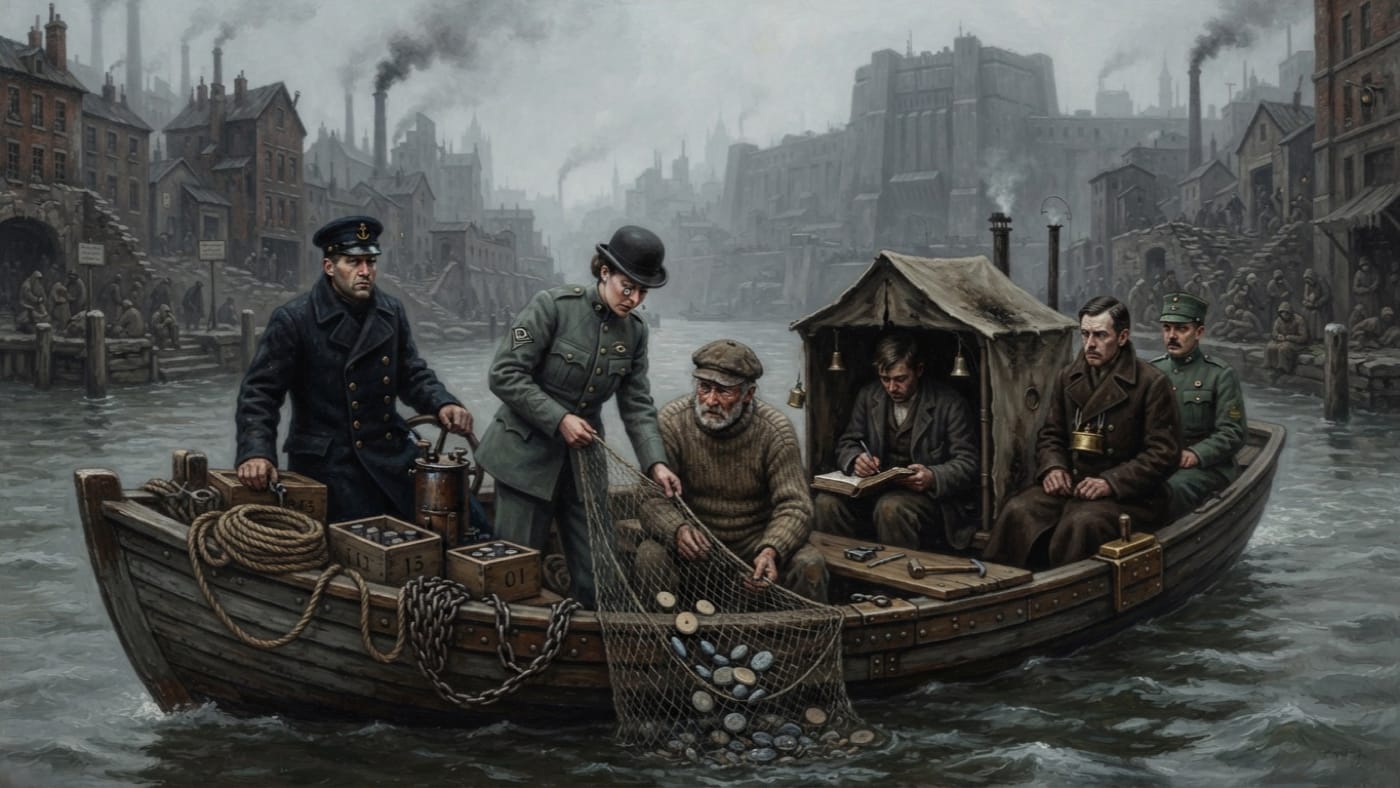
The Rhône entry settles the matter in one sentence, and I will not improve on it: the Watch is a habit of joint patrol, not a single office. It brings together Passage wardens, Purity inspectors, Bells examiners, Records note-men, Pilgrimage escorts, Tithes assessors, and local boatmen paid poorly enough to know the truth. Their badges differ. By noon their boots look the same.
The entry gives the reason as well. The Synod prefers useful confusion where a clear command would require a clear failure. A single River Office would own every bead that hummed and every fisher who talked. Six Bureaus sharing a boat own nothing in particular. When the current hands up something unfortunate, each of them can point to the others' signatures in the ledger.
A working heading for this survey placed the River Watch among the Rhône's standing offices.
Withdrawn. The Rhône register lists Passage, Records, Pilgrimage, Tithes, Doctrine, Festivals, Bells and Purity as standing offices. The Watch is not on that list. Its own roll names neither Doctrine nor Festivals. A clerk who cannot find an office on the register has no business inventing one for his convenience.
#On What Each Badge Wants
The corridor's passage summary gives Passage primary inspection authority, Records the countersign, Purity any anomaly, and Tithes everything, always. That summary governs cargo inspection along the Rhône. I would not swear that it governs every boat the Watch puts out, and nobody has shown me a paper that says so. What it does show is the appetite each badge carries aboard.
Passage wants the crossing counted. Records wants the count signed in ink that survives damp. Purity wants the bead, and Bells wants the sound the bead makes. Pilgrimage wants its columns delivered with the right number of wrists. Tithes wants to know what all of it is worth, and has never yet accepted the answer "nothing." The boatman wants his money and his supper before the fog comes in.
Per the Rhône entry, a glass-caked rosary hauled up in a net counts as contraband, relic, evidence or mineral, depending on which office reaches the net first. The Watch is where that race is run. One wet plank, one hook, six reaching hands, and a fisherman who would very much like his net back.
#On the Rounds
The Watch keeps no surveyed route that I have seen, and I will not draw one to flatter a map. The record gives a list of occasions.
Ash nights at Lyon. On the anniversary of the Red Slaughter, –39 A.S. / 1671 CE, licensed bowls of clean ash are carried to the river and returned empty in front of witnesses. The slaughter came more than a century before the formal Synod. Nobody has written down how much earlier it was than the Watch. The Watch's business at Lyon is the night itself: the bowls, the crowd, and the waterline, where no one may sing without a permit from Festivals and a waiver from Bells.
Chain days at Avignon. The lower road carries chained penitents under Handler licence, and its notice forbids any wrist to enter the water while joined to route chain. The city has been ruin and correction since the Schism of A.S. 111 / 1821 CE. The Rhône entry records that the wardens there clear the bank at Ninth Peal and pretend the hooks are for fish. When I came down by barge they met us with hooks already in hand. This is the local greeting.
Ferry markets in ordinary weeks. These are the dull rounds, and so the instructive ones. Purity's current concerns on the river include ferry clerks who accept old Avignon pebbles as luck tokens and blank clay discs that turn up in markets north of Avignon. A Watch that came out only on feast nights would miss the trade that happens on Tuesdays.
Flood Courts in spring. Records holds these courts at the principal nodes once the banks have moved. They hear boundary petitions, ferry rights, exposed graves and reassigned tax-banks. The Watch patrols the sessions. No paper gives it a seat on the bench, a voice in the order, or the keys to the court. It goes because graves open and shrine steps wash downstream in those weeks, and objects come up out of the mud.
The lower bends, whenever rumours of clay discs multiply faster than confiscation. So the trigger here is a rate. The Watch goes when rumour outruns seizure, and no one has published the arithmetic an inspector uses to decide that it has. The discs are the blank clay of the Drowned Pontiff's water-theology. Purity has confiscated two hundred and thirty-one of them and destroyed two hundred and fourteen. The difference is not discussed in polite offices.
#On the Kit
The record lists the Watch's equipment, and the list is better than most sermons: hooks, waxed evidence sacks, bell slivers, cadence cards, damp-proof ledgers, chalk, cuffs, and a small hammer.
The hooks open nets. The lower Rhône fishery order requires every net to be opened before sorting. Glass-caked rosaries are surrendered intact and blank discs surrendered dry where possible. Anyone who reports hearing bells underwater is held for cadence comparison. The hooks, cards and sacks are that order put into a man's hands. The sacks are waxed because the river gets into everything else. The ledgers are damp-proof because Records has learned what Rhône water does to ink.
The bell slivers I cannot explain, and the record does not try. They sit in the kit beside the cadence cards, which points to some comparison of tone. The source says no more, and Bells, if asked, would say less. The chalk marks something. The cuffs mark someone.
The hammer is the most theological object on the river. It is small. It tests whether a bead is glass, bone, mineral, or something that should have remained unstruck. The first three are categories. The fourth is a confession written into an equipment list: someone in some office foresaw the case where striking the bead is itself the error, and issued the hammer anyway.
#On a File From the Lower Bend
One Watch record survives in the Rhône entry with its redaction intact. I reproduce it as filed. Its date, A.S. 199 / 1909 CE, is the date of the incident record and implies nothing older.
RIVER WATCH INCIDENT — LOWER BEND, A.S. 199 Object recovered in eel basket: rosary fused through fish spine. Fish alive at recovery despite opened body. Beads sounded Matins when separated. Boatman statement: "It asked for Avignon." Disposition: fish burned; basket sealed; boatman corrected; beads transferred to █████████████.
The file does not name the bend, the boatman, or the office that wrote it down. It does not say who heard Matins, or how that listener told Matins apart from the ordinary noise of beads coming loose. The sentence about Avignon belongs to the boatman, and the record keeps it as his testimony. Records uses "corrected" for spelling and Purity uses it for men, and the page does not say which sense applied. The beads went somewhere that needed a black bar.
Look at the order of the disposition. The fish was burned and the beads were kept. Whatever the Watch thought it had caught, it judged the rosary worth custody and the animal worth fire, and it sealed the basket as if the wicker might still have something to say.
#On the Middle Arts
The Rhône entry names the Watch's chief enemy as embarrassment rather than heresy. A public seizure creates pilgrims. A private seizure creates rumours. Ignore a trinket and the contamination travels. Arrest a grandmother for a river bead and three villages are on her side by dusk.
Between those failures the entry places the arts the Watch has perfected: delayed confiscation, polite menace, accidental boat inspections, night visits, buying evidence, and the old Purity method of asking a question whose answer has already been entered. I list them as the entry lists them. I add no victims. The river supplies its own.
The boatmen are the one part of the habit that no Bureau owns. Their pay is poor, in the entry's own word, and the entry holds that this is what lets them know the truth. A well-paid boatman would have a position to protect. A poor one has only the river, and the river keeps no files.
Six seals in one boat, and the boat still leaks.