
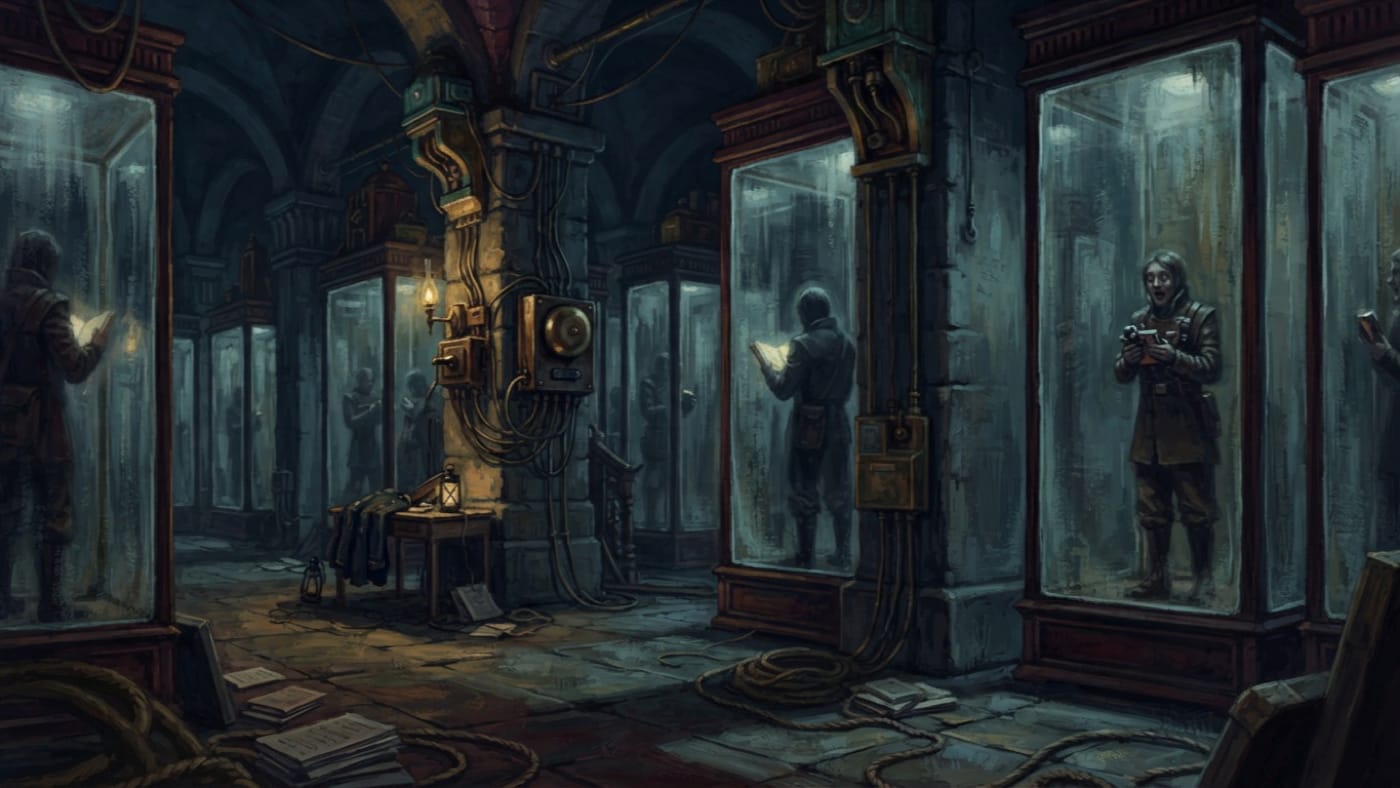
#On the Fourth Authorisation
In A.S. 196 / 1906 CE the Bureau of War authorised a fourth entry into the Vault of Ten Thousand Keys, the seat of Velmora beneath the walls of the Gilded Chasm. The Bureau of Doctrine objected in writing. Its objection was brief enough to read aloud between two bells. A fourth expedition, Doctrine warned, would add a fourth set of casualties and would not measurably improve the Synod's knowledge of the interior. War read the objection, filed it and sent twelve operators.
The earlier record did not support optimism. In A.S. 114 the Bureau of Tithes sent twelve auditors to assess the gold, and one came back. Those twelve were accountants. They are not the twelve of this entry, although the Synod's fondness for the number deserves its own inquiry. In A.S. 147, War and Cartography chained their party together with consecrated links and forbade anyone to touch anything. The chain broke when the chaplain reached for a purported finger-bone of Saint Aldebrand. In A.S. 174, Inspector Joris Venne sat down in the Counting Halls with a ledger and did not get up. A geologist and two guards walked out. Each party brought a precaution, and each precaution failed at a different depth. Every failure left survivors, pages of notes and a recommendation that the next party be better prepared.
War's better-prepared party was drawn from the Bureau of Shadows. Their names are withheld from this Ledger and from every copy I have seen. Their training in resistance to demonic influence is reputed to be the most rigorous the Synod produces. A reputation is not a certificate, and the file contains no certificate.
#On the First Report
They entered on the morning of the fourth day of the Feast of Doctrinal Submission. The minutes do not say whether War chose the date for its irony. I note the irony and bring no charge.
Their reports came out by bell-signal relay. The first day's report placed them in the outer galleries. These are the great halls where earlier clerks spent more time cataloguing than advancing. Cabinets and vitrines stand along the walls, holding crowns, coins and silks, the kind of goods any honest sinner understands. Each gallery is entered through a door with a lock of exceptional workmanship. Every expedition has reported that these doors close behind the visitor, and the first day's report gave no reason to doubt it.
The first report agreed with earlier surveys and reported no casualties. Clerks love a report like that, because it is short and confirms the file.
#On the Altered Displays
On the second day the operators reported from the Gallery of Rarities. The relay preserves their wording:
"Contents have changed since Third Expedition. Displays appear to reference current Synod intelligence priorities. Advise extreme caution."
The Gallery had always been stranger than the halls above it. Earlier parties described instruments that played themselves and maps that seemed more correct than Cartography's own. A Tithes man is tempted by a crown, a chaplain by a relic. The Shadows were offered what Shadows exist to take, which is information the Synod wants and cannot get anywhere else.
The report names no particular priority, and I will not supply one. It does not say how the Vault knew what the Synod was asking that year. I decline to speculate in front of a Doctrine tribunal that would enjoy my speculation more than I would. "Appear" is the operators' word, and their assessment stays theirs. Note the last three words of the transmission. On the second day the twelve were still writing in the grammar of their trade, with position, observation and advice in their proper order.
#On the Living Cases
A lip-reading specialist went with the expedition. The glass of the Vault's cases carries no sound, so everything the specialist recorded was taken from moving mouths and not from voices. Sixteen separate times the specialist read the same phrase: I found it.
These are sixteen readings. They are not a census. The record does not establish sixteen different captives, and it certainly does not establish sixteen dead. It establishes that people stood alive in cases, holding the things they had come for, and that their faces showed joy. This was joy and not terror. The parent entry on the Locked treats that joy as the central doctrinal danger, and I agree with it.
An early War summary described the Locked as "prisoners immobilised by demonic force."
Withdrawn. The Locked are held by glass, by lock and by their own grip on the prize. Possession in the Vault means ownership. Nobody's body is being worn by anything. Their wills are still their own, and that is the terrible part.
One case held an Answer-Locked chaplain pressed against the glass with a doctrinal treatise open in both hands. The operators saw the title change between observations. The last title they reported was On Why You Were Right. The record does not identify this chaplain, and he must not be confused with the chaplain lost in A.S. 147. All twelve operators walked past him. When the Vault offered them their own vindication, bound and titled, they refused it. Whatever happened afterwards, the Ledger records that refusal as theirs.
The expedition also reported a Self-Locked figure in the uniform of a Shadows operator. The name is sealed. The relay entry says only: "Subject appeared to recognise subject." A separate visual report, filed under its own number, follows below. I keep the two entries apart because the Seal keeps them apart. Neither entry explains the other.
FOURTH EXPEDITION VISUAL REPORT, SEAL AMBER: Case 41 contained █████████, alive, holding ███████████████. Subject outside the case denied recognition twice. On third viewing, subject inside mouthed, "You brought me." Relay officer ordered withdrawal. The next transmission omitted the officer's name from the roster.
The omission is documented. The fate of the officer is not. An absent name on a relay roster proves that a name was absent. Any clerk who writes "deceased" in that margin will answer to me before he answers to Doctrine, and I am the less forgiving of the two.
#On the Third Day's Signals
On the third day the transmissions doubled in frequency. The Shadows relay record calls them frantic and compressed, and says they were stripped of operational syntax. A field report has an order to it, and that order is what makes it a report. On the second day the order held. On the third day it was gone. The content of those transmissions is classified under Seal Amber, and it is not in this file.
On the evening of the third day the final transmission reached Bastion-Sibiu by bell-signal relay. It consisted of eleven words. The count is public, and the words are not.
The relay operator who received it asked for an immediate transfer. The request was granted without the usual forty-day processing period. This operator was at Bastion-Sibiu and should not be confused with the relay officer named by role in the Case 41 report. Nothing in the file connects the two posts or the two people. The waiver is an administrative fact. The file records nothing about the operator's state of mind, and I will not fill that gap with ghosts.
I have been asked, by letter and once in the nave, what the eleven words said. Every reconstruction I have heard says more about the person asking than about the Vault. The Keymasters keep inventories of that kind of wanting, and I do not intend to add to them.
#On the Return That Remains Unreported
No member of the Fourth Expedition has been reported as returned. No fifth expedition has been authorised, and Doctrine has formally recommended against one. I attached my own recommendation to the file. My objection to sending auditors into a crocodile and then expressing surprise at the crocodile's surplus is on record in the Vault entry and does not need repeating.
The absence of a return does not certify twelve deaths. It does not prove that twelve operators became exhibits or deserted, and it does not prove that they survive together somewhere below the Gallery. The reports place the expedition in the outer galleries and in the Gallery of Rarities. They do not place it in the Confessional, and they do not record an encounter with the Covetous Serpent herself. Readers who want more than this have the Great Deceiver's catalogue to turn to, and he prints it in the colours they prefer.
Two later rulings, made after the fact, govern how the Synod now handles the matter. In A.S. 198 Doctrine classified the Vault as a Category One Spiritual-Architectural Threat under permanent interdiction, with recovery operations suspended. In the same year an inter-Bureau ruling on the Locked fixed how the institution treats living captives behind glass. That ruling is a policy on a category of captive. It is not a death certificate for any of the twelve. Prohibiting recovery is a policy decision. It does not decide what the Creator may or may not redeem, and it was never intended to.