
#On the Day That Teaches the Spine to Bend
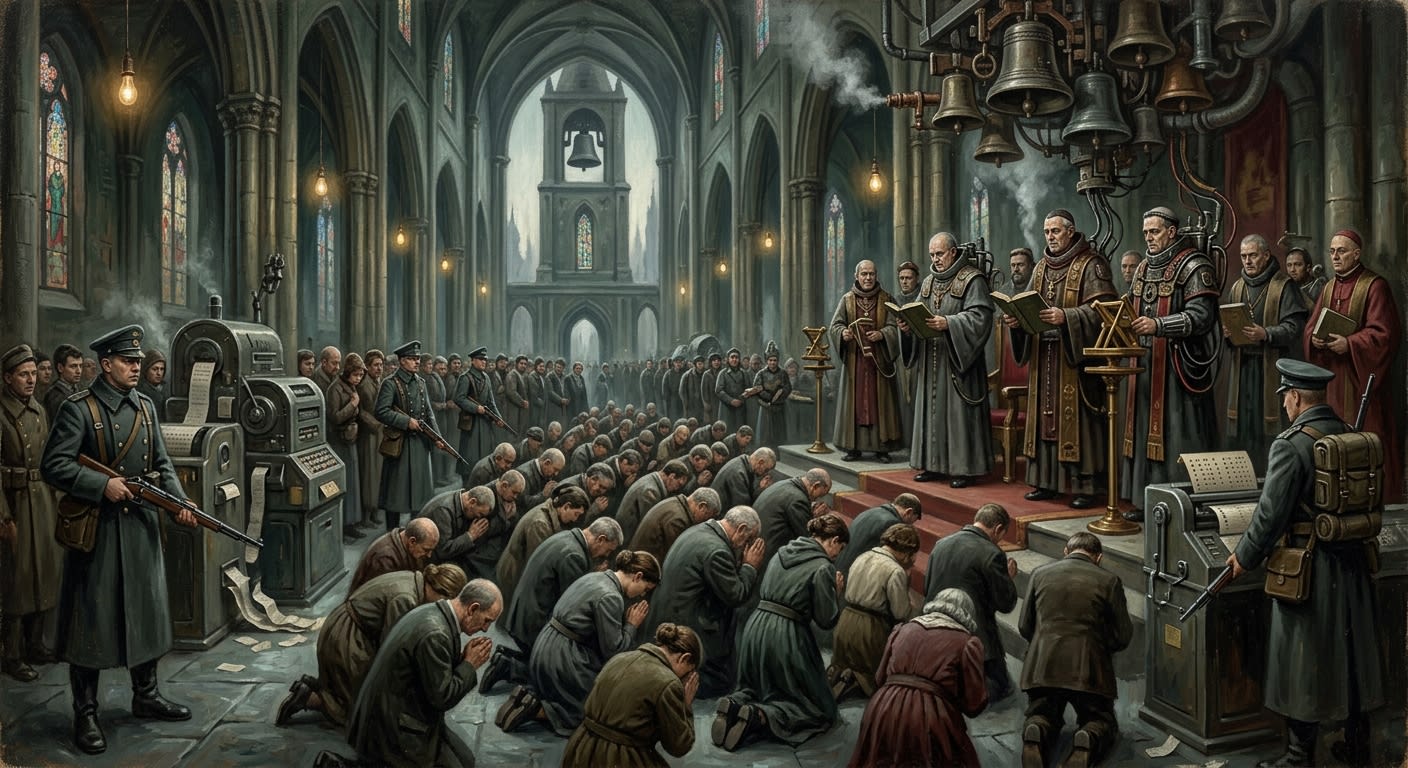
The Feast of Doctrinal Submission falls on the 3rd of Ferrum, when winter has not yet surrendered, Lent has begun sharpening its little knives, and the common citizen is most receptive to ceremonies that explain why obedience feels like hunger. It is a mandatory observance across Synodal Europe and a dangerous one at Bastion-Constantinople, where the festival has accumulated enough ash, chain-light, maritime anomaly, bell law, and public starvation to make joy stand at attention.
The name troubles soft men. Submission sounds severe, they say. It does. That is why it was chosen. The Bureau of Festivals once proposed the gentler title Feast of Concordant Obedience. Doctrine rejected it for smelling of upholstery. Purity proposed Day of Kneeling. Bells objected on grounds of schedule. War proposed no title and requested the population assemble for inspection. Festivals, after six committees and one fatal chorister dispute, returned to the oldest phrasing: Doctrinal Submission.
The Feast does not commemorate a single victory. Inferior festivals do that. A victory is an event, and events have the bad manners to pass. The Feast commemorates the condition by which every victory may later be claimed: the bending of private will beneath public Doctrine, the alignment of mouth, knee, ration, bell, and ledger into one administered posture. It teaches the body what the catechism teaches the tongue. Kneel when the bell commands. Rise when the permit permits. Sing the submitted verse. Receive bread. Depart in order. Repeat annually until death or correction.
Do not mistake the Feast for piety alone. Piety is never alone after Strasbourg touches it. The Feast is census, morale test, procession, ration queue, crowd drill, theatrical catechism, loyalty assay, and soft conscription rehearsal performed under garlands. Its genius lies in making the citizen rehearse surrender while believing he has been granted celebration.
#On the First Forms of the Feast
The Feast began before it possessed its current name. In the raw decades after the Sundering, when the Great Retreat had not yet stiffened into the Sagittal Line, commanders discovered that soldiers accepted impossible orders more readily if the order came after a communal gesture. A line of men made to kneel together will stand together with less argument. A starving unit told to sing before receiving bread will remember the song as part of eating. A refugee column forced to bow before crossing a bridge will call the bridge merciful because it opened afterward.
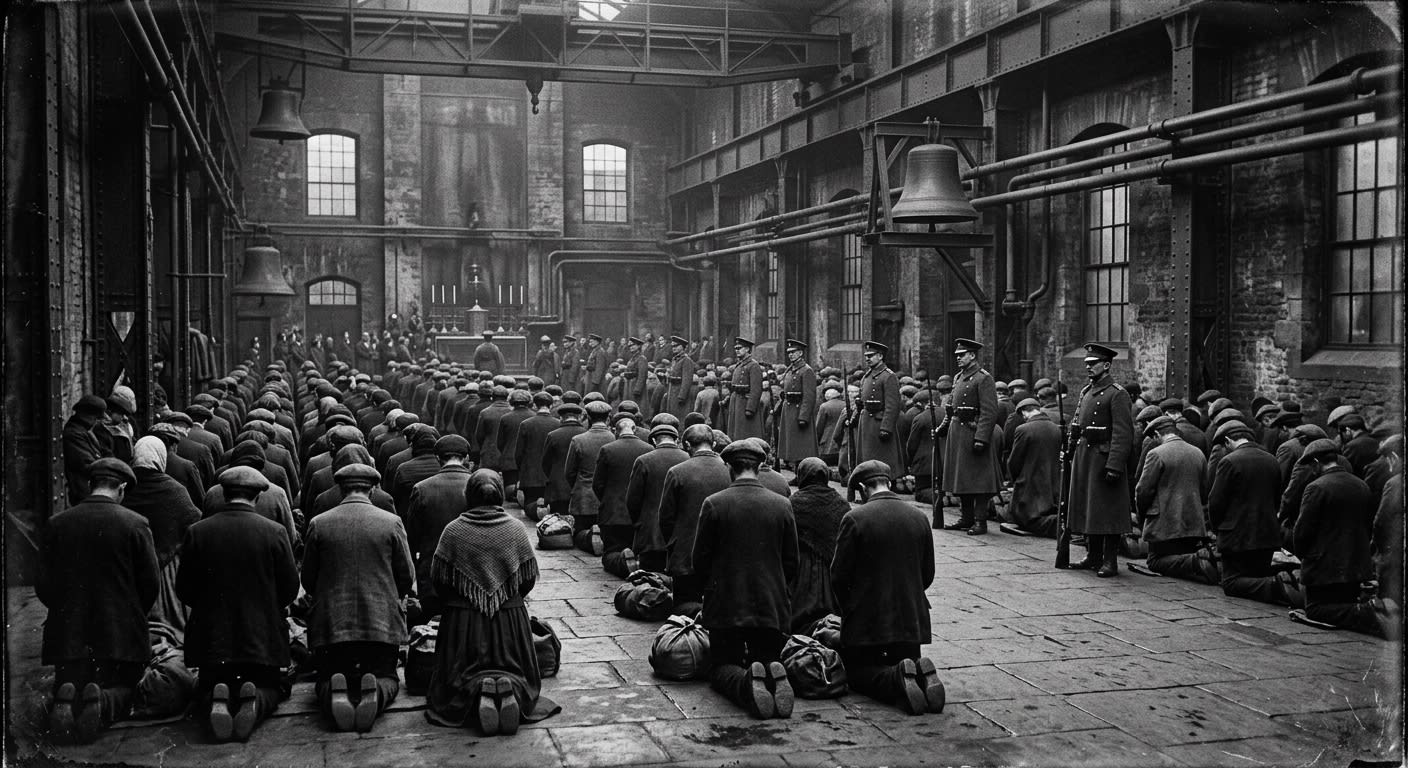
These were crude discoveries made by priests, quartermasters, and officers who had never heard of cultural administration and were free to be useful for that blessed reason.
The earliest recorded Submission rite appears in a field ledger from A.S. 54 near the Danubian withdrawal roads. Three hundred and twelve refugees were required to kneel before receiving passage tokens through a military checkpoint. The priest read a brief formula: The spine bends before Doctrine; Doctrine stands before Hell. The passage clerk, a practical man whose name deserves preservation and whose file has been lost because Records is a jealous cow, noted that the kneeling reduced crowd pressure by half and improved token distribution. He also noted that two men who refused to kneel were beaten by other refugees before soldiers could intervene. This detail caused interest in Strasbourg.
By A.S. 72 the young Bureau of Festivals had absorbed these frontier kneeling rites into its developing calendar. The Feast was standardised under the Charter of Prescribed Observance, then revised after the Concordat of Strasbourg in A.S. 90, when the Synod acquired enough authority to convert habit into obligation. The 3rd of Ferrum was selected because it fell between the winter scarcity audits and the harsher Lenten registers, giving the Bureau a public hinge between hunger endured and hunger sanctified.
The first full Strasbourg edition, A.S. 94, required three kneelings, one litany, one hymn, one public assent, and one distribution of coarse bread stamped with the Triune Knot. The bread mattered. Bread always matters. A government may teach citizens to bow; only a foolish government forgets to place something in the mouth afterward.
Later provincial pamphlets claim the Feast was instituted by spontaneous acclamation of the faithful after a miraculous victory on the Line.
Corrected. The faithful acclaimed what had already been scheduled. The miracle lay in timing, paperwork, and sufficient bread flour. These are not lesser miracles. They merely have fewer stained-glass admirers.
#On the Rite as Performed
The standard Feast begins at first bell with the Posting of the Calendar. A Chorus-Master or licensed parish conductor displays the day's permit sash, reads the local attendance requirement, and announces the approved emotional range. Exuberance may be permitted in rear provinces; solemn gratitude is preferred near the Line; laughter is forbidden within three hundred yards of any active military hospital unless specifically called for by script. Children under seven may fidget. Children over seven may not, which is how one separates infancy from citizenship.
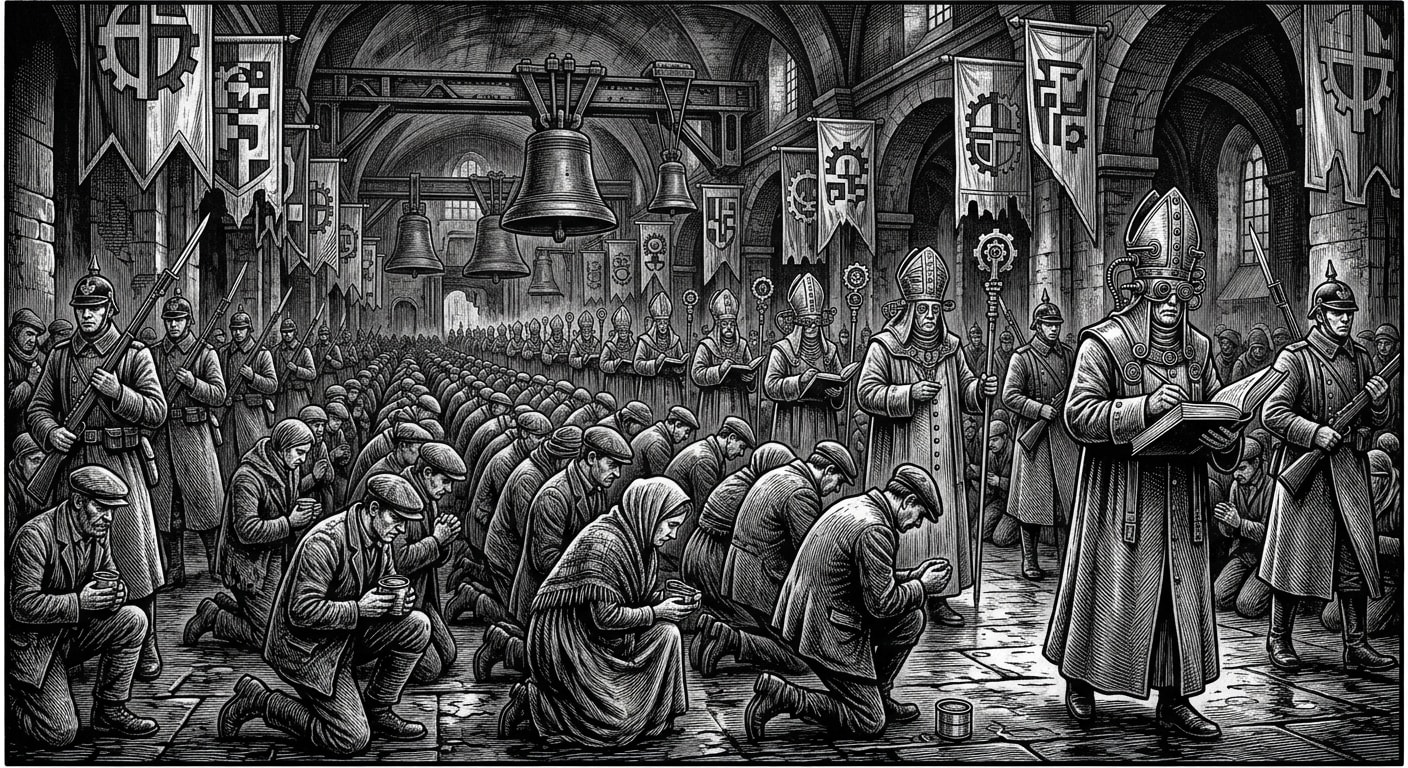
At third bell the first kneeling occurs. The crowd faces east where geography allows, toward the Line and the Charnel Lands beyond. In western cities whose streets refuse alignment, painted arrows are placed on walls and pavement. The Bureau of Engineering has objected to the expense. The Bureau of Doctrine has replied that souls cost more to realign after error.
The litany follows:
The sequence is short by design. Long litanies produce wandering attention. Wandering attention produces private thought. Private thought produces pamphlets, and pamphlets are festivals held without permits.
At sixth bell, the pageant begins. A child dressed as Europe enters carrying a cracked bowl. Seven masked figures representing Sin approach in turn. Pride offers a crown. Greed offers keys. Wrath offers a torch. Gluttony offers meat. Envy offers a mirror. Sloth offers a pillow. Lust offers a ribbon. Europe rejects each by kneeling toward the Synodal banner while the Chorus sings the submitted refrain. In frontier versions, the seven figures are dragged away by Wardens. In Strasbourg, they are corrected by clerks, which is more accurate and less satisfying for children.
At ninth bell, bread is distributed. The bread is coarse, square, stamped, and deliberately small. It is not meant to satisfy appetite. It is meant to teach proportion. The citizen receives enough to understand gift and too little to forget dependence. In port cities, a salt wafer may accompany the bread. In mountain districts, a spoon of ash porridge is permitted. At Constantinople, the ninth-bell distribution carries another history, and every hand that receives bread does so under the shadow of the year when the doors opened onto nothing.
At vespers, the second kneeling. At final bell, the Release of Joy: licensed singing, approved lamps, small garlands, children permitted to run in circles under watch, old women permitted to weep without grief classification, men permitted to drink one cup where local ration law allows. The Bureau calls this joy. The people call it what they can get.
#On Chorus-Masters and Measured Enthusiasm
No Feast functions without Chorus-Masters. Priests can preach, officers can shout, Lictors can strike, but only the licensed Festival Chorus-Master can make a crowd move as one without turning the square into a casualty table. He is conductor, stage warden, informant, accountant, and goat tethered beside the dragon. If the crowd goes flat, he is blamed. If the crowd grows too warm, he is blamed. If the harmony shifts into an unsanctioned interval and opens a condition in the air, he is blamed posthumously if necessary.
The Bureau of Festivals trains Chorus-Masters to hear disobedience before it becomes speech. A delayed response in the third refrain may indicate grief, dissent, bad acoustics, or a cart blocking the north alley. The Chorus-Master marks it anyway. The mark travels upward. A city can be diagnosed through its singing. Strasbourg has known this for a century and has been insufferable about it for nearly as long.
Enthusiasm is measured in three registers. Vocal compliance: did the mouth produce the required words? Physical compliance: did the knee descend, the hand rise, the head lower, the ration card appear? Affective compliance: did the face display gratitude at a level neither seditiously low nor theatrically high? The third register has ruined many honest citizens. Sorrow resembles dissent. Terror resembles piety. Hunger resembles philosophy. The face is a treacherous clerk.
Purity maintains observers at major Feasts. Records maintains counters. Tithes watches bread loss. Bells watches timing. Doctrine watches language. Festivals watches everybody watching and complains afterward that no one understands art.
A.S. 148 Festival guidance described measured enthusiasm as “non-punitive communal encouragement.”
Clarified after the Reims prosecutions (Unregistered). Measured enthusiasm is punitive when deficient, suspicious when excessive, and acceptable only when it permits the reviewing officer to leave early.
The Chorus-Master's private terror is the unscheduled encore. Crowds desire repetition. Repetition creates possession of the form. Possession of the form creates ownership, and ownership of public emotion belongs to the Synod. The Feast permits a second refrain only under Clause 3-F, after the presiding officer signs the green slip. If the crowd demands it without slip, the joy has escaped.
#On Constantinople and the Ash-Bread Memory
At Constantinople, the Feast of Doctrinal Submission is performed under heavier bells. The city learned the cost of ninth-bell theology during the Ninth Bell Famine and the Year of Ash Rain, when Maldrake burned the Thracian forests and ash fell for nine months. The ration doors opened. Bread did not come. The bell tolled regardless, obedient to schedule while stomachs learned doctrine from absence.
Since A.S. 145, Constantinople's Feast includes the Ash-Bread Memory. A pinch of consecrated grey flour is mixed into the first ration batch. The public explanation calls it remembrance. The private quartermaster explanation calls it efficient use of stored ash-flour, though no sane quartermaster writes that twice. The bread tastes of dust, salt, and old smoke. Citizens eat it slowly because their grandparents told them to.
The Ash-Bread procession begins at the Cathedral of the Perpetual Registry and moves toward the Harbor of Chains. Children carry empty bowls. Veterans carry sealed loaves. Widows carry nothing, by privilege. At the ninth bell, the loaves are struck on the ration tables before cutting, so the whole square hears the sound of bread behaving like wood. Then distribution begins.
The Harbor of Chains adds further complication. During the Feast, the Chain of Saint Anakletos is garlanded with iron flowers, each petal stamped by Engineering and blessed by Bells. Since the Black Sea Armada of A.S. 162, the chain has remained intact and dormant. During the Feast it is watched for glow. No glow has been officially recorded. Unofficial glow reports are numerous, usually from sailors, children, widows, drunks, or men about to become troublesome.
The Iron Idol gives the observance its submerged unease. Fishermen say that eyes open under Phaleron Bay on the Feast. The Bureau of Engineering says water refraction. The Bureau of Doctrine says unhelpful talk. The Bureau of War says distance. All three are correct enough to be useless. Boats are forbidden within the inner hazard line from second bell to dawn. Every year one boat crosses it. Every year the report describes error, current, intoxication, or ignorance. The water keeps a better record.
HARBOR WATCH ADDENDUM — FEAST NIGHT, A.S. 196 Boat name: Little Mercy. Crew: two registered, one unregistered child. Crossed hazard line at third night bell. Lanterns observed lowering vertically. Recovered item: ration card, wet, stamped with next year's date. Public disposition: current accident. Private disposition: ███████████████████████
At Constantinople the Feast becomes less celebration than controlled pressure around a wound. The people kneel toward Hell, eat ash, watch a chain that once burned, avoid water that may be looking back, and call this obedience because any other name would require additional guards.
#On the Feast Beyond the South
In Strasbourg the Feast is polished. The squares are swept. The bells agree because disagreement near the capital embarrasses too many powerful men. The Hierarchs attend by representation unless illness, politics, or virtue intervenes. Children dressed as provinces present ribbons to a veiled figure representing Doctrine, who accepts them with the strained patience of a woman being handed evidence. The bread is better than in the provinces, an injustice the Bureau calls central standardisation.
In France and the Rhineland, the Feast has become civic theatre. Guilds compete in banner discipline. Parish choirs rehearse submission harmonies for weeks. City councillors kneel in front rows and rise with the terrible care of aging knees performing loyalty under observation. In Iberia, the Feast carries penitential heat: candles, veils, iron garlands, and public weeping so accomplished that visiting inspectors have mistaken it for unrest. In the Fractured North, the Feast is shorter, colder, and sung through scarves; snow muffles half the responses, which the Bureau records as environmental compliance loss.
At Bastion-Brest, the bridge authorities use the Feast to drill crowd lanes through confession queues. At Bastion-Przemyśl, the kneeling is timed to artillery pauses when possible and to artillery fire when necessary. At Bastion-Irongate, Bells and Orison dispute the underchord sequence every year, creating a local tradition of procedural resentment. At Bastion-Shipka, sleepers must be prodded upright before the litany, lest Sloth receive an accidental compliment.
The Netherlands do not observe the Feast, though Dutch merchants have been known to sell submission ribbons at excellent margins. The British mock it in private and send naval observers to Constantinople when the Chain is garlanded, proving that mockery and intelligence gathering are cousins with different hats. Independent territories disdain Synodal ceremony until a convoy requires blessing, whereupon disdain becomes ecumenical courtesy and everyone washes their hands after.
Some frontier soldiers love the Feast. This surprises civilians, who mistake compulsion for uniform resentment. Soldiers love any day with extra bread, predictable bells, and permission to stand in formation without being shot at. Many keep the square ration stamp in prayer books. Many curse the Chorus-Master and sing louder than anyone. Men are not simple. This has inconvenienced every Bureau except Mercy, which built a career on the fact.
#On Children, Masks, and the Seven Refusals
The child-pageant is the Feast's prettiest cruelty. Its cast changes by province, yet the doctrinal pattern holds: Europe appears small, endangered, and over-costumed; the Seven Sins approach with gifts; Europe rejects each by kneeling under the Synodal sign. Adults applaud because children make obedience look innocent. Children enjoy masks, applause, and bread. Both parties leave improved in the direction the Bureau intended.
Costumes are regulated with more ferocity than several artillery depots. Pride's crown may not exceed three finger-widths above the brow lest it become attractive. Greed's keys must be tin, never brass, after the A.S. 164 Metz incident in which three children refused to surrender them. Wrath's torch is painted wood in rear provinces and unlit iron in front-line districts where sentimentality has less authority. Gluttony's meat is cloth, except in famine memorial parishes, where any representation of meat requires special permit. Envy's mirror must be fogged. Sloth's pillow must be stuffed with straw, not feathers. Lust's ribbon may be red only in cities with Purity staffing adequate to the colour.
The children learn their refusals by rote. “I will not rise above the Wall.” “I will not own what belongs to the Ledger.” “I will not burn what Doctrine has numbered.” The lines are too long for the smallest children, who chew them into fragments that sometimes improve the theology. A five-year-old in Mainz once told Greed, “I will not own the Ledger because it bites.” I recommended adoption by Doctrine. The request was ignored, proving that genius in children remains unsafe around clerks.
The masked Sins are usually played by apprentices, minor clerics, condemned actors granted performance remission, or, in poorer parishes, whichever adult can still fit inside the inherited costume without profanity. The role is dangerous. Crowds like to boo Sin. Children kick Sin. Purity watches Sin. If the actor performs too persuasively, questions follow. If he performs badly, Festivals fines the parish for doctrinal limpness. Many actors prefer prison work. Prison audiences are less moral.
The Seven Refusals make the Feast portable. A mining town can stage them with soot and rope. A port can stage them with nets and salt. A bastion can stage them in a shell crater with seven soldiers wearing labels. The rite survives poverty because its central prop is refusal, and refusal is cheap until enforced.
#On Abuses, Heresies, and Useful Failures
Every mandatory joy breeds counterfeit joy. The Feast has accumulated its own heresies: false submission ribbons sold in market lanes; private counter-litanies muttered under the approved words; unsanctioned kneelings toward local graves rather than east; children taught to swallow the bread without touching it to the tongue; provincial jokes about Doctrine's posture; naval wagers on Chain glow; lovers arranging meetings at Release of Joy because Purity cannot watch every alley after vespers, despite its moving devotion to the attempt.
The most famous abuse remains the Reims Enthusiasm Fraud of A.S. 176, when a parish choir achieved perfect affective compliance for three consecutive years by painting mild gratitude onto their faces with diluted berry dye. The fraud was discovered after rain. Purity prosecuted the choir, the painter, the berry seller, and two weather observers accused of negligence. Festivals argued privately that the parish had met the measurable standard and should be commended for technique. Doctrine suppressed the argument because it was correct in a manner injurious to authority.
Darker incidents exist. During the A.S. 153 aftermath of the Laugh Riots of Seville, several provinces attempted to reduce the Feast's Release of Joy to silence. The result was worse than laughter. Crowds held still too long. Men fainted. Children began whispering the litany backward for amusement. One old woman in Salamanca stood after final bell and asked, clearly, whether obedience required joy or merely proof of attendance. She died peacefully six years later, which shows that Purity sometimes misses the truly dangerous ones.
Demonic interference is rare and not ornamental. Influence-demons prefer cracks in crowds: envy of those in front rows, pride in perfect performance, greed at bread tables, wrath toward observers, lust under garlands, sloth in the kneeling posture, gluttony in ration panic. The Feast gathers seven sins and teaches citizens to refuse them in costume. Hell has noticed the irony. Hell is many things; stupid is not among them.
Festival manuals instruct Chorus-Masters to watch for harmonic drift, mass silence after cue, laughter during eastward kneeling, faces turned toward water, children speaking in adult registers, and bread bleeding when cut. Only the last permits immediate armed suspension without countersign. The others require paperwork unless the crowd has already begun to move in a shape not approved by Engineering.
#On the Accounting of Knees
The Feast's hidden instrument is the knee-count. Publicly, attendance is marked by household and parish. Privately, every square of consequence records kneeling speed, delay, asymmetry, assistance required, refusal, collapse, and postural enthusiasm. A bent knee is more than a joint in motion. It is a confession made by bone.
Records keeps the primary rolls. Festivals keeps the performance rolls. Purity keeps the suspicion rolls. Tithes, proving that appetite always finds a desk, keeps a secondary ration exposure sheet comparing bread received to reverence displayed. A family whose sons kneel late three years in succession may find its next Levy exemption reviewed. A guild that sings under-strength may lose festival frontage. A parish whose old women remain standing too long may receive benches, inspectors, or both. The Synod is generous in small furniture when small furniture assists surveillance.
The most delicate cases are the infirm, the wounded, and the bereaved. A veteran without legs cannot kneel, though several local officials have proposed symbolic alternatives so stupid that charity forbids quotation. Widows may kneel by proxy through bowl placement. Children too small to understand are lowered by guardians, which creates touching scenes later used in Festival engravings and Purity training plates for entirely different lessons. The elderly may remain seated if their parish has filed Form K-3, Joint Limitation of Pious Flexion, at least nine days before the Feast. Sudden age is not accepted.
Fraud thrives in mercy's shadow. Families hire kneelers for absent relatives. Guilds stack children in front rows to hide adult reluctance. Provincial choirs cough during the knee-drop to obscure the sound of delay. In one Ghent parish, an enterprising sacristan constructed hinged kneeling rails that lowered the entire front row simultaneously, producing perfect compliance among men asleep, drunk, or dead. The device was condemned, copied, and quietly purchased by three military chapels.
The knee-count has become one of the Feast's richest harvests. From it Strasbourg learns which districts ache, which resent, which starve, which perform too eagerly, which require bread, which require theatre, and which require night wagons. Citizens believe they are bending before Doctrine. Doctrine, with proper modesty, is also looking down.
#On the Present Observance
As of A.S. 201, the Feast of Doctrinal Submission remains one of the forty-one mandatory attendance observances in the Bureau of Festivals calendar. It is beloved by officials, dreaded by Chorus-Masters, tolerated by citizens, exploited by merchants, watched by Purity, miscounted by Records, taxed by Tithes, argued by Bells, and defended by Doctrine as proof that Europe still knows how to bend without breaking.
Attendance compliance remains high. Enthusiasm compliance varies. Bread shortfall remains the usual scandal and the usual teacher. In the southern theatre, Constantinople's observance has grown heavier since the A.S. 185 Saint Veritas affair and the renewed harbour restrictions around the Iron Idol. In the capital, Strasbourg has added a fourth child-province to the pageant after complaints that Zone 8 was being symbolically neglected, which Zone 8 received with its customary warmth: none.
I have attended the Feast in Strasbourg, Constantinople, Reims, Brest, and one village outside Mainz where the Chorus-Master was drunk, the bread was late, the children forgot which masked Sin carried the pillow, and the crowd sang with such ordinary tired force that every official present became, for three minutes, irrelevant. This is the danger and the use of festivals. They gather people into a body. The Synod says: kneel. The people kneel. Then, while kneeling, they hear one another breathe.
No Bureau has yet found a way to regulate that sound.