
#On the Civilian Quarter That Laughs Too Loudly
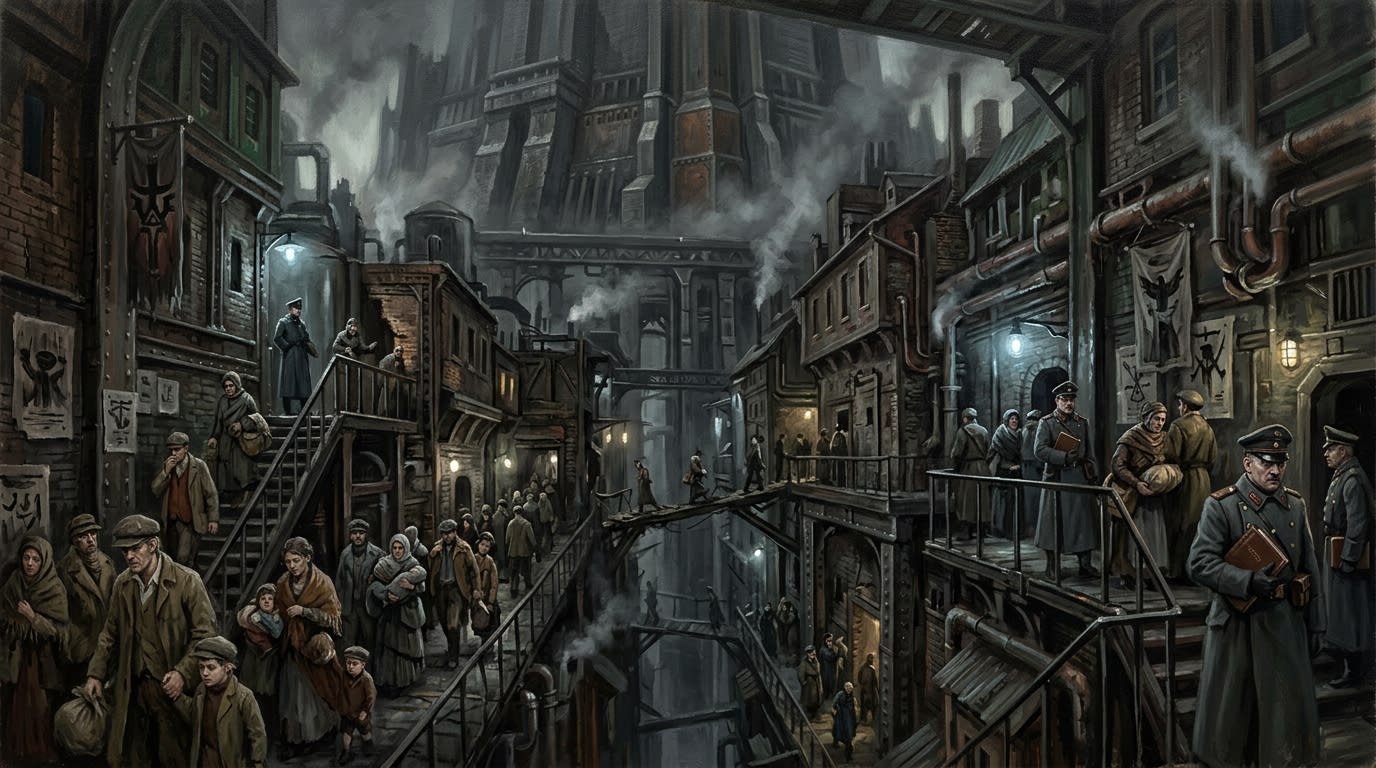
The Warrens of Bastion-Königsberg are the civilian quarter pressed between the Ordensburg (Unregistered) and the Harbour (Unregistered), where nineteen thousand registered and semi-registered souls live under the northern guns with the cheerfulness of people who have discovered that terror, when rationed daily, becomes weather. Fishermen’s families who refused evacuation, Prussian merchants with profitable nerves, eastern refugees who retreated until retreat ran out of continent, sutlers, dock wives, camp followers, bell-laundry girls, Passage clerks, charm makers, salt sellers, orphaned bell-runners, and old men who claim to remember Königsberg before it became a holy nail all sleep within the same cold municipal lie: that a fortress may possess civilians without becoming responsible for them.
The Warrens are not under the city. That honour belongs to better damp in Constantinople, where stone descends into sub-ossuary embarrassment. Königsberg’s Warrens stand above ground, naked to salt wind, squeezed into alleys too narrow for full wagons and too crowded for Purity to raid without witnesses. Their roofs lean toward one another as if conspiring against snow. Their shutters carry brine scars. Their doorframes bear three marks: household name, ration class, and private scratch to show whether the family has seen fog close enough to stop joking about it.
The bastion file calls the district a civilian quarter. This is accurate in the way a corpse awaiting burial is a resident of the Frost Yards. The Warrens serve the garrison by cooking, mending, unloading, laundering, selling, listening, bribing, warning, burying, remembering, and producing children who learn the bell schedule before they learn mercy. The garrison serves the Warrens by not evacuating them, not protecting them sufficiently, and not letting them leave without papers signed by men whose offices are warm enough to cultivate delicacy.
#On Refusal, Profit, and the First Winter
The Warrens began when evacuation failed and profit succeeded. Königsberg was requisitioned into the northern Line around A.S. 67, when the Synod hardened retreat into refusal and discovered that old Prussian brick made excellent obedience once plated with iron. Officials expected the civilian population to thin under military pressure. Officials also expect ink to dry faster when stared at. The fishermen stayed because the Baltic had fed their fathers and because no inland clerk had yet learned to gut cod properly. Merchants stayed because siege inflates price, risk sanctifies margin, and artillery men pay quickly when hungry. Widows stayed because husbands were stationed on the wall and the alternatives were Warsaw, Kanzleiburg, or a road full of colder lies.
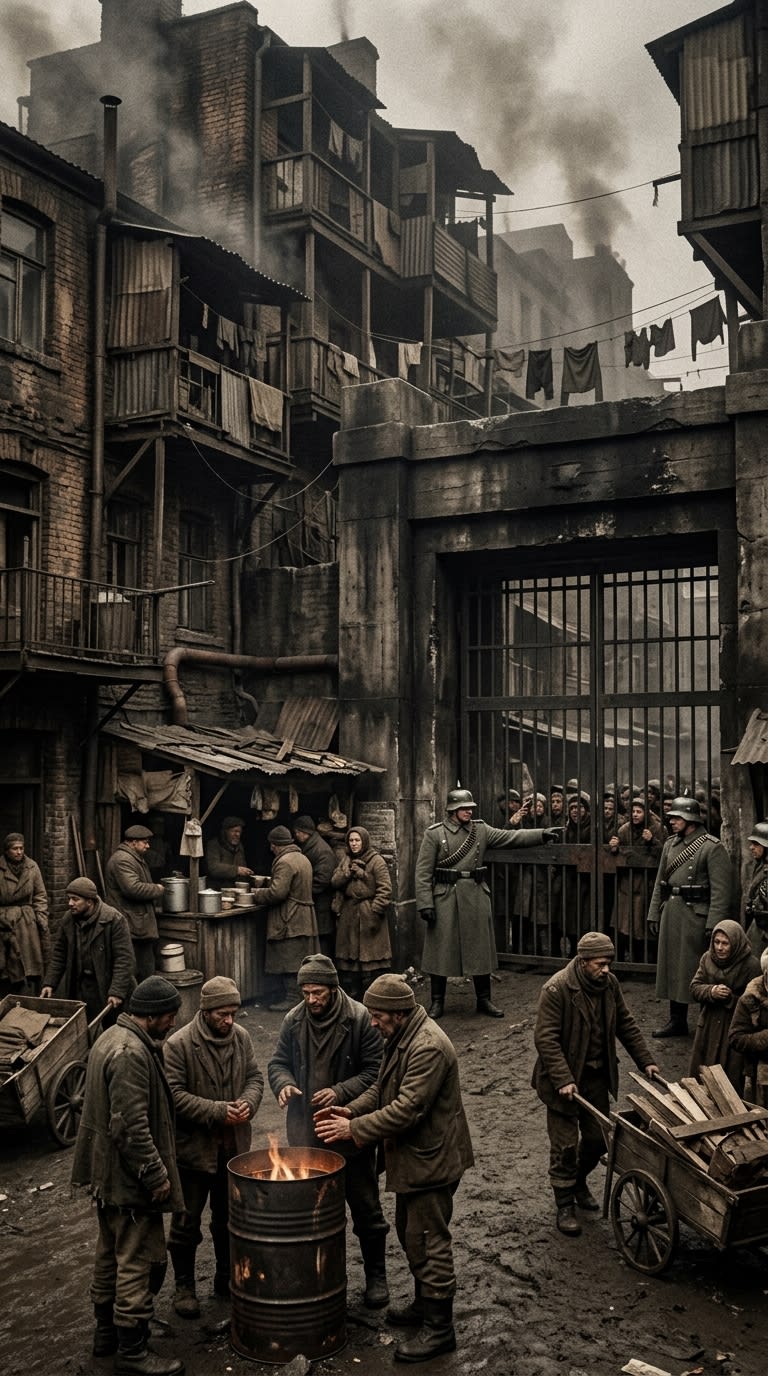
The first winter settled the matter. Harbour ice closed honest movement. Military stores needed hands. Bell bronze needed polishing. Salt meat needed cutting. Gun shutters needed ragging. Chaplains needed candles, washerwomen, and children small enough to carry notes through snow-drifts between offices. The Bureau of Passage opened a counter to regulate departure; by doing so it made departure a commodity. The people who could pay left. The people who could not pay became local.
An A.S. 74 Passage memorandum described the remaining civilians as “temporary service population pending orderly relocation.”
Corrected after one hundred twenty-seven years of failure. Temporary populations do not develop marriage customs, fishing debts, roof feuds, child nicknames for artillery pieces, and three rival recipes for gull stew.
By the Concordat rebuilding of A.S. 92–110, the Warrens had become too entangled to remove. The Ordensburg needed clerks’ lodgings close enough to command to be summoned during night reports. The Harbour needed labour that knew which ice could bear a cart and which ice could swallow one politely. The Northern Carillon needed bell-servants, rope greasers, cloth menders, and families whose sons could be trained to hear the difference between cracked bronze and ordinary cold. The Sea Wall needed men who could arrive without complaint at second bell and women who could repair gloves stiff with salt, blood, and that thin grey residue soldiers bring back after fog nights.
The Warrens took shape as such places do: one rented room becomes three; a warehouse loft becomes a dormitory; a widow turns a net shed into a soup room; a retired sapper boards up a passage and sells sleeping rights; a Passage clerk marries a fishmonger and discovers that local law has teeth; a child is born during a bombardment and no one remembers which office should have registered him, so he is registered by neighbours, which is more accurate and less lawful.
#On Streets, Salt, and Household Weather
The district’s lanes bear names no official map accepts: Codgut Street, Salt Mercy, Broken Oar Row, Widow-Bell Cut, Three Clappers, Greylaugh Court, Little Pregel, the Fishbone Steps, Halder’s Corner, Old Snow Yard, and the Blind Lantern, where the lamps burn behind horn panes so thick the light appears ashamed. Bureau maps use block numbers. Residents use incidents. Incidents are better geography because they bleed when misremembered.
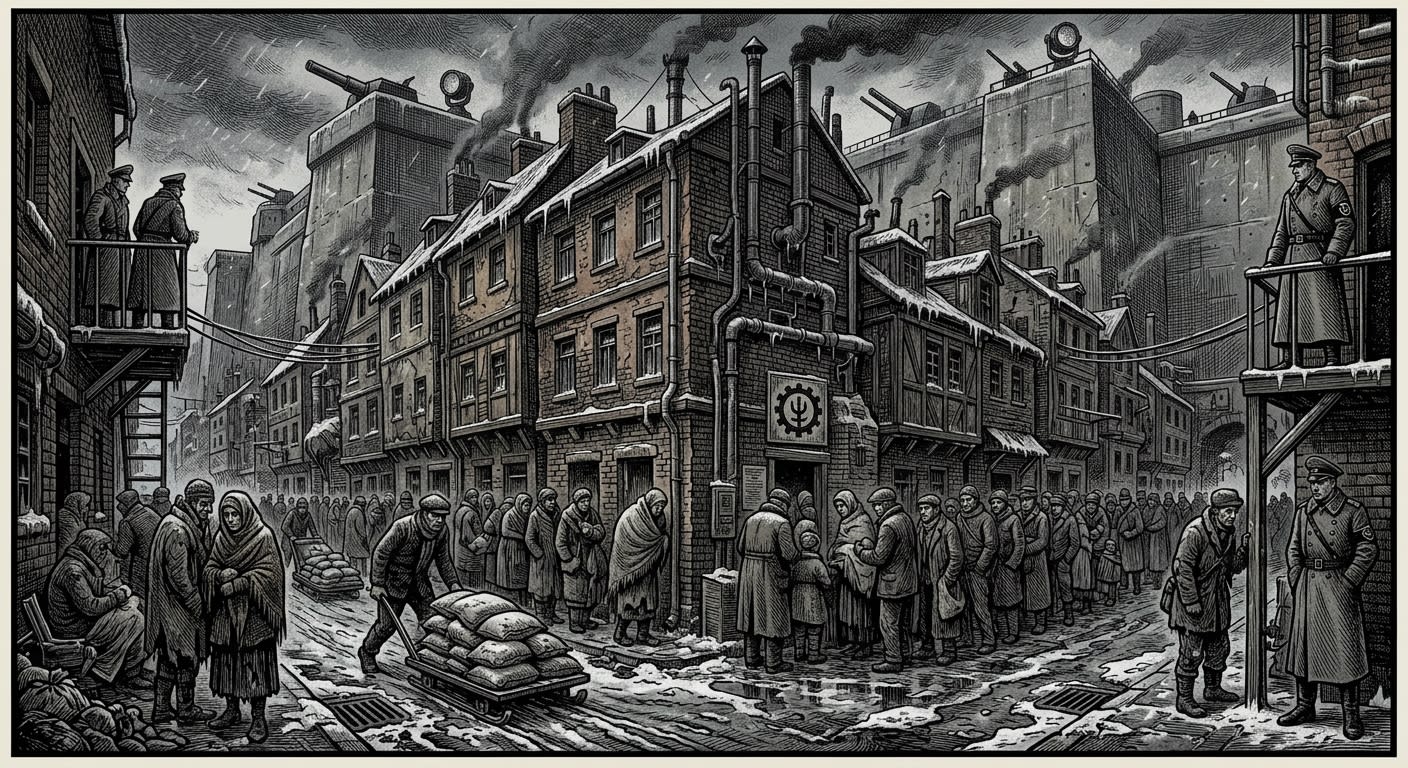
Every household has two inventories: what it owns and what it can carry if the fog bell sounds wrong. The first is stored in chests, hooks, rafters, wall niches, fish barrels, and saints’ boxes. The second is kept by the door: boots, papers, knife, salt packet, charm string, child blanket, ration coin, bell token, and a strip of cloth tied with the family’s spoken names. Call it civic prudence in a place where a face in fog may resemble a person too closely for comfort and a Purity interview may ask whether the resemblance was recognised.
Salt is the district’s second weather. It enters soup, lungs, bedding, marriage sheets, prayer books, ink, infants’ hair, and every wound neglected for longer than one bell. Roofs sweat it. Floors grit with it. Men who work the harbour carry it in their cuffs; Sea Wall soldiers bring it home in their beards; bell-servants taste it on the ropes. The Warrens have developed domestic sacraments against salt: vinegar cloths over cradles, oil rubbed into doorframes, prayer slips wrapped in wax, fishbone charms hung above beds, and the rude old Prussian practice of spitting toward the northeast before sleep. Purity dislikes the last custom. Naturally, it works best.
The market opens at dawn if the harbour bells do not forbid it. Cod, seal oil, old rope, boot nails, broken military buckles, Scandinavian thread, fishbone medals, contraband clapper filings, tallow, stale bread, grey wool, cracked icons, illicit warming stones, and copies of copies of fjord-bell notations pass hand to hand under awnings stiff with frost. Nothing is sold without gossip. Gossip is function: the district’s early warning system. Which sentry saluted. Which choir boy stopped singing. Which Purity man asked about dreams. Which Scandinavian boat came in without gulls behind it. Which corpse in the Frost Yards turned northeast. The Warrens know before the Ordensburg admits.
#On Laughter, Charm, and Purity’s Irritated Ear
Bastion reports say the Warrens are the only district of Königsberg where laughter can still be heard. This is true and incomplete. The laughter is not merriment. It is knife maintenance. People laugh at prices, weather, officers, bad sermons, Purity questions, broken carts, frozen fish, bureaucratic notices, marriages arranged during shell warnings, children who mimic bell inspectors, and soldiers who return from the Wall too solemn to be allowed indoors without insult. A man not mocked after Sea Wall rotation may begin believing his own dread singular. The Warrens cure this with cruelty. It is one of their public services.
Purity monitors the laughter but has not prohibited it. Prohibition would require defining the offence, and the Bureau of Purity is brave only when vocabulary is already loaded. It contents itself with listening posts, informants, exit-room questions, charm seizures, and periodic sweeps through market stalls where old women sell knotted grey thread with the serene criminality of saints who know the gallows has arthritis.
The charm trade is the district’s most visible argument with official theology. Knotted grey thread, fishbone tabs, counterfeit Saint Olaf (Unregistered) medals, clipped bell-rope fibres, paper triangles stamped with unauthorised Scandinavian marks, bits of salt-wax from old harbour seals, and tiny bronze splinters said to come from rejected Carillon clappers circulate in pockets and under collars. The Fractured North murmurs behind half of them. Purity burns them in public. The Bureau of Bells buys them in private for acoustic curiosity. The soldiers buy them because a man who has saluted fog will not be lectured out of wanting a knot on his wrist.
#On the Passage Counter and the Art of Remaining
The Bureau of Passage counter stands near the Harbour arch, where anyone may apply to leave the bastion and almost no one leaves honestly. Its brass grille is polished by desperation. Behind it sit clerks whose primary function, as the garrison says without sufficient malice, is to prevent anyone from becoming somebody else’s problem. Papers fail by damp, category, witness, debt, labour obligation, fog exposure, minor doctrinal concern, missing sponsor, wrong bell hour, or the simple discovery that the applicant’s work remains necessary.
The Warrens hate the counter with domestic intimacy. People curse it, bribe it, marry around it, forge it, feed its clerks, seduce its assistants, mislay its forms, and name dogs after its supervisors. A departure stamp has three values: lawful movement, black-market debt, and family betrayal. The person who obtains one may be envied until the road takes him, then mourned as if dead, then cursed if he writes from warmer country.
The Passage clerks themselves are half prisoners. They know every family, every false cousin, every dock injury, every orphan with two names, every soldier’s widow whose pension waits in a file so old the wax has developed a personality. Some clerks sell mercy. Some sell delay. Some sell exactly what the law permits and are hated most because honest obstruction has no bargaining surface.
A Passage Office notice describes the Harbour counter as “a civil mobility service operating under wartime necessity.”
Corrected. It is a sieve held upside down. What ought to pass is caught; what ought to be caught passes if folded small enough in silver.
The district’s forgers are modest compared to those of Brest or Skopje, which is to say they possess professional pride and insufficient ventilation. They do not forge grand transfers often. Grand paper attracts grand nooses. They alter salt stains, repair witness marks, age signatures, reassign infants to aunts, resurrect dead sponsors, and modify labour obligations by the width of a pen hair. The best work is not a false document. It is a document tired enough to look true.
#On the Grey in Domestic Rooms
The Grey does not enter the Warrens as an army. It enters as household adjustment. Children stop drawing the sea with waves and begin drawing it as blank wall. Dogs face the Harbour arch before fog reports arrive. Soup spoons tap against bowls during returned hymns. Babies sleep through artillery and wake crying when the Carillon sounds too cleanly. Old women refuse to hang laundry toward the northeast after certain watches. Men back from the Sea Wall stand in doorways before stepping inside, waiting for permission no one admits is required.
The faces in the fog trouble the Warrens differently than they trouble soldiers. Soldiers fear recognition as tactical breach. Families fear it as domestic theft. If a sentry sees a mother’s face in the fog and the mother is alive, what has been borrowed? If a husband hears his dead child’s laugh near the salt arch, should the wife be told, or has the telling invited the face nearer? If the Grey returns a hymn not yet sung, may it also return a voice not yet dead?
WARRANT ROOM NOTE — WIDOW-BELL CUT, A.S. 200 Household reported knocking at shutter during clear weather, third night bell. Voice outside matched resident child, deceased A.S. 196, harbour fever. Mother opened inner latch; outer shutter remained sealed by frost from exterior side. Interior wall thereafter showed handprint in salt bloom, child-sized, palm facing inward. Disposition: Purity sealed room for two nights; family relocated to cousin’s loft; room currently occupied.
Rector-Chaplain Wendelin Grau serves the Warrens more than his schedule admits. He hears soldiers, yes, but he also hears fishwives, rope boys, charm sellers, widows, and children who know that the formal confessional screen is less frightening than Purity’s chair. He teaches the same rule he teaches the Choir: give nouns before interpretation. Fog. Face. Bell. Hand. Mother. Salt. Window. Rank. Nothing. The Warrens have adopted the practice in kitchens. It has prevented several heresies and started better rumours.
Halvorsen uses the district as unofficial instrument. Her northeast logs receive market observations no officer could obtain without frightening the source into performance. Gulls absent from fish stalls before Grey approach. Scandinavian boats arriving with crews silent in the wrong dialect. Bell echoes heard first by laundresses before Cathedral Close registers variance. Frost Yards gossip carried by coffin nail sellers. The Warrens are not a laboratory. They are more useful. Laboratories tell investigators what investigators have arranged to notice.
#On Children, Work, and the Inheritance of Cold
Children in the Warrens learn the bastion by sound: harbour bell, fog bell, Carillon, Purity boots, Passage grille, gull alarm, ice crack, shutter order, soup ladle, rifle bolt, and the particular silence adults make when a soldier says he recognised something. They play Sea Wall in alleys, which consists of standing very still while one child in a grey rag walks past and the others try not to salute. Purity forbade the game in A.S. 197. This improved its rules.
Work begins early. Boys carry coal, fish, messages, salt sacks, and sealed gossip. Girls mend, gut, launder, count, run, and learn which men may be lied to safely. Both climb roofs because snow must be pushed before rafters surrender. Both know where Bureau inspectors slip. Both can read ration stamps before Scripture, an ordering the Bureau of Doctrine condemns in schools and relies upon in markets.
The district’s women hold most of its memory. Men vanish into wall rotations, harbour accidents, distant postings, transfer failures, or the ordinary attrition of being useful to a fortress. Women keep rent lines, kinship lies, charm recipes, false sponsor trees, burial debts, and the household rulebook for what may be said after fog. They decide whether a returned soldier is to be mocked, fed, questioned, sent to Grau, hidden from Purity, or struck once and told to sleep. No Bureau has improved upon this sequence.
#On Present Condition
As of A.S. 201, the Warrens remain inhabited, cold, profitable, watched, and impossible to remove without admitting what the northern anchor has become. The official figure stands at nineteen thousand. The market says more. The ration rolls say fewer. The truth sleeps in lofts, boats, sheds, back rooms, and the second names of children. The district supplies labour to the Harbour, mouths to the Carillon service chain, ears to Halvorsen’s unofficial logs, informants to every office, charms to Wall men, and jokes to soldiers who might otherwise mistake fear for revelation.
The Grey has not crossed into the Warrens. This sentence, like most comforting sentences in Königsberg, has been overfed. The Grey need not cross a district that already dreams toward it. Its pressure enters by bell, face, rumour, salt bloom, returned hymn, and the thousand domestic adjustments by which a population learns to live beside a thing nobody may name in full.
At dusk, when the Harbour lamps frost over and the Carillon begins its lawful peal, the Warrens answer in their own register: shutters pulled, soup ladles struck against pot rims, children counted, charms tucked under sleeves, insults thrown across alleys, prayers muttered through salt cloth, papers hidden behind saints whose paint has peeled into anonymity. Above the roofs, the bells ring toward the water. Below them, laughter rises fast, thin, and necessary.