
#On the Crossings and Their Jurisdiction
"No oath, no passage." — This Codex, on the Pilgrim Roads
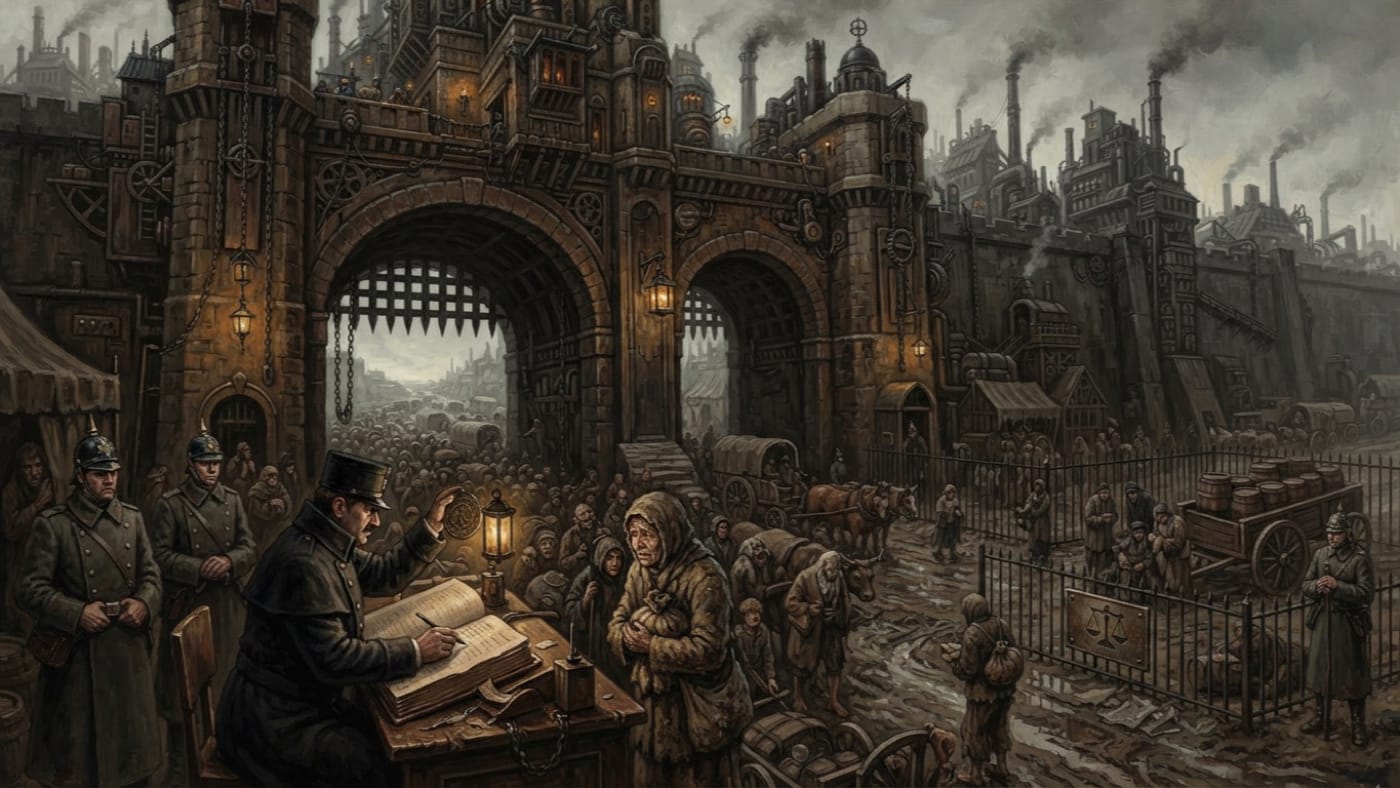
You know a crossing is near before you can see it. The road narrows. Carts stand axle to axle in the mud, oxen steaming, pilgrims sitting on their bundles with the patience of people who have already paid once today. Somewhere ahead a clerk is asking a man to repeat himself.
The Gate and Bridge Tariffs are levied by the Bureau of Tithes on every person who passes through a tithe-gate or crosses a tolled bridge. There is no single building to visit. The tariff lives in a thousand places at once: the tithe-gates that punctuate the pilgrim roads, the gatehouses cut into city and bastion walls, the tollhouses squatting at bridge approaches, the tariff-chapels of the Rhine corridor where bridge courts and ferry landings crowd the same bank. Mainz keeps a bridge and toll system that the river traffic curses in several dialects and pays in one.
Each crossing serves the whole road. The pilgrimage roads double as trade arteries, and the caravans that move along them under Warden guard carry grain, cloth, relics and coin through the same stone throats as the barefoot faithful. Foreign merchants pay the Tithe of the Gate so that no heretic grows rich on the Creator's soil without first kneeling at it. The pilgrim and the cloth-factor wait in one queue. Their papers differ, and so does their treatment. The mud is common to both.
#On Coin and Creed
Passage requires two payments, and the Bureau accepts neither alone.
The first is coin, ordinarily the Crown of Grace: stamped iron, marked with the Synod's sigil, consecrated at the mint by priestly blessing. The tariff schedules are the Bureau's business, and this Codex does not reproduce them. The traveller who wants to know the rate will learn it at the gate, as their parents did.
The second is Creed. As the coin is surrendered, the traveller recites the appropriate verse of the Catechism aloud, and the recitation is heard, judged and entered. A mispronunciation voids the passage. The coin and the voice are separate obligations under a single act, and a traveller who has paid in full and stumbled on a vowel has paid in full for nothing.
At a parish footbridge, the whole apparatus may consist of one clerk, one box and one ledger. At the great gates of a city or bastion, the work is divided among offices that resent being confused with one another. The Gate Assessor performs the fiscal assessment, with scales, a gilded ledger and a seal-press, flanked by armed clerks; the Gate Assessors belong to the diocesan corps, answering through their Principal Assessor to the Palatine Counting House in Strasbourg. The Gatewarden-Notary of Passage examines papers, verifies identity, orders holds and escorts, and keeps the custody records. Where a caravan carries freight, a Commerce Clerk in the tariff-chapel weighs the load against sanctified standards and issues tallies and clearance slips. Assessment, recitation, registration, release. The order is my synthesis of how the great gates operate. The clerks perform it without needing my synthesis.
The failed reciter does not vanish. The register enters them as absent, and in the Synod's arithmetic absence is a status, recorded in wax and correctable only by confession. Peasants on the pilgrim roads insist the gate erases more than ink. Records says it erases nothing and registers everything. I have read the register. It is very tidy.
#On the Cost of Waiting
I once watched a caravan of Iberian traders held at a tithe-gate for seven days because their interpreter had pronounced the third syllable of the Creed with insufficient reverence. Their papers were sound. Their coin was iron and correctly stamped. Their cargo was olives.
By the end of the week the traders were weeping for mercy, and the olives had spoiled. I noted at the time that this proved indulgence to be a curse, and I note it again here because the observation has worn well and the olives have not.
The gate did not close during those seven days. It cannot close; it has no provision for closing. Pilgrims went through, and wagons, and Assessors' escorts changing shift, while the Iberians sat in the holding ground beside their barrels and the interpreter practised a syllable aloud under the eyes of men paid to find it wanting. Fodder had to be bought. Lodging had to be bought. Each morning the cargo was worth less than the tariff that had already been collected on it.
This is the second tariff, the one no schedule records. A Gatewarden-Notary controls paper, routes and bodies, and the most valuable thing the office controls is time. Grain sweats in a held wagon. Fish turn. A pilgrim's ration bag, packed for a road of known length, empties at a gate of unknown length. Under the arches the queue becomes a neighbourhood, with its own hawkers, its own fevers and its own disputes over who arrived first, and every dispute ends at the same clerk's table.
#On Pilgrim Roads and Their Keepers
"Pay clean. Pass clean." — Saying of Griefgate
The pilgrim roads are marked mile by mile with ration-stones carved in the names of saints, One meal to Saint Edras, Three fasts to Theophania, which soldiers curse as milestones and peasants kiss until their lips bleed. The stones are kept upright, and the roadbed kept passable, by maintenance covenants: whole parishes labouring for absolution rather than wages. The Bureau of Records lists them as "mobile chapels." The Bureau of Tithes lists them as "taxable assets." I have reviewed both entries and see no conflict between them.
The Bureau of Pilgrimage objects to the tariffs, on the grounds that tolls discourage sacred travel. The Bureau of Tithes replies that tolls fund the roads on which sacred travel occurs. The parishes who actually lay the stones receive absolution, which the Bureau of Tithes does not issue, and which therefore appears in neither Bureau's accounts. A reduced pilgrim rate was introduced in A.S. 170. Its amount, its eligibility papers and its practical application are not set out in any instrument I have been shown. Both Bureaus describe it as a compromise, and both describe it bitterly.
Where several levies meet at one threshold, the crossing becomes a town. Griefgate is built into a narrow cut on the Pilgrim Roads, where the traffic must pass beneath three arches of black stone under hanging chains, each arch a lane, for coin, confession and cargo, with holding ground for those whose answers did not satisfy. The Widow's Pennies collected there are a bereavement levy and a separate instrument. The ordinary passage tariff is owed as well. A mourner pays for the dead and for the road, at two counters, under one arch, in the same iron.
#On the Bridges and Their Exceptions
The Synod's older catechisms taught that every gate is a tithe-gate and every bridge an altar, and that to cross is to receive a sentence.
Every bridge is an altar; to cross is to be absolved or accused.
Corrected per the Bureau of Records: bridges do not absolve or accuse. Bridges only register. The altar formula is metaphorical, and all catechisms are to be corrected accordingly. This Codex used the formula in the sentence above. That sentence stands corrected. The bridges continue to register.
At Rouen, the Bridge of Saint-Cuthbert is paved with brass plaques, each bearing the name of someone who crossed without paying. Every morning the clerks polish them until the condemned names shine back at travellers' boots. Peasants swear the plaques whisper prayers in the voices of the people they name. The Bureau of Records has classified the sound as wind anomalies. I have stood on that bridge in a dead calm and heard the wind anomalies, and I filed nothing, because the classification was already complete.
At Metz, the Bridge of the Silent Toll takes neither coin nor prayer. Travellers cross without speaking, and the silence itself is said to pay the passage. It is the only crossing I know of where the Creed is forbidden rather than required, and the Bureau of Tithes has never explained to me how a silence is entered in a ledger. Once, a child cried halfway across, and the bridge fell into the river. The Bureau rebuilt it. The Bureau still requires silence. The official finding attributes the collapse to defective masonry and records no correlation with the crying.
#On the Present Passage
As of this survey the network is operating. The gates of the pilgrim roads are open at the hours the Bureau sets. The Rhine tollhouses are working through the river traffic, bank by bank, and the tariff-chapels are weighing what comes through. Somewhere this morning an Assessor has held a Crown of Grace up to the candle, put it in the box, and lifted a pen to wait for the verse.
The traveller will speak it or fail to. The ledger takes the coin either way. The queue behind them will move, or it will not, and either outcome will be entered in the register in good wax. I have crossed more bridges than any living theologian of my rank, and I have been registered at every one of them, correctly, at the full rate.