
#On the Gate's Office
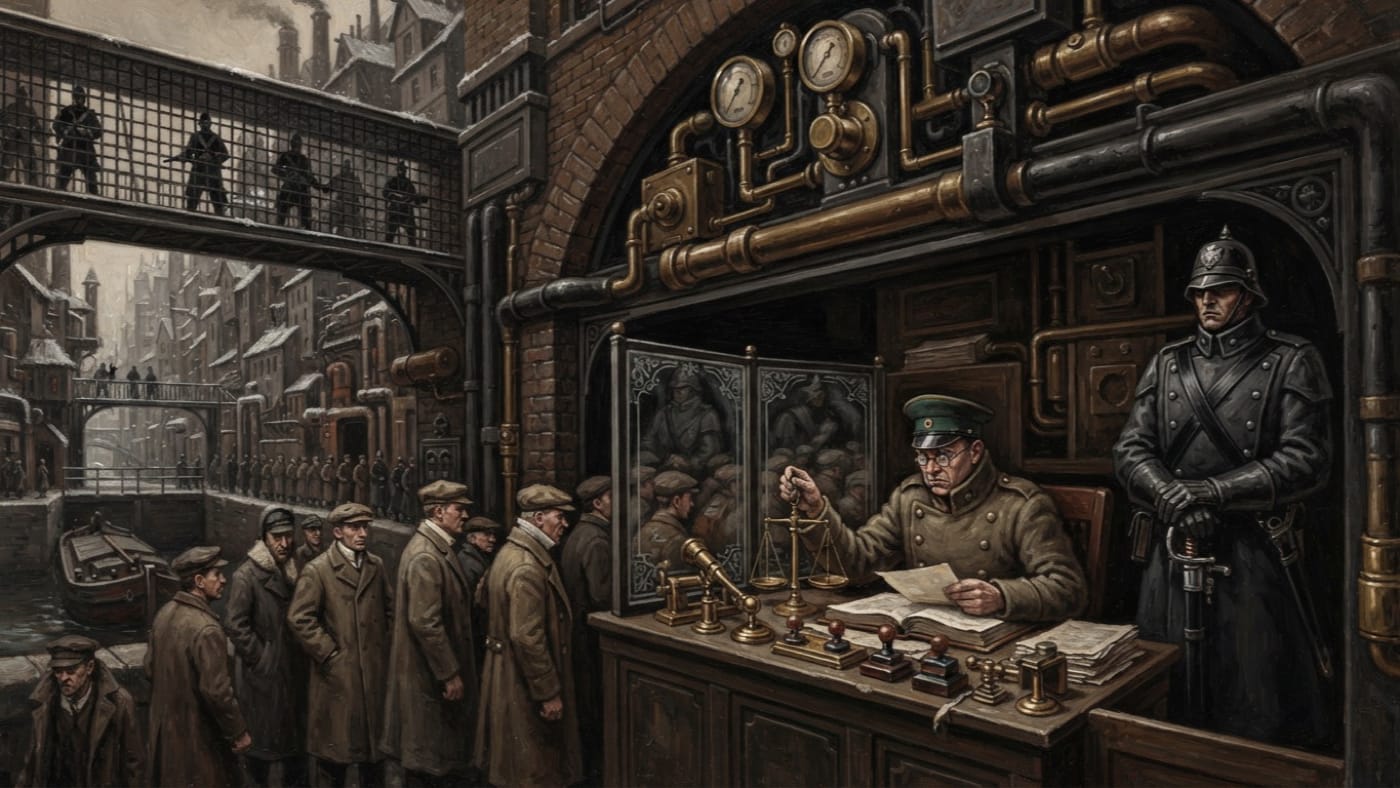
The Gate of Assay belongs to the Mint-Chapter, and it says so in the only language Sable Court respects: wax, brass, and a clerk who will not look up until you have been weighed. It is the lawful counter of admission. Whoever passes it has been found sufficient in three separate respects. The metal must be sound, the papers valid, and the face recognized. The quarter treats these as a single judgment because a single judgment is cheaper to administer. They are three judgments, and any one of them can fail while the other two shine.
A coin may ring true on the counter while the paper beneath it carries a lapsed seal. The paper may be immaculate while the face it names sits a hair loose on the bearer's skull. The clerk is paid to notice which of the three has lied. He is paid considerably less to wonder why.
Its name survives in our records largely through comparison. In this office's notice on the Clipped Choir, the Gate of Assay appears as the Mint-Chapter's answer to the Choir's back table behind a soap-seller in Clipper's Market. One counter is lawful and the other is not. The same people stand at both.
#On the Quarter Around It
The Crownwright Diehouses are a walled quarter of Cologne, not a city of their own, whatever the older atlases say in their enthusiasm. The Mint-Chapter Compact of A.S. 94 fused the Crownwright Guild with the Synod's new office of coinage. Between A.S. 94 and A.S. 100 the old guild district was enclosed and gated, its windows mirrored, its entire population renamed. By A.S. 102 the Face Archive existed and identity could be carried in a purse.
When the Gate of Assay was raised, who designed it and which arc of the mint-wall it occupies are questions the registries in my keeping do not answer. I have been offered a founding seal by a junior archivist who wanted a reference for preferment. I declined it, along with the reference.
The surroundings are better attested. Sable Court is a ringed enclave of customs gates and checkpoint arcs, with interior courts folded behind them like the inner leaves of a sealed folio. The brick is black. The ironwork rusts as though it were ordered to. Polished basalt takes the boot-scuff of every petitioner and gives back nothing. The inspection windows are etched or mirrored, so that a person waiting sees himself and nobody behind the glass. Above, wardens cross the rooftop watchwalks in counted rhythm. Below, the bullion canal spur takes barges at the lockhouse. Ash from the annealing stacks settles over the whole arrangement as dry snow, and somebody in the queue is always being served bitter tea.
#On Admission and Doubt
Nobody enters Sable Court on the strength of a pleasant face. Entry requires guild papers, an assay appointment, or a labour warrant. Cargo travels under canal manifest. Exchange permissions arrive with intent declarations, which is what the quarter calls confession when it wants a receipt. The documentary liturgy of the place includes the assay slip, the exchange warrant, the face-confirmation paper, the correction order and the vault manifest. Each of them is a small sacrament, and each carries a fee.
Two offices meet the petitioner. The face-check clerk examines what is offered. The mint warden in his black sash stands near enough to make the examination sincere.
Every gate in the quarter performs the clean-hand inspection, and the Gate of Assay does not pretend to an exemption. Hands are shown, turned and judged. A finger stained with acid, a palm that smells of wax, a nail rimmed with grey filings: these are questions the hand asks on its owner's behalf, and the owner had better have answers.
The doubt inspection follows when the clerk is unsatisfied. Here the petitioner must narrate his name-history aloud and without stalling: who he is, whose he was, under which face his coin was struck. Hesitation is evidence. A man who pauses to remember his mother's maiden name has, in the eyes of the Wardenate, just confessed to owning two mothers.
Quarter law forbids certain objects from passing any gate. Unassayed metal, blank dies, unstamped seal wax, foreign coinage without quarantine and personal journals are all barred. The last item puzzles visitors until they notice that a private journal is an unlicensed registry of faces.
The clerk's authority ends at the counter's edge. He may admit, refuse, hold and report. He cannot commission a die. He cannot touch a Face Archive plate, which no one touches without annihilation following. His refusal is not a Tribunal verdict, though the petitioner who receives it may die of it just the same. Final judgment belongs to the Mint Tribunal in the Tribunal Hall of Corrections. Behind the Tribunal stand the portfolios that make the Gate possible. Mint-Prelate Varo Sable governs what the realm's currency legally recognizes. Master Engraver Irena Coilhand governs who is struck into permanence at all. Warden-Captain Joss Kline governs the gates, the watchwalks and the vaults, and therefore the sash standing behind the clerk.
The clerk is the smallest of these powers and the only one the petitioner ever meets.
#On the Person Held Outside
A facehold freezes a person's money while their identity is in dispute. The coin is unchanged in weight, and the face upon it has not moved. It simply ceases to be accepted. In Sable Court that is a sentence of death by commerce. Unpaid fines harden into identity holds. Disputed faces draw correction levies. A recall can render a citizen unspendable between one bell and the next, and from that moment the Gate of Assay is a counter at which they can stand and nothing more.
Consider what the refused petitioner holds. They have a purse of sound metal, a warrant without visible fault, and a face the quarter has decided to doubt. They cannot buy bread inside the wall. They cannot pay the correction levy with frozen coin. They may not leave the queue without inviting the warden's interest, nor stay in it without inviting his attention.
The quarter's records note what follows when recognition is revoked, though they decline to explain it. Merchants lose names they have spoken daily for decades. Witnesses forget the suspects they swore to. Families dispute whether a son or sister ever lived under their roof. In Sable Court a coin carries a face, the face carries a name, and the name carries an account in the Great Ledger of Souls. Doctrine has tidy language for this sequence. The petitioner at the counter has only the sequence itself, working backward through them.
#On the Choir's Other Counter
Every exclusion creates a market, and the Gate of Assay excludes with great diligence.
The Choir's back table sells what the Gate refuses. Its brokers offer portable innocence, a packet assembled to pass as clean for a day: an assay slip, a witness chit, an exchange token, a face-confirmation note and one warmed coin carrying enough of the bearer to satisfy a clerk who is tired, or bribed, or both. Its face-swap artists sell borrowed correspondence. A recalled merchant's jawline and a dead clerk's eye-spacing are softened through acid and careful circulation until a coin will vouch for a stranger long enough to cross a counter.
These goods have limits, and the limits are the trade. A face-swap decays with handling. Pass it through too many hands and it frays. Leave it in a drawer and it never takes. No broker strikes a permanent lawful person from nothing; that remains the province of the Face Archive and of rumours I am not yet licensed to repeat. What the Choir rents is a margin of time, measured from one gate to the next.
The Choir's work has succeeded at the quarter's gates. Choir assayers certified two counterfeit batches that passed outer-gate inspection, and brokers have moved debtors through on borrowed faces. The records assign these failures to the gate network at large. None names the Gate of Assay, and I will not hang a breach on a counter merely because it has the better name. This office's own assessment holds that the Choir keeps at least twelve assay clerks by debt or kinship. Which counters those clerks occupy, it did not say.
This office previously advised that the Clipped Choir could be dismantled through market arrests and seizure of clipping instruments.
Corrected. A shaving knife confiscated at a gate is a knife. Seizing it leaves untouched the broker who assembled the packet, the clerk who accepted it, the canal judge who priced it and the respectable purchaser who never stood in the queue. The prior advice mistook fingers for the hand.
One point the Mint-Chapter prefers left unsaid: the back table only works while the Gate does. Portable innocence is worth fourteen silver because recognition at the lawful counter is worth a life. If the registry collapsed, the Choir's stock would collapse with it. Their criminality is parasitic, and the host must be kept in good health.
#On the Present Restriction
Since A.S. 199 the Face Theft has strained every checkpoint arc in the quarter. Lawful citizens have found the faces on their coins altered. The Mint-Chapter ordered recalls across seventeen denominations. Warden circuits doubled. Doubt inspections multiplied until, by one account, whole queues forgot why they were queuing. The Gate of Assay stands inside this emergency like any other counter, only busier.
The cause is not established. Official suspicion fell on the Choir, which did some of the damage. The rest is spoken of in two words: master die. The Mint-Chapter treats that die as a threat and the Choir treats it as a rumour that terrifies them. Warden-Captain Kline is said to carry a private pouch of coins that answer to no archived plate. What those coins prove, he has not told this office. The Bureau of Engineering wants its sealed A.S. 187 survey beneath the canal reopened. The Bureau of Records wants names. The Bureau of Purity wants a fire. The Bureau of Doctrine, whose seal I carry, wants the matter described accurately and without conclusions, which is the harder commission.
Meanwhile the clerk still weighs the coin, reads the paper and studies the face. His tests have failed before, and the quarter knows it. Nobody inside the wall has found another way to be admitted.