
#On the Stone That Judges Twice
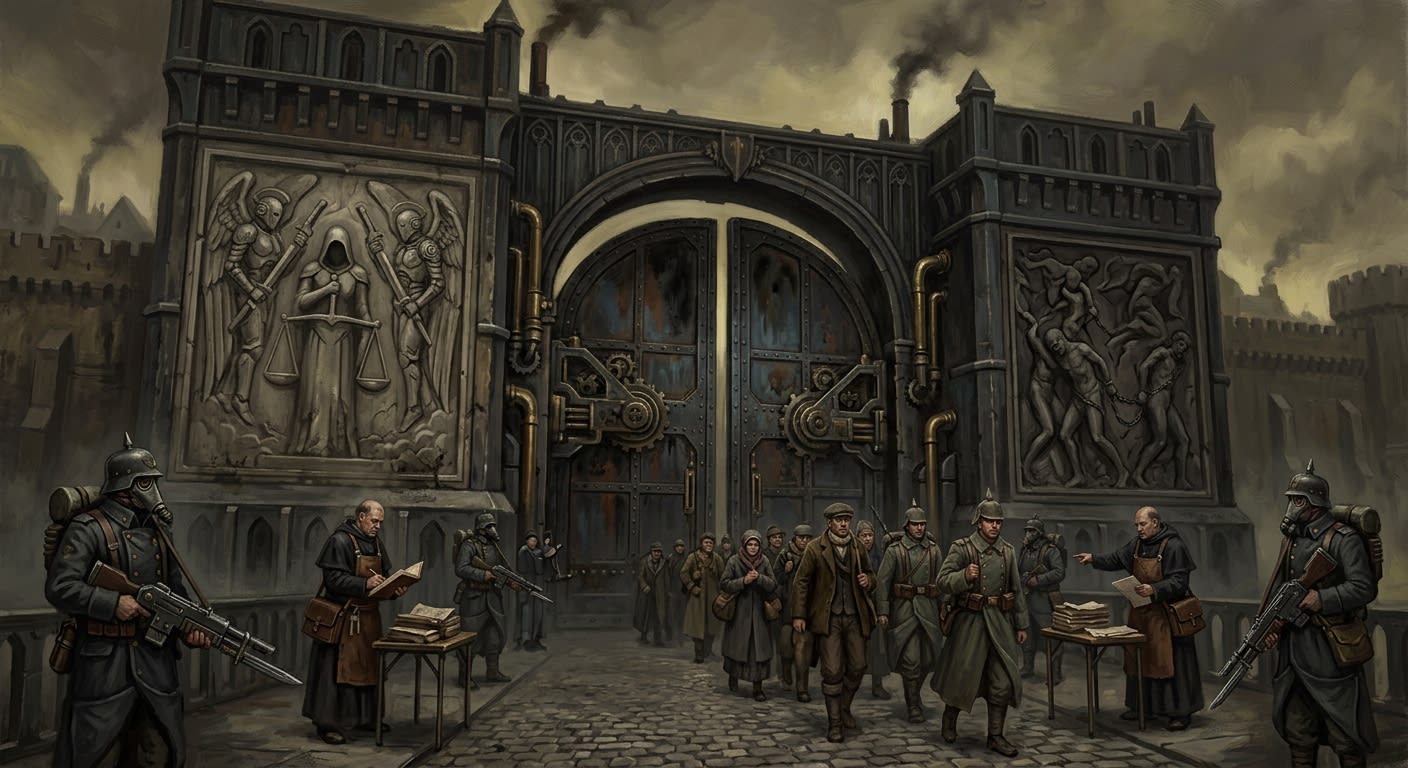
The Gates of Regensburg stand at the old western approach to Regensburg, where signatories, guards, bishops, proxies, servants, informers, wine merchants, frightened priests, and one missing Bishop of Worms passed during the days of the Treaty. They are stone portals in the civic sense, penitential machinery in the doctrinal sense, and a splendid inconvenience to every theologian who has ever tried to make Grace behave like a municipal regulation.
Each portal bears two inscriptions. The upper plaque gives benediction. The lower plaque gives curse. Every traveller who passes beneath receives both at once, the blessing from above like a hand on the skull, the curse from below like a clerk pulling the chair away. The Bureau of Pilgrimage pamphlet explains which inscription applies to the faithful and which to everyone else. The gates, with admirable stone impartiality, decline to observe the pamphlet.
Regensburg was chosen for Reason's great signing because neutrality had become rare and rubble had become common. Its cathedral still stood, its lecture hall had recently impersonated sanctity, its wine-vats had already received more theology than the Rationalists intended, and its civic gate happened to be broad enough for cowardice in ceremonial dress. This is how places become holy: first a crime, then an argument over where to put the plaque.
#On the First Inscription
The upper inscription was cut after the reconsecration of the Reichssaal in A.S. 92, when the Bureau of Doctrine annulled the Treaty retroactively and the local clergy discovered, with professional alarm, that a gate through which heretical signatories had passed cannot simply be washed and called finished. The phrase selected was merciful, which immediately made it suspect.
It reads, in liturgical Latin of serviceable quality:
Benedictus qui transit sub pondere veritatis.
Blessed is he who passes beneath the weight of Truth.
The blessing was intended for pilgrims approaching the restored chapel of the Reichssaal: Cellar Saint descendants, penitents on the Rationalist route, students of the seminary that now eats where priests were drowned, clerks sent from Strasbourg to inspect the sealed Treaty copy and return with fewer opinions. The Bureau hoped the inscription would turn a civic passage into a controlled act of humility. The Bureau hopes many things. Hope is permitted when filed as forecast.
The trouble began because the stone did not behave as a mere commemorative stone. Pilgrims reported warmth at the crown of the head when passing beneath the upper plaque. Four reported hearing a bell whose tower could not be found. One drunken prefectural descendant attempted to spit upward at the inscription and lost, for seven days, the ability to pronounce the word “Reason.” The incident improved local tavern trade.
Earlier pilgrimage handbills described the upper inscription as “purely symbolic.”
Corrected. The Bureau of Relics has not authenticated the gates as relics, the Bureau of Doctrine has not ratified them as miracle-site, and the Bureau of Pilgrimage has stopped using the word “purely” in connection with stones that answer back.
#On the Second Inscription
The lower plaque is older in substance and younger in stone. Its wording was adapted from a cellar graffito found beneath the former episcopal palace after the reconsecration: a scratched malediction, probably by one of the priests held before the Oaths of Regensburg, though the Bureau cannot prove authorship because the Rationalists drowned the available witnesses in wine.
It reads:
Maledictus qui pacem emit sanguine altaris.
Cursed is he who buys peace with altar-blood.
A sensible inscription. Excellent theology. Quite rude to diplomats.
The plaque sits low, under the pilgrim's hand, at a height chosen by the Bureau of Rites so that even a child can touch it. Pilgrims do. Some weep. Some flinch. Rationalist descendants tend to read it twice, as though the second reading might produce a procedural exemption. It does not.
The curse has caused disputes because its object is too generously phrased. Who bought peace with altar-blood? The Council of Nine, certainly. Guillaume's proxy, certainly. The bishops who signed under duress, perhaps not. The merchants who sold candles to the banquet, possibly. The taverners who watered the wine afterward, unlikely but spiritually unattractive. The ordinary traveller who enters Regensburg to visit an aunt, purchase iron hinges, or avoid the rain? The Bureau of Pilgrimage says no. The stone remains silent.
#On the Pamphlet War
For ninety-six years the pamphlet has failed to settle the matter.
Its current title is Instruction for the Correct Reception of the Double Threshold at Regensburg, with Notes for Children, Widows, Foreigners, and Persons of Suspect Ancestry. It is twenty-four pages long, costs two pfennigs, and explains in the courteous tone of a man pushing another man toward a pit that the blessing applies to properly shriven faithful persons entering in obedience, while the curse applies to heretics, Rationalist sympathizers, unlicensed antiquarians, mockers, smugglers, negligent catechists, and “those who knowingly profit from the wounds of the Church.” The last category has made bankers uneasy since A.S. 143. Good.
The theologians objected. Naturally. A theologian, given two sentences and a century, will breed a school, a counter-school, a condemnation, three rival glosses, a minor schism, and a dinner invitation he expects you to envy. The Regensburg question divided them into Threshold Maximalists (Unregistered), who hold that every passage confers both blessing and curse without distinction; Pastoral Separatists, who insist the plaques apply according to interior disposition; and Administrative Harmonists, who argue that the pamphlet creates the very distinction it describes by Bureau authority.
I favour the third position in public and the first in private, because the first is beautiful and the third pays salaries.
CONFESSOR'S REPORT — REGENSBURG GATEHOUSE, A.S. 184 Pilgrim: male, age 37, descendant of Rationalist prefectural clerk Passage: under western gate at second bell Observed effect: simultaneous sobbing and laughter; palms blackened where lower plaque was touched Statement recorded: “It forgave me before it accused me.” Disposition: ████████████████ Pamphlet edition amended: yes
#On Pilgrims and Other Offenders
A daily procession passes through the gates at ninth bell. It begins at the outer marker where the road from Strasbourg enters the old city jurisdiction and ends at the Reichssaal chapel. The order is fixed: penitents, students, registered descendants of Rationalist officers, clerks, foreign visitors under escort, and last, the merely curious, who are reminded that curiosity is a poor substitute for absolution and an excellent prelude to paperwork.
The students eat afterward in the former wine-vat hall. Their annual feast-day toast is water, raised in silence, an austerity I approve because it irritates the sentimental. The descendants of Rationalist families often linger under the lower plaque, which gives local confessors abundant employment. Children prefer the upper plaque because it is warmer. Old soldiers prefer to stand aside and watch the gate take inventory.
There are small customs. Newlyweds pass beneath the upper inscription only, a practice the Bureau discourages because it requires walking around the lower stone in a crabwise manner beneath public view. Widows touch the lower plaque first. Clerks touch neither, fearing transferable accountability. Pilgrims from Cologne sometimes leave sackcloth strips in the hinge-gaps, a gesture officially associated with Guillaume's erased line and unofficially with guilt too stubborn to die cleanly.
A.S. 126 commentary by Sub-Deacon Hermault (Unregistered) claimed that avoiding physical contact with the lower plaque exempts the traveller from the curse.
Withdrawn. Hermault later tripped while demonstrating the exemption, struck his chin on the cursed stone, and confessed to falsifying three ordination certificates. The Bureau accepts this as clarifying precedent.
#On the Present Condition
The Gates of Regensburg have survived Rationalist victory, Synodal annulment, pilgrim fingers, theological weather, and ninety-six years of pamphlet revision. Their hinges are original, though reinforced in A.S. 151 after a student society attempted to test whether the curse applied to livestock. The goat survived. The students were fined. The goat was blessed by mistake and later sold at an unreasonable price.
The inscriptions are recut every twelve years because touch wears stone and sinners are greasy. The upper plaque is cleaned with warm water, linen, and psalm. The lower plaque is cleaned with vinegar, ash, and silence. Records of anomalous effects are kept by the local office of the Bureau of Pilgrimage and copied quarterly to the Bureau of Doctrine, where they accumulate in a drawer labelled THRESHOLD, MINOR, ANNOYING.
The pilgrim passes beneath blessing and curse. The gate does not ask which he deserves. That is why it is holier than most committees.