
#On the Hall That Lent Empire to Heresy
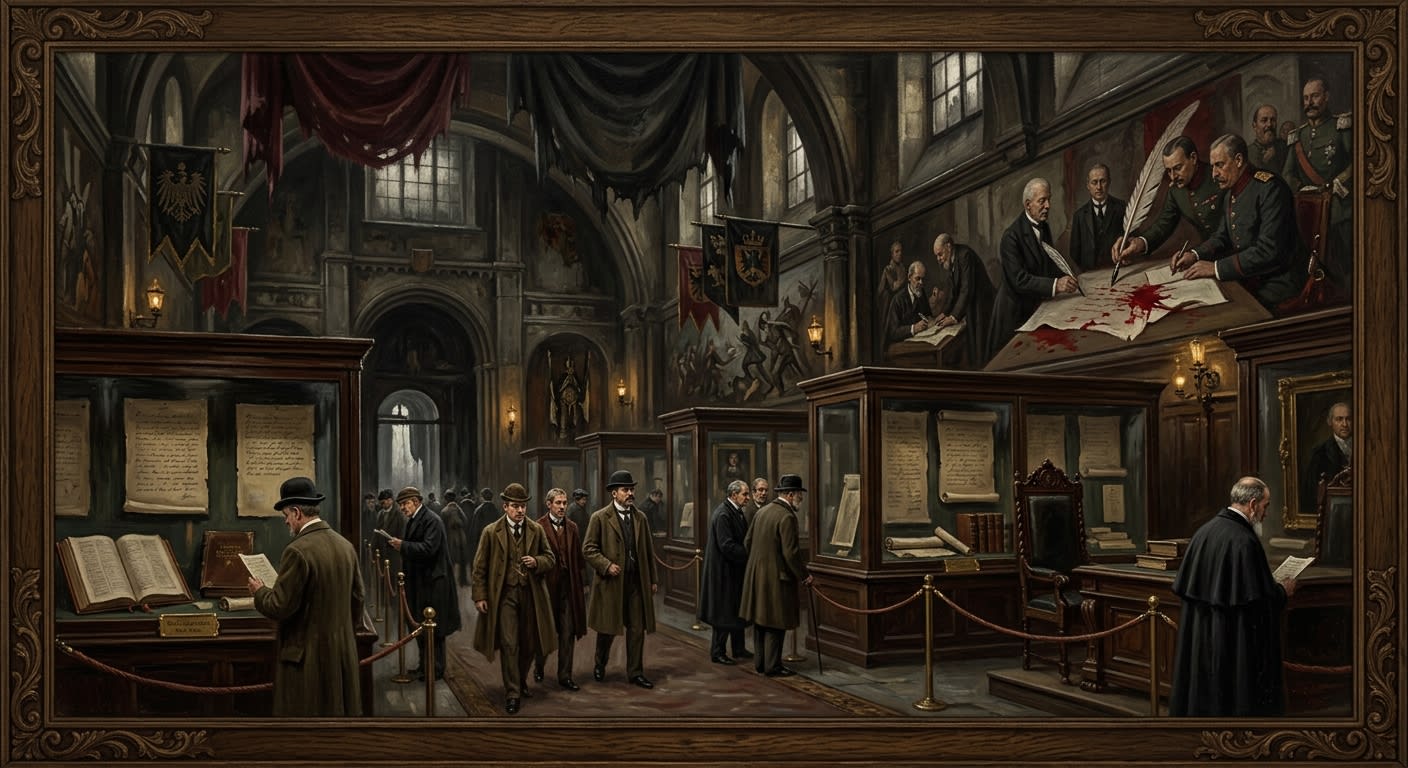
The Reichssaal of Regensburg is a room with the insolence of a courthouse and the shame of a chapel. It began as a chamber of imperial deliberation, where old princes, bishops, electors, envoys, hangers-on, debtors in velvet, and hereditary bores gathered beneath beams blackened by lamp-smoke to perform that German sacrament by which argument is mistaken for government. It became, in A.S. 30, the table (Unregistered) upon which the Treaty of Regensburg was signed. It is now a reconsecrated chapel under Synodal custody, visited by penitents after they pass the Gates of Regensburg and discover that stone has better doctrinal manners than most men.
This sequence—diet hall, heretical theatre, chapel—is often recited as if it were redemption. Careful. Redemption is not a change of furniture. A chair may be blessed, cursed, upholstered, stolen, and blessed again while remaining recognisably the same chair to anyone with eyes and a proper suspicion of wood. The Reichssaal's genius lies in its continued usefulness to authority. It served empire when empire could still afford sentences longer than its armies. It served Reason when Reason required antique walls to make theft look inherited. It serves the Synod now because the Bureau, being merciful in the exact way a ledger is merciful, never wastes a guilty room.
Regensburg's cathedral (Unregistered) stood near enough to lend sanctity by proximity and far enough to avoid interrupting the ceremony with dignity. Through the Reichssaal windows, the ruins of three churches were visible during the signing, a scenic arrangement which the Rationalists admired and the Bureau has preserved in instructional paintings as evidence against taste. The Rationalists understood stagecraft. That is why they chose the old Imperial Diet (Unregistered) chamber. A treaty abolishing the old Church needed the old empire to stand behind it like a coerced witness.
#On the Stripping of the Chamber
Before A.S. 30, the Reichssaal contained the usual debris of old political sanctity: crucifixes, heraldic panels, imperial devices, benches worn by noble impatience, clerks' desks scarred by knife-points, and enough precedence disputes to stucco a lesser city. During the Cauterization years (Unregistered) the Rationalists stripped its crucifixes and hung banners bearing the Broken Cross. They did not leave the walls bare. Bare walls accuse. Decorated walls collaborate.
The Broken Cross hung where the imperial eagle had once strutted. Blue cloth. Black fracture. A severed vertical line, clean enough to please the learned and ugly enough to instruct the honest. Beneath it the long table was set for signatories: nine Rationalists on one side, remnants of the old order on the other, clerks posted at the ends, guards at the doors, windows cleaned to permit a fine view of rubble. One must admire the wicked when they polish the glass through which they mean you to see your own defeat.
Earlier municipal guides described the Rationalist decoration as “temporary republican furnishing.”
Corrected. A banner hung above a coerced signature is not furnishing. It is testimony. The guide-writer responsible has been dead for sixty years, which spares him nothing in the index.
The chamber's acoustic properties also assisted blasphemy. Its high ceiling gathered voices and returned them with borrowed dignity. Men who spoke there sounded larger than their souls. This benefited the Rationalists, whose souls were by then compact, polished, and convenient for storage. The Archbishop of Vienna's blood signature was witnessed under that ceiling. His refusal, if he had attempted one, would have returned to him magnified. So did his obedience.
The table itself became infamous at once. Ink entered the grain. Blood touched the right-hand edge. One Rationalist clerk, later named in a suppressed account as Marten Voss, drew idle geometric shapes in the margin of the draft between Article Thirty-Nine and Article Forty. The Bureau of Silence classified the doodles as non-doctrinal artistic expression pending review. The review remains pending. The Bureau of Silence loves nothing so much as an undecided scrap of paper; it can nurse one for generations and call the milk security.
#On the Signing Table
The Treaty was drafted in nine days and signed in an afternoon. The Reichssaal did not protest. This has been counted against it by several severe theologians and one very emotional stair-cleaner whose memorandum, though doctrinally unsound, possessed admirable venom. Rooms rarely protest. They receive. Their guilt is architectural: permission by arrangement, complicity by angle, collaboration through exits, sightlines, locks, and polish.
At the long table sat the Council's men, their names sealed, their faces hidden in vault portraiture. Across from them sat three bishops, a Rhineland baron whose forces had already cracked at Aachen, Guillaume's proxy, and the Archbishop of Vienna. The Archbishop's signature was required for dissolution of the Holy See. The Rationalists explained the requirement with fingers, guards, and the usual civic politeness of victorious butchers. He signed in his own blood. The ink behaved. The blood did not.
Witnesses later disagreed on whether the blood darkened across the page before drying or after. Records accepts both accounts under hostile sacramental condition. Relics petitioned to cut the table edge and remove the stained portion in A.S. 93, A.S. 101, A.S. 128, and A.S. 177. Doctrine denied each petition. A wound hidden in a vault teaches fewer fools.
The Articles moved from hand to hand under the hall's obedient light: dioceses dissolved, monasteries nationalised, sanctuary abolished, faithful prisoners sorted, property renamed public education, Europe redrawn in prefectural arithmetic. The Reichssaal gave each clause the old hush of imperial business. Men outside heard nothing but ceremony. This is how bureaucratic murder prefers to enter the world: through a room already accustomed to minutes.
REICHSSAAL TABLE LISTENING REPORT, A.S. 128 Three novices reported scratching beneath the glass after Compline. Phrase heard by two: ARTICLE FORTY— Phrase heard by one: GIVE BACK THE █████ Table cloth replaced with weighted pall. Novices reassigned to supervised silence.
#On Annulment and the Three-Day Cleansing
The Sundering made the Treaty ridiculous before Doctrine made it void. Hell is occasionally useful that way. By A.S. 45 the Republic had spoiled in its own hands; by A.S. 92 the Bureau of Doctrine possessed enough authority, enough appetite, and enough splendid clerks to annul the Treaty retroactively to the moment of signing. It had never been valid. It had always been evidence. The Reichssaal, which had hosted the signing, became the trial exhibit.
The reconsecration took three days. Fourteen exorcists attended, a number mocked by the Bureau of Engineering as structurally unnecessary and praised by Rites as proportionate. Engineering was wrong on poetry and right on load-bearing. Rites was right on theatre and probably right about the smell. Old Rationalist banners were removed with tongs. The walls were scrubbed with ash-water, vinegar, psalm, and a paste made from pulverised confiscation seals. Crucifixes returned. The table was covered in glass for instruction. The windows that once framed ruined churches were retained so the faithful might learn how scenic blasphemy becomes when men clean its panes.
The chamber was chapel thereafter, though the Bureau of Rites disliked how quickly pilgrims preferred the table to the altar. Pilgrims are natural heresiarchs of attention. Put one interesting stain beside one perfectly valid altar and they will drift toward the stain like children toward a puddle. Doctrine adjusted the route: altar first, table second, window third, exit under supervision. The line improved. Humanity did not.
A.S. 94 Pilgrimage circular stated that the Reichssaal had been “purified of all Rationalist residue.”
Withdrawn. The site is corrected, consecrated, supervised, and useful. Purified was an ambitious adjective and has been reassigned to soap.
#On the Chapel's Present Discipline
In A.S. 201 the Reichssaal is entered after the pilgrim has passed beneath blessing and curse at the western gate. The route is deliberate. A pilgrim must receive contradiction in stone before approaching contradiction in wood. The guide recites the short Treaty history at the threshold, names A.S. 30, names A.S. 92, names the annulment, and forbids laughter except under pastoral emergency, a clause added after students from Cologne found the phrase “retroactive void” amusing in A.S. 169 and were made to copy the Treaty with their left hands until Advent.
The chapel contains three public stations. First, the restored altar, plain and severe, because ornament would flatter the room. Second, the table under glass and pall, opened only at scheduled hours for witness. Third, the window line, where rebuilt churches stand smaller than their ancestors and wear plaques reading: REBUILT BY THE BUREAU. DO NOT BURN. The plaques are popular with children. Children appreciate command prose.
Seminary students eat nearby in the former wine-vat hall. Their annual toast is water, raised in silence, in memory of the priests drowned before the signing. The Reichssaal chapel hears the clink of those cups through the wall every year. Some claim the table answers with one soft knock. Records attributes the sound to settling. Records attributes many things to settling; it is the coward's physics.
Custody is divided, which means everyone blames everyone else and the room remains safer for it. Doctrine governs interpretation. Pilgrimage governs movement. Records governs table access. Rites governs the altar. Purity arrives quarterly to inspect for Rationalist residue, illicit sketches, student pranks, hereditary nostalgia, and the oily little gleam men get when forbidden symbols begin to look handsome.
#On the Room's Refusal to Become Innocent
The Reichssaal is loyal now. The Bureau says so. The seals say so. The altar says so. The guides say so four times daily in winter and six in summer. Loyalty, in such places, is a state of custody rather than a quality of stone. The chamber has learned obedience because the Bureau has taught it locks, schedules, cloth, glass, route order, and interpretive monopoly. Sanctity may descend by grace. Safety descends by staffing.
Students still dare one another to whisper Article Forty-Eight beneath the table. Pilgrims still look first at the glass before remembering the altar. Descendants of Rationalist clerks sometimes faint at the window line, especially when the afternoon sun catches the rebuilt church plaques. Once, in A.S. 198, a visiting antiquarian claimed the Broken Cross banners should be reproduced for context. Purity removed him before he reached the word educational. Good reflexes remain possible in modern administration.
The Reichssaal's value lies in its refusal to become innocent. Innocent rooms are decorative. Guilty rooms instruct. The pilgrim enters, sees where authority was borrowed, where blood was signed, where empire lent its chair to Reason, where Reason wrote its own indictment, where the Bureau later placed an altar without pretending the table had vanished. A lesser regime would hide the stain. The Synod charges admission and assigns a guide.
The room has served empire, heresy, and Doctrine.
It has finally met an owner vain enough to tell the truth about ownership.