
#On the Measure
One thousand four hundred and thirty-five millimetres. The Bureau has spoken. The iron was told afterward.
In A.S. 136, which is 1846 by the older reckoning, the Bureau of Engineering issued the Gauge Standardization Decree. It fixed the width of every rail line in the Dominion at 1,435 millimetres. One number now governed every spur, yard and siding that served the Sagittal Line, from the Baltic approaches in the north to the Bosphorus feeds in the south. Two rails were to stand that distance apart and no other.
A reader who has never knelt on ballast should understand the matter physically. Gauge is the gap between the rails, measured from one to the other across the sleepers. A wheelset is built to that gap. Its flanges ride the inner edges of the rails and keep the wagon honest. If the gap widens, the wheels drop between the rails. If it narrows, they climb out. Either way the train leaves its appointed path and enters the Ledger as a derailment.
The Track Engineer tests the measure with a gauge rod. This is a rigid bar laid across the track every twenty metres on an ordinary walk. It is read with the eye, the hand and the habits of a profession that does not trust iron to keep its promises overnight.
#On the Inherited Disagreement
For forty years, from A.S. 96 to 136, the Dominion conducted what the Guild of Rails still calls the Gauge War. The name misleads the young. No regiment ever marched under the banner of a narrow track. This war was fought in drawing offices, survey reports, appropriation ledgers and the patience of supply officers. Its battlefield was the place where the rails of the northern bastions met the rails of the southern bastions and declined to agree.
Different hands had laid them under different emergencies, each to whatever width its builders could procure, defend or remember. Each width worked on its own. Joined end to end, they produced a gauge-break, and a gauge-break produced the most expensive ritual in Dominion logistics.
Every Carpathian supply train that reached the break was unloaded. Its cargo was carried across and reloaded into wagons built for the other width. Shells, flour, coal and boots all passed through human arms at the one point where the Dominion most needed speed. Bastion-Przemyśl and Bastion-Sibiu stood at the far end of that ritual and waited on it.
Standardization was attempted, and standardization failed. Each district preferred that the other convert. Every conversion would have shut a working line during a war that did not pause for surveyors. So the trains stopped at the break, the labourers lifted, and the decades passed in correspondence.
#On the Order and the Work
The decree ended the dispute by administrative fiat. No agreement was ever reached. Agreement was simply no longer required. On the day Engineering's seal dried, the Gauge War was legally over and physically unchanged. Every incompatible section stayed where it lay and kept its old width in the frost, as stubborn as a canon who has not read the circular.
Law settles a measure, but only labour moves a rail. The Dominion's actual track lay between those two acts.
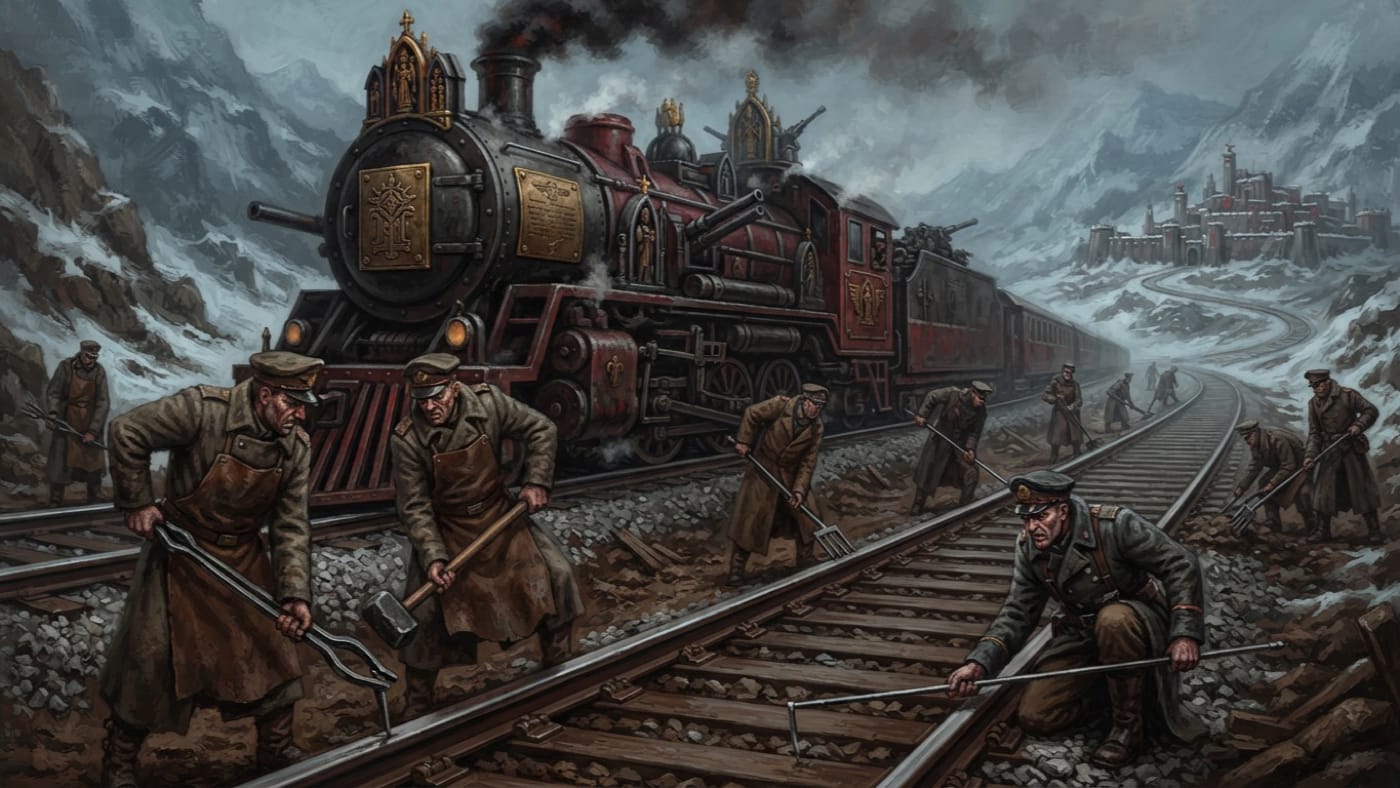
The work fell to the Guild's crews, four to six to a gang. They carried the same instruments Track Engineers carry today: the gauge rod, the alignment glass, the spike maul, the tie tongs, the ballast fork, the oilcan and a stub of demon-sign chalk. Conversion meant drawing the spikes and lifting the rail. It meant shifting or replacing sleepers, re-bedding the ballast, relaying, respiking and aligning. Then the crew measured, and measured again, because a tired man had taken the first reading. Each finished length was entered in a maintenance ledger. The ledger is where a rail becomes true in the eyes of the Bureaus. Until then it is merely iron lying in a field.
#On the Years of the Hammer
Whole sections were torn up and rebuilt under wartime conditions. The front did not pause. The trains could not stop for long, because the bastions they fed could not stop eating, firing or burning coal. The old track had to come out and the new track go down in whatever intervals traffic allowed: by day, by lantern, in any hour the dispatchers could surrender.
Track Engineers worked double shifts for three years. The Guild remembers this as the Years of the Hammer, and the name is exact. The sound of those years was the maul on the spike, repeated across the Dominion until the crews heard it in their sleep. By Guild account, some never stopped hearing it.
An estimated four thousand died in the relaying.
The figure is an estimate and covers the conversion alone. It excludes the earlier toll of the gauge-breaks and the later dead of the Corps. It is a reported total, rounded the way Records rounds anything that grieves. These men died the way track crews die: crushed by shifted rail, fallen from bridgework, taken by frost and by exhaustion. More of them died than usual because tired gangs were doing heavy work to a schedule written by men who had never lifted a sleeper.
The Bureau of Doctrine filed the whole period under a classification of perfect serenity.
Gauge Standardization, A.S. 136: "an administrative disagreement, resolved by technical consensus." — Bureau of Doctrine classification.
Clarified. The disagreement was administrative for forty years and physical for three. It was resolved by decree. Consensus was neither sought nor obtained. Compliance was carried out in double shifts, at an estimated cost of four thousand lives. Doctrine's classification remains on file, where it accurately describes the paperwork.
#On the Rail Carried Forward
The decree did not create the Military Track Corps. The Corps began in Guild secondments during the Gauge War itself. The Bureau of War borrowed skilled crews for work that was too urgent, or too close to the guns, for ordinary section gangs. The decree hardened that loan into an institution, and the reason is easy to state.
A single measure made a single network, and a single network made every line a possible military line. Once a wagon loaded at a rear depot could roll unbroken toward the mountain bastions, War saw no reason for it to halt at the last yard. It saw every reason for it to continue to the battery, the trench and the breach. Someone had to lay that last length under fire, certify it and repair it whenever the enemy disagreed. Engineering had issued the measure. The Guild held the competence and the right to certify. War held the requisition seals. The Corps is what those three facts produce when they are pressed together under bombardment.
The Sepulcher Locomotive shows the stakes at their heaviest. It is an armoured shrine carrying artillery on rails, a sacred argument conducted entirely in tonnes, and it can advance only where the gauge beneath it is right. Standard gauge lets it run on any certified line in the Dominion. Nothing in the decree guarantees that the line will hold it.
When the Corps laid the southern spur for the Constantinople relief of A.S. 191, it laid to the 1,435 millimetres fixed fifty-five years earlier. The rest of that account belongs to the Corps and its dead.
#On the Continuing Measure
As of A.S. 201 the measure governs every Guild line I have seen in the ledgers. The Track Engineer's gauge rod still crosses the rails every twenty metres, from the northern corridor to the southern feeds, and the Line's supply depends on it. The decree did not abolish the mule. On the Carpathian Corridor, standard-gauge rail runs over a network of roads and mule transfers that still carry whatever the rails cannot reach. A uniform width ends a gauge-break. It does not end a mountain.
Gauge certifies one distance and nothing more. It says nothing of a cracked joint, a scoured bridge abutment, a stress fracture working inward from the foot of a rail, or a sleeper rotting under ballast that looks sound. A train may run on perfect gauge and die on a fractured rail. The rod tells the crew that the rails are the right distance apart. The hammer, tapped against the steel and listened to, tells them whether the steel is whole. The ledger tells War, and War reads only the first line.
The decree left that quarrel to the Corps and to every section foreman since. An officer holding a passage order sees standard-gauge track and calls it ready. The engineer hears a dead ring in the steel and says it is not. The decree of A.S. 136 settled what width the rails would keep. It settled nothing about who may overrule the man listening to them.