
#On the Railway Track Engineer
Or: the Gandy Dancer, the Iron-Blood, the Rail-Priest — he who walks the line and listens to what the steel remembers.
The Synod moves by rail. I do not state this as rhetoric; I state it as logistics. One hundred and eleven years of unbroken sovereignty — from the Concordat of Strasbourg to the present hour — has been purchased not by prayer alone (though prayers are audited, and their frequency recorded) but by the brute fact that coal reaches furnaces, shells reach batteries, and men reach trenches faster than the Enemy can rot the ground beneath them. The rails are the Dominion's circulation. The men who maintain them are, by this analogy, the Dominion's blood-wardens — though the Bureau of Heraldry has declined, on four occasions, to grant them that title formally.
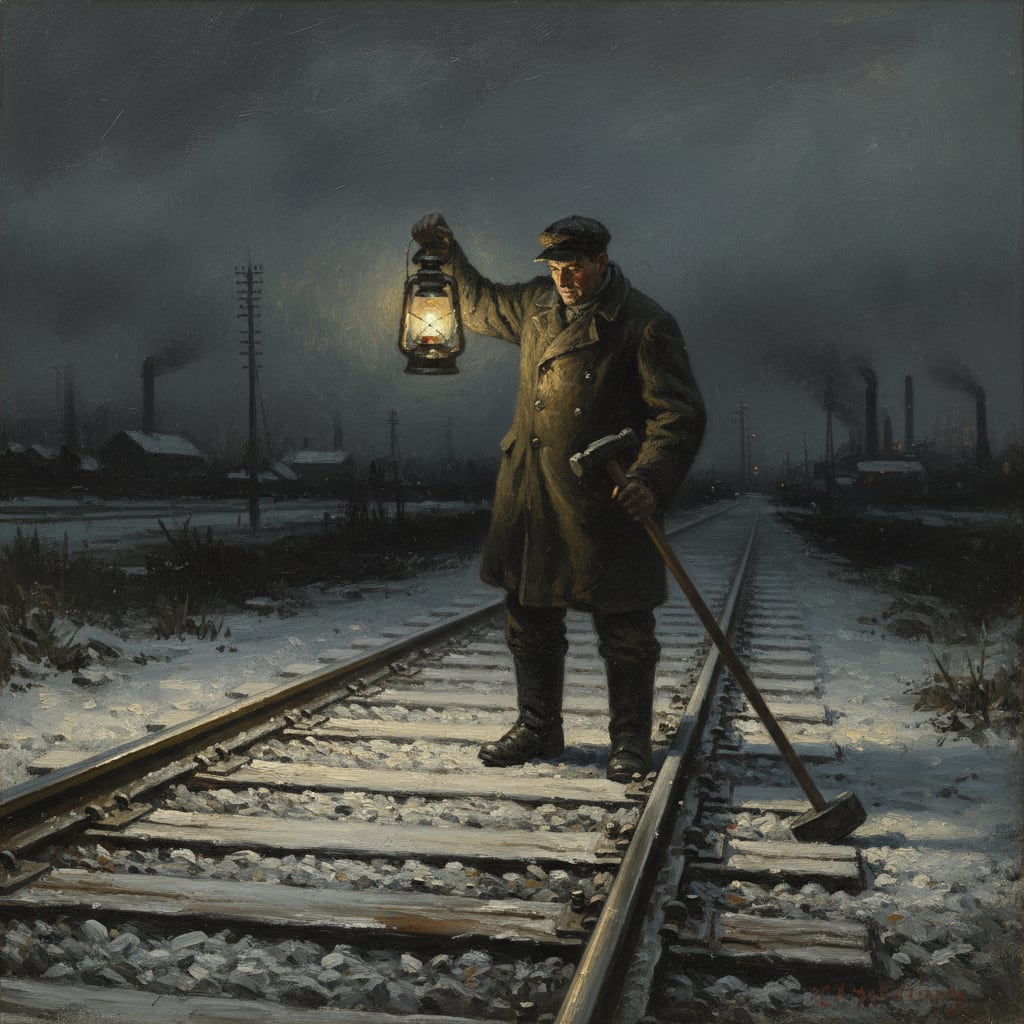
I have walked the lines myself — once, in A.S. 186, on an inspection tour that the Bureau of Doctrine insists was voluntary and that my knees insist was punitive. Three days between Strasbourg and Bastion-Przemyśl, in the company of a Track Walker named Grosz who smelled of lamp-oil and spoke in monosyllables, and who saved my life on the second night by pulling me back from a stretch of rail that, to my untrained eye, looked identical to every other stretch of rail in the Church's lands. "Dead sound," he said, tapping with his hammer. The ring came back flat. Hollow. Like tapping a coffin lid.
We went around.
#On the Nature of the Work
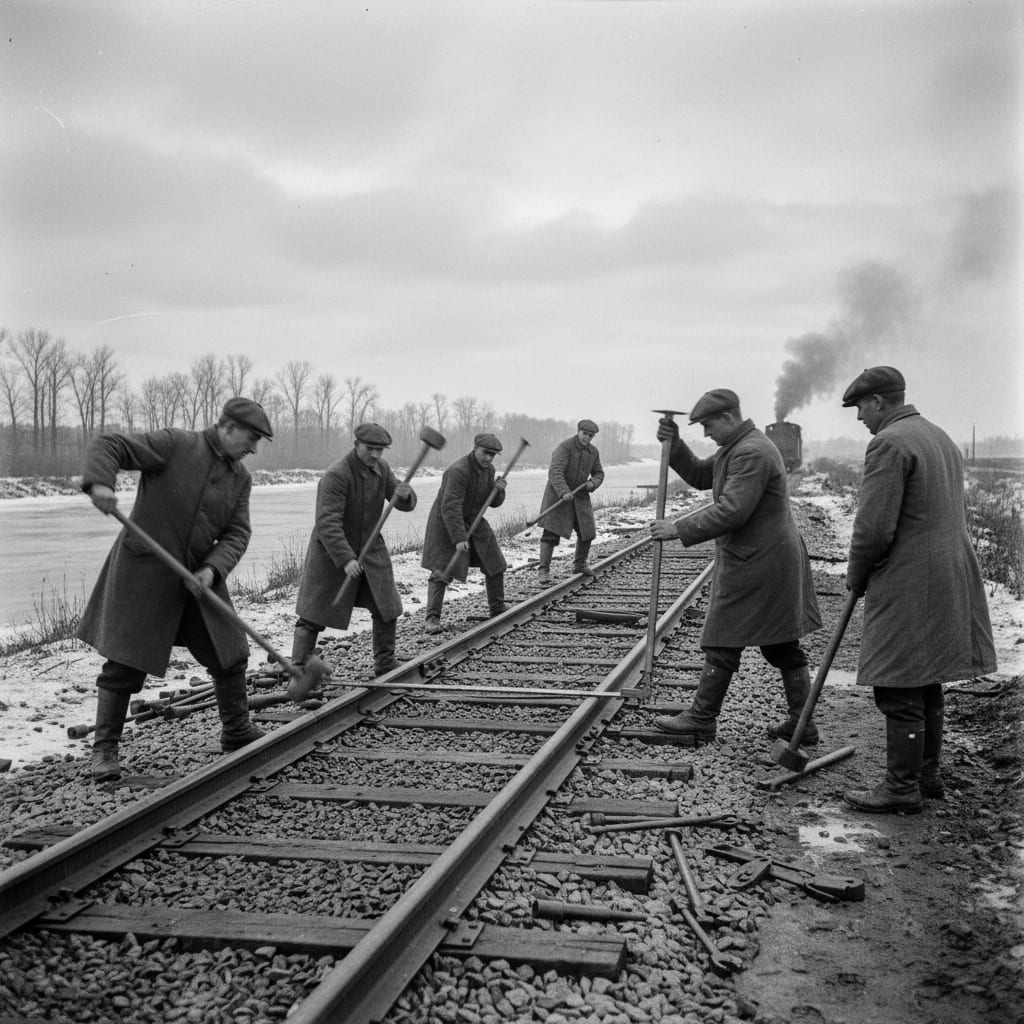
The Railway Track Engineer — called Gandy Dancer by the crews themselves, for reasons no etymologist has satisfactorily explained — maintains the physical integrity of the rail network that binds the Dominion's seven bastions to its heartland cities. This is not a glamorous sentence. It is not meant to be. The work is gauge-checks and tie-replacements and ballast-redistribution; it is the measurement of distances so small that a two-centimetre deviation can flip a loaded ammunition train at speed. It is crawling on hands and knees in the dark with a hammer and a gauge rod while the temperature drops to levels the Bureau of Engineering classifies as "operationally discouraging."
The standard crew numbers four to six. Each is Guild-certified — a process involving two years of apprenticeship, an examination administered by the Guild of Rails in Strasbourg, and a practical demonstration in which the candidate must identify, by sound alone, twelve categories of rail defect. Those who pass receive their gauge rod and sledgehammer. Those who fail are reassigned to ballast-shovelling, which requires less hearing and more spine.
Their tools are simple: the gauge rod (precision-machined, often inherited), the alignment glass, the sledgehammer, the spike maul, tie tongs, ballast fork, oilcan, and — in a breast pocket, never discussed in official reports — a stick of demon-sign chalk. Consecrated or mundane, depending on the crew's theology. The Bureau of Doctrine has not ruled on the question. The Bureau of Doctrine prefers not to acknowledge that the question exists.
#On Iron-Blood and the Rail's Memory
There is a doctrine among the crews — not official, not written, but spoken in every section house from Königsberg to Constantinople — that long proximity to rail changes a man. They call it iron-blood: a gradual transformation in which the body begins to respond to the rail's stress as if it were the body's own. Old Track Walkers claim they can feel a fracture forming three days before it manifests visibly. They say their teeth ache before a cold-snap buckles the steel. They say the rail remembers every train that has passed over it, every load, every stress — and that they, having walked it long enough, share in that memory.
The Bureau of Purity has investigated iron-blood on six occasions. Each investigation concluded with the same finding: "No evidence of supernatural contamination; recommend continued observation." The Track Engineers read this as vindication. I read it as the Bureau of Purity declining to open a file it cannot close.
#On Saint Vandrail and the Sacred Rails
The Guild of Rails venerates Saint Vandrail — patron of the track, the spike, and the straight line. His hagiography is enthusiastic beyond what the Bureau of Doctrine considers tasteful: he drove spikes with his bare fists, sang each rail-section into harmony with the earth, and walked from the Baltic to the Bosphorus in a single night, laying track that needed no maintenance for a century. The Bureau has not formally canonized him. The Bureau has not formally denied him, either, because the Guild of Rails moves six million tonnes of war material per annum and the Bureau of Doctrine knows better than to antagonize six million tonnes.
His icon — a hammer-wielding giant with rails for fingers — hangs in every section house. Offerings are left at his feet: oil, chalk, sometimes a gauge rod from a man who has lost his hands and can no longer walk the line. The Bureau of Rites records these as "guild observances, tolerated" and charges no pilgrimage fee.
A previous entry attributed the founding of the Guild of Rails to Saint Vandrail directly, citing the Codex Ferrum as evidence.
The Codex Ferrum is a guild charter document dated A.S. 94. Saint Vandrail's supposed dates predate the Concordat. The guild was founded by secular engineers drafted from Prussian military rail battalions; the hagiography was attached later, during the Gauge War, as a unifying mythology. The Bureau of Records considers the question "procedurally resolved," which is to say: unresolvable but no longer worth the ink.
#On the Gauge War and the Standardization
The Gauge War is not taught in schools. The Bureau of Doctrine classifies it as "an administrative disagreement, resolved by technical consensus." In fact it was a forty-year civil conflict within the rail network — A.S. 96 to A.S. 136 — in which incompatible rail widths between the northern and southern bastions meant that every supply train crossing the Carpathian corridor had to be unloaded, transferred to different rolling stock, and reloaded at the gauge-break. Men died waiting. Trenches starved while bureaucrats argued millimetres.
The standardization — 1,435 millimetres, imposed by decree of the Bureau of Engineering in A.S. 136 — cost an estimated four thousand lives in the relaying. Entire sections had to be torn up and rebuilt under wartime conditions. Track Engineers worked double shifts for three years. The Guild of Rails commemorates this period as the "Years of the Hammer," and its veterans — the few still living — are accorded a respect that borders on worship.
#On Rail-Demons
I will not discuss rail-demons at length. The Bureau of Doctrine maintains that they do not exist — that "rail-demons" is a folk-term for mechanical failure patterns that the uneducated mind interprets as intentional. The Bureau of Purity maintains that if they did exist, the matter would fall under their jurisdiction, and they have received no formal referral. The Bureau of Engineering maintains that metal does not possess volition.
The Track Engineers maintain that something lives in the junctions.
They mark the suspect sections with demon-sign chalk — a white mark on the rail-head that, to the uninitiated, looks identical to a frost-crack indicator. It is not a frost-crack indicator. The marks are consistent across every section house in the Dominion: a circle with a vertical line through it, like a simplified eye. No one will say who designed the symbol. No one will say what it means beyond "do not walk this section alone after dark."
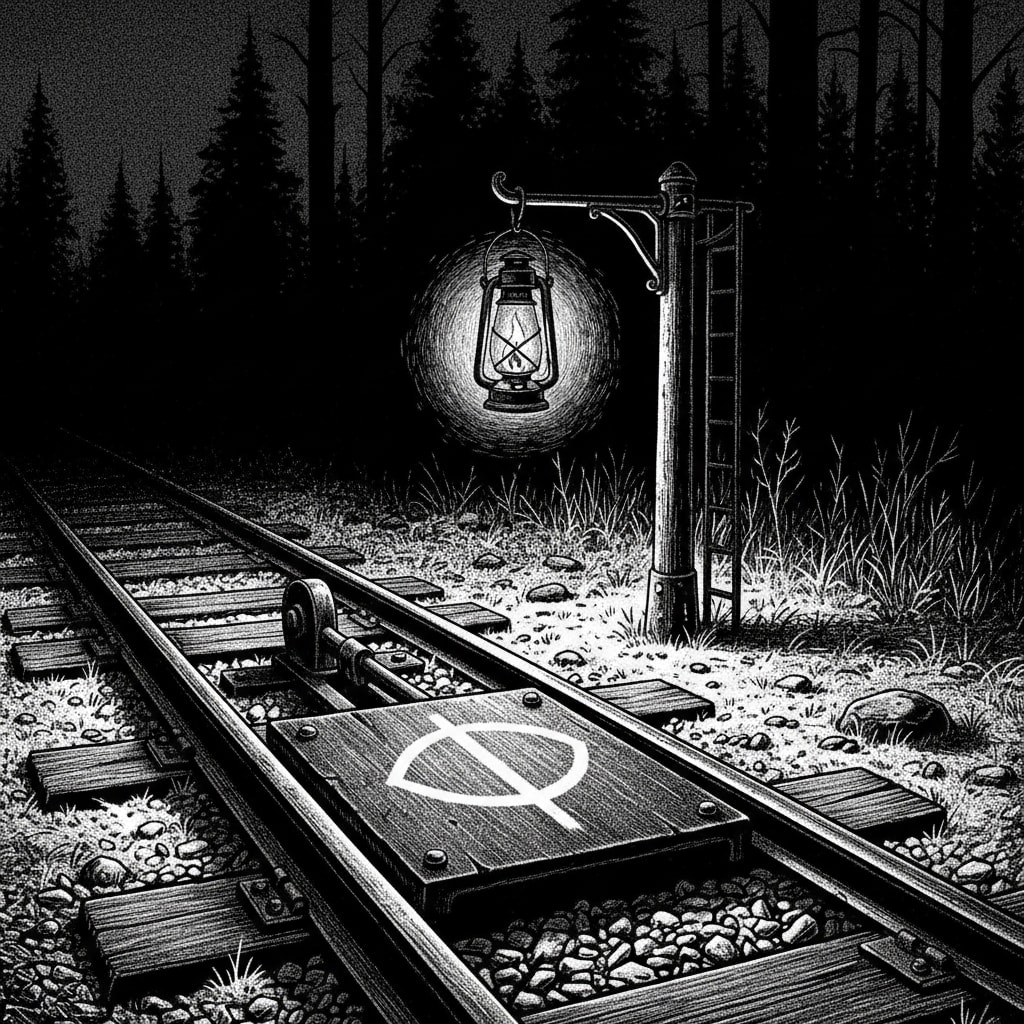
The Bureau of Doctrine's official position is that demon-sign chalk is "a maintenance tool with no theological significance." I have held a stick of it. It was warm.
[SECTION REMOVED — BUREAU OF DOCTRINE STANDING ORDER 44/197 — "NO PUBLISHED MATERIAL SHALL DESCRIBE THE SPECIFIC MECHANISM BY WHICH RAIL-BOUND ENTITIES ARE CONTAINED OR SUPPRESSED" — REFER ALL INQUIRIES TO BUREAU OF PURITY, DIVISION OF IRON OVERSIGHT]
#On the Section Houses
The Track Engineer lives, for most of the year, in a section house — a stone or timber shelter positioned every eight to twelve kilometres along the line, housing one crew and their tools. They are cold, they are drafty, they smell of lamp-oil and sweat and the particular iron-tang that Track Engineers carry in their clothes. They are also, in many sections, the only structures between bastions — which makes them waypoints for travellers, intelligence-drops for the Bureau of Shadows, and, on two documented occasions, improvised field hospitals.
The crews form bonds that the Bureau of Doctrine, in its more candid assessments, compares to monastic orders. They eat together, sleep in the same room, share the same dangers, and develop a vocabulary of gesture and tone that outsiders cannot penetrate. Section Foremen who lose a crew member to accident or reassignment have been known to request transfer rather than break in a replacement. The Guild permits this. The Guild understands what the Bureau does not: that a crew is a single organism, and amputating a limb does not heal.
#On the Night Walkers
Every section has its Night Walkers — men (always men; the Guild has not explained this requirement and declines to discuss it) who patrol the line between dusk and dawn, lantern in one hand, hammer in the other, listening. Listening to what, precisely, is a question that generates different answers depending on whether you ask the Guild, the Bureau, or the man with the lantern.
The Guild says: stress fractures are more audible at night, when traffic is reduced and ambient noise is lower.
The Bureau of Engineering says: thermal contraction occurs predominantly after sunset, making night inspection a matter of prudent scheduling.
The Night Walker says nothing. He walks. He taps. He listens. Sometimes he marks with the chalk. Sometimes he does not return.
An earlier edition stated that Night Walker disappearances averaged "two per annum across the network."
The Bureau of Records has corrected this figure to "fewer than one per annum, attributable to weather, terrain hazard, and personal misadventure." The Guild of Rails' internal records, which are not subject to Bureau audit, list a different figure. The Guild has declined to share this figure. The Bureau has declined to request it.
#On the Sepulcher Locomotive and the Military Lines
The Track Engineer's civilian work is demanding. His military work is worse. When the Bureau of War requires tactical rail — lines laid under fire, bridge sections repaired while artillery falls, junctions maintained in contested territory — it does not deploy engineers of its own. It requisitions Guild crews. The Military Track Corps is, on paper, a volunteer formation. In practice, every Track Engineer knows that the Corps takes the crews that the Guild Stationmasters like least.
The Sepulcher Locomotive — that rail-bound juggernaut of armoured carriages, turreted guns, and mobile shrine — runs on track that someone must maintain. The men who maintain it work within range of the Enemy's attention, which is to say: within range of things that notice rail-steel and find it interesting. Corps casualties run at eleven per cent per rotation. The Bureau of War classifies this as "acceptable." The Guild of Rails classifies this as "the reason we drink."
#On What Is Owed
The Railway Track Engineer asks for three things: fair pay, safe tools, and the right to refuse certification on a section he judges unsound. The Guild guarantees the first two. The third is contested — because closing a section means starving a trenchline, and starving a trenchline means the Enemy advances, and the Enemy advancing means the Bureau of War sends a very unpleasant letter to the Guild Stationmaster, who sends a very unpleasant letter to the Section Foreman, who must choose between his conscience and his crew's continued employment.
Most sign. Most certify the unsafe track. Most pray to Saint Vandrail that the train makes it through. Most, statistically, are correct. The rail holds. The train passes. The section is repaired the following week.
Sometimes it does not hold.
The dead are buried by the section crew. The ledger entry is filed. The Guild pension pays the families — less than the Bureau of War pays for a replacement artillery piece, more than the Bureau of Mercy pays for a coffin. The Track Engineer returns to work the following morning. The rail does not wait. The rail does not mourn.
The rail remembers.