
#On the Forty-Year Misrule of Measures
One empire. One Creed. Seven corridors. Nine gauges. The Ledger blushed. — marginal note in the Codex Ferrum, later scraped, badly
The Gauge War was the forty-year civil conflict of the Dominion’s railways, A.S. 96 to A.S. 136, in which incompatible rail widths between northern, central, and southern corridors forced supply trains to halt, unload, transfer, reload, plead, spoil, and bleed at every break in measure. The Bureau of Doctrine classifies the period as “an administrative disagreement, resolved by technical consensus.” This classification is a small polished reliquary containing a large dead rat.
The Guild of Rails calls those decades the Years of the Hammer. I call them what they were: forty years of men starving at gauge-breaks while committees argued millimetres over soup.
The war began without artillery, banners, declarations, or heroic stupidity in a saddle. It began with local pride attached to arithmetic. A northern yard used the old Prussian military measure. A southern spur used a maritime contractors’ width inherited from harbour cranes. Mountain sections used emergency gauge because their first rails had been laid on ledges where surveyors counted survival as precision. City yards maintained private widths, each justified by terrain, inheritance, tool stock, tunnel clearance, rolling stock, charter privilege, and the eternal provincial sentence: we have always done it this way.
#On the First Breaks
The Sagittal Line made rail indispensable before it made rail obedient. After the Siege of Vienna and the expansion of forward supply, Strasbourg needed iron corridors to feed seven bastions strung from the Baltic to the Bosphorus. The Bureau of War demanded shells, flour, coal, timber, lime, relic crates, condemned labour, chapel glass, telegraph wire, gun oil, bell bronze, and replacement sons. The old roads could carry only hunger with wheels.
Rail answered quickly because speed is the railway’s first seduction. The northern corridors toward Bastion-Königsberg and Bastion-Brest grew from absorbed Prussian military rail habits after the north was administratively swallowed. The central Carpathian approaches toward Bastion-Przemyśl and Bastion-Sibiu grew from mountain improvisation, fortified church supply, and survey lines scratched over maps by men whose boots knew more than their pencils. The southern feeds toward Bastion-Irongate, Bastion-Shipka, and Bastion-Constantinople grew from Danube traffic, Balkan emergency contracts, and coastal shipping logic dragged inland by force.
Each corridor worked. Together, they contradicted one another.
The first public disaster was delay, with derailment spared the honour. A battery train bound for Przemyśl reached the Carpathian gauge-break in winter and sat for sixteen hours while shell crates were unloaded from one rolling stock and loaded onto another by lantern. Seven crates cracked. Two froze shut. One powder wagon lost its seal and was condemned by a chaplain who had never lifted anything heavier than a censer. The receiving trenchline filed its report three days later: ammunition shortfall, ration shortfall, prayer adequate.
#On the Gauge-Break Stations
A gauge-break station is a confession booth for bad planning. It has platforms on both sides, cranes between, sheds for goods that should never have stopped moving, and clerks trained to describe delay as process. During the Gauge War these stations multiplied along the Carpathian corridor like bureaucratic boils.
Every transfer carried cost. Flour spoiled in sleet. Shells cracked under rough handling. Wounded men were shifted from carriage to carriage with their blankets stuck to frozen blood. Relic crates were counted twice, blessed twice, and stolen once. Livestock bolted. Coal scattered. Prisoners escaped, were recaptured, or were lost in the useful middle category that lets several offices sleep.
The worst breaks acquired nicknames. The Przemyśl Split (Unregistered). The Sibiu Mouth (Unregistered). The Three-Measure Yard at Bratislava (Unregistered), where three incompatible widths met under one roof and produced a season of paperwork so obscene that Records sealed the index rather than admit paper could suffer. The Budapest West Bank break, after the east bank abandonment, became a feeding station for shortage: everything south wanted passage, everything north wanted explanation, and the yard wanted fire.
Men died at gauge-breaks in ways too small for monuments. Crushed under crates. Frozen in night queues. Scalded beside boilers held too long under pressure. Shot for theft. Hanged for sabotage. Abandoned between ledgers because the clerk on the north platform and the clerk on the south platform used different rosters. Hunger also killed at a distance: a trenchline unfed by twelve hours, a mortar battery silent by two, a hospital train waiting on the wrong width while fever moved without rails.
#On the Committees of Millimetres
Strasbourg did what Strasbourg does when a wound is obvious: it formed committees and asked the wound to submit measurements. The Bureau of Engineering argued for standardization early, late, repeatedly, and with the weary righteousness of men whose calculations had been ignored by people wearing cleaner sleeves. War demanded exemptions for urgent theaters. Records demanded conversion tables. Tithes demanded compensation schedules. Doctrine demanded language that did not imply the Synod had permitted disorder.
The Guild, chartered in A.S. 94 by the Codex Ferrum, inherited the quarrel two years before the quarrel received its proper name. Its founders were secular engineers, Prussian rail officers, heartland labour bosses, requisitioned surveyors, and the first Stationmasters (Unregistered) — a fraternity built from rival measures and expected to produce unity by invoice. Saint Vandrail entered Guild devotion during this pressure, that hammer-fisted giant broad enough, in hagiography, to hold all gauges by the throat.
Committee minutes from the middle years make excellent kindling and poor reading. One side argued the northern gauge carried heavier loads. Another argued the southern width tolerated rough curves. Mountain men said the standard proposed by Engineering would not fit certain tunnels without widening works. War said widening works would interrupt supply. Engineering said supply was already being interrupted by incompatibility. Doctrine said the word incompatibility should be avoided in public filings. Records asked whether “harmonic variance” would suffice. Nobody was punched. This is why the war lasted forty years.
Earlier catechetical summaries state that the Dominion “swiftly adopted common rail measure after technical consultation among loyal offices.”
Corrected. The consultation lasted from A.S. 96 to A.S. 136 and consumed more lives than several respectable sieges. Loyalty was abundant. Common measure was not.
#On the Years of the Hammer
By A.S. 136 the arithmetic could no longer be gilded. The Carpathian gauge-breaks were starving the central Line. The southern corridors could not be fed fast enough for Constantinople’s appetite. Bastion reports had begun to contain the phrase “rail-delay casualties,” a phrase Records disliked because it made an office look like a weapon. The Bureau of Engineering issued the Gauge Standardization Decree: 1,435 millimetres across the Dominion, deviations to be corrected under penalty of closure.
Administrative fiat ended the quarrel. Labour paid the fee.
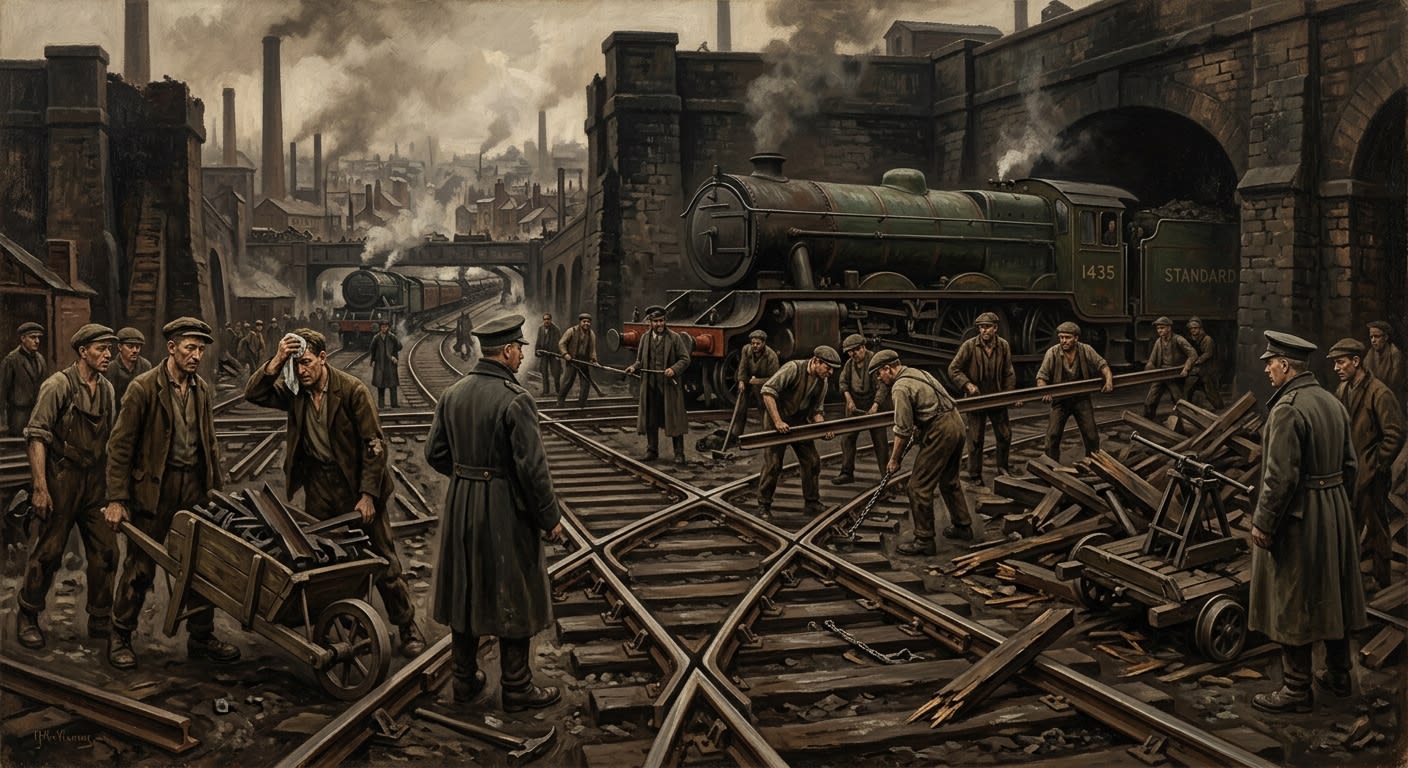
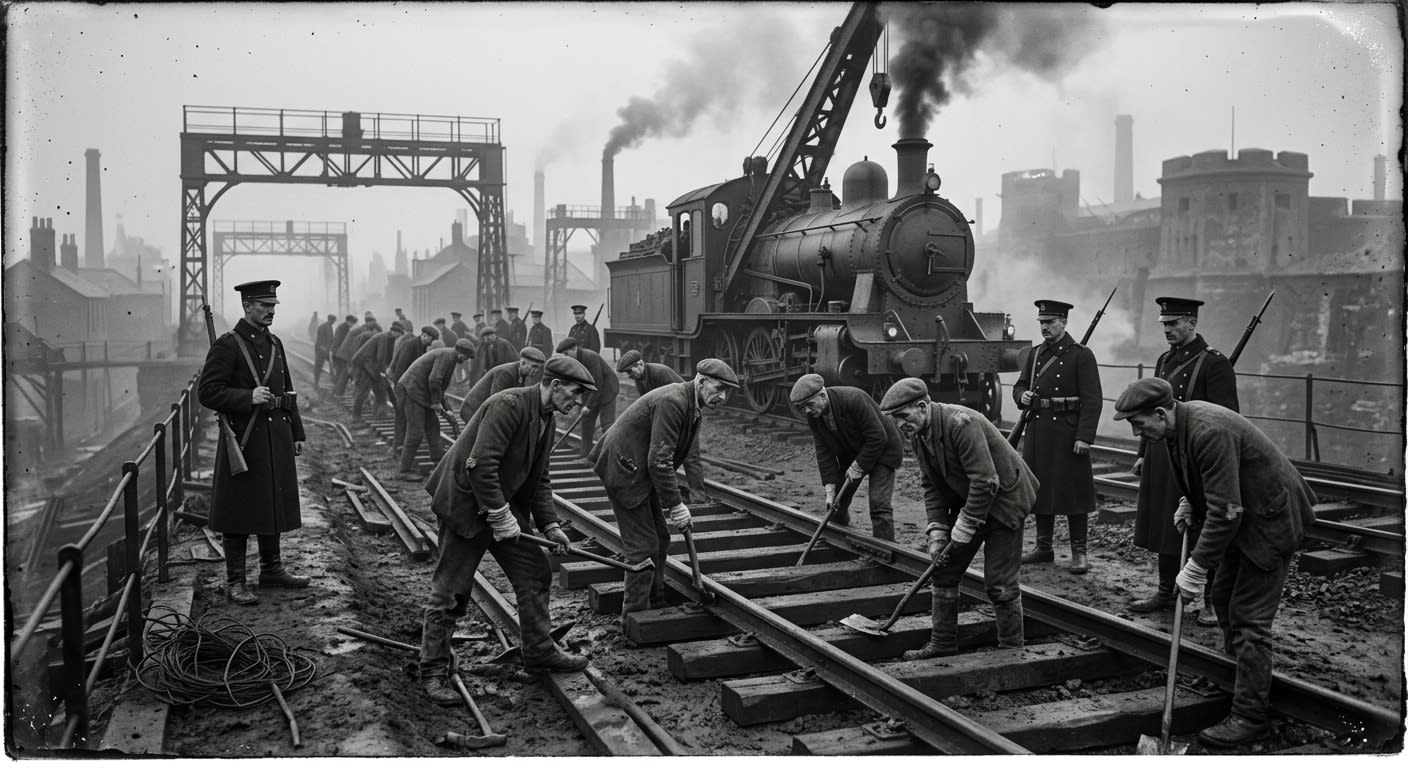
The relaying took three years of double shifts under wartime conditions. Entire sections were torn out and rebuilt. Old sleepers burned in pits beside the new works. Bridges were jacked, tunnel mouths shaved, yard throats recut, turntables broken apart, rolling stock converted, wheels reset, axles scrapped, ledgers rewritten, schedules burned, and men driven until their hands curled around invisible hammer shafts in sleep.
Four thousand lives were lost in the relaying. The number is an estimate because the first months counted dead workers by payroll office, condemned labour by transport chain, military assistants by unit, and crushed prisoners by whether anyone important had ordered them alive. The Guild keeps a different count in section houses. Guild numbers tend to be less convenient, which recommends them to me.
Track Engineers worked until hearing failed. Spike mauls rang day and night. Gauge rods became instruments of judgment. A man who set one on a table in a section house could silence an argument faster than a pistol. Veterans of the relaying still receive a respect that borders on cult: seats surrendered, cups filled, young crews quieted by a look from hands bent into permanent claws.
EXTRACT — RELAYING CASUALTY LEDGER, CARPATHIAN CORRIDOR, A.S. 137 REVIEW Cause categories: crush, cold, blast, fever, exhaustion, fall, misfire, rolling-stock failure, unauthorized burial. Supplemental category sealed by Doctrine: █████████████████ during night conversion of Tunnel 8. Guild marginal note: “Do not strike the old rail after midnight.” Records marginal note: “Folklore; exclude from public copy.”
#On the Standard Measure
The standard measure was 1,435 millimetres: a number too plain for poetry and too powerful for local vanity. It entered the Dominion with closure threats behind it. Deviation became defect. Local exception became heresy’s dull cousin: noncompliance.
The number allowed through-running from Strasbourg to the Line with fewer transfers, faster mobilization, cleaner accounting, and fewer frozen bodies between platforms. It allowed War to plan with larger appetites. It allowed the Guild to acquire an authority no sermon could grant. A Stationmaster with a gauge rod now held a fragment of imperial law in his hand. If the rod did not fit, the section failed. If the section failed, the train stopped. If the train stopped, generals discovered humility in small, bitter doses.
The decree left danger intact and made danger legible. This was sufficient for Strasbourg to call it victory.
#On Winners, Losers, and the Guild’s Throat-Hold
Engineering won the argument and lost the right to be surprised by politics. War gained faster movement and immediately demanded tactical rail under fire, which would later harden into the Military Track Corps. Doctrine gained a cleaner story. Records gained new forms. The Guild gained the throat of war.
Every corridor after A.S. 136 depended on Guild certification. Northern ammunition toward Königsberg and Brest, central supply through Przemyśl and Sibiu, Danube traffic toward Irongate, Balkan strain-lines toward Shipka, southern feeds toward Constantinople: each passed over iron the Guild could declare unsound. The Guild did not rebel. It learned a subtler liturgy. Section requires inspection. Bridge plate doubtful. Yard throat closed. Certified crew unavailable. Ballast settling. Switch key missing. All true, or true enough to survive audit.
The losers were everyone whose local measure had carried a private kingdom. City yard masters lost patronage. Contractors lost tool monopolies. Provincial nobles lost the little delays by which they made Strasbourg bargain. Smugglers lost the gauge-break confusion that had hidden half their trade. Chaplains lost duplicate blessing fees at transfer stations, which explains several unexpectedly fierce sermons against “mechanical pride.”
The Line gained supply. The price was iron obedience.
#On Remembrance and Present Use
The Gauge War remains absent from school catechisms because children might ask why a holy government required forty years to agree on the distance between two rails. In Guild houses it is present in tool racks, bent hands, memorial nails, and the winter ritual of setting the gauge rod across the supper table on the anniversary of the decree. No one eats until the rod is lifted. No one touches it without permission from the oldest hammer veteran present.
The Dominion of A.S. 201 treats the standard as natural law. Trains move from Hamburg, Munich, Warsaw, Vienna, Budapest, Marseille, Genoa, and Venice toward the Line on one measure, beneath one schedule, under one chain of certification. The achievement is real. So are the ghosts beneath it.
Public histories describe the Gauge Standardization Decree as “bloodless administrative modernization.”
Corrected by Guild memorial count, Engineering casualty abstracts, and the continued existence of the Four Thousand Nails roll. Bloodless modernization is what clerks call slaughter when the corpses wore work clothes.
Ask a veteran what the Gauge War settled and he will not say unity, progress, efficiency, or any other polished word fit for an Archon’s mouth. He will set the rod down. He will wait for silence. He will name the measure.
One thousand four hundred thirty-five millimetres.