
#On the Iron Guild
The rail remembers. The Guild invoices. — marginal saying from the Metz section house
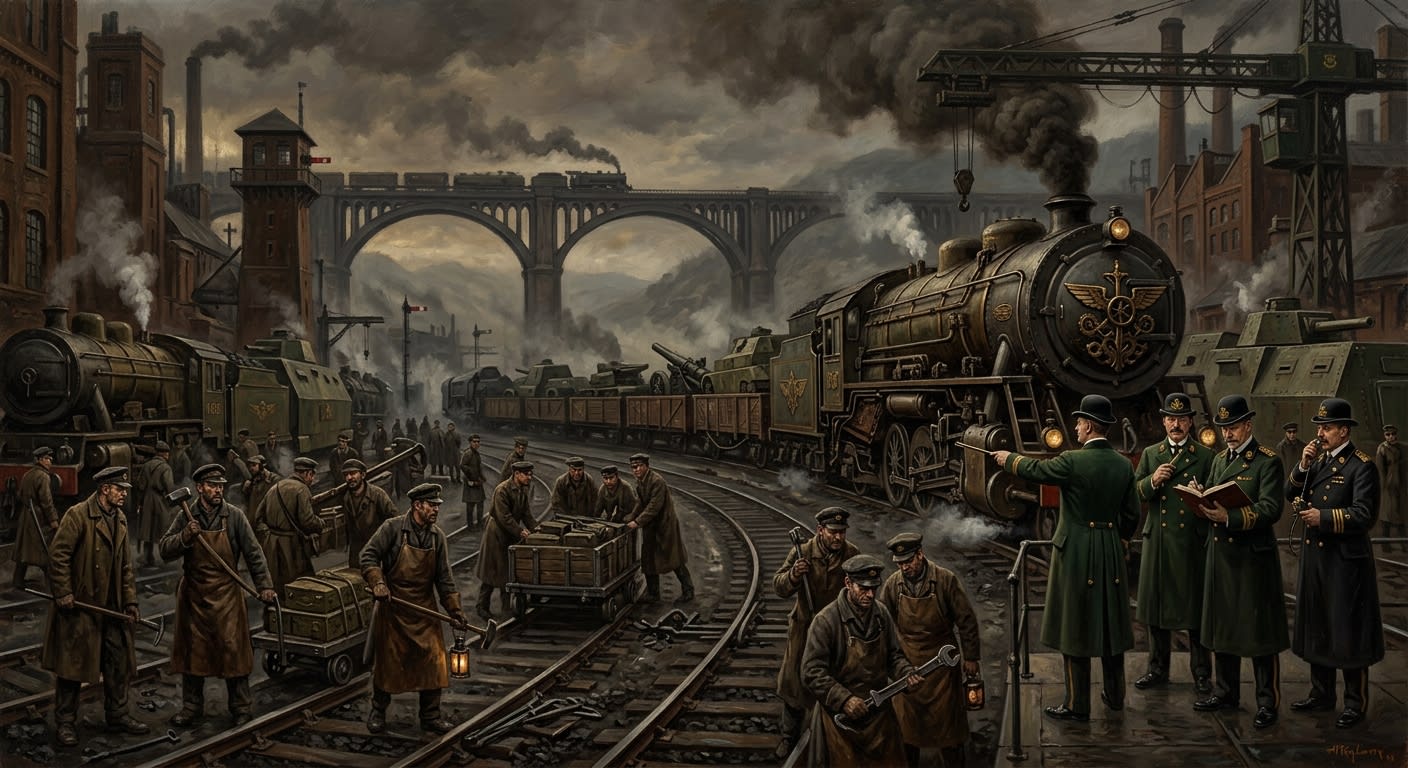
The Guild of Rails is the Dominion’s licensed brotherhood of track, gauge, junction, ballast, bridge, and schedule: a corporate body chartered in A.S. 94 from Prussian military rail battalions, civilian navvy gangs, requisitioned surveyors, and men whose ears could tell cracked steel from cold steel before a clerk could sharpen a pencil. It operates all seven bastion corridors. It maintains the iron roads by which coal, shells, relic crates, condemned men, artillery throats, flour, lime, corpses, and memoranda pass between Strasbourg and the Sagittal Line.
The Dominion moves six million tonnes of war material per annum over Guild-kept rail. This number is recited in War briefings with martial satisfaction and in Guild houses with the dead-eyed contempt of men who know tonnage has no blisters.
One may insult the Guild safely in private, cautiously in a tavern, foolishly at a station, and fatally beside a switch-point during winter. The Guild does not command armies. It decides whether armies arrive with ammunition.
#On the Charter and the First Lie
The Guild dates its soul to Saint Vandrail, who drove spikes with his bare fists, sang rail-sections into obedience, and walked the Baltic-to-Bosphorus distance in a night laying track that required no maintenance for a century. This is impossible, which has never inconvenienced a useful cult.
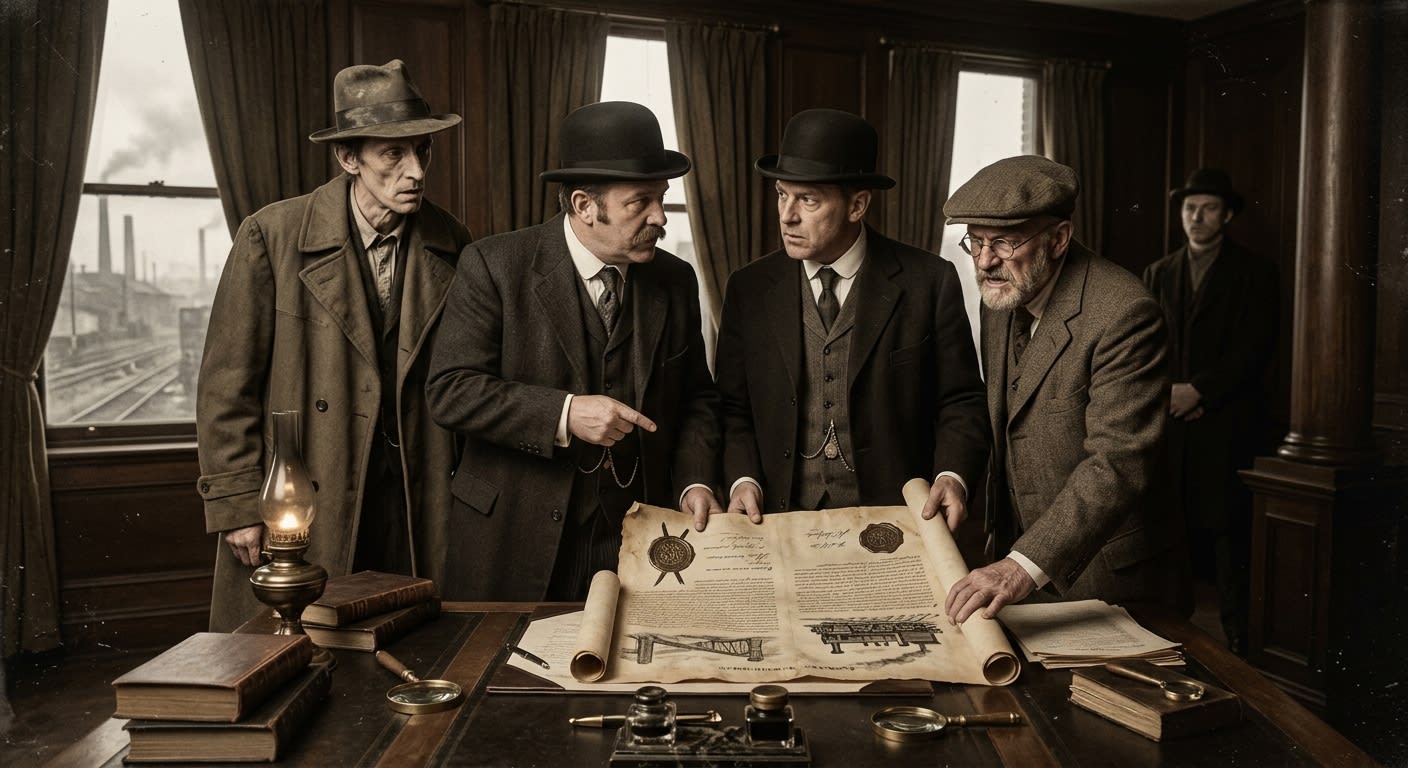
The charter dates to A.S. 94. That document, the Codex Ferrum, was written in ink, witnessed by engineers, countersealed by Records, and financed with sums that would have purchased a modest bishopric in less decadent centuries. Its founders were secular men drafted from Prussian military rail units after the northern administrative absorption, with heartland labour bosses and Synod surveyors added to make the arrangement look less German and more holy. Vandrail entered the story later, during the Gauge War, when a guild made from rival measures required a giant broad enough to hold them all by the throat.
Guild shrine-books attribute the founding charter to Saint Vandrail’s own hand, “pressed into iron-leaf by fist and prayer.”
Corrected for doctrine. The charter was filed in A.S. 94 by mortal engineers. The fist was added later. The prayer arrived once the dead needed consoling and the living needed discipline.
Doctrine has not canonised Vandrail. Doctrine has not denied him. The Guild moves six million tonnes a year. A saint who carries six million tonnes acquires a halo by weight.
#On the Gauge War
The first great sin of the railways was arithmetic with local pride attached. Northern sections used one gauge, southern sections another, mountain spurs a third, and certain city yards maintained private widths whose justification involved inheritance, terrain, and the usual guild-master lie: we have always done it this way. Between A.S. 96 and A.S. 136, the Dominion’s rail network fought itself.
The Bureau of Doctrine calls this period “an administrative disagreement, resolved by technical consensus.” The Guild calls it the Years of the Hammer. I call it forty years of men starving at gauge-breaks while committees argued millimetres over soup.
Every Carpathian supply train crossing a break had to be unloaded, transferred, and reloaded. Shell crates cracked. Flour spoiled in sleet. Wounded men were moved from one carriage to another while pretending not to notice their blood freezing on the platform boards. Trenchlines at Bastion-Przemyśl and Bastion-Sibiu counted their hunger by rail width. The Guild learned its first true law there: a wrong measure kills at a distance.
The Bureau of Engineering ended the quarrel in A.S. 136 with the Gauge Standardization Decree: 1,435 millimetres across the Dominion, deviations to be corrected under penalty of closure. Four thousand lives were lost in the relaying. Entire sections were torn up under wartime conditions. Men worked double shifts for three years, hammering one measure into a continent that had already proved it disliked agreement.
The veterans of those years are venerated in section houses with near-religious unease. Their hands are crooked. Their hearing is ruined. They can silence a room by setting a gauge rod on the table.
#On the Corridors
The Guild keeps the seven bastion corridors in motion: north toward Bastion-Königsberg and Bastion-Brest, through the central iron throat toward Przemyśl and Sibiu, down the Danube approaches toward Bastion-Irongate, across the Balkan strain-lines toward Bastion-Shipka, and south to Bastion-Constantinople, where the rails arrive smelling of salt, smoke, and bad decisions.
A corridor is more than a line on a map. It is a chain of section houses, yards, bridges, switch towers, tunnel mouths, repair caches, coal stops, signal posts, sleeping crews, bribed dispatchers, War requisition slips, unfiled delays, and women in station offices who know which colonel’s train may be made to wait because his mistress has written too often. The Guild keeps all of it moving. The Bureau of War pretends command is enough. The Guild knows command must be coupled, oiled, scheduled, and given a clear signal at the junction.
Its authority is quiet until interrupted. A Stationmaster can close a section for unsafe rail and starve a front. A corridor auditor can reroute an ammunition train and ruin a campaign timetable. A yard master at Munich can make three hundred wagons vanish for six hours by calling them “misindexed,” which is the sort of miracle Records respects because it uses their own language.
The Guild’s power rests on delay. It does not need rebellion. It needs fogged dispatch sheets, cautious inspections, a missing switch key, a bridge declared doubtful, a crew reassigned for grief, a coal tender weighed twice. War moves by urgency. Rails move by permission.
#On the Men Who Walk for It
The Guild’s visible priesthood is the Railway Track Engineer: Track Walker, Gandy Dancer, Iron-Blood, Rail-Priest, Steel-Ass if the speaker lacks gratitude and dental caution. Standard crews number four to six. Apprentices learn gauge by hand, weather by scar, and defect by sound. A clear tap means live steel. A dead sound means fracture, void, or something waiting below the sleeper with patience enough to be mistaken for geology.
Their tools are humble: gauge rod, sledgehammer, spike maul, alignment glass, tie tongs, ballast fork, oilcan, ledger, chalk. The ledger is legal protection. The chalk is practical heresy. Demon-sign chalk is officially a maintenance marker with no theological standing. It is warm in the pocket.
BUREAU OF DOCTRINE STANDING ORDER 44/197 — EXCERPT No published instruction shall describe the mechanism by which rail-bound entities are contained, diverted, named, spiked, salted, soothed, bargained with, or █████████. Guild reports using the phrase “the junction accepted the offering” shall be returned for technical revision.
Guild training teaches the body to listen. Long service produces the condition called iron-blood: teeth aching before cold-snap buckle, palms tingling near hidden fracture, dreams of trains that have not yet departed. Purity has investigated six times and found no supernatural contamination. Purity recommends continued observation. Purity is very brave when the file can remain open.
#On Section Houses and Stationmasters
The section house is the Guild’s true chapel. It stands every eight to twelve kilometres along the line, cold, cramped, oil-smelling, stove-poor, and richer in authority than half the parish churches of the safe provinces. Tools hang in ranked order. Wet boots steam near the hearth. Ledger books sleep in tin boxes. Vandrail’s icon presides with hammer, rail-fingers, and that expression saints have when later institutions have made them responsible for payroll.
Crews form bonds deeper than regulation prefers. They eat together, freeze together, bleed together, and learn the little hand signs by which one man can tell another to step back from a rail before the sound arrives. A foreman who loses a junior may walk alone for months rather than admit a replacement into the room where the dead man’s cup still sits.
Above the section houses stand the Stationmasters: local sovereigns of track, schedule, crew, requisition, and excuse. A good Stationmaster can hear a false delay in a clerk’s first cough. A bad Stationmaster lasts until winter. The Guild’s internal discipline is rough, private, and effective in the way a hammer is effective. Men who steal from tool caches are expelled. Men who falsify safety ledgers are beaten first and expelled if they can stand. Men who sell rail-time to smugglers pay a percentage, provided no train derails.
#On the Military Track Corps
When the Bureau of War requires tactical rail under fire, it requisitions the Guild rather than admit that War’s own engineers cannot lay a stable line while being shelled by things with opinions. The Military Track Corps exists on paper as a volunteer formation. On paper, many cruelties become elegant. In practice, Stationmasters send crews they can spare, crews they dislike, crews whose debts need discipline, and crews whose skill is too valuable to be called punishment aloud.
The Corps lays temporary rail to batteries, repairs bridge sections during bombardment, keeps siege trains moving, and maintains shrine-locomotives whose boilers are blessed more often than their crews are paid. Casualties run at eleven per cent per rotation. War classifies the figure as acceptable. The Guild classifies it as arithmetic with blood under the nail.
The Sepulcher Locomotive would be a stranded reliquary without Corps men crawling beneath its armoured carriages in mud. During the A.S. 191 Constantinople relief, a Corps crew repaired the track ahead of its passage while the southern sky burned. One man remained beside the ballast when the train passed. Dead or asleep, the conductor did not stop. The timetable had priority.
War circulars describe Military Track Corps requisition as “honoured voluntary technical service.”
Clarified. Honour is present. Voluntariness varies by Stationmaster, debt book, weather, and whether the crew asked too loudly about hazard pay.
#On the Devil’s Joint and Other Junctions
The Guild’s public manuals speak of fatigue, stress, frost-heave, ballast scour, switch failure, and signal error. Its private manuals speak in shorter phrases. Dead sound. Wrong heat. Honey-ozone. Unwatched lever. Junction with appetite.
The Devil’s Joint Incident of A.S. 147 near Metz killed three hundred in one night: derailments, signal failures, switch malfunctions, all inside the same half-mile. The crew that sealed it worked until dawn with silver spikes and salt-ballast. Their foreman’s report reads: Junction secured. Recommend no further inquiry. Records accepted the recommendation with unusual speed, a phrase that deserves its own candle.
No Guild man crosses that junction bareheaded. No Night Walker taps it twice. The rails there ring clear now, which reassures only visitors.
#On Antagonising the Guild
The Synod may threaten the Guild, tax it, audit it, sermonise at it, and requisition its least beloved crews. It may not antagonise it past function. This is Doctrine’s quiet concession to physics. A decree does not move a train over split rail. A sermon does not align a bridge. A threat does not make a frozen switch confess.
The Guild understands its hold on the throat of war and dresses that understanding in workman’s humility. It never says we can stop the war. It says Section 22-North requires inspection. It says the Irongate bridge gang has no safe sleepers. It says the Constantinople spur must wait for ballast. It says the Munich yard lacks certified coupling-men. All of these statements may be true. Truth is most useful when timed.
As of A.S. 201, the Guild remains loyal, rich in resentment, poor in sleep, and indispensable in the hideous old sense: everyone curses it until the train arrives, then curses someone else.