
#On the Side Queue
"Don't cry under the arch. The stone remembers." — Local superstition at Griefgate, older than the Synod and unimproved by it.
The Pilgrim Roads come east through chalk, narrow to a single defile, and pass beneath three arches of black stone that the Widow's Pennies Exchange has furnished with scales, ropes and ledgers. Coin goes left. Confession goes right. Cargo goes through the centre under seal. Every traveler who reaches the cut is classified into one of the three and queued accordingly, and the arrangement has the tidiness the Bureaucratic Synod prizes above most virtues and several sacraments.
Some travelers spoil the tidiness. They come in red-eyed and keening, carrying a death too fresh to have settled into a figure on the posted grief-tables, and the Rope Saints take them out of the line. They are walked to a drainage culvert at the margin of the cut and kept there until they are quiet. The pilgrims call this place Grief Lane. The Gate Chapter keeps three arches and three toll schedules, and the culvert adds to neither. It is a holding-place for a condition, and the condition is sorrow loud enough to interfere with the stamping.
No survey I have been shown records which side of the defile the culvert opens on, how far it runs into the stone, or how many it holds. Roman engineers cut it to carry water off the road. The Synod found it a second use: carrying off pilgrims who leak.
#On the Quiet Required
The difficulty is administrative, and the Gate treats it as such.
Large mournful crowds under the arches produce what the Bureau of Bells confirmed in A.S. 143 and reclassified in A.S. 187 as a Category Two Ambient resonance. Its manifestations are few and well attested. Wax will not set, or sets and then smears. Coins tarnish on the counters. A bell rung in the cut gives a flat tone the clerks call damp. People forget names. They forget the names of the dead they are declaring, and sometimes their own, halfway through the syllable, with their papers open in their hands.
Each of these is a fault in processing. A slip with smeared wax is a slip an inquisitor at the next checkpoint will question. A coin that darkens on the assay counter must be tested twice, and the Assayers of the Bitter Scale do not test twice for free. A widow who cannot finish her husband's name at the confession screen has given the clerk a story that does not match her papers. The Gate cannot stamp a declaration the declarant has mislaid.
No one has fixed the density of sorrow at which the effects begin. The Bureau of Bells concedes the threshold has never been calibrated, and no mechanism has been established for why grief, of all the burdens on the tables, should trouble wax. The local saying credits the stone with a memory. The Bureau of Doctrine certifies nothing about the stone's memory, its appetites, or its intentions, and I decline to certify them here.
What the administration has done is adopt countermeasures. Incense fans work the Exchange hall. Licensed clerks recite steady chants through the heavy hours, in the even tone of a man reading an inventory aloud. And the visibly mourning are separated into the side queue. Nobody has measured how well any of the three works. The chants belong to the clerks alone. Singing in the queue remains forbidden to pilgrims on the ground that it stirs crowds, and a mourner in the culvert who begins a hymn for the dead has committed a queue offence.
#On Classification and Passage
The culvert begins with rope. The Queue Marshals, whom the pilgrims call Rope Saints, run the lines with rope, whistle codes, reclassification and their hands. Their ropes are blessed each day by a Gate Chapter deacon, and cutting one is sacrilege. A mourner drawn out of the Confession line and into the culvert has been moved by the same authority that decides who stands in sun and who stands in damp, and the marshal who moves her does so in the name of order.
She has been held aside. Nobody has yet detained her. The distinction matters, and the Gate guards it closely. The Holding Pens, which the local cant calls the Delay Gardens, lie in a depression behind the eastern bluff, and detention there runs up a delay debt, assessed by the day, that can end in a labor-conversion contract. Grief Lane keeps no such account that I have found. Its occupants wait under the same papers they arrived with. Their class has been suspended. It has not been changed.
The culvert releases its occupants in the order in which they fall silent.
The culvert releases its occupants in the order in which they fall silent.
No record establishes any order of release from Grief Lane. Silence makes a mourner fit to be processed and buys her no place in line. Lane priority and the speed of paperwork belong to the Broker Compact at every point in Griefgate, and the surveyor who wrote the struck sentence mistook a hope for a procedure. The Bureau has corrected the surveyor. He was me.
Quiet earns a mourner the confession screen, and the screen is where her real trouble starts. At the Kneel-Sheds the clerks compare each traveler's story against papers, appearance, companions, stated destination, and every confession already filed against the name on the road. A story that agrees is a story-fit. A story that does not raises a doubt flag. A widow who forgot her husband's name in the culvert may remember it at the screen. If her declaration still does not fit, her calm earns her nothing, and Gate-Canon Meral Voss's doubt inspections proceed exactly as they would for a dry-eyed liar. The flag attaches to the name and travels with it to the Great Ledger.
If she disputes the toll assessed on her loss, the dispute goes before Arbiter-Widow Solenne, called Blue Veil for the mourning gauze she has worn for eleven years over a husband whose death no one has verified. Above the arches, a veil is a credential. In the culvert, the same grief is a hazard to the seals.
#On the Evening Collection
The arches close at dusk. Any traveler who has not reached one by then spends the night where the line left them, and the Gate has made provision for this too.
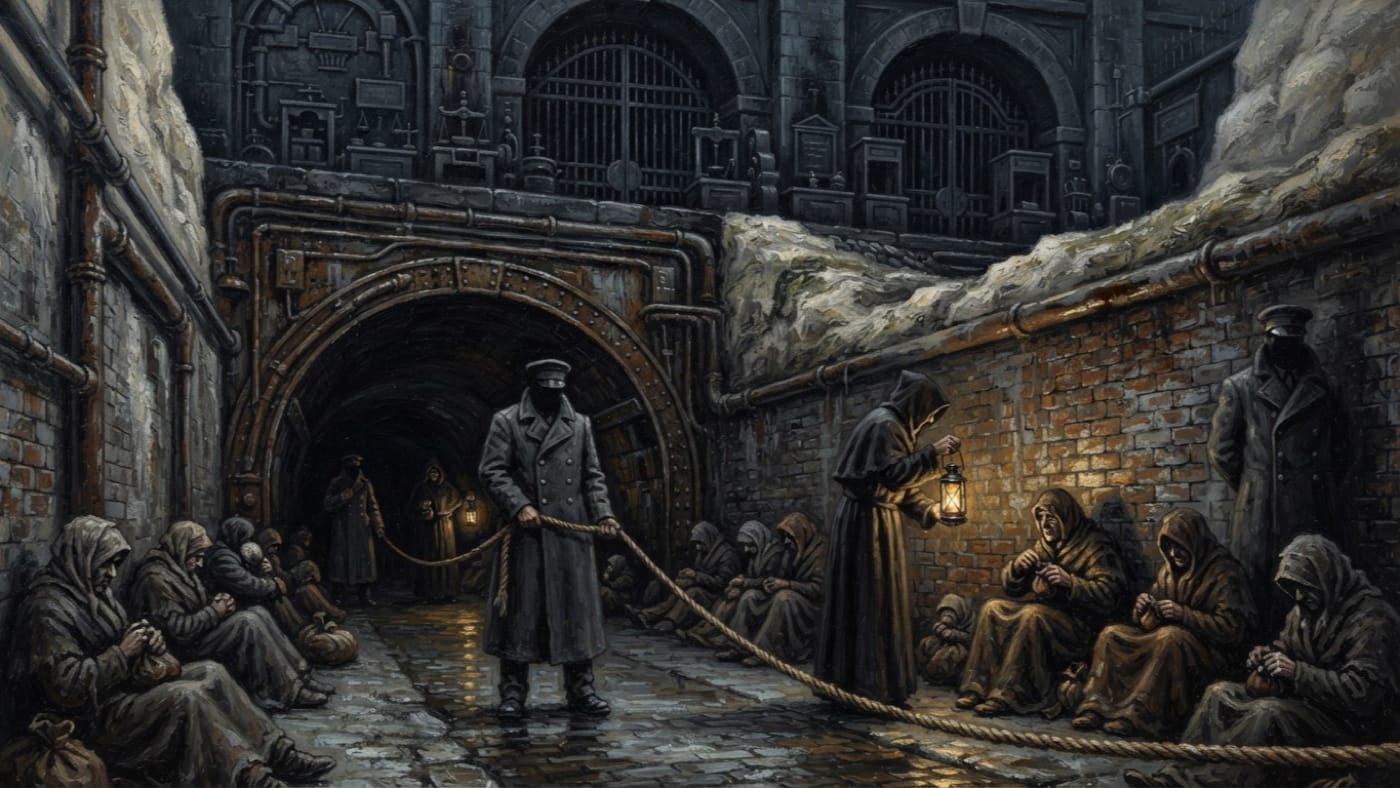
The Exchange's own illustration of the place shows the evening queue at Grief Lane: exhausted pilgrims sitting against chalk walls, and robed Penny Collectors moving among them under brass lanterns, taking coin. The arches are shut. The clerks have gone up to their suppers. The collection goes on below them in the cold, with the lantern light lying yellow on wet brick and on the faces turned up to it.
The setting can be described from what the place is made of. The masonry sweats. Chalk comes off on wool and stays there. Papers that were dry at noon have gone soft at the folds by lamp-lighting, and a traveler who sits against the wall all evening keeps a hand on them in case the damp reaches the wax. The rope runs on past the seated bodies, blessed that morning, sacrilege to cut, and no one rests a foot on it.
The coin goes into the collectors' hands. The documents I am permitted to read do not record what it buys. I have found no tariff for the evening collection, no rank or charter for the collectors, and no form of receipt. Nothing gives a collector power to clear a traveler, record a confession, or open an arch before morning. A pilgrim who pays at Grief Lane after dark has paid. The next morning she is still a pilgrim in a queue, and nothing in her papers has changed.
Nor do the records say whether the travelers stranded at dusk and the mourners held for quieting are the same people, or share the same stretch of masonry once night falls. The illustration puts the collection at Grief Lane and puts those who missed the arches in it. I report both and survey neither.
#On the Present Condition
Griefgate in A.S. 201 runs past capacity. Refugee traffic, mandated penitential travel and the ordinary commerce of a Church at war have pushed peak waits at the arches to three days. That figure covers the whole gate. Nobody has counted the culvert's occupants or timed their stay, and a wait of three days at the arches tells the surveyor nothing about the order in which mourners are fetched out of the side queue.
Three neighbouring arrangements should be kept apart from it. The Holding Pens detain, keep their own accounts and labor contracts, and lie behind the eastern bluff. The Culvert Market trades beneath the arches in forged slips, rented witnesses and passage. The smuggler ring styled the Culvert Choir can move a body under the Gate, but it cannot lift a doubt flag already entered. No map I have seen shows where Grief Lane stands in relation to any of them. The sealed subsurface chambers reported in A.S. 199 have never been identified with it.
Pilgrims fed down the mule-road from the Choir-Broker Hall of Peregrine Row arrive singing, as the parent survey records. Some of them have buried someone on the road since Peregrine Row. Those are the ones who end up in the culvert.
Above it all runs the accusation, carried in culvert talk and denied in the surface ledgers, that the Exchange manufactures guilt when the supply runs short. It concerns the side queue only as it concerns every desk in Griefgate. A mourner arrives with a loss the tables can price, and the Exchange depends on that.
The survey was closed at dusk, when the arches shut. The lanterns were already going down into the culvert.