
#On the Registered Anomaly
"Don't cry under the arch. The stone remembers." — Griefgate saying, older than any ledger that records it.
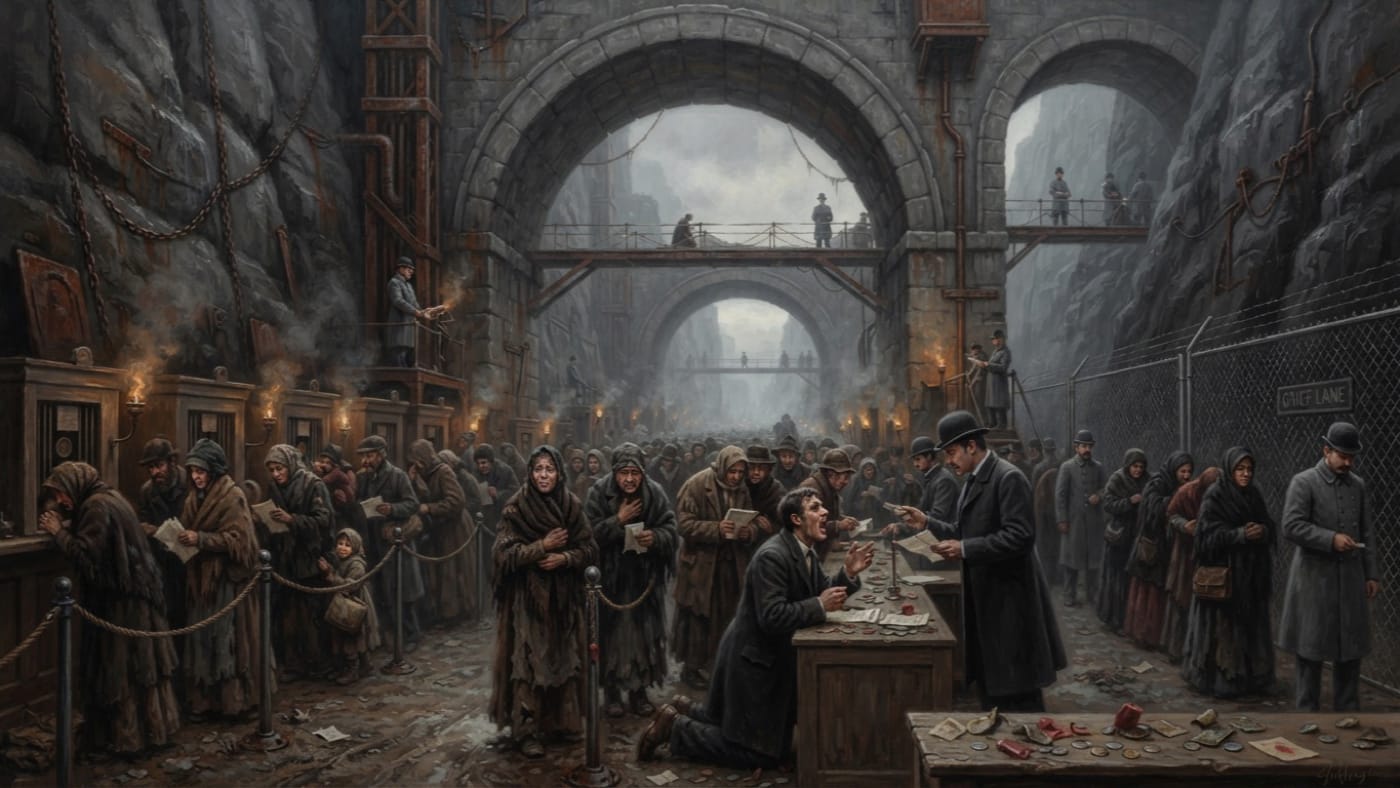
At Griefgate the Pilgrim Roads narrow between chalk bluffs and pass under three arches of black stone, beneath which a disturbance occurs from time to time. The residents call it the arch-hum. The Bureau of Bells calls it Grief Resonance. It appears when large mournful crowds gather under the stone. Wax seals smear before they set. Coins tarnish when they touch the counters of the Widow's Pennies Exchange. Bells ring flat. Travelers lose a name halfway through saying it, and sometimes the name is their own.
That is everything anyone has observed. The rest is talk.
The Bureau of Bells confirmed the phenomenon in A.S. 143, during a general survey of acoustic anomalies carried out in the Year of Ash Rain. In A.S. 187 it reclassified the phenomenon as Category Two Ambient, meaning present, measurable, and insufficiently lethal to warrant a dedicated study. The date 143 records when the Bureau recognized the anomaly, and nothing more. The arches are a Roman remnant, and the saying above predates the Synod by a margin nobody has troubled to measure. When Griefgate first began to hum, no officer of the Church was standing by with a pen, and the Bureau has declined to invent one. This is the only restraint I have ever seen the Bureau of Bells exercise, and I commend it.
#On the Arches and the Crowd
"Three lanes. One throat." — Broker Compact proverb.
The cut at Griefgate is narrow enough, in its tightest stretches, that a tall man could lay a palm on each bluff. Rusted chains hang from the stone. The provost bridgewalk crosses overhead, and the officers on it watch the rope lines below. The queue packs wet wool against wet wool, cold seeps up through boot leather, and the air tastes of tallow and wax smoke. Inside this compressed space every sound folds back on itself: prayers, the clink of coin, the whistles of the Queue Marshals, the scrape of a thousand soles on wet rock, and the sobbing. The arches amplify sobbing into a low hum, and the hum affects wax seals.
A queue at Griefgate is a grieving queue by nature. Some pilgrims are widowed, some are in debt, and some are refugees who have learned that a declared loss moves faster than an undeclared one. At some density of sorrow the hum begins. The Bureau concedes that the threshold has never been precisely calibrated, and it has kept that concession to itself with great efficiency. Nobody has recorded a crowd count that triggers the hum, or how often it comes, how long it lasts, or how far from the central arch a seal is still at risk. The station assessed some forty-one thousand travelers in A.S. 200. That figure measures throughput. It has never measured the anomaly.
Most pilgrims arrive from Peregrine Row, a day or two to the west, still humming whatever the Choir-Brokers sold them. Peregrine Row suffers its own anomaly, the Echo Creed, and it has its own file. Clerks who confuse the two are reassigned to Peregrine Row.
#On Wax, Coin, Bells and Names
The seal goes first. An indulgence slip at Griefgate carries the Gate Chapter's mark in red wax, and that wax is the whole of its authority. When the hum is up, wax will not set. The sealer presses, lifts, and finds a soft red smear where the Chapter's device should be. A slip with a smudged seal earns its bearer a conversation with an inquisitor that the bearer would rather avoid. Under the central arch, the thing that most resembles a forged seal is a genuine seal stamped during the hum.
The coin goes next. Coins laid on the Exchange counters during the hum come up tarnished. The Assayers of the Bitter Scale exist to tell the crowd which metal is true. They weigh it against brass, bite it, and test it with reagents in full public view, because a crowd watching its money being tested is too busy to riot. Master Assayer Tinn Halve, who fears a counterfeit flood above all things, is therefore offered a choice between two errors. If he calls tarnish taint, trade freezes. If he calls taint tarnish, counterfeiters learn when to stand in line.
The bells go flat. The confession clerks call the tone "damp." The Bureau of Bells governs when and in what tone a bell may ring anywhere in the Synod's territories, so a bell at Griefgate that sounds the wrong note during the hum is committing a doctrinal irregularity on Bureau property. The bell-masters have filed this as an acoustic matter and look relieved about it.
Then the names go. At the Kneel-Sheds every traveler must kneel and name, then give an account that the clerk checks against papers, companions and previous confessions recorded along the road. A pilgrim who stops partway through their own name, papers in hand and mouth open around a syllable the arch has taken, has given the clerk a mismatch. The record does not say how long the gap lasts, and the queue does not wait to find out.
#On the Measures Applied
The Gate Chapter has three measures against the hum, and none of them is a cure.
The first is incense fans in the Exchange hall, installed to mask the wax-smearing effect. Mask is the correct verb. The fans push sour smoke across the counters, the sealers work faster, and a wax smear in a smoke-filled hall is harder to see. No one has shown that the smoke helps the wax set.
The second is the steady chant. During high-throughput periods the confession clerks recite slow, level chants intended to stabilize the acoustic environment. The pilgrims are forbidden to sing in line on the grounds that singing stirs crowds, so the only people at Griefgate licensed to make the sound that might keep the hum down are the clerks paid to do it.
The third is the side queue. Travelers who are visibly mourning are taken out of the rope lines and placed in Grief Lane. Grief Lane is a culvert in all but name, a place where the weeping are stored until they are quiet enough to be processed without spoiling the seals. They rejoin the queue once they have stopped crying, and stopping crying takes as long as it takes. At Griefgate, delay is the commodity the brokers sell. Places in the queue are bought and sold, and a mourner in the culvert has no place in it.
The grief-tax and the hum must be kept apart in any honest ledger, and I keep them apart here. The grief-tax is an institution. It prices declared loss by table and collects the price at the counter. The hum is an observed disturbance under old stone. They meet in the same hall, on the same people, on the same afternoons. No Bureau finding says the one produces the other, and I do not intend to be the first to sign one.
#On Assessment and Liability
Every instrument at Griefgate exists to tie a person to a record. The seal ties a slip to the Chapter, the assayed coin ties payment to value, and the spoken name ties the body at the stall to the confessions filed under it in the Great Ledger. The hum loosens all three at once.
The consequences fall to Gate-Canon Meral Voss, who controls the doubt inspections. When a clerk finds that a traveler's story does not match the papers, the clerk raises a doubt flag. A flag brings an inspection, and an inspection can end in the Holding Pens, where delay debt accrues by the day and is paid in coin or in labor. Doubt clearance is the one thing at Griefgate that is never for sale. Arbiter-Widow Solenne, called Blue Veil, hears disputes over assessed grief in her own courts, at a speed I admire professionally. Her courts have no column for a burden the traveler cannot declare because the traveler cannot, for the moment, recall who they are.
The record lists no prosecution that was caused by the hum, and I will not supply one. A smeared seal can also be the work of a forger, and the Culvert Choir now sells blank slips to anyone with a competent hand. A tarnished coin can also be a tainted one. A stalled name can also be a lie. The hum produces genuine symptoms that look exactly like forgery, taint and lying, which is precisely the evidence the Gate Chapter exists to collect.
#On the Present Classification
As of the present year, A.S. 201, Griefgate is congested, overextended and operational. Its operational status is Amber, a rating of the town's capacity to function. The anomaly's classification remains Category Two Ambient. The two ratings are kept in separate files, which agree only that the gate should stay open.
Previous Bureau assessments described Griefgate's throughput capacity as "adequate to projected demand through A.S. 210."
The projection is withdrawn. I have read it. Grief Lane does not appear in it.
One document resists classification. A field note held in the Gate-Canon's private archive, dated A.S. 199, reaches the Bureau in the following condition:
█████████████████████████████████████████████████████████████████████ ██ FIELD NOTE — A.S. 199, GATE-CANON'S PRIVATE ARCHIVE ██████████████ ██ "The stone does not remember grief. The stone ██████ grief. ██████ ██ I have sealed the subsurface chambers. Do not ████████████████████ ██ The sobbing you hear at night is structural." ██████████████████████ █████████████████████████████████████████████████████████████████████
I do not fill in redactions. Whatever the verb was, the Bureau of Bells has not been asked to survey the chambers, and the Gate-Canon has not offered. The chambers remain sealed. Traffic has not stopped.
Lacrimae non probantur.