

#On the File and the City
Documentary survey compiled A.S. 201 / 1911 CE. The date belongs to this compilation. No year is recorded for the prosecution it describes.
This survey draws on the Bruges municipal dossier, the Register of Forms, and one rubbing I have handled myself. The case is old enough to be taught to novices. It is also undated, so clerks who ought to be indexing still argue over its year. I have declined to settle it. The file declines too, and on this one point the file outranks me.
Bruges lies in the Lowlands of Zone 1. It is Synod-held, wet, rich, and a long way west of anything with claws. Its walls face canals, not a front, and its dangers come through the gate carrying credentials. For generations its stonemasons carved saints, capitals, corbels, lintels, drain-mouths and grotesques for the city's churches and halls. They kept apprenticeship ledgers stricter than some episcopal courts. A guild like that produces excellent stone. It also produces a written record of who taught whom, and that record is the first thing an examiner asks for.
#On the Three Figures
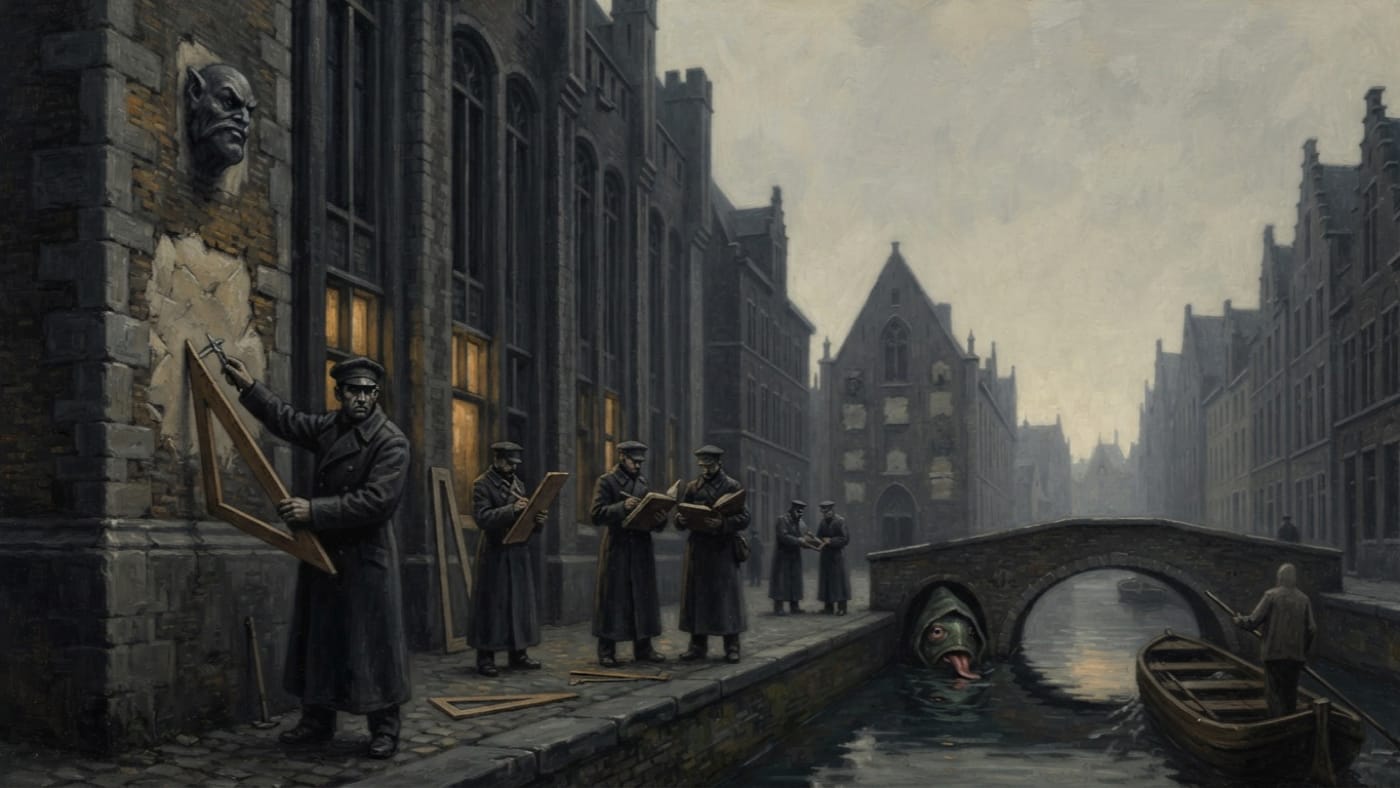
The matter opened on the south face of Saint Odran's Exchange Chapel, when a visiting Chromatic Auditor looked up.
The dossier preserves his office but not the man. His name appears in no cabinet I have opened. Only his title survives, which is the most an Auditor should hope for.
He noticed three figures. The first was a hooded fish-monk with one human eye. The second was a dog-faced tithe clerk counting its own tail. The third was a winged woman whose smile the dossier will not commit to: it may show penitence, invitation, contempt or municipal commentary. The Auditor, says the file, interpreted all four.
Observe the order of events, because the defence never did. The carvings came first, and had been on the chapel long enough to collect pigeons. Then came a man trained to read colour and form as testimony. Then came his reading. Then Purity was summoned. The stone did not change between the second step and the fourth. Only the eye looking at it changed.
I do not hold that the figures were demonic, and the file does not either. On this point it is more careful than its readers. Beast-faced gargoyles are ordinary church furniture. They have frightened rain and sin away from the faithful since before anyone in Strasbourg had a name for the practice. The charge against Saint Odran's was never that a servant of the Great Deceiver crouched under its eaves. The charge was that the masons had made a joke well enough that it began to read as doctrine.
#On Angles Entered as Evidence
The technical charge was symmetry heresy.
Clerks still stumble over this, because the indictment describes faces that do not mirror. Their left sides suggested contrition and their right sides suggested appetite. I will not try to reconcile the legal term with the features it names. The Register made no such attempt, and I am not paid to improve the Register's mathematics. The term was enough to sustain a sentence, and the sentence is what concerns this survey.
The examiners recorded further particulars. The pupils had been drilled at angles that, under afternoon light thrown up off the canal, appeared to follow officials across the square. I write "appeared" deliberately. The dossier describes an effect reported by men who believed they were being watched. It does not establish that stone turned in its socket, and I will not establish it for them.
One gargoyle's tongue lined up with the shadow of a Tithes warehouse at Vespers. The indictment called this "an obscene directional theology." I have seen the rubbing. The tongue points beautifully.
From these observations the Index Damnatus received entries for the figures and for their angles. Forms is the fourth division of the Index, and Bruges is the first case its novices learn. The dossier names left-eye depression, jaw asymmetry, wing-to-spout ratio and eyebrow pitch among the entries. It also names a provocative Toledo number, reproduced in one Bruges arch by accident or genius. These are the dossier's examples. The full schedule has never reached me, and I will not draft one to make the page look tidier.
Toledo's condemned arch is a separate entry in the Register. The Bruges dossier says its number turned up in Bruges stone and says nothing about how it got there. I attach no figure to any entry above, including the Toledo number. Readers who want the measurements may apply to Purity in person and explain why they want them.
This Codex's entry on the Index placed Procurator della Torre's work before Cardinal Kratz's reforms by at least two decades.
Corrected. Kratz's Night of Black Decrees fell in A.S. 58, and the Index was developed around A.S. 80 under della Torre. Neither year dates the Bruges prosecution, and this survey assigns it none.
#On the Reach of the Examination
Saint Odran's was one wall, and the Bureau of Purity's examiners did not stop there.
They reported similar offences across five parishes, two guild halls and the west warehouse of the Glasswrights' Brotherhood. Those are the counts. I have been asked to name the other parishes and halls. The dossier withholds them, or never had them, and I will not draw a map from my own wishes.
The warehouse should be kept apart from its neighbours in the file. The Glasswrights have their own disputes on record, and none of them dates or explains this inspection. Offending stone was found on the glass men's premises. That is all the file says, and it is enough.
My own reading begins here, and I mark it as mine. A single bad gargoyle is one carver's fault. The same depressed left eye on a chapel, a hall and a warehouse is a habit, and habits belong to workshops. Workshops keep patterns, templates and ledgers recording who learned which angle from whom. Once Purity found the fault repeated across the city, its quarry was the guild and no longer a single carver. No statute I have seen states this reasoning. Without it, the sentence that followed makes no sense.
#On the Exiled Hands
Bruges argued tradition. Purity answered with calipers.
The file records the disposition in three parts, and I give them in its order: guild lineages removed, patterns seized, offending stone corrected. The charge was heresy, the particulars were angles, and the punishment fell on people.
Three generations of stonemasons were exiled.
The phrase passes too quickly. It means a craft's whole living membership at once, from the oldest hand still holding a chisel to the youngest still sweeping chips. My account of the dossier under Bruges names who the sentence reached. It reached masters whose hands had shaped half the city's churches, and journeymen who could hear a flaw in limestone by tapping it with a fingernail. It reached apprentices who had barely learned to sharpen awls. It reached the widows who kept guild accounts, the daughters who mixed lime and the sons who carried templates. That list is my reckoning of who stood inside the sentence. It is not a deportation manifest, and no manifest has reached me.
I cannot give a headcount. I cannot give a name, a departure date, a road taken, a destination or anyone's later fate. The Register leaves all of it unknown, and I have found nothing to add. The Codex's article on the Index says the masons recorded nothing afterward. Read that as rhetoric. A guild scattered beyond the reach of Bruges's ledgers stopped appearing in them, and that proves only where the ledgers end.
The patterns passed into Purity's custody. Templates are a stone workshop's memory. They are cut from thin board, carried from site to site under a journeyman's arm, and whoever takes them takes the means of teaching the next hand. The file says only "patterns seized." I have described what a template is, but I offer no inventory.
I approve of the procedure. Measurement met sentiment and won, as measurement does, and no one burned. I have also stood beneath the chapels of Bruges and seen that the replacement work is worse. Both statements are entered in my hand, and the Bureau of Doctrine may decide which one to quote.
#On the Corrected Stone
Correction left marks a child could find. There are blank patches beneath the eaves, and saints standing on newer stone under older feet. Plain replacement spouts now vomit rain without opinion.
The city adjusted, as Bruges does. Its later masons carved obedient public angels with empty faces. Privately they kept working, on cellar lintels, on hearths and on the undersides of canal bridges. I record this as reported habit only. There is no evidence of a league, an oath or a secret school, and Purity has looked. The Records cabinets hold the complaints. They do not hold a conspiracy.
On the old south canal, at dusk, I saw a small grotesque under a bridge, where only boatmen and disobedient children look up. It was a fish in a monk's hood with one human eye, and its tongue was directed toward the Tithes office. I cannot certify it as a survivor of Saint Odran's. It is on the wrong wall, and no record links the two carvings. The guide saw me notice it. The Purity men with me did not.
I left it there.