

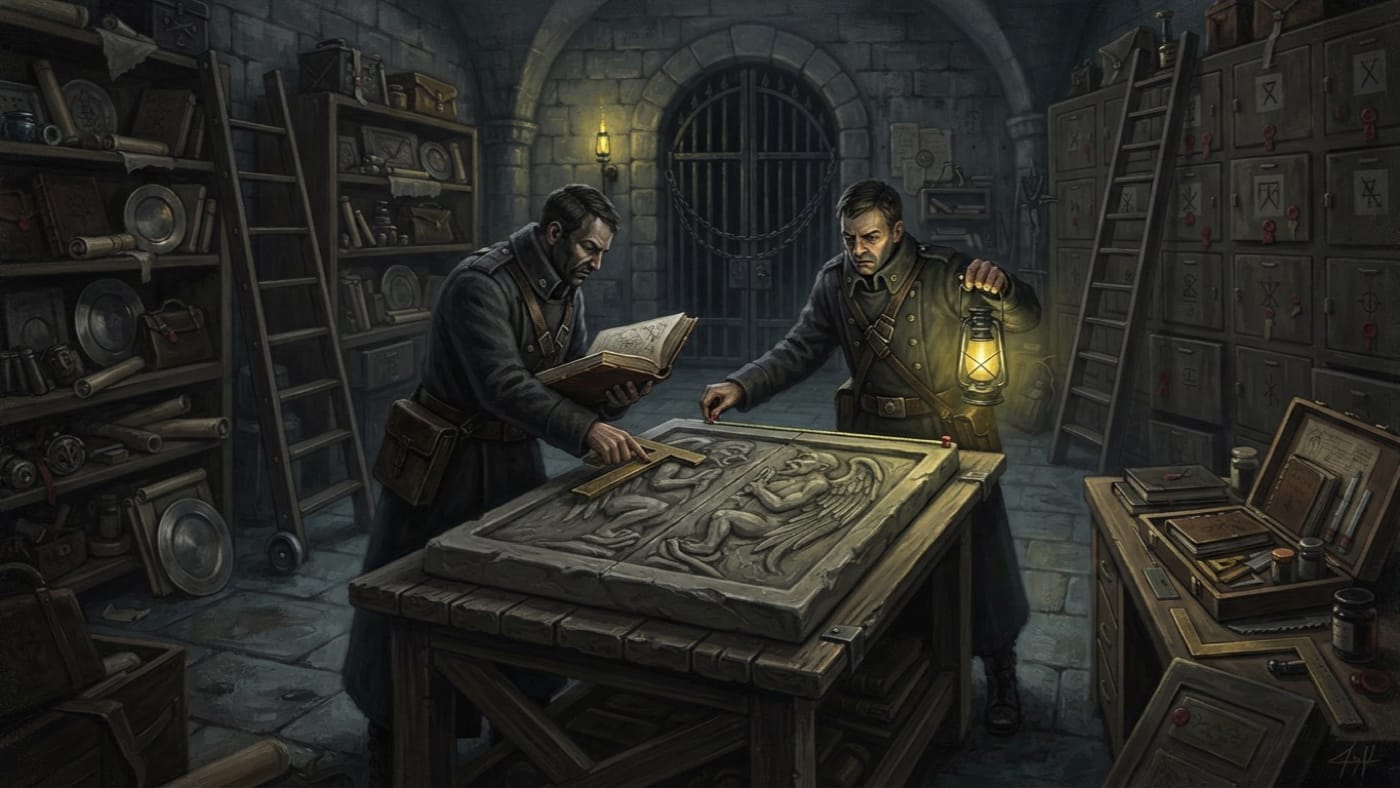
#On What the Eye Is Forbidden
Current documentary survey — A.S. 201 / 1911 CE. The date belongs to this entry; the first issue of the Register of Forms remains unrecorded.
"A line has no tongue. It is condemned for what it says all the same."
A mason's square held against a carved corbel tells you whether the stone is true. Put the same square in the hand of a clerk of the Bureau of Purity, with the proper folio open beside it, and it tells you whether the mason is. That second use is the business of the Register of Forms. It is one of the five divisions of the Index Damnatus, and the only one whose offences can be committed without a single word.
Its remit covers four things: forbidden geometries, architectural plans, artistic compositions and symbols. A geometry is condemned for its proportions. A plan is condemned for what it would raise. A composition is condemned for its arrangement, whatever the figures in it may be. That means the placing of figures on a painted panel, the order of saints along a frieze, or the way one carved head relates to its neighbour. A symbol is condemned for being itself. The prosecutor never needs a sentence to quote. The heresy lies in the layout, and the layout is the evidence.
The Register of Texts needs someone to write a thing down. The Register of Names needs someone to say a thing aloud. Forms needs only that someone build, carve, paint or stitch something, and that a Purity officer looks at it.
#The Fourth Register and Its Keepers
The Index is a rolling compendium. It is amended continually and never closed. Forms is a division inside the same master copy, governed by the same Bureau. Some people imagine a second chained volume of forbidden diagrams somewhere beneath Strasbourg. They have been reading the wrong kind of pamphlet.
Each Register answers to its own quorum of the Bureau of Purity. Each seals its amendments with its own wax, and each requires its own ratification before a line can be added. Forms follows the same rule. The sources available to this Codex do not record who sits on its quorum, what device its seal bears or what grade of ratification its amendments need. I decline to decorate the gap.
The division of labour is the familiar one. The Bureau of Doctrine defines orthodoxy and Purity enforces it. Doctrine may declare that a certain proportion offends. Purity enters the offence in the Index, seals it, and sends out the people who carry measuring cord. Other offices contribute surveys, plans and complaints. Contributing gives none of them custody.
The Index itself was developed around A.S. 80 under Procurator Maxentius della Torre of Ravenna. At that time the Church's administration was still ten years short of the Concordat of Strasbourg, which made it a Synod. Here, as elsewhere, the title "Bureau" is applied with the convenience of hindsight. The date of A.S. 80 belongs to the Index as a whole. No record before me says when Forms first received its own quorum and its own wax.
This Codex's entry on the Index placed della Torre's work before the reforms of Cardinal Kratz.
The order runs the other way. Kratz's Night of Black Decrees fell in A.S. 58. Della Torre's Index followed around A.S. 80, some twenty-two years later. The Index is still the Procurator's work. It simply arrived later than this office once claimed.
#The Grotesques of Bruges
Bruges, a Synod city in the western heartlands, supplied the case every novice clerk of the Register learns first. Three generations of stonemasons were exiled for carving grotesques that the Bureau judged heretical in symmetry. According to the Codex's own article on the Index, the Index recorded the angle of offence.
That ruling needed a great deal to happen. First, it needed a grotesque, which is already licensed ugliness: a gargoyle's snarl, a squatting beast, a face pulled sideways by the chisel to frighten the weather off a gutter. The ugliness had to be permitted while its balance was forbidden. Then an officer had to stand beneath the roofline, sight along the carving, and decide that its left half answered its right half in a way Doctrine could not tolerate. Finally, the finding had to travel from the stone to the master copy as an angle, entered beside the condemnation, so that the next officer could find the offence by measurement alone.
After all that, the ruling still needed the punishment to fall on three generations.
A mason learns the trade at the banker where stone is dressed, beside the person who learned it there before them, and later teaches the next generation at the same bench. The geometry in a mason's hands is inherited as surely as a surname. When the Bureau condemned a symmetry, it condemned every hand that carried it, and in Bruges those hands spanned three generations. The sentence was exile. The Codex does not hold their names, the measurement, the year of judgment, the number of the exiled or the road they took out of the city. The Index holds the angle.
I approve the ruling. A workshop whose carvers all cut the same forbidden balance is a school of forbidden balance, and you do not burn one copy of a book while the press is still running. In this case the press happened to be a family with chisels. That does not change the principle. It only made the principle portable.
#The Arch at Toledo
Toledo, a Synod-held city in Iberia, gave the Register its second celebrated entry, and the stranger of the two. An arch was raised there at a certain angle. When that angle was calculated, it produced a number the Bureau found "provocative." The arch entered the Register of Forms.
The accusation sounds precise. Someone took the angle and ran a calculation on it to reach a figure. Someone else read the figure and was provoked. Each step implies a measurement, a method and a result, and I have none of the three. The number is not given and the calculation is not described. The arch is not named. Neither is its designer, the year it was raised or the year it was condemned.
I will not supply them. Readers who want a number may go and measure Toledo's arches themselves. Anyone who comes back with one can explain to a Purity officer why they went looking.
Note the Bureau's word. "Provocative" is a judgment about effect: about what the number might do in the mind of whoever worked it out. In the Register of Forms that is enough. I cannot say whether the Bureau reached its verdict by arithmetic, by revelation or by indigestion. The Codex has not been told, and a gap in my sources is only a gap.
#Cord, Scraper and Seal
Few Purity officers ever see the master copy. The judgments of Forms reach the street through people who carry their consequences in a satchel. The Index Damnatus Runners take sealed amendment strips to gatehouses and registries, and collect a countersignature and a stamp marking the bell at which each was received. Sigil Inspectors carry the rest.
An Inspector's kit is a seal-book of approved plates, a measuring cord, colour swatches, a scraper blade and a lantern for checking pigment at dusk. At a gate, a guildhall or a shop front, the Inspector checks the geometry of a mark and the ratio of its colours against the codex. They test whether the paint came from an authorized dye lot, and they ask who displayed the mark and what crowd gathered near it. The possible outcomes are clearance, confiscation, a repaint order or a citation for heraldic heresy. Every one is logged. Inspectors take a bleak satisfaction in that.
Most of this work has nothing to do with the Register of Forms. A guild may hang a perfectly lawful crest without its permit. The Inspector cites the missing seal, and once the wax is paid for, the crest is innocent again. A form entered in the Register has no such remedy, and no permit can cure it. A forbidden symmetry cannot be licensed, because the offence lies in the shape itself.
The two kinds of work meet at the cord. An Inspector measuring a banner's emblem against the plate is doing what the officer at Bruges did beneath the roofline, only on a smaller surface and with a cheaper sentence attached. If the cord finds a proportion the Index condemns, the case is no longer about permits. What happens next depends on what has been condemned. A banner can be confiscated, and a painted sign can be scraped back to bare wood. A carving or an arch might be defaced, rebuilt or simply entered in the record. My sources prescribe no single remedy for every condemned stone, and I will not invent one.
#On Drawing the Thing One Forbids
The Register of Forms has a difficulty its sister Registers share only in part. To ban a book, you need only give its title. To ban a name, you must spell it, and the Runners carry the spelling. To ban a shape, you must describe it exactly enough that someone with a cord can find it on a wall. A description that exact is also a set of instructions for making the shape.
The master copy rests in chains in the Vault of Silences beneath Strasbourg. Consulting it requires written authorization from two Procurators, the seal of the Bureau of Purity, and cleansing rites before and after. Abridged, redacted copies go out to the provincial bastions and cathedral cities every quarter, and urgent amendments travel by courier. I cannot say how Forms entries are shortened for those copies, or whether a provincial officer receives drawn plates, bare measurements or something else. The sources do not record it, and I have not handled those copies myself.
I have seen the difficulty all the same. Every officer who can recognise a forbidden symmetry carries it whole in their head, and could cut it into soft stone in an afternoon. The Bureau trusts those officers. Once it trusted the masons as well, and they carried the same knowledge in their hands.