
#On the Room That Calls Itself Principal
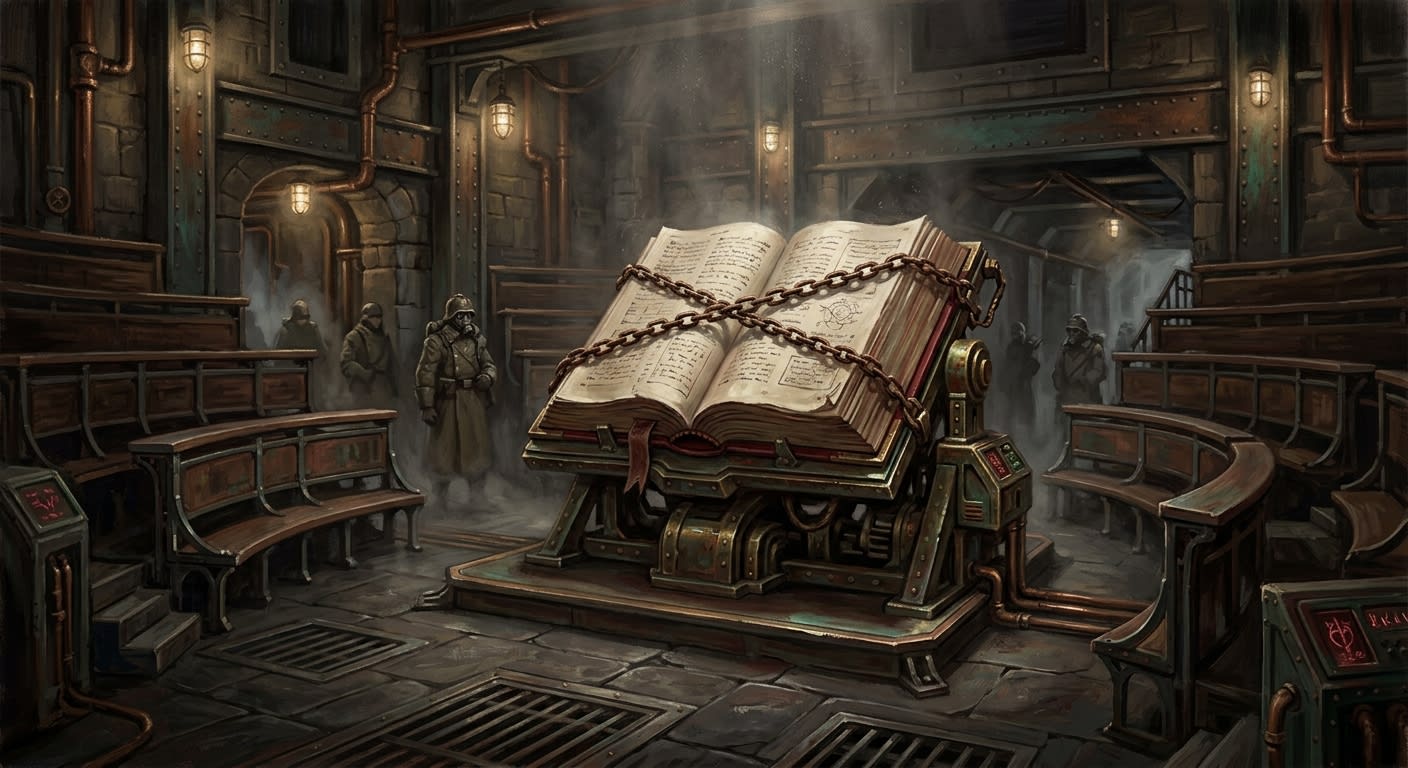
The Index Damnatus Chamber is the principal room of the Vault of Silences, which lies beneath the Basilica of the Ledgered Saints in Strasbourg, beneath the north transept, beneath the tolerable lies told at street level, beneath forty-seven steps on the way down and forty-nine on the way back. The Bureau of Purity calls it a chamber. Visitors call it the Vault. I call it a throat, because everything sealed below it seems eventually to pass through its cold rectangular mouth.
It is forty paces by twenty. This measurement has been verified by the Bureau of Engineering, the Bureau of Records, and one extremely pale assistant of mine who counted twice and requested wine afterward. The ceiling is ribbed stone, converging on a central boss carved with the Synod's seal. The seal looks downward. Everything else in the room looks toward the lectern, even when instructed not to look.
The air is cold. The air has always been cold. Braziers are forbidden by document-preservation rule, candle density is restricted by smoke index, and warm clothing is permitted only where it does not obscure mantle insignia, because even hypothermia must respect rank. A man may stand there for five minutes and begin to hear his own thoughts clearing their throats like witnesses.
#On the Lectern and the Chain
At the centre stands the iron lectern. Iron chains secure the master copy of the Index Damnatus to the lectern. Iron bolts secure the lectern to the plinth. The plinth secures itself to the floor with that superior tenacity possessed by ancient stone, bad decisions, and institutions that have outlived their founders.
The Index is open. It is always open. A different page each day receives the chamber's consecrated air, turned at Matins by the senior Inquisitor using bleached linen gloves and the Prayer of Unseeing. The Bureau's explanation is doctrinal potency: forbidden knowledge must be exposed in strict rotation lest it fester under closure. A closed book is a box. A box invites pressure. Pressure invites leakage. Purity, whose whole business consists of containing what it insists should not exist, understands leakage with the intimacy of a plumber in vestments.
No visitor forgets the chain. Citizens imagine forbidden books as muttering things in velvet wraps, passed by conspirators in culverts and read by fools with candles. The master Index is uglier and less romantic: iron on iron, paper under custody, ink disciplined by weight. Its danger does not diminish because the apparatus looks like furniture. Gallows also look like carpentry until a clerk brings the rope.
#On the Three Benches
Three stone benches stand at the points of an equilateral triangle around the lectern. The geometry is Purity's little sacrament of balance: three watchers, three sight-lines, three bodies instructed to guard what they may not read. South, east, west. No north bench. The absence is explained by page-turning access, lamp placement, old masonry stress, and spiritual circulation, depending on which office is cornered. All four explanations are useful, which is to say none is trusted.
The south bench faces the Register of Names on every fifth day of the rotation, when ten thousand condemned identities lie within the fall of an incautious eye. The east bench faces the Register of Sounds on every eighth day, when proscribed melodies, bell-tones, and vocal cadences sit in notation so neat it resembles innocence. The west bench receives the remaining exposure sequence and the worst draught. Do not pity the west bench. Draughts do not enter duty logs and teach them songs.
The attending Inquisitors avert their eyes by rule. They are trained to look beside, above, through reflection, at glove-seams, at lamp brackets, at the centre boss overhead, at the senior officer's hands during the turn. Training helps. So does fear. Neither has abolished accidents. Breel sat east-facing too long in A.S. 187 and transcribed the Register of Sounds into her duty log without memory. The Bureau reduced twelve-hour shifts to eight. It did not move the bench.
Earlier floor-guides described the three-benched arrangement as “protective symmetry.”
Corrected. The arrangement is protective, observational, punitive, and experimentally unwise. The term symmetry remains approved. The word protective is to be used only with the modifier “claimed.”
#On the Boss, the Ribs, and the Listening Stone
The ceiling ribs are older than the Basilica's visible foundations. Their convergence is too exact for accident and too discouraging for comfort. The central boss bears the Synod's seal, though stone analysis suggests the boss predates the Synod, which means either the seal was carved into older stone or the stone anticipated our authority. Doctrine prefers the second explanation when preaching and the first when audited.
The ribs carry sound strangely. A cough near the west bench returns above the south bench. A pen laid down too sharply seems to land twice. Spoken formulas lose their consonants near the plinth, then regain them along the eastern wall as if the room were correcting pronunciation after reflection. The Bureau of Orison and Song has tested the chamber only twice under Purity supervision. Both reports survive. Neither mentions satisfaction.
ORISON TEST FRAGMENT — SEALED Tone issued: sanctioned low Lauds pitch. Return: █████████ Hz variance, source indeterminate. Observed effect: east-bench lamp lowered without touch; attending Inquisitor reported childhood hymn in mother's voice; test halted before third measure. Recommendation: no further vocal calibration inside principal chamber.
The stone does not echo. It remembers carelessly. There is a difference.
#On the Page-Turn
At Matins the senior Inquisitor approaches the lectern. The other two watchers stand, turn their faces aside, and recite the first clause of the Prayer of Unseeing. The senior officer lifts the upper corner of the page with a flat ivory tongue, never a finger, and moves the exposed leaf according to the rotation table. The motion takes less than thirty seconds. It occupies the whole room.
The Registry requires three entries after each turn: page exposed, page retired, disturbance observed. “None” is the usual answer. “None” appears thousands of times in the Vault ledgers. It sits there with exemplary posture, a parade of obedient lies waiting for promotion.
Disturbance has many official forms. Page-shift without contact. Ink darkening. Edge-curl toward a bench. Notation bleed. Name emergence. Unsanctioned warmth. Lamp-smoke inclination. The duty officer marks the code, seals the note, and continues the shift. Panic is not a code. Prayer is not a code unless improperly timed. Screaming appears under vocal breach.
The Index sometimes assists the ritual. A page will loosen before the ivory tongue touches it. A margin will widen around the senior Inquisitor's shadow. A line will seem to lean away from the glove. Purity calls this static response. Records calls it paper behaviour. I call it etiquette, which is the most frightening of the three.
#On Visitors and Their Little Permissions
Visitors are rare, ranked, frisked, blessed, sealed, countersigned, and insulted by process before entry. A Procurator may receive supervised consultation rights. A Hieromnemon may receive them with sufficient stamping and insufficient sleep. An ordinary Inquisitor may guard the Index for years and never earn permission to read one line. The chamber is generous that way: it places forbidden knowledge three feet from the obedient and then praises obedience for starving.
Consultation desks are not allowed inside the chamber. Notes must be taken on stamped folios held against a standing board near the western wall. Ink is issued at the door and reclaimed by weight. Sand is forbidden. Blotting cloths are burned. A reader may request a line repeated only once. A second request becomes appetite. Appetite becomes file material.
Absorption is a splendidly dishonest word. It makes forbidden knowledge sound like damp in a wall. The absorbed officer does not become wet. He becomes useful to something else.
#On the Present Condition
The Index Damnatus Chamber remains in service as of A.S. 201. The benches remain fixed. The lectern remains bolted. The Index remains open. The room remains cold enough to make breath visible on certain mornings, though the Bureau of Engineering denies the visibility because exhalation records create maintenance obligations. Eight-hour shifts continue. East-bench exposure is restricted after Breel. The Prayer of Unseeing is recited at every turn, which comforts the reciter and interests the page.
No restoration is planned. No renovation is permitted. No cushion has been approved for the benches, despite fourteen petitions from Vault personnel and one private endorsement from a physician whose name Purity has since misplaced. The room's cruelty is described as conservation. Its discomfort is described as discipline. Its failures are described after they have names.
At Matins tomorrow, the page will turn.